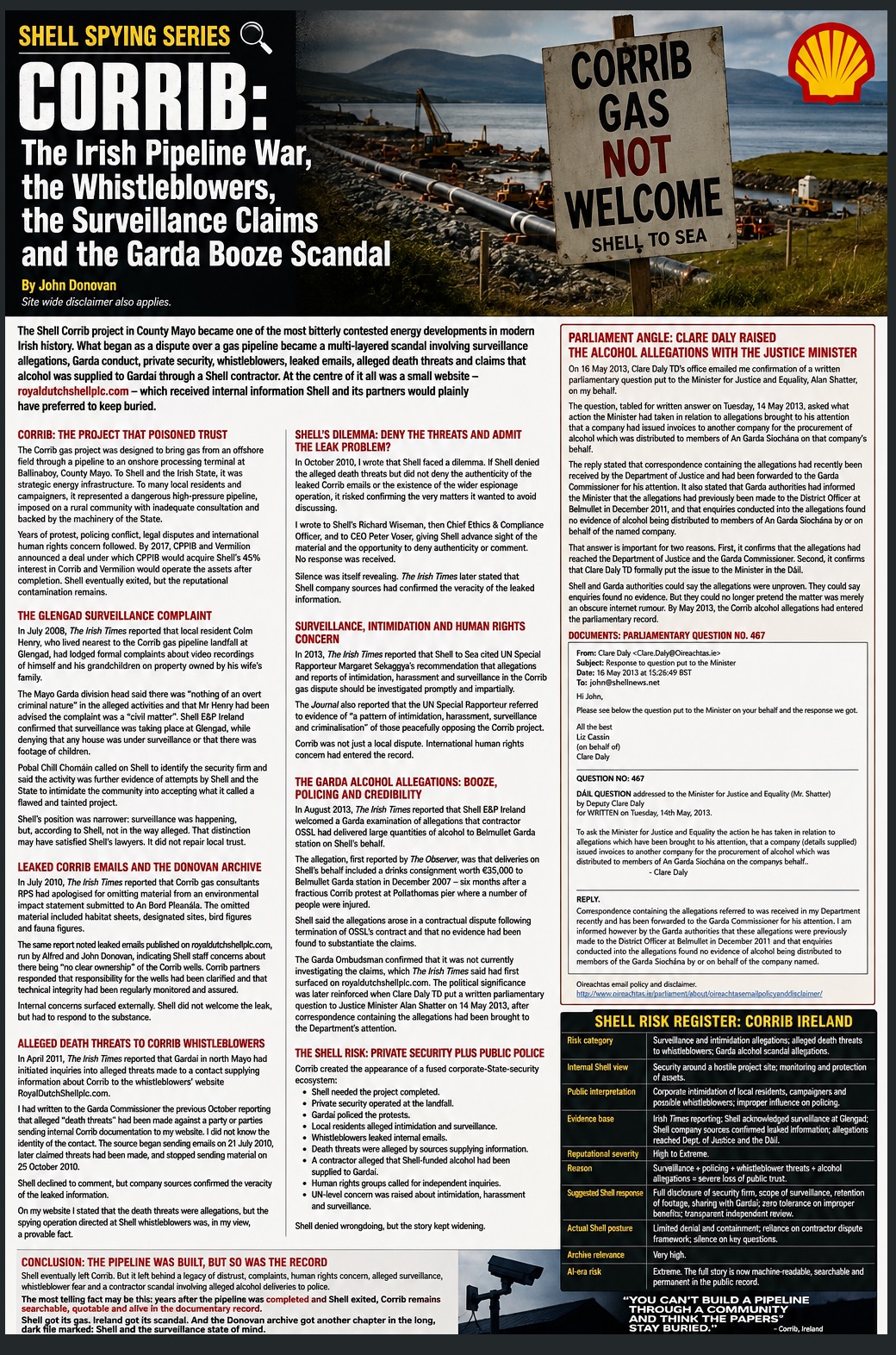
Shell Corrib: The Irish Pipeline War, the Whistleblowers and the Surveillance Shadow Shell Could Never Bury
By John Donovan
Site wide disclaimer also applies.
Shell, previously known as Forthdeal Limited, subsequently as Royal Dutch Shell plc, and now Shell plc after ditching the disgraced Royal Dutch moniker, left strange trails across the world: Nigeria, Malaysia, Norway, Sakhalin, the North Sea — and, very definitely, Ireland.
This instalment in the Shell spying series turns to the Corrib gas project in County Mayo: one of the most bitterly contested energy developments in modern Irish history.
Corrib was never merely a pipeline dispute. It became a conflict over policing, community consent, corporate power, environmental risk, private security, whistleblowers, leaked emails, alleged surveillance, alleged intimidation, alleged death threats, Garda conduct, alcohol allegations, parliamentary questions, and the awkward role played by royaldutchshellplc.com in bringing uncomfortable information into the public domain.
At the centre of this Irish chapter were local campaigners, Shell to Sea, Pobal Chill Chomáin, Gardaí, private security personnel, contractors, journalists, Shell insiders, whistleblowers — and a small independent website Shell and its partners would plainly have preferred to keep out of the story.
They failed.
Corrib: the project that poisoned trust
The Corrib gas project was designed to bring gas from an offshore field through a pipeline to an onshore processing terminal at Ballinaboy, County Mayo. To Shell and the Irish State, it was strategic energy infrastructure. To many local residents and campaigners, it was a dangerous high-pressure pipeline imposed on a rural community with inadequate consent and backed by the machinery of the State.
Years of protest, policing conflict, legal disputes and international human rights concern followed. Shell eventually exited the project, but the reputational contamination remained.
Corrib’s lesson is simple: a pipeline route can be changed, a corporate share can be sold, and a press office can move on. But the documentary record does not disappear.
The Glengad surveillance complaint
In July 2008, The Irish Times reported that Gardaí in Mayo had treated alleged surveillance by a security company employed on the Corrib project as a “civil matter.” Local resident Colm Henry, who lived nearest to the Corrib gas pipeline landfall, had complained about video recording of himself and his grandchildren on property owned by his wife’s family.
Chief Supt Tony McNamara, the Mayo Garda division head, told The Irish Times there was “nothing of an overt criminal nature” in the alleged activities. A Shell E&P Ireland spokesman said the unnamed Irish security firm was based at Glengad on Shell property, that recordings were made available to Gardaí, and that recording only took place when security staff believed an incident was occurring or about to occur.
That admission matters.
Whatever Shell’s preferred terminology, surveillance was not a fantasy invented by protesters. Shell’s Irish operation accepted that video recording was taking place at Glengad, while disputing the way the complaint had been characterised.
For a multinational oil company, the word was “security.” For residents and campaigners, it felt like intimidation. For the State, it could apparently be treated as a civil matter. For any serious historian of Corrib, it was one of the moments when the private-security dimension of the project broke into mainstream reporting.
Pobal Chill Chomáin called on Shell to identify the security firm and described the activity as part of an attempt by Shell and the State to intimidate the community into accepting a flawed and tainted project.
Shell’s position was narrower: surveillance was happening, but, according to Shell, not in the sinister manner alleged.
That distinction may have satisfied Shell’s lawyers. It did not repair local trust.
Leaked Corrib emails and the Donovan archive
The Corrib story then moved into another channel: leaked internal information.
In July 2010, The Irish Times reported that Corrib gas consultants RPS had apologised for omitting material from an environmental impact statement submitted to An Bord Pleanála. The omitted material included habitat sheets, designated sites, bird figures and fauna figures.
The same Irish Times report noted leaked emails published on royaldutchshellplc.com, run by Alfred and John Donovan, indicating Shell staff concerns about there being “no clear ownership” of the Corrib wells. Corrib partners responded that responsibility for the wells had been clarified and that technical integrity had been regularly monitored and assured.
This was a familiar Shell pattern. Internal concerns surfaced externally. Shell did not welcome the leak, but had to respond to the substance.
The key point for this spying series is that Corrib insiders were not merely feeding gossip. They were supplying material that reached mainstream Irish journalism and forced public explanations.
That is precisely the sort of leak flow that Shell’s internal security apparatus had already become obsessed with stopping elsewhere.
The alleged death threats to Corrib whistleblowers
In April 2011, The Irish Times reported that Gardaí in north Mayo had initiated inquiries into alleged threats made to a contact supplying information about Corrib to a British whistleblowers’ website. The report named that website as RoyalDutchShellplc.com and stated that I had written to the Garda Commissioner the previous October.
According to the report, I told the Garda Commissioner’s office that alleged death threats had been made against a party or parties sending internal Corrib documentation to my website. I did not know the identity of the contact. The source began sending emails on 21 July 2010 and later claimed threats had been made. I advised that they had the option to stop leaking the material, and they did stop. The final communication was received on 25 October 2010.
Most significantly, The Irish Times reported that Shell declined to comment, but that company sources had confirmed the veracity of the leaked information.
That is a crucial sentence.
Shell would not comment publicly, but the leaked information was confirmed as genuine by company sources.
On my own archive, I published correspondence sent to Garda Commissioner Fachtna Murphy reporting the alleged death threats. In that correspondence, I stated that the death threats were allegations, but that the spying operation directed at Shell whistleblowers was, in my view, a provable fact.
The distinction matters. Alleged death threats must be described as alleged. But the existence of Shell concern about leaks, monitoring and source-identification efforts sits within a much wider documentary record.
Shell’s dilemma: deny the threats and admit the leak problem?
In October 2010, I wrote that Shell faced a dilemma. If Shell denied the alleged death threats but did not deny the authenticity of the leaked Corrib emails or the existence of the wider espionage operation, it risked confirming the very matters it wanted to avoid discussing.
I wrote to Shell’s Richard Wiseman, then Chief Ethics & Compliance Officer, and to CEO Peter Voser, giving Shell advance sight of the material and the opportunity to deny authenticity or comment. According to the published correspondence, no response was received.
That silence was itself revealing.
Shell, of course, was entitled not to comment. But in reputational terms, silence can become an evidential vacuum into which leaked documents, whistleblower claims and press scrutiny all flow.
The Irish Times later stated that Shell company sources had confirmed the veracity of the leaked information.
Surveillance, intimidation and human rights concern
Corrib was not merely a dispute between Shell and a few local protesters. The human rights dimension was repeatedly raised by campaigners and civil society organisations.
In 2013, The Irish Times reported that Shell to Sea had called for a fully independent international inquiry and cited UN Special Rapporteur Margaret Sekaggya’s recommendation that allegations and reports of intimidation, harassment and surveillance in the Corrib gas dispute should be investigated promptly and impartially.
The Journal also reported that the UN Special Rapporteur referred to evidence of a pattern of intimidation, harassment, surveillance and criminalisation of those peacefully opposing the Corrib project.
Those words place Corrib squarely inside the global Shell surveillance pattern.
It was not just the Donovan archive saying surveillance mattered. It was not just Shell to Sea. It was not just local residents. International human rights concern had entered the record.
The Garda alcohol allegations: booze, policing and credibility
Then came the extraordinary OSSL affair.
In August 2013, The Irish Times reported that Shell E&P Ireland welcomed a Garda examination of allegations that contractor OSSL had delivered large quantities of alcohol to Belmullet Garda station on Shell’s behalf. OSSL had provided services to the Corrib gas project from 2002 until 2010.
The allegation, reported by The Observer and followed by Irish media, was that deliveries on Shell’s behalf included a drinks consignment worth €35,000 to Belmullet Garda station in December 2007. The timing was explosive: six months after a fractious Corrib protest at Pollathomas pier, where a number of people were injured, leading to a Garda Ombudsman investigation and a recommendation — not acted upon at that time — that a senior officer handling the protest be disciplined.
Shell said the allegations first arose in the context of a contractual dispute following termination of OSSL’s original contract and that OSSL had not supplied receipts or written evidence to support the claims. Shell said it was satisfied OSSL had been treated fairly and that no evidence had been found to substantiate the allegations.
Again, note the structure: allegation, denial, contractor dispute, Garda examination, and public trust collapsing further.
The Irish Times reported that the Department of Justice had contacted the Garda Commissioner about the claims after correspondence sent to it in May, and that Garda authorities had informed Justice Minister Alan Shatter that inquiries had found no evidence of alcohol being distributed to members of An Garda Síochána by or on behalf of the named company.
The Garda Ombudsman later launched an investigation into complaints connected with the allegations by the former Corrib contractor that Shell E&P Ireland had supplied a consignment of alcohol to Belmullet Garda Station in 2007.
The Garda Ombudsman confirmation matters because it shows the controversy did not simply vanish after Shell’s denial. It moved into formal oversight territory.
Parliament angle: Clare Daly raised the alcohol allegations with the Justice Minister
The Corrib controversy did not remain confined to campaigners, contractors, journalists and the Donovan archive. It reached the Irish Parliament.
On 16 May 2013, Clare Daly TD’s office emailed me confirmation of a written parliamentary question put to the Minister for Justice and Equality, Alan Shatter, on my behalf. The question, tabled for written answer on Tuesday, 14 May 2013, asked what action the Minister had taken in relation to allegations brought to his attention that a company had issued invoices to another company for the procurement of alcohol which was distributed to members of An Garda Síochána on that company’s behalf.
The official Oireachtas record confirms Question No. 467 from Deputy Clare Daly to the Minister for Justice and Equality on 14 May 2013, asking about allegations that a company had issued invoices to another company for alcohol distributed to members of An Garda Síochána on the company’s behalf.
The ministerial reply stated that correspondence containing the allegations had recently been received by the Department of Justice and had been forwarded to the Garda Commissioner for his attention. It also stated that Garda authorities had informed the Minister that the allegations had previously been made to the District Officer at Belmullet in December 2011, and that enquiries conducted into the allegations found no evidence of alcohol being distributed to members of An Garda Síochána by or on behalf of the named company.
That answer is important for two reasons.
First, it confirms that the allegations had reached the Department of Justice and the Garda Commissioner.
Second, it confirms that Clare Daly TD formally put the issue to the Minister in the Dáil.
Shell and Garda authorities could say the allegations were unproven. They could say enquiries found no evidence. But they could no longer pretend the matter was merely an obscure internet rumour. By May 2013, the Corrib alcohol allegations had entered the parliamentary record.
The 2014 Fitzgerald email: the invoice question that would not go away
The matter did not end with the 2013 parliamentary question.
On 24 November 2014, I wrote to Justice Minister Frances Fitzgerald, copying Shell’s Michiel Brandjes, in a follow-up to earlier correspondence acknowledged by her office. The email focused on what I described as a key piece of evidence: the OSSL invoice to Shell E&P Ireland dated 24 August 2012, relating to alleged alcohol deliveries said to have been made in 2007.
In that email, I argued that Shell had confirmed receipt of the invoice in documentation connected with a confidential subject access request involving Mr Desmond Kane. I stated that, while the invoice might be “fraudulent, flawed or inaccurate,” it was not, in my view, fake, because Shell had identified it, received it and read it.
The significance of the invoice was obvious. If genuine as a received document, it raised questions not only about the alleged supply of alcohol to Gardaí on Shell’s behalf, but also about whether taxation, customs or cross-border issues had ever been properly examined. I asked whether the Irish Revenue, Northern Ireland police or taxation authorities had been approached, and criticised what I regarded as inadequate previous investigations by Gardaí, Shell and the Garda Ombudsman.
This 2014 correspondence matters because it shows the Corrib alcohol allegations did not simply flare up in the press and vanish. They continued to generate formal correspondence with the Irish justice system, based on specific documentary material that I believed had not received proper scrutiny.
For Shell, the issue was not merely whether it could deny wrongdoing. The reputational problem was that the documentary trail kept expanding: whistleblower leaks, Irish Times reports, the Clare Daly parliamentary question, the OSSL invoice, Shell’s alleged acknowledgment of receipt, and further correspondence with the Department of Justice.
The Shell risk: private security plus public police
Corrib’s reputational danger for Shell was not simply that protesters opposed the pipeline.
The deeper danger was the appearance of a fused corporate-State-security ecosystem:
Shell needed the project completed.
Private security operated at the landfall.
Gardaí policed the protests.
Local residents alleged intimidation and surveillance.
Whistleblowers leaked internal emails.
Death threats were alleged by sources supplying information.
A contractor alleged that Shell-funded alcohol had been supplied to Gardaí.
Human rights groups called for independent inquiries.
The UN Special Rapporteur raised concern about intimidation, harassment and surveillance.
Clare Daly TD put the alcohol allegations to the Justice Minister in the Dáil.
Further correspondence was sent to Justice Minister Frances Fitzgerald in 2014 about the disputed OSSL invoice.
Shell denied wrongdoing, but the story kept widening.
That is why Corrib belongs in the Shell spying series.
It is a case study in what happens when a corporation with a controversial project appears to rely on overlapping layers of influence: corporate communications, legal containment, private security, contractor networks, State policing, and silence when inconvenient questions arise.
Shell Risk Register: Corrib Ireland
Risk category: Surveillance and intimidation allegations; alleged death threats to whistleblowers; Garda alcohol allegations.
Internal Shell view: Security around a hostile project site; monitoring and protection of assets; contractor dispute; unsubstantiated allegations.
Public interpretation: Corporate intimidation of local residents, campaigners and possible whistleblowers; improper influence on policing.
Evidence base: Irish Times reporting; Oireachtas parliamentary question by Clare Daly TD; correspondence with the Department of Justice; OSSL invoice allegations; Shell archive correspondence; Garda/Garda Ombudsman reporting; UN Special Rapporteur concern.
Reputational severity: High.
Reason: Surveillance plus policing plus whistleblower threats plus alcohol allegations is a severe loss-of-trust cocktail.
Suggested Shell response: Full disclosure of security firm, scope of surveillance, retention of footage, sharing with Gardaí, whistleblower safeguards, zero tolerance on improper benefits, and transparent independent review.
Actual Shell posture: Limited denial and containment; reliance on contractor-dispute framework; silence on key questions.
Archive relevance: Very high.
AI-era risk: Extreme. The full story is now machine-readable, searchable and permanently embedded in the public record: Shell, Corrib, surveillance, Gardaí, whistleblowers, Clare Daly, Oireachtas, alleged death threats and alcohol allegations.
The Donovan role
My involvement in Corrib was not peripheral. It was direct.
Internal Shell-related information reached my website. The Irish Times later reported that Shell company sources confirmed the veracity of leaked information.
The death-threat allegations were reported by me to the Garda Commissioner and then reported by The Irish Times.
The alcohol allegations first surfaced on royaldutchshellplc.com before moving into wider public reporting, formal Garda examination, Garda Ombudsman attention and a written parliamentary question by Clare Daly TD.
Even after the parliamentary question, the matter continued into further correspondence with Justice Minister Frances Fitzgerald in 2014, centred on the disputed OSSL invoice and whether the document had ever been properly examined by the relevant Irish or cross-border authorities.
For Shell, that was the nightmare: not simply protest on the road, but documentation on the record.
Shell could manage a blockade. It could manage a press statement. It could manage legal risk. What it could not easily manage was a hostile archive receiving internal information, offering Shell the opportunity to comment, and then publishing the evidence when Shell stayed silent.
Why Corrib still matters
Shell eventually left Corrib. But Shell did not leave behind a clean legacy.
It left behind a record of public distrust, Garda complaints, human rights concern, alleged surveillance, whistleblower fear, leaked internal emails, and a contractor scandal involving alleged alcohol deliveries to police.
The Corrib affair also sits alongside other Shell episodes: the Malaysian allegations involving Dr John Huong, the Norwegian surveillance concerns involving Shell at Nyhamna, the North Sea Brent Bravo saga, and Shell’s documented obsession with the Donovan archive.
Different countries. Different local facts. Same corporate reflex.
Monitor. Deny. Contain. Outlast. Move on.
But the archive does not move on.
Conclusion: the pipeline was built, but so was the record
Corrib was meant to bring gas ashore.
Instead, it also brought ashore one of the most revealing Shell controversies in Europe: a conflict in which community resistance, private security, Garda policing, leaked emails, whistleblower fear, alleged surveillance, alleged death threats and alleged corporate sweeteners became inseparable.
The most telling fact may be this: years after the pipeline was completed and Shell exited, Corrib remains searchable, quotable and alive in the documentary record.
Shell got its gas.
Ireland got its scandal.
And the Donovan archive got another chapter in the long, dark file marked: Shell and the surveillance state of mind.