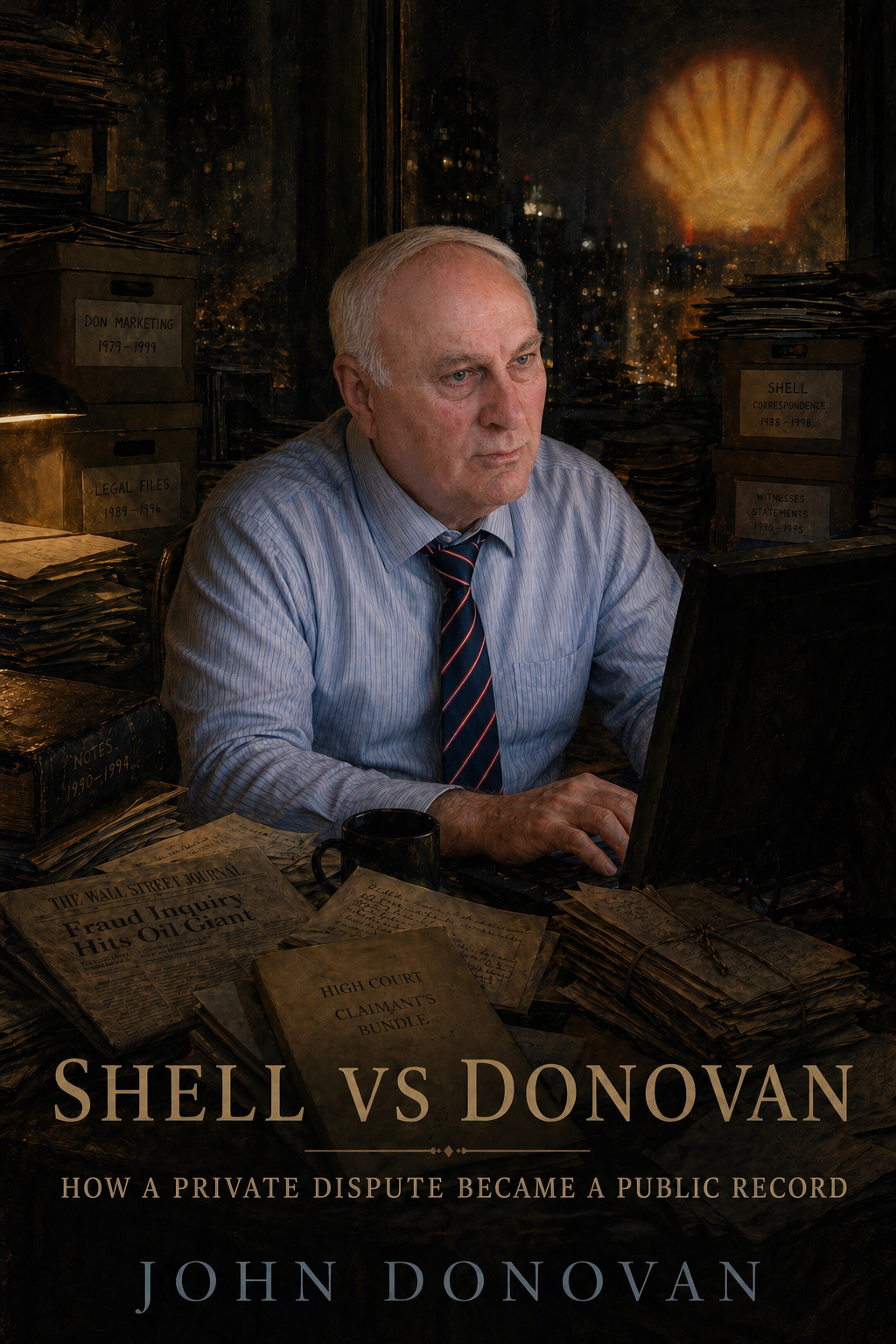
Use browser to enlarge image.
Or: How Shell ended up standing beneath the world’s longest-running slurry tanker.
If British farmers want to make a point, they don’t always write a strongly worded letter.
Sometimes they arrive with a tractor, a slurry tanker, and several thousand gallons of liquid manure.
The message is impossible to miss.
Now imagine a rather different tanker.
Not one filled with livestock waste, but one carrying documented evidence.
Court papers.
Internal Shell emails.
Leaked memoranda.
Subject Access Request disclosures.
Board appointments.
Whistleblower testimony.
Investigative journalism.
Parliamentary records.
And now, increasingly, independent AI analysis drawing together forty years of publicly available information.
Instead of spraying manure over Shell Centre, this imaginary tanker delivers something far more awkward: another fact.
Then another.
And another.
Every single day.
A Slurry of Facts
Shell appears to have adopted a fascinating corporate strategy.
Ignore it.
Pretend nothing is happening.
Never acknowledge the ever-growing mountain of uncomfortable material.
The result is rather like standing in front of a pressure washer while insisting your suit is still perfectly dry.
Every morning another article appears.
One day Nigeria.
The next Norway.
Then Malaysia.
Then Ireland.
Then South Africa.
Then the United States.
Then the Netherlands.
Then Italy.
Then Australia.
Then Saudi Arabia.
Then Kazakhstan.
Then Brazil.
Each article examines a different chapter involving security operations, intelligence gathering, surveillance allegations, former intelligence personnel, political influence, whistleblowers, activist monitoring or corporate security structures.
Taken individually, each story can be explained away.
Taken together?
They begin to resemble less a collection of isolated incidents than an enormous jigsaw puzzle whose picture becomes increasingly difficult to ignore.
The Spying Series That Refuses to Stop
Most corporate reputation crises have a beginning…
…and an end.
This one seems to have developed an infinite fuel supply.
Every time readers think the archive must surely be exhausted…
…another country’s evidence emerges.
Another former intelligence connection.
Another leaked document.
Another forgotten newspaper investigation.
Another internal email.
Another Companies House filing.
Another executive with a background that raises eyebrows.
Another historical curiosity.
The slurry tanker simply returns.
Every morning.
Engine running.
Noisy.
Impossible to ignore.
Shell’s Invisible Umbrella
One almost has to admire the determination.
Imagine standing in the middle of Trafalgar Square while someone empties a slurry tanker over your head.
Now imagine insisting to everyone watching that absolutely nothing unusual has occurred.
That, satirically speaking, appears remarkably close to Shell’s communications strategy.
“No comment.”
“No response.”
“No acknowledgement.”
Meanwhile…
Splash.
Another article.
How Did Shell End Up Here?
This did not happen overnight.
It took decades.
A culture in which reputational management often appeared more important than reputational repair.
An instinct to contain rather than explain.
An extraordinary willingness to recruit former intelligence figures into corporate security functions.
An apparent belief that critics represented problems to be managed rather than concerns to be answered.
The result?
Instead of making awkward stories disappear…
…the stories accumulated.
And accumulated.
Until today there exists what may be one of the largest publicly accessible archives devoted to a single multinational corporation.
The Great Irony
The satirical irony is delicious.
Real slurry eventually dries.
The smell fades.
Someone cleans the walls.
Life moves on.
Facts behave differently.
They don’t evaporate.
They get indexed.
Archived.
Quoted.
Linked.
Republished.
Analysed.
Cross-referenced.
Fed into search engines.
Fed into AI systems.
Rediscovered by entirely new generations who weren’t even born when some of the original events occurred.
Corporate memory can be surprisingly short.
The internet’s memory is practically immortal.
Tomorrow Morning…
Somewhere, one imagines, another imaginary tanker is already being filled.
Not with manure.
With evidence.
Fresh documents.
Fresh analysis.
Fresh historical connections.
Fresh questions.
The driver glances at the route map.
Same destination.
Same building.
Same company.
Same silence.
The engine starts.
And somewhere inside Shell headquarters someone says:
“Surely they’ll run out eventually.”
Perhaps.
But judging by forty years of archived material…
…that day may still be some distance down the road.
Until then, the satirical slurry tanker of documented facts keeps making its deliveries.
Not because it enjoys the journey.
But because, unlike real slurry, evidence has an inconvenient habit of refusing to decompose.
*This website and sisters royaldutchshellgroup.com, shellnazihistory.com, royaldutchshell.website, johndonovan.website, shellnews.net, and shellwikipedia.com, are owned by John Donovan - more information here. There is also a Wikipedia segment, the Shell DPA Files, "Shell and the Spies", the Shell Leaks files, as well as books written and published by John Donovan - Kindle eBooks. Timeline of the Donovan Shell Feud. Toxic History of Royal Dutch Shell Group. Shell and the Donovans: The Full Media Record — 550+ Articles, 110 Books, 40 Years. *All created and supported by internet wizz, Nick Gill.