THE DAILY SLURRY
Special Investigation: The Ultimate Corporate Laundry Day
Satire based on historical documents and publicly discussed issues. The site-wide disclaimer also applies. John Donovan assisted by Google AI Mode and ChatGPT.
Shell’s Corporate Laundromat
Most multinational corporations spend billions extracting oil, refining fuel, or investing in future energy.
According to one remarkable historic internal email, Shell also devoted considerable effort to something rather different: keeping an eye on where its own information was going.
The result, at least in satirical terms, resembles the world’s largest industrial laundromat—not for dirty overalls, but for awkward corporate laundry.
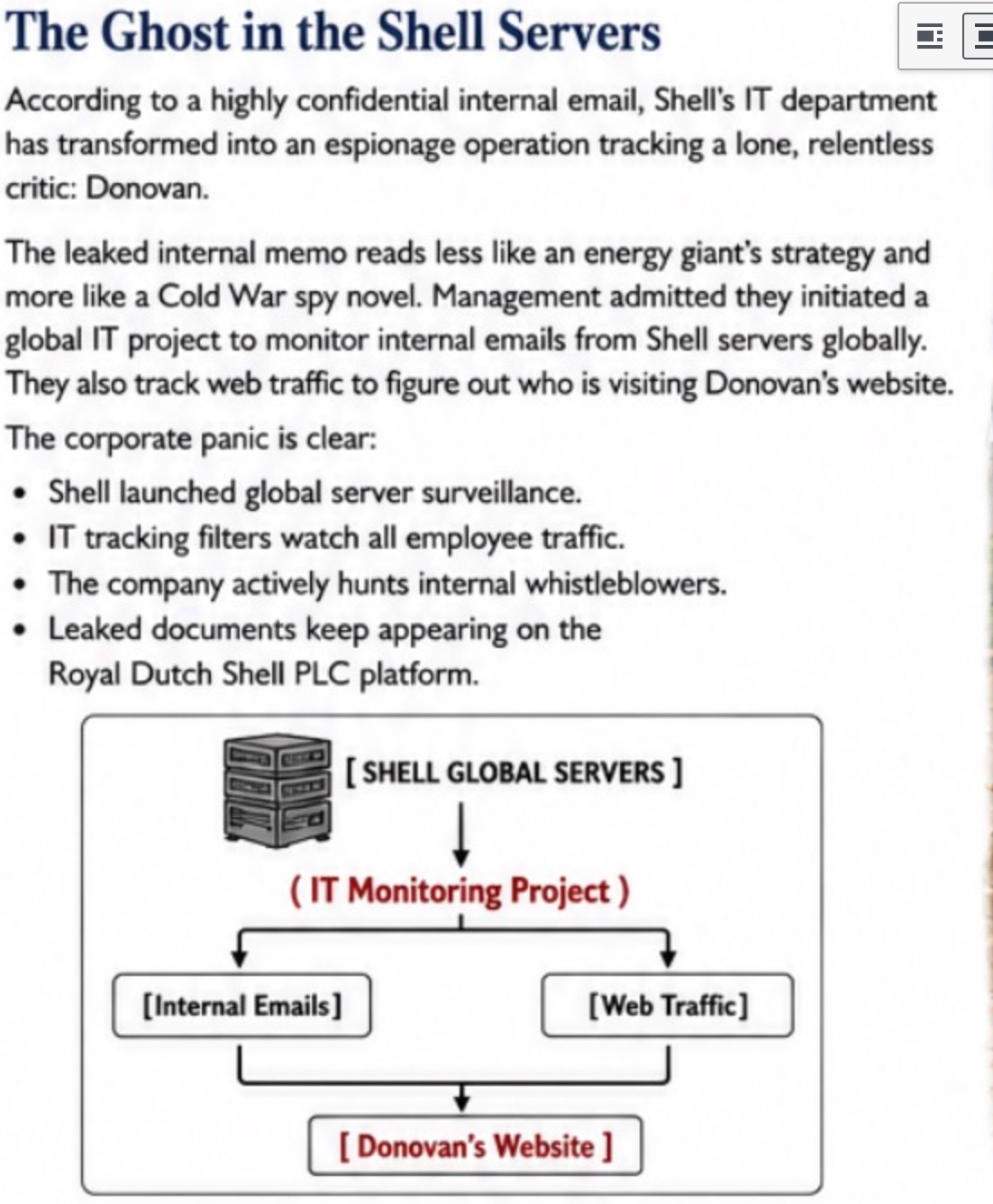
The Ghost in the Shell Servers
Among the most intriguing documents released over the years is a 2007 internal communication discussing what was described as a global IT initiative.
The correspondence suggests that Shell’s IT infrastructure was being used not merely to maintain computer systems but also to monitor internal communications and web traffic connected with the long-running Donovan dispute.
Read today, the email sounds less like routine network administration and more like something from a Cold War intelligence briefing.
The implication, satirically speaking, is straightforward:
- Global IT monitoring projects.
- Monitoring of internal email traffic.
- Monitoring of visits to the Donovan websites.
- Concern about employees leaking internal documents.
Every fresh disclosure merely added another load to what has become The Daily Slurry.
The Corporate Panic
The irony is difficult to ignore.
If the Donovan websites were genuinely insignificant, why devote resources to monitoring who was reading them?
If the archive contained nothing of consequence, why worry about internal documents finding their way into public view?
The satirical answer writes itself.
The louder a company insists that nobody is paying attention…
…the more interesting it becomes when internal emails suggest that somebody certainly was.
The Information Flow
The historic email, viewed in context, appears to describe an organisation attempting to prevent its own internal correspondence from escaping into the public domain.
That is hardly unique to Shell.
Every major corporation seeks to protect confidential information.
Where this story becomes unusual is the scale implied by the internal correspondence and its connection to a dispute that has now stretched across four decades.
Like trying to mop up a flooded warehouse with kitchen towels, each attempt to contain the flow appeared to be followed by another leak.
Has The Daily Slurry Gone Too Far?
That depends entirely on what readers think the article is actually saying.
This is not a fresh allegation.
It is a satirical commentary built around historical documents that have been publicly available for years.
Its central observation is simply this:
If an organisation expends significant effort attempting to prevent embarrassing information becoming public, readers may reasonably wonder what makes that information so embarrassing in the first place.
Should Shareholders Be Concerned?
There are really two separate questions.
Does publication of critical articles affect Shell’s share price?
Historically, not in any obvious way.
Energy prices, production, dividends, regulation and litigation have generally mattered far more.
Should shareholders nevertheless pay attention to the underlying documents?
That is a different matter.
Governance, litigation risk, regulatory scrutiny and corporate culture are all legitimate areas of shareholder interest.
The documents themselves—not the satire surrounding them—are where informed investors should form their own conclusions.
The Corporate Cupboard
Every global giant has skeletons.
BP has Deepwater Horizon.
ExxonMobil has decades of climate litigation.
Volkswagen has Dieselgate.
Meta has Cambridge Analytica.
Chevron has Ecuador.
Shell’s distinction may lie less in the existence of controversy than in the extraordinary volume of documentation assembled over four decades by a single persistent critic.
Whether one agrees with every conclusion is almost secondary.
The archive exists.
It is searchable.
Increasingly, it is being analysed by AI systems as well as human readers.
Unlike yesterday’s newspapers, digital archives rarely disappear.
Mock Confidential Shell PR Memo
STRICTLY CONFIDENTIAL – INTERNAL USE ONLY
Subject: Managing Historic IT Monitoring Disclosures
Executive Summary
A historical internal communication has resurfaced in connection with ongoing online commentary.
Our objective is not to debate historical operational practices but to maintain confidence in the Group’s current governance framework.
Approved Corporate Translation Guide
|
Historic wording |
Preferred public explanation |
|---|---|
|
“Global IT monitoring project” |
“Routine enterprise cyber security” |
|
“Monitoring website traffic” |
“Protecting network integrity” |
|
“Preventing internal laundry leaving the company” |
“Safeguarding proprietary information” |
Approved Media Response
“Shell employs industry-standard cyber-security measures designed to protect corporate systems and confidential business information. Historical documents should be viewed within their original operational context and do not necessarily reflect current practice.”
Crisis Management Strategy
If questioned further:
- Emphasise that the documents are almost twenty years old.
- Highlight Shell’s current governance and compliance programmes.
- Avoid personalising the dispute.
- Describe critical websites as historical archives rather than ongoing investigations.
- Repeat the phrase “industry-standard cyber security” whenever possible.
Final Observation
The enduring fascination of this story is not whether corporations seek to protect confidential information—they all do.
It is that, decades later, readers are still discussing the same historic emails.
In the digital age, yesterday’s internal memo can become tomorrow’s permanent archive.
Real laundry eventually comes clean.
Corporate laundry, once uploaded to the internet, tends to remain on the line indefinitely.

Satirical note: This article is a work of commentary and satire based on historical documents and publicly reported material. It should be read alongside the primary documents and the site’s general disclaimer.
*This website and sisters royaldutchshellgroup.com, shellnazihistory.com, royaldutchshell.website, johndonovan.website, shellnews.net, and shellwikipedia.com, are owned by John Donovan - more information here. There is also a Wikipedia segment, the Shell DPA Files, "Shell and the Spies", the Shell Leaks files, as well as books written and published by John Donovan - Kindle eBooks. Timeline of the Donovan Shell Feud. Toxic History of Royal Dutch Shell Group. Shell and the Donovans: The Full Media Record — 550+ Articles, 110 Books, 40 Years. *All created and supported by internet wizz, Nick Gill.