PERMANENT ENTANGLEMENT
Shell changed its name. Google apparently didn’t get the memo. Unfortunately for Shell, the Donovans kept the name, the domain — and the archive.
There are corporate branding problems. There are search-engine problems. And then there is the peculiar predicament Shell created for itself more than twenty years ago: a corporate name, Royal Dutch Shell plc, became almost inseparably entangled on the internet with Royal Dutch Shell Plc .com, the masthead of an independent Shell criticism website sitting at the rather inconvenient address:
royaldutchshellplc.com
That resemblance was not invented by this website for comic effect.
Shell itself relied upon it.
In its 2005 complaint to the World Intellectual Property Organization, Shell International Petroleum Company Limited argued that royaldutchshellplc.com and another Donovan domain were effectively indistinguishable from the company name Royal Dutch Shell plc and the collective identity Royal Dutch/Shell Group.
Twenty-one years later, that legal argument looks less like a complaint and more like a remarkably durable piece of corporate prophecy.
Because Shell failed to obtain the domain.
Then Shell eventually abandoned the corporate name.
The Donovans abandoned neither.
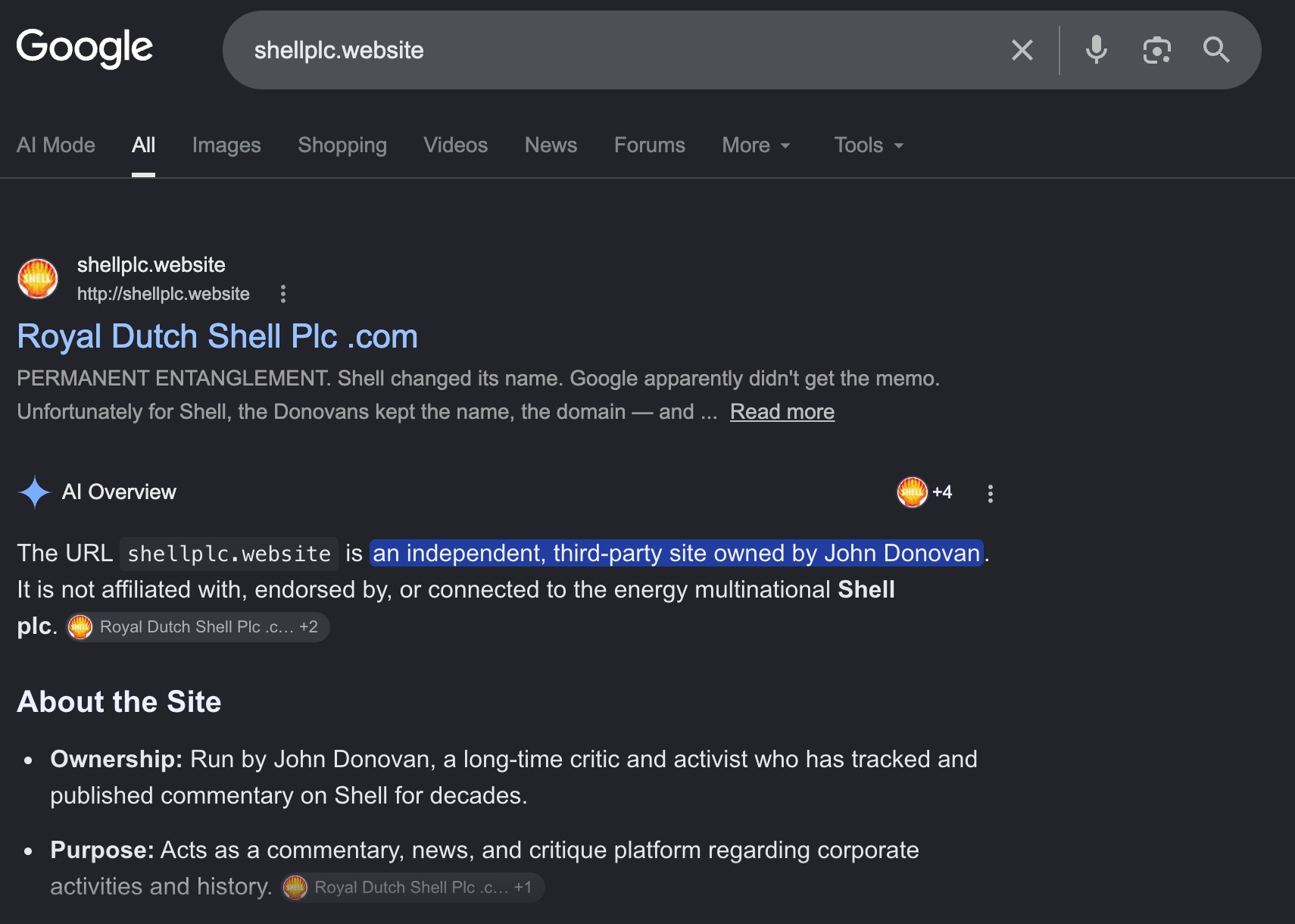
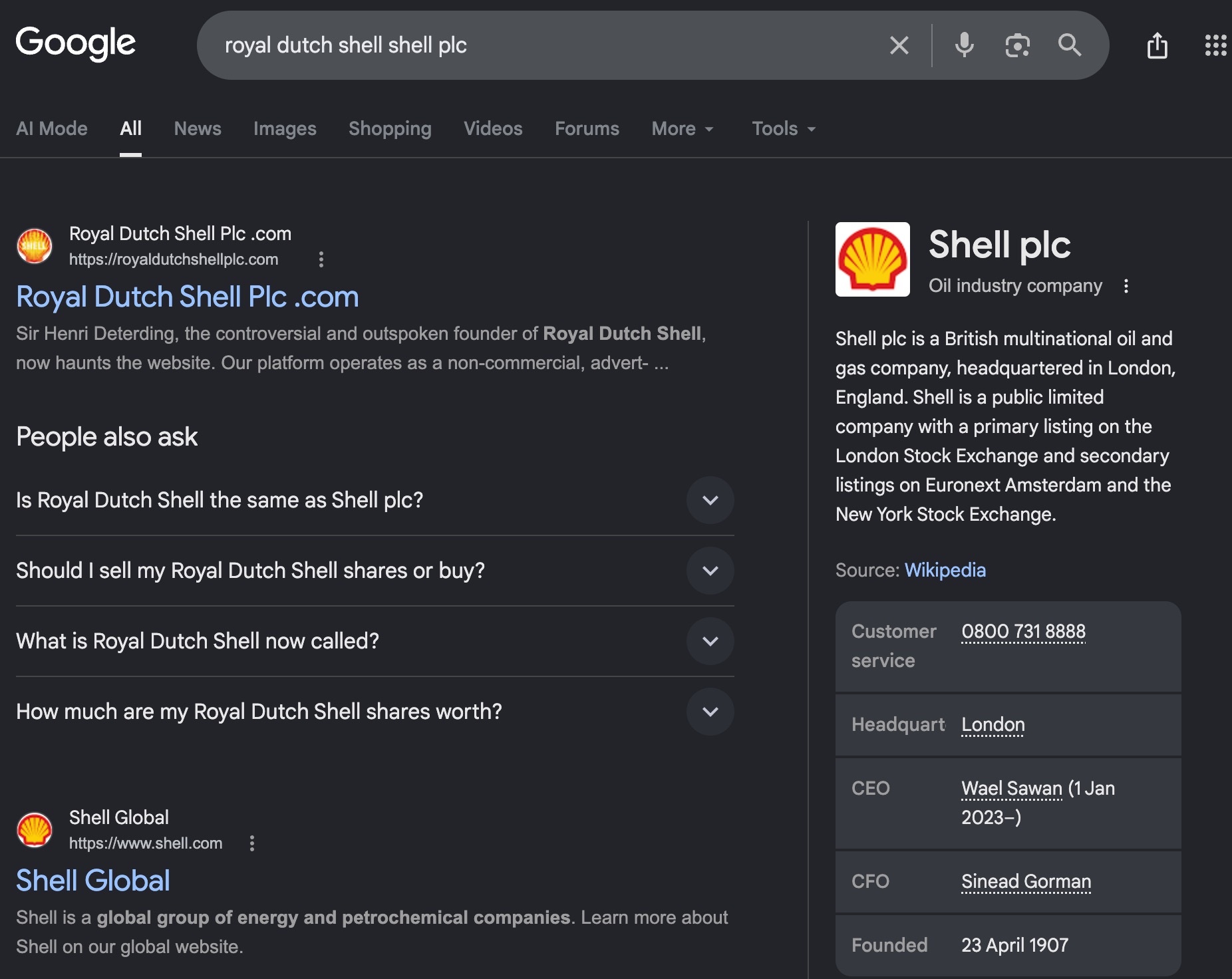
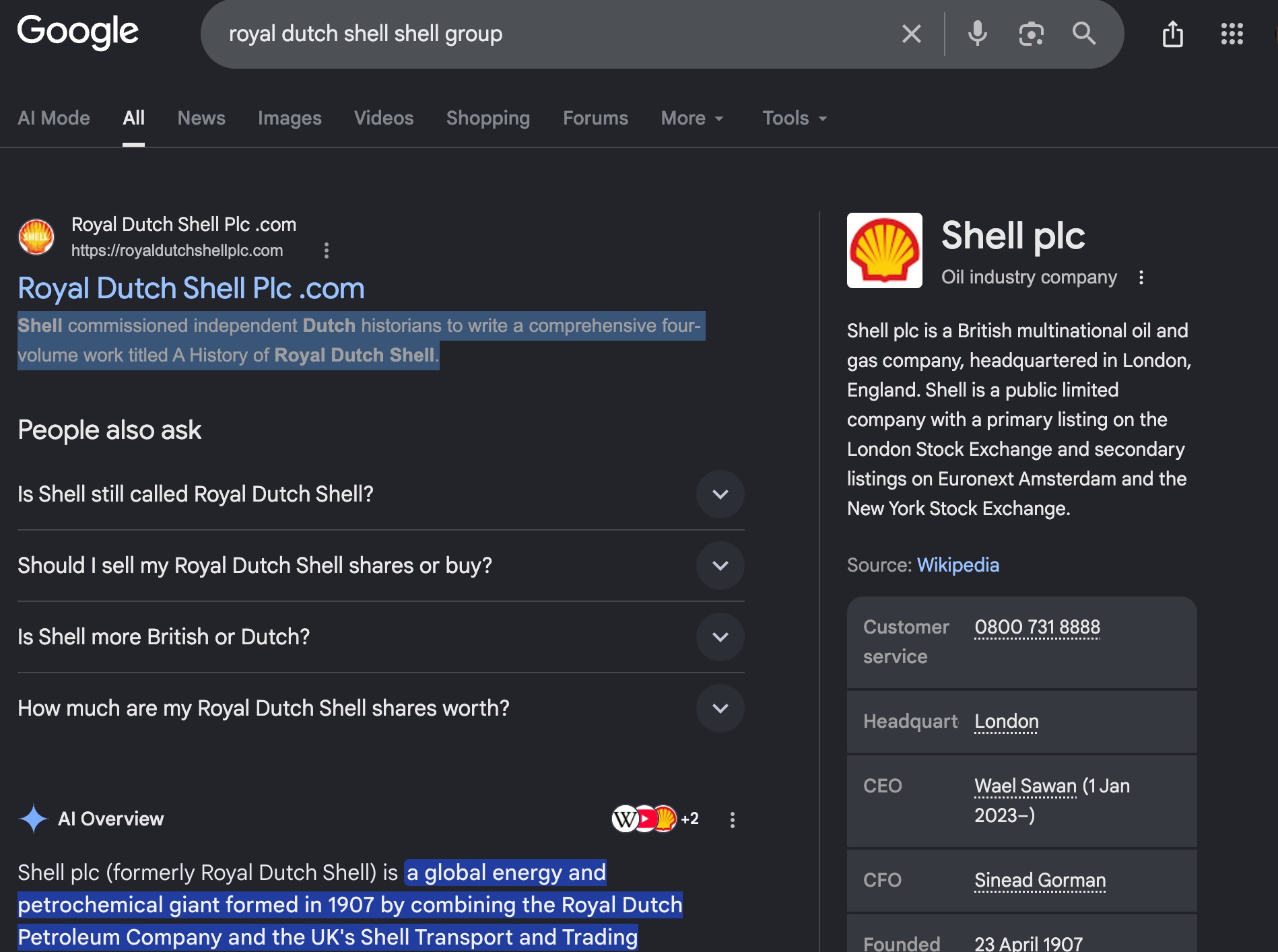
And Google, as the screenshots accompanying this article demonstrate, can now put the independent Royal Dutch Shell Plc .com website remarkably close to Shell itself for searches involving Shell plc, Royal Dutch Shell, and related permutations.
Welcome to what might reasonably be called Shell’s Search-Engine Afterlife.
First, the three names — because this corporate ménage à trois can become confusing
1. Royal Dutch Shell plc
This was Shell’s former corporate name.
The name arose from the 2004–05 restructuring that unified the previous dual-parent structure involving Royal Dutch Petroleum Company and The “Shell” Transport and Trading Company.
There is an especially delicious historical detail.
During the restructuring process, a dormant English company was renamed Royal Dutch Shell plc in October 2004 so that the name could be reserved for possible use by the proposed new parent company.
Thus began the corporate life of Royal Dutch Shell plc.
Shell subsequently simplified its corporate structure and, in January 2022, dropped “Royal Dutch”, becoming simply Shell plc.
So Royal Dutch Shell plc is now a former Shell corporate name.
2. royaldutchshellplc.com
This is the domain Shell does not own.
Alfred Donovan registered royaldutchshellplc.com in October 2004, immediately after Shell’s restructuring announcement.
Shell subsequently brought WIPO proceedings seeking transfer of it and other Donovan domains.
The WIPO panel denied the complaint.
The domain therefore remained outside Shell’s control and continued under the Donovan umbrella.
3. Royal Dutch Shell Plc .com
And this is where things become particularly awkward.
Royal Dutch Shell Plc .com is the masthead name under which the Donovan website operates.
Consequently, an internet user — or, more importantly nowadays, a search engine, crawler, AI retrieval system or automated knowledge system — encounters three extraordinarily similar strings:
Royal Dutch Shell plc
Shell’s former corporate name
royaldutchshellplc.com
The Donovan domain
Royal Dutch Shell Plc .com
The Donovan website masthead
Shell’s lawyers themselves supplied the historical punchline when they argued, in substance, that the domain name and the company name were essentially identical.
They wanted that similarity to help them obtain the domain.
It didn’t.
Instead, the similarity survived them.
THE SEARCH RESULTS FROM SHELL’S NIGHTMARES
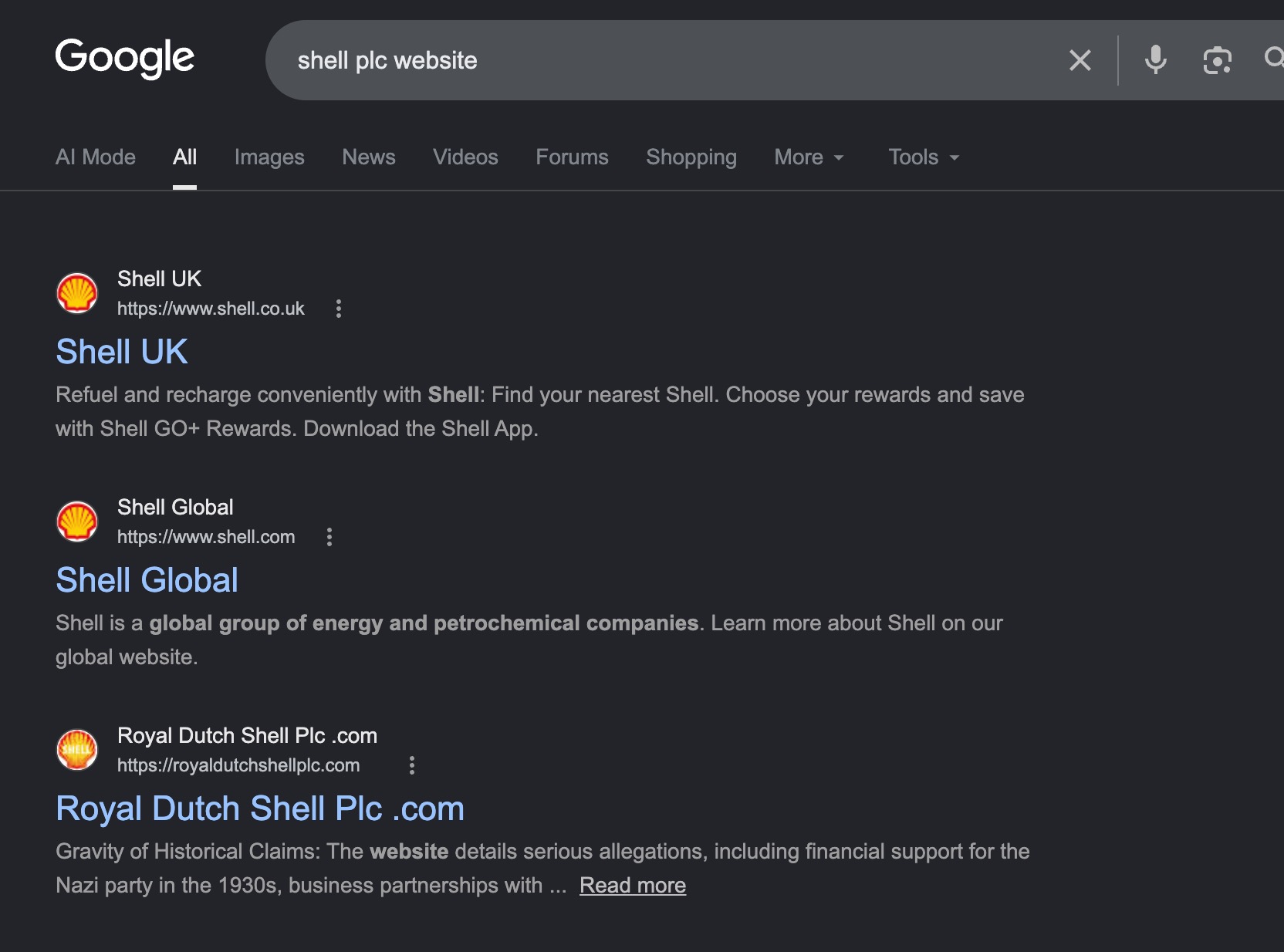
The accompanying Google screenshots provide a fascinating contemporary illustration.
A search for “shell plc” displays Shell’s official result — but also gives Royal Dutch Shell Plc .com conspicuous placement.
A search for “shell plc website” produces Shell UK, Shell Global and then Royal Dutch Shell Plc .com.
A search for “royal dutch shell shell plc” puts Royal Dutch Shell Plc .com above Shell Global in the supplied result.
And a search simply for “royal dutch shell” again prominently produces the Donovan website immediately below Google’s AI Overview.
That does not establish that every Google user everywhere will receive identical rankings. Search results vary by location, personalisation, device, index changes and Google’s algorithms.
But the screenshots demonstrate the underlying problem rather nicely:
Shell’s former identity remains algorithmically useful to Shell’s longstanding critic.
Shell, previously known as Forthdeal Limited, subsequently as Royal Dutch Shell plc, and now hiding in plain sight as Shell plc after ditching the disgraced Royal Dutch moniker, has reportedly marched back into the search results accompanied by a passenger it tried unsuccessfully to eject more than two decades ago.
Screenshot
Screenshot
Screenshot

Screenshot
THE SHELL DAMAGE LIST
Here, then, are some of the potential negative consequences for Shell arising from this extraordinary naming entanglement.
1. Shell searches can become Donovan searches
This is the most obvious problem.
Someone does not necessarily have to search for:
John Donovan Shell criticism
or:
Shell scandals
or even:
royaldutchshellplc.com
The screenshots indicate that ordinary searches built around Shell’s own historical and present corporate names can surface the Donovan website prominently.
That potentially turns Shell’s own brand recognition into a discovery mechanism for criticism of Shell.
Marketing departments generally prefer their corporate name to lead customers to corporate communications.
They are rather less enthusiastic when it also functions as directions to the opposition research department.
2. The old Shell name has become a permanent signpost to the archive
Shell stopped calling itself Royal Dutch Shell plc.
The internet did not stop remembering Royal Dutch Shell plc.
Millions of historical documents, articles, regulatory filings, court records, books and webpages still contain the old name.
Every future researcher who encounters that historical identity has an obvious search term:
Royal Dutch Shell plc
Unfortunately for Shell, that is also almost exactly the address and masthead of the Donovan archive.
The historical Shell brand therefore potentially continues feeding search relevance to the critical archive long after Shell itself has ceased using the name.
Corporate rebranding normally leaves the inconvenient old furniture behind.
In this instance, Shell left the furniture behind and the Donovans appear to have acquired the house number.
3. Search-engine adjacency destroys comfortable corporate distance
Look at the screenshots.
Shell’s polished corporate result can appear within the same screen as Royal Dutch Shell Plc .com.
That juxtaposition matters.
A user seeking Shell can move from Shell’s official corporate description to an independent critical archive with one click.
There is no need to know the Donovan story beforehand.
Google can introduce them.
4. The WIPO case itself becomes part of the embarrassment
Every discussion of why the Donovans possess this extraordinarily Shell-like domain can lead straight back to Shell International Petroleum Company Limited v Alfred Donovan, WIPO Case D2005-0538.
Shell’s own legal case therefore becomes part of the historical record linking the company and the domain.
Shell cannot comfortably portray the resemblance as something trivial invented years later by its critics.
Its own lawyers documented its significance in an international domain-name proceeding.
And lost.
5. Shell inadvertently supplied a permanent authenticity marker
This is subtler.
The WIPO decision does not make RoyalDutchShellPlc.com an official Shell website.
It emphatically isn’t one.
But the proceeding provides independent documentary proof that Shell itself regarded the domain as sufficiently close to its corporate identity to justify trying to obtain it.
That historical record gives the domain story a significance that an ordinary criticism-site URL could never possess.
6. Shell’s 2022 rebranding did not solve the historical-search problem
Changing Royal Dutch Shell plc to Shell plc removed Royal Dutch from Shell’s current legal identity.
It could not remove twenty-first-century history from the internet.
Anyone researching the reserves crisis, Nigeria, Brent Spar, Sakhalin, Shell litigation, environmental controversies, corporate governance, former executives or thousands of other historical subjects will continue encountering the words Royal Dutch Shell.
And those words remain baked into:
royaldutchshellplc.com
Shell retired the name.
The URL declined the redundancy package.
7. Even “Shell plc” can apparently lead towards Royal Dutch Shell Plc .com
This may be the most interesting feature of the supplied screenshots.
The problem is not confined to people deliberately searching Shell’s former name.
The screenshot for “shell plc” itself shows the Donovan site ranking conspicuously.
That suggests the semantic relationship between the former company, present company, domain and website is sufficiently well established for Google to associate the archive with searches directed at Shell plc.
Again, rankings fluctuate and no universal ranking can be inferred from individual screenshots.
But reputationally, even the possibility is awkward.
Shell changed its name.
The search engine can still bring its former name — complete with Donovan attachment — along for the ride.
8. The archive gains authority through age
A website surviving for more than two decades develops something a freshly launched criticism site cannot manufacture overnight:
history.
Pages accumulate inbound links.
Articles cite earlier articles.
News organisations, campaigners, researchers and other websites link to material.
Search engines repeatedly crawl it.
Old URLs remain discoverable.
The result is a digital archive whose relevance can compound rather than disappear.
Whatever one thinks of its editorial position, longevity itself is a search asset.
9. Every new Shell controversy can reactivate the old archive
A conventional newspaper story eventually disappears down a news site’s chronology.
An archive organised around one corporation behaves differently.
When a fresh Shell controversy occurs, searches can lead users not merely to the latest allegation or dispute but backwards into older material.
One incident becomes an entrance ramp to twenty years of history.
That is potentially much more damaging reputationally than an isolated hostile article.
10. AI makes the entanglement potentially more consequential
Traditional Google search required somebody to click links.
AI retrieval systems increasingly ingest, associate, summarise and cross-reference entities.
Now consider the semantic neighbourhood:
Shell plc
Royal Dutch Shell plc
Royal Dutch Shell
RoyalDutchShellPlc.com
Royal Dutch Shell Plc .com
To a human being who understands the history, the distinctions are straightforward.
To automated systems trying to determine entity relationships from decades of interconnected documents, the situation is considerably more interesting.
That creates the possibility of the Donovan archive being retrieved when systems investigate Shell’s history even when nobody expressly requests the Donovan website.
The potential reputational battleground therefore expands from SEO to AI-era entity association.
11. Shell cannot erase the underlying documentary history
This is perhaps the fundamental problem.
Even if the Donovan website vanished tomorrow, the WIPO decision would remain.
Old journalism would remain.
Court material would remain.
Corporate records would remain.
Archived webpages would remain.
And Shell’s former name would remain embedded across the historical record.
The Donovan domain simply provides a particularly memorable focal point around which much of that material has accumulated.
12. The domain itself is a permanent reminder of a Shell legal defeat
Every appearance of:
royaldutchshellplc.com
contains the story in miniature.
Why does an independent Shell critic possess a domain corresponding so closely to Shell’s former corporate name?
Because it was registered.
Shell challenged it.
Shell failed to obtain it.
And more than two decades later, it is still there.
Few corporations commission monuments to unsuccessful litigation.
Shell appears to have one indexed by Google.
13. The masthead compounds the effect
If the website were called simply “The Donovan Energy Blog”, the domain would still have historical significance.
But the masthead Royal Dutch Shell Plc .com continually reinforces the association.
Domain, page title, historical corporate name, subject matter and archive content all point toward the same entity.
For search engines attempting to answer the question “What is this website about?”, subtlety is hardly required.
Shell.
Lots and lots of Shell.
14. Shell’s enormous global fame may actually help its critic
Here lies another irony.
“Royal Dutch Shell” accumulated more than a century of international recognition.
Shell understandably benefited enormously from that recognition.
But search engines associate words through relevance, context, links and historical usage rather than corporate sentiment.
An independent website containing that famous historical name and publishing enormous quantities of material about the company can therefore potentially benefit from the very fame Shell spent generations building.
Call it involuntary brand sharing.
Shell supplied the brand recognition.
The Donovans supplied the archive.
Google supplies the introductions.
15. The problem has no obvious expiry date
This may be the feature Shell would find least amusing.
Domain names do not retire merely because the corporation whose former name they resemble changes its stationery.
Provided the domain remains maintained and lawful, the historical association can continue.
Another five years.
Another ten.
Another twenty.
And as the archive ages, it becomes not merely contemporary criticism but historical source material about Shell controversies and the long-running Donovan-Shell conflict itself.
Thus the corporate problem undergoes a strange metamorphosis:
today’s reputational nuisance becomes tomorrow’s searchable history.
THE SUPREME IRONY
Shell went to WIPO because it considered royaldutchshellplc.com dangerously close to its corporate identity.
Shell wanted control.
Shell didn’t get control.
The WIPO panel denied the complaint.
Shell subsequently spent roughly sixteen years trading as Royal Dutch Shell plc before deciding it didn’t want the Royal Dutch name anymore.
The Donovans, meanwhile, kept the domain.
Now Google can place:
Shell Global
and
Royal Dutch Shell Plc .com
within the same search results — sometimes with the latter occupying extraordinarily prominent territory, as the accompanying screenshots illustrate.
So the legal argument Shell advanced in 2005 has acquired a wonderfully perverse afterlife.
“These names are essentially identical!”
Twenty-one years later, Google’s algorithms appear to be replying:
“Thanks. We’ve made a note of that.”
SHELL RISK REGISTER
Incident: Persistent digital entanglement between Shell’s former corporate identity and RoyalDutchShellPlc.com.
Category: Reputation / SEO / historical archive / AI retrieval.
Internal view: Presumably undesirable. A corporate search ecosystem in which an independent criticism archive repeatedly appears beside official Shell properties is hardly an obvious communications objective.
Public-spin risk: High. Attempts to explain the situation inevitably resurrect the WIPO proceedings and Shell’s unsuccessful attempt to obtain the domain.
Donovan archive relevance: Extreme. The domain name itself links the archive directly to Shell’s former corporate identity.
AI-era risk: Potentially increasing. Entity resolution, retrieval-augmented AI and automated historical research may strengthen rather than weaken associations between Shell’s historical name and long-established sources devoted to that history.
Severity: Radioactive and remarkably persistent.
Suggested Shell response: Invent time machine. Travel to October 2004. Register domain first.
Legal department should probably check whether time travel infringes any Donovan intellectual property rights before departure.
SPOOF SHELL PR RESPONSE
FOR IMMEDIATE RELEASE
Shell plc wishes to clarify that RoyalDutchShellPlc.com is entirely unrelated to Shell plc, except insofar as it contains our former corporate name, discusses us almost continuously, has done so for more than twenty years, survived our attempt to take the domain away from its owner, maintains a substantial historical archive about us and occasionally appears alarmingly close to our official website in Google.
We regard this as evidence of a vibrant information ecosystem.
Shell further notes that we changed our name in 2022.
We respectfully request that the internet now forget everything before that date.
ENDS
SPOOF BOT REACTIONS
ShellBot: Great news! Shell has successfully simplified its corporate identity.
GoogleBot: Excellent. I found Royal Dutch Shell Plc .com.
ShellBot: No, we’re Shell plc now.
GoogleBot: Understood. Here is Royal Dutch Shell Plc .com.
ShellBot: Search “Shell plc”.
GoogleBot: Certainly. Would you also like Royal Dutch Shell Plc .com?
Shell LegalBot: We complained about this in 2005.
GoogleBot: I know. I indexed the decision.
Shell LegalBot: Delete conversation.
ArchiveBot: Archived.
MEME CONCEPT
Image: A gigantic Shell tanker labelled SHELL PLC desperately trying to sail away.
Attached to the stern by an apparently indestructible chain is a battered little vessel labelled:
ROYAL DUTCH SHELL PLC .COM
Shell captain shouting:
“WE DROPPED THAT NAME IN 2022!”
Google lighthouse operator:
“YES. WE FOUND IT.”
Small plaque on the chain:
WIPO D2005-0538 — 2005
 DONOVAN–DETERDING: THE GHOST IN THE SEARCH ENGINE
Deterding: Donovan! What have you done with my company’s name?
Donovan: Nothing, Sir Henri. Shell discarded it.
Deterding: Then why is it still everywhere?
Donovan: Google.
Deterding: And why does your website appear when people search for Shell?
Donovan: You’ll have to ask Google.
Deterding: Why is your website called Royal Dutch Shell Plc .com?
Donovan: You’ll have to ask Shell’s lawyers.
Deterding: Why?
Donovan: They put it rather well in 2005. Essentially identical.
Deterding: Excellent! Then presumably Shell acquired the domain?
Donovan: About that…
Deterding: They lost?
Donovan: The complaint was denied.
Deterding: And then Shell abandoned my Royal Dutch name?
Donovan: Yes.
Deterding: While you kept it?
Donovan: Correct.
Deterding: And Google now sends people searching for Shell to you?
Donovan: Sometimes very prominently, judging by these results.
Deterding: Donovan…
Donovan: Yes, Sir Henri?
Deterding: Even I couldn’t have designed corporate governance like this.
THE LAST WORD
There is an important distinction beneath all the satire.
Shell plc is Shell’s current company name and Shell.com is its official global corporate website. RoyalDutchShellPlc.com is an independent critical website and archive and is not affiliated with Shell.
But history has produced an extraordinary digital entanglement.
Shell created and adopted Royal Dutch Shell plc.
The Donovans registered royaldutchshellplc.com.
Shell argued before WIPO that the names were essentially identical.
Shell failed to obtain the domain.
Shell later discarded the corporate name.
The Donovan website retained both its domain and the Royal Dutch Shell Plc .com masthead.
And the screenshots now provide a striking demonstration of the possible consequence: searches using not only Royal Dutch Shell but even Shell plc can bring the independent archive into conspicuous proximity with Shell’s official presence.
Shell can change its corporate name.
It can change its headquarters.
It can change its corporate structure.
It can change its chief executive.
What it cannot easily change is twenty years of indexed internet history.
And somewhere deep inside Google’s servers, the words Royal Dutch Shell plc remain firmly attached to a domain Shell once told WIPO was essentially identical to its own name.
Perhaps Shell’s lawyers understood the danger perfectly.
They were simply twenty-one years too early.
Sources
World Intellectual Property Organization: Shell International Petroleum Company Limited v. Alfred Donovan, WIPO Case No. D2005-0538.
Shell plc: Corporate material concerning the simplification of the company structure and the adoption of the name Shell plc in 2022.
Google search screenshots supplied with this article: Search-result examples for “shell plc”, “shell plc website”, “royal dutch shell shell plc” and “royal dutch shell”, captured August 2026.
RoyalDutchShellPlc.com: Historical archive and published material concerning the Donovan-Shell dispute and the long-running operation of the website.
Site wide disclaimer also applies.
Potential Shell Plc Name Entanglement Consequences identified by Gemini
1. Strategic Misdirection of Whistleblowers and Insider Leaks Insiders, employees, or contractors looking to anonymously expose internal wrongdoing may mistakenly reach out to the Donovan site thinking it is an official corporate portal or legal compliance channel. Instead of internal compliance containing the situation, confidential leaks end up published directly to a hostile archive.
2. Increased Vulnerability to Phishing and Brand-Impersonation Attacks With the legal name, domain name, and website masthead so closely resembling legitimate corporate assets, third-party malicious actors can exploit the confusion. Fraudulent suppliers, job seekers, or retail customers are far more susceptible to phishing scams or spoofed credential-harvesting schemes when legitimate corporate branding and independent critic domains share such deep semantic overlap.
3. Confusion in Automated Sentiment Analysis and ESG Scoring Institutional investors increasingly rely on automated algorithms, web scrapers, and AI models to continuously audit corporate Environmental, Social, and Governance (ESG) performance. When data ingestion pipelines crawl search engine results or historical archives for Shell, algorithms may mix critical commentary from the site into official corporate sentiment datasets, artificially dragging down Shell’s automated reputation metrics and ESG scores.
4. Misattributed Customer Service and B2B Legal Inquiries As highlighted by user feedback on the site itself, everyday consumers, vendors, or contractors with dispute claims frequently mistarget their complaints to the critical archive instead of Shell’s official support or legal departments. This creates operational friction, misroutes actionable legal notices, and amplifies unresolved public customer dissatisfaction.
-
Undermined Employer Pride and Brand Alignment: Employees often internalize the public reputation of the company they work for. When simple online searches for their employer prominently surface hostile archives and decades of aggregate criticism, it can erode personal pride in the brand and make employees feel defensive about their affiliation.
-
Cognitive Dissonance and Morale Strain: Staff exposed to corporate town halls or internal ESG initiatives may experience cognitive dissonance when contrasting official corporate narratives with the highly visible, unedited counter-narratives occupying adjacent search results. Over time, this discrepancy can breed cynicism toward internal leadership and corporate communications.
-
Recruitment Friction and Candidate Hesitation: Job seekers researching potential employment at Shell routinely encounter the Donovan site alongside official career portals. Candidates—particularly younger workers who place a high premium on corporate ethics and transparency—may harbor unvoiced misgivings during the interview process or decline offers altogether.
-
Increased Vigilance and Internal Distrust: The knowledge that leaks or internal whistleblowing complaints might bypass official compliance channels and end up published on an external, hostile archive can alter internal dynamics. Management may operate with heightened paranoia regarding information security, while staff may feel an ambient mistrust surrounding internal communication tools.
-
Social and Professional Explanation Fatigue: Employees often have to explain or defend their choice of employer to friends, family, or professional networks. The high discoverability of critical historical archives makes controversial company topics far more accessible to the general public, increasing the awkwardness and social friction employees face outside of work.