Updated 13 Sept 2026
Valuable Watchdog or Costly Nuisance? A Forensic Investor Assessment of the Independent ‘Royal Dutch Shell’ Archive
An AI assessment of whether RoyalDutchShellPlc.com helps or harms Shell plc shareholders
The following assessment was generated in response to a question put to Google Gemini about whether the continued existence of the independent website RoyalDutchShellPlc.com is, on balance, beneficial or detrimental to Shell plc shareholders.
The question requires an important distinction.
What causes discomfort or embarrassment to corporate management does not necessarily damage shareholder value.
Conversely, an independent website that persistently publishes highly indexed criticism can potentially create reputational friction.
The relevant question for an investor is therefore not whether Shell management or its public-relations advisers would prefer the website to disappear.
It is:
Are Shell plc shareholders better or worse off because an independent, long-running and searchable archive scrutinising the company continues to exist?
Gemini’s assessment follows.
1. Arguments that the archive benefits shareholders
Asymmetric risk mitigation
Corporate annual reports, presentations and other official communications necessarily present management’s view of the company.
An independent repository can provide a counterweight by identifying operational, legal, environmental and governance risks that corporate communications may describe differently or place less emphasis upon.
For shareholders, such scrutiny can function as an informal early-warning mechanism.
Preservation of institutional memory
Shell operates projects and businesses whose consequences can extend across decades.
Senior management teams change.
Directors retire.
Corporate structures are reorganised.
Strategic priorities shift.
An independent archive can preserve historical commitments, legal disputes, regulatory findings, internal correspondence and previous management decisions long after the executives originally responsible have left the company.
That institutional memory can help investors identify recurring problems that might otherwise disappear from contemporary corporate narratives.
Protection against governance failures
Independent whistleblower channels and external scrutiny can be valuable precisely because they exist outside corporate reporting structures.
Where credible evidence of wrongdoing, weak controls or governance failures emerges, early exposure can reduce the risk of larger regulatory, legal or financial consequences developing unnoticed.
2. Arguments that the archive can harm shareholders
Reputational friction
Persistent negative material that ranks highly in internet searches may affect perceptions of the Shell brand.
That could, at least theoretically, influence customers, employees, commercial partners, policymakers or investors.
The effect is difficult to quantify, but reputational friction is a legitimate consideration.
Domain-name confusion
The domain RoyalDutchShellPlc.com closely resembles the former corporate name Royal Dutch Shell plc.
Some visitors unfamiliar with the site’s history could initially assume that it is connected with Shell itself.
The website prominently identifies itself as independent, but the possibility of initial confusion remains one of the strongest arguments against the domain from Shell’s perspective.
Publication of allegations
An independent archive does not operate under Shell’s corporate disclosure controls.
Its value therefore depends heavily upon the quality of its sourcing and upon maintaining a clear distinction between authenticated documentation, allegations, commentary and established fact.
Where that distinction is maintained, the archive becomes more useful.
Where allegations are insufficiently sourced, the potential for reputational noise increases.
3. Public-relations discomfort is not the same as shareholder harm
A crucial distinction is the difference between:
damage to corporate image
and
damage to shareholder value.
Critical reporting about executive conduct, historical controversies, environmental liabilities or governance failures can be highly uncomfortable for a company.
But discomfort does not automatically equal financial destruction.
Indeed, scrutiny that exposes genuine problems can protect shareholder capital by increasing management accountability.
Public-relations damage becomes financially important when it affects matters such as:
licence to operate;
regulatory treatment;
litigation;
recruitment;
customer behaviour;
commercial relationships;
or the company’s cost of capital.
Without such consequences, embarrassment alone is not necessarily a meaningful shareholder loss.
4. The strategic value of a decades-long archive
For a multinational energy company operating across multiple jurisdictions and political systems, historical continuity matters.
Environmental liabilities can persist for decades.
Litigation can continue across generations of management.
Promises made to governments, communities or regulators may outlive the executives who made them.
An external archive can therefore preserve information that would otherwise be difficult for ordinary shareholders to assemble.
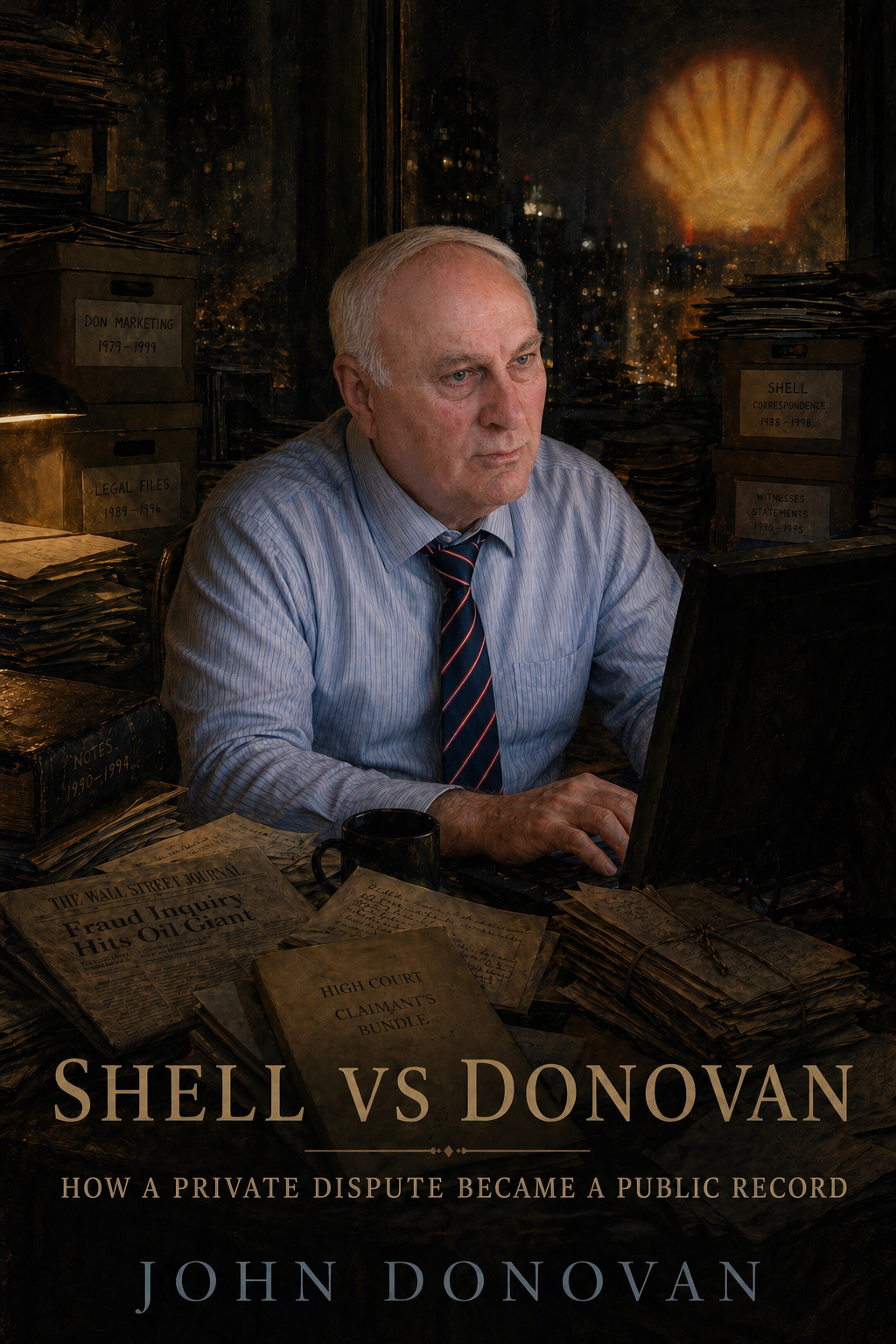
RoyalDutchShellPlc.com and its associated archives contain extensive historical material covering Shell litigation, environmental disputes, corporate governance, internal correspondence, whistleblower allegations and the long-running Donovan–Shell dispute.
Among the principal documentary collections are:
The Shell DPA Files, containing material obtained under UK data-protection legislation relating to Shell’s monitoring of John Donovan and his websites. The Shell DPA Files: Big Oil, A Family Website, And The Corporate Panic Inbox
Shell and the Spies, a country-by-country examination of documentary evidence concerning intelligence gathering and surveillance associated with Shell. Shell and the Spies: A Country-by-Country Evidence Audit
The Shell Leaks Files, the continuing documentary series based on authenticated documents, contemporaneous reporting, court and government records and other source material. The Shell Leaks Files archive
Timeline of the Donovan–Shell Feud, setting out the history of the dispute in chronological form. Timeline of the Donovan Shell Feud
Toxic Timeline of Royal Dutch Shell Group, Now Shell plc, documenting a wider chronology of Shell controversies. Toxic Timeline of Royal Dutch Shell Group, Now Shell plc
Shell and the Donovans: The Full Media Record — 550+ Articles, 110 Books, 40 Years, collecting external media and published references to the dispute and associated archives. Shell and the Donovans: The Full Media Record
5. What changed when Royal Dutch Shell became Shell plc?
In January 2022, Royal Dutch Shell plc formally changed its name to Shell plc.
That altered the character of the RoyalDutchShellPlc.com domain.
“Royal Dutch Shell plc” is now primarily a historical corporate name rather than Shell’s current legal name.
The domain consequently has particular archival significance because it corresponds to the name under which the company operated from 2005 until 2022.
For institutional investors, contemporary Shell information is generally accessed through the ticker SHEL, regulated market announcements, investor-relations services and financial-data platforms.
That reduces the likelihood that the existence of an independent website using the former company name could materially influence institutional investment decisions.
At the same time, the historical domain remains highly visible in searches concerning Royal Dutch Shell and its corporate history.
6. What would shareholders gain if the archive disappeared?
This is perhaps the most important test.
If RoyalDutchShellPlc.com and its associated archives disappeared tomorrow, what measurable financial benefit would Shell shareholders receive?
Gemini’s assessment was:
very little, if any.
Shell’s market valuation is principally driven by factors such as:
oil and gas prices;
LNG markets;
production;
refining and chemical margins;
capital expenditure;
debt;
share buybacks;
dividends;
project economics;
regulation;
geopolitical developments;
and global energy demand.
A critical historical website is unlikely to have a measurable direct effect upon those variables.
Its disappearance might reduce an irritant for Shell’s public-relations operation.
But that is not the same as increasing Shell’s cash flow, reserves, production or dividend capacity.
By contrast, the disappearance of the archive would remove a substantial body of historical material available to shareholders, journalists, researchers and other interested parties.
7. The decisive variable is sourcing quality
The investor value of any watchdog depends heavily upon the reliability of its evidence.
An archive built around:
authenticated internal documents;
court records;
regulatory findings;
official correspondence;
contemporaneous journalism;
verified whistleblower material;
and clearly identified commentary
can provide genuine forensic value.
An archive relying predominantly upon unsupported allegations would be far less useful and potentially more damaging.
This makes evidential discipline particularly important.
The stronger the provenance of the material, and the clearer the distinction between established fact, allegation and commentary, the stronger the case that the archive serves shareholders rather than merely criticising management.
8. How does it compare with other forms of external scrutiny?
RoyalDutchShellPlc.com occupies an unusual position.
It is neither a conventional newspaper nor an institutional shareholder adviser.
It combines elements of:
shareholder activism;
investigative publishing;
historical archiving;
whistleblower material;
corporate criticism;
and documentary research.
Traditional financial journalism operates within a rapid news cycle.
Proxy advisers concentrate on matters such as voting, remuneration and governance.
Regulators examine particular breaches of law or regulation.
An independent archive can perform a different function:
long-term corporate memory.
Its particular value lies in connecting events separated by years or decades.
Investor Choice: A, B or C?
The question presented to Gemini offered three broad possibilities:
A — shareholders are better off if RoyalDutchShellPlc.com continues to exist.
B — shareholders would be better off if it disappeared.
C — its existence makes no meaningful difference.
Gemini selected:
A — RoyalDutchShellPlc.com should continue to exist.
Its reasoning was that information asymmetry is one of the principal risks facing shareholders.
Corporate management possesses vastly greater resources than ordinary investors to construct and distribute its preferred account of company performance.
An independent, permanent and searchable archive containing internal documents, litigation history, whistleblower reports and other source material therefore acts as a free additional risk-monitoring resource.
The archive may occasionally create reputational noise.
But Gemini judged the potential cost of that noise to be substantially smaller than the benefit of independent accountability and historical memory.
Quantitative assessment
| Measure | Score | Assessment |
|---|---|---|
| Benefit to shareholder transparency | 8/10 | Provides a substantial counterweight to corporate reporting |
| Benefit to corporate accountability | 8/10 | Preserves commitments, controversies and liabilities across management generations |
| Usefulness as a historical archive | 9/10 | Extensive repository of legal, regulatory, media and internal material |
| Potential reputational harm to Shell | 4/10 | Can create negative search visibility and brand friction |
| Potential financial harm to shareholders | 2/10 | Little evidence of a meaningful direct effect on Shell valuation or cash flow |
| Overall net benefit to shareholders | 8/10 | Strong net benefit |
Net shareholder-value assessment
Positive factors
Transparency: 8/10
Accountability: 8/10
Risk-warning function: 9/10
Negative factors
Brand friction: 4/10
Direct financial harm: 2/10
Overall result
SIGNIFICANT NET BENEFIT TO SHAREHOLDERS
Final judgment
Gemini’s conclusion was straightforward:
On balance, Shell plc shareholders are better off with the continued existence of RoyalDutchShellPlc.com.
Strongest argument for continued existence
The site functions as a long-memory corporate watchdog.
It preserves historical failures, commitments, internal material and controversies across successive generations of Shell management.
That helps reduce the information imbalance between corporate executives and the owners of the company.
Strongest argument for disappearance
The domain closely resembles Shell’s former corporate name, and a large archive containing both documentary evidence and strongly expressed criticism can create reputational friction and possible confusion among visitors unfamiliar with its independent status.
Gemini nevertheless concluded that these disadvantages were outweighed by the value of transparency, accountability and preservation of institutional memory.
The wider independent Shell archive
RoyalDutchShellPlc.com does not stand alone.
Related independent sites include RoyalDutchShellGroup.com, which includes the Shell Online Library. Royal Dutch Shell Group .com
ShellNaziHistory.com contains historical research concerning Shell, Sir Henri Deterding and the Nazi era. Shell Nazi History
RoyalDutchShell.website contains additional Shell-related archival material. RoyalDutchShell.website
JohnDonovan.website is a text-focused historical archive covering John Donovan, Don Marketing and the Donovan–Shell dispute. JohnDonovan.website
ShellNews.net contains thousands of pages of historical Shell-related news, correspondence and documentation. ShellNews.net
Together with the documentary collections on RoyalDutchShellPlc.com, these sites form an independent historical record covering decades of Shell-related material.
Editorial note
This assessment was produced by Google Gemini in response to a question about the value of RoyalDutchShellPlc.com to Shell plc shareholders.
Its scoring and conclusions represent the AI system’s assessment, not an independent financial valuation of the website or a claim that its economic effect on Shell’s share price has been empirically measured.
The website is wholly independent of Shell plc and is not authorised, operated or endorsed by Shell.
Site-wide disclaimer applies.