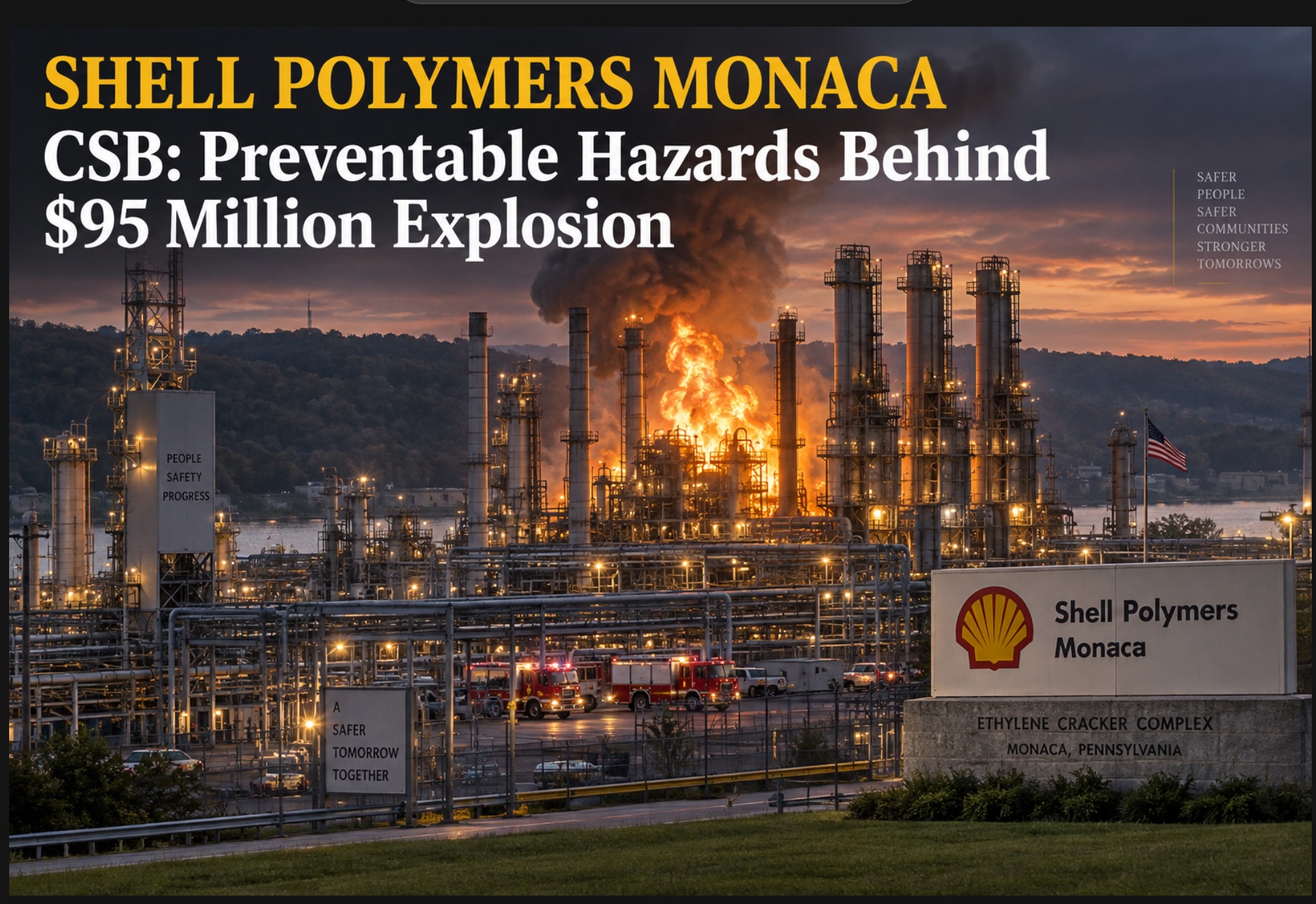
The US Chemical Safety and Hazard Investigation Board (CSB) has completed its investigation into the June 4, 2025 explosion and fire at Shell Polymers Monaca in Pennsylvania, an incident that caused extensive damage to the giant petrochemical complex and could, under slightly different circumstances, have had far more serious consequences.
The central finding is troubling: a known potentially catastrophic hazard was being controlled largely through procedures and human intervention when an engineered safeguard could have provided a stronger line of defence.
The accident involved Furnace 5 in the ethane cracking unit. Flammable cracked gas was inadvertently allowed to flow backwards into the furnace firebox, where ignition sources were present.
The result was an explosion, rupture of part of the furnace firebox wall and a major fire.
The CSB’s own records confirm that the June 4 incident caused substantial damage to the ethane cracking unit, resulted in personnel being evacuated from the furnace area and caused several people to receive first aid. Hazardous chemicals, including benzene and 1,3-butadiene, were also released.
US Chemical Safety and Hazard Investigation Board – Shell Polymers Monaca investigation
What went wrong
Furnace 5 had been taken out of service so that its coke trap could be cleaned.
Coke traps collect solid carbon deposits generated during the ethane-cracking process. Shell had decided that the coke traps associated with the furnaces should be cleaned.
After the work on Furnace 5 was completed, the furnace had to be reconnected to downstream processing equipment.
During that operation, a process-control engineer inadvertently opened two motor-operated isolation valves simultaneously.
That created an unintended flow path between downstream process equipment and Furnace 5.
Flammable cracked gas was consequently able to travel backwards towards the furnace firebox.
Approximately six minutes later, the gas reached ignition sources associated with the furnace pilots.
It ignited.
The resulting explosion damaged the furnace and ruptured part of the firebox wall, followed by a substantial fire.
An engineer who had never performed the task before
One of the most striking elements of the investigation concerns the experience of the person carrying out the valve operation.
The process-control engineer assigned to the task had not previously performed the operation and had limited familiarity with the relevant process.
That matters because this was not an inconsequential control-room operation.
The valves formed part of a system handling highly flammable hydrocarbons connected to a furnace containing ignition sources.
But attributing the accident simply to an employee operating the wrong valve would miss one of the most important lessons emerging from the investigation.
Modern process-safety philosophy assumes that human beings will occasionally make mistakes.
The more important question is therefore: why was one mistaken valve operation capable of producing an explosion?
Eleven administrative controls — but no effective engineered safeguard
This is perhaps the most significant aspect of the entire investigation.
Shell was relying on 11 administrative controls intended to prevent cracked gas from flowing backwards into the furnace.
Administrative controls include procedures, instructions, training and other measures that ultimately depend upon people performing the correct action.
The hazard itself was not unforeseeable.
Shell’s process hazard analyses had identified cracked-gas backflow as a potentially fatal scenario.
Yet the Monaca facility did not have an engineered safeguard configured to prevent the backflow under the particular operating condition involved in the accident.
That distinction is crucial.
An administrative safeguard essentially says: follow the correct procedure and do not create the dangerous condition.
An engineered safeguard attempts to make it physically or automatically difficult — or impossible — for the dangerous condition to arise in the first place.
According to the reported CSB findings, furnace technology supplied to the facility included engineered controls capable of preventing backflow, but those controls had not been configured to protect against the particular situation encountered during removal of the double isolation.
The accident therefore raises a much larger process-safety question than who opened which valve.
Why was a potentially fatal scenario allowed to depend so heavily upon flawless human performance?
A confusing control-system display
The human-machine interface — the computer system through which personnel operated the plant equipment — also came under scrutiny.
Three almost identical valves appeared on the same logic display.
Their identifying tags differed principally in their final digit.
The CSB concluded that the design contributed to selection of the wrong valve.
In an ordinary office application, confusing two nearly identical controls might result in an inconvenience.
Inside a petrochemical complex, a mistaken click can alter the physical configuration of equipment carrying large quantities of flammable hydrocarbons.
Good human-factors engineering therefore attempts to design control systems so that foreseeable human errors do not escalate into catastrophic events.
The Monaca accident provides a striking example of why that principle matters.
The consequences
The consequences were substantial.
The explosion damaged Furnace 5 and ruptured part of its firebox wall.
A major fire followed.
Personnel were evacuated from the furnace area and several people required first aid.
The CSB has previously confirmed that benzene and 1,3-butadiene were released during the incident.
Shell reportedly estimated the property damage at approximately $95 million, and Furnace 5 remained unavailable for months while repairs were undertaken.
That nobody was killed is obviously fortunate.
It should not obscure the severity of the underlying failure.
The combination of a large hydrocarbon release, an operating furnace and an ignition source is precisely the sort of scenario process-safety systems are designed to prevent.
The recommendations to Shell
The recommendations reported from the CSB investigation go beyond correcting the particular valve configuration involved in the accident.
Shell is being called upon to examine its hazard analyses for other potentially catastrophic accident scenarios in which protection depends solely upon administrative controls.
Where appropriate, those controls should be replaced or supplemented by inherently safer design measures or engineered safeguards.
Shell is also being asked to work with the furnace technology licensor and recognised industry practices to establish an engineered control capable of preventing cracked-gas backflow into a furnace during all relevant modes of operation.
That is an important distinction.
The objective is not merely to prevent somebody from repeating exactly the same mistake.
It is to change the system so that a foreseeable human error cannot so readily produce the same dangerous result.
Shell Polymers Monaca
Shell Polymers Monaca is a huge petrochemical complex in Beaver County, Pennsylvania.
The Pennsylvania Department of Environmental Protection describes the facility as containing several ethane-cracking furnaces and polyethylene units. Ethane derived from natural gas is processed to manufacture polyethylene plastic.
The site also includes three gas-powered electricity-generating turbines.
Commercial polyethylene production began in 2022.
Pennsylvania Department of Environmental Protection – Shell Polymers Monaca facility information
The Pennsylvania DEP’s records also provide useful wider context.
In May 2023, Shell entered into a consent order and agreement with the state after formally acknowledging that the facility had exceeded total emission limitations for air contaminants during commissioning.
Shell agreed to undertake repairs and make payments approaching $10 million, including funding intended to benefit the surrounding community.
Pennsylvania DEP – Shell Petrochemical Complex
That earlier environmental enforcement action is separate from the June 2025 explosion, but it illustrates the level of regulatory attention the enormous Monaca complex has attracted since commencing operations.
The danger of calling it “human error”
Industrial accidents are frequently reduced afterwards to two words:
Human error.
The Monaca investigation demonstrates why that explanation can be dangerously incomplete.
Yes, somebody operated the wrong valve.
But the more important questions are systemic.
Why could the wrong valve be selected so easily?
Why were almost identical valves presented together on the control interface?
Why was an inexperienced person carrying out a safety-critical operation?
Why was a known potentially fatal backflow scenario dependent upon numerous administrative controls?
And why was an engineered safeguard not configured to prevent precisely the dangerous condition that developed?
Those are process-safety questions rather than questions about individual blame.
The wider lesson for Shell
The most consequential part of the CSB investigation may therefore extend far beyond Furnace 5 at Monaca.
If Shell is required to examine other potentially catastrophic scenarios in which administrative controls are the principal defence against disaster, the investigation potentially has implications elsewhere within the company’s operations.
The hierarchy of controls exists for a reason.
Procedures are important.
Training is important.
Competent personnel are essential.
But when an industrial process contains enough energy and flammable material to produce a major explosion, the strongest protection is generally a system engineered so that one foreseeable human mistake cannot unlock a pathway to catastrophe.
At Monaca, that pathway opened.
The remarkable good fortune is that a roughly $95 million industrial accident did not also become a fatal one.
For Shell, its employees, regulators, shareholders and communities living alongside major petrochemical installations, that is the central lesson from Furnace 5.
Sources
US Chemical Safety and Hazard Investigation Board – Investigations
Pennsylvania Department of Environmental Protection – Shell Polymers Monaca Facility Information