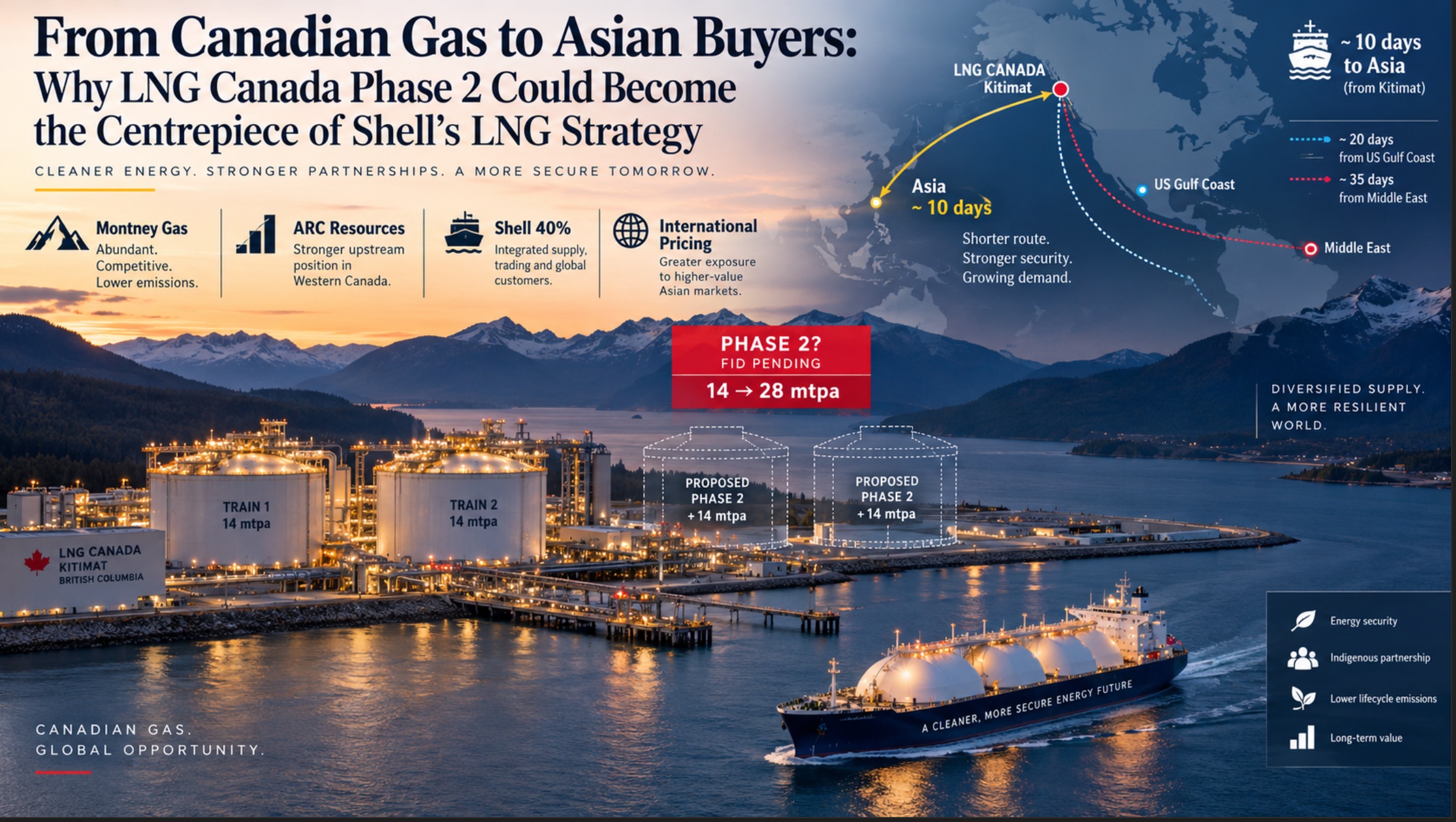
Shell-led LNG Canada could make a final investment decision on Phase 2 as early as October, according to Reuters. If approved, the expansion would roughly double the Kitimat facility’s capacity from 14 million tonnes a year to about 28 million tonnes. More importantly, it would connect Shell’s enlarged Western Canadian gas position directly to Asian LNG markets at a time when buyers are increasingly concerned about supply security.
Shell may be approaching one of the most consequential investment decisions in its global LNG portfolio.
Reuters reported on 17 September that the partners in LNG Canada could reach a final investment decision on the proposed Phase 2 expansion as early as next month, citing three people familiar with the matter.
The project would add roughly another 14 million tonnes per annum of LNG capacity, taking the Kitimat facility from its current 14 mtpa to approximately 28 mtpa.
That would effectively double the scale of Canada’s first major LNG export terminal.
But the number alone does not explain why Phase 2 matters so much to Shell.
The real significance lies in what sits behind the liquefaction trains:
Shell’s expanding Montney gas production.
Its 40% stake in LNG Canada.
Its global LNG trading organisation.
Its shorter Pacific shipping route to Asia.
And now:
a geopolitical environment in which Asian customers are placing increasing value on diversified supply that does not depend upon Middle Eastern shipping routes.
That combination makes Phase 2 potentially much more than an expansion project.
It could become one of the clearest expressions yet of Shell’s integrated gas strategy.
First, the important caveat
Phase 2 has not yet been approved.
Reuters reports that a decision could come as early as early October.
But Shell told Reuters that it continues to work with its venture partners to explore pathways towards a possible expansion, and that any decision would depend upon factors including competitiveness, affordability, government support and stakeholder needs.
LNG Canada itself was equally careful.
It said that any final investment decision remained subject to each joint-venture participant independently satisfying its commercial, fiscal, regulatory and governance requirements.
The company said only that it hoped to make a decision before the end of 2026.
So the correct position today is:
Phase 2 appears to be moving closer to FID.
Not:
Phase 2 has been sanctioned.
That distinction should remain explicit until the partners make a formal announcement.
Shell is the largest shareholder
The LNG Canada ownership structure is:
Shell — 40%
PETRONAS — 25%
PetroChina — 15%
Mitsubishi — 15%
KOGAS — 5%
Shell therefore holds the largest individual interest and operates the project through LNG Canada Development Inc.
The existing facility consists of two LNG trains with combined capacity of approximately 14 mtpa.
The proposed expansion would add two further trains and roughly double the plant’s output.
That alone would make Phase 2 significant.
But recent developments have made it strategically more interesting.
LNG Canada only started shipping last year
Phase 1 reached a historic milestone on 30 June 2025, when its first LNG cargo departed Kitimat.
Shell described the project at the time as a new supply source primarily serving Asian markets and said LNG Canada would strengthen its integrated gas portfolio.
The existing plant was one of Canada’s largest private-sector investments, with Reuters putting Phase 1’s cost at approximately C$40 billion.
So Shell and its partners are potentially considering doubling the facility barely more than a year after LNG Canada entered commercial operation.
That is an unusually rapid transition from:
“Can this vast project actually be built and started?”
to:
“Should we build another two trains?”
The answer is not yet known.
But even serious consideration of Phase 2 at this stage says something important about how the partners view the asset.
The location is one of LNG Canada’s greatest advantages
Kitimat is not simply another liquefaction terminal.
Its geography gives Shell a significant structural advantage in supplying Asia.
Shell’s own investor material says LNG Canada can reach Asian markets in around 10 days.
The same presentation shows indicative shipping times of roughly:
24 days from the US Gulf Coast;
16 days from the Middle East;
and:
8 days from Australia.
That matters because LNG is not just natural gas.
It is natural gas plus liquefaction plus shipping plus regasification.
Every extra day at sea costs money.
A shorter route can mean:
lower freight costs;
less fuel consumption;
less exposure to vessel availability;
faster cargo cycling;
and fewer maritime chokepoints.
Shell describes LNG Canada as having lower supply and shipping costs versus the US Gulf Coast, giving it what the company calls a structural margin advantage.
That is precisely the sort of advantage Wael Sawan’s Shell now prioritises.
And there is no Panama Canal problem
US Gulf Coast LNG bound for Asia can face a choice.
Transit the Panama Canal when capacity and vessel dimensions permit.
Or take a much longer route.
Canadian Pacific LNG avoids that problem.
A cargo leaving Kitimat is already on the Pacific side of North America.
That means LNG Canada is geographically aligned with the markets Shell expects to drive a substantial share of future gas demand.
Shell has said LNG Canada offers an advantageous route to Asia with shipping times substantially shorter than those from the US Gulf Coast.
That was commercially attractive before the latest Middle East disruption.
It becomes more interesting when customers begin attaching an explicit premium to supply-route diversity.
Reuters says Asian buyers are increasingly focused on security
This is where the timing becomes particularly important.
Reuters reports that LNG customers — especially in Asia — are placing greater emphasis on supply security because of:
the Middle East conflict;
Red Sea disruption;
and uncertainty surrounding future flows through the Strait of Hormuz.
That does not mean LNG Canada replaces Middle Eastern LNG.
Qatar alone is too important for that.
Nor does it mean Canadian LNG is insulated from every geopolitical or operational risk.
But it does offer a geographically distinct source of supply.
For a utility or national energy buyer trying to diversify procurement, that matters.
The attraction is therefore not merely that Canada can supply LNG.
It is that Canadian LNG reaches Asia through an entirely different geopolitical corridor.
Shell has just spent $13.9 billion buying more Canadian energy
Then comes the ARC Resources acquisition.
On 2 September 2026, Shell completed its acquisition of ARC Resources for an updated equity value of approximately US$13.9 billion, assuming roughly US$2.5 billion of net debt and leases for an enterprise value of approximately US$16.5 billion.
ARC adds approximately 370,000 barrels of oil equivalent per day across gas and liquids and dramatically expands Shell’s position in the Montney basin of British Columbia and Alberta.
Shell explicitly said when announcing the acquisition that ARC’s gas reserves have the potential to support its LNG growth in Canada.
That makes the timing of a possible LNG Canada Phase 2 decision especially significant.
Only weeks after completing one of Shell’s largest recent acquisitions, the company could move towards creating a much larger export outlet for Western Canadian gas.
That starts to look less like coincidence and more like an integrated strategy.
Groundbirch already feeds LNG Canada
Shell was already vertically integrated before buying ARC.
Its Groundbirch gas asset in British Columbia supplies LNG Canada as well as the domestic gas market.
ARC adds much more gas-producing acreage and resources in the same broad basin.
Shell’s April acquisition presentation went further.
It identified LNG Canada Phase 2 explicitly as part of the strategic upside from the combination.
On one slide, Shell described LNG Canada Phase 2 as providing:
“optionality to further accelerate shift towards non-US international pricing.”
That sentence deserves attention.
Because it explains in financial terms why Shell might want another 14 million tonnes of LNG capacity.
From AECO gas to international LNG pricing
Western Canadian natural gas is frequently priced against AECO, a benchmark that can trade at substantial discounts when local gas supply exceeds takeaway capacity.
A gas producer selling exclusively into that market is exposed to those regional conditions.
Liquefaction changes the equation.
Convert Canadian gas into LNG and move it to Asia, and the molecule can gain exposure to international pricing rather than remaining trapped inside the Western Canadian gas market.
Shell’s own analysis shows the potential effect.
Its April 2026 presentation estimated that the combined portfolio had roughly:
40% AECO exposure
and:
60% international exposure
before Phase 2.
With LNG Canada Phase 2, Shell’s indicative analysis showed that changing to approximately:
20% AECO exposure
and:
80% international exposure.
That is arguably the single most revealing chart in the entire Phase 2 story.
The expansion is not simply about producing more LNG.
It is about changing where Shell’s Canadian gas is priced.
Shell calls that a structural margin advantage
The same Shell presentation makes the economic logic explicit.
Lower supply and shipping costs to Asia compared with US Gulf Coast exports can generate what Shell calls a:
“structural margin advantage.”
That phrase goes directly to Wael Sawan’s corporate strategy.
Shell is not pursuing growth simply because growth looks impressive.
The company repeatedly says projects must compete for capital and generate attractive returns.
That is why Phase 2 remains conditional.
The partners still have to decide that the economics justify another enormous investment.
But if it does pass that test, Shell’s own analysis suggests that the opportunity is unusually integrated:
produce low-cost Canadian gas;
liquefy it at a plant Shell already knows;
ship it across a comparatively short route;
sell it into higher-value international markets;
and optimise the entire chain through Shell’s global trading organisation.
Trading sits in the middle again
This follows a pattern we have already seen in Shell’s US power transactions.
Physical assets become more valuable when they support Shell’s trading capability.
LNG Canada is the same principle on a much larger scale.
Shell does not merely receive its share of LNG and sell it to one fixed customer.
Its Integrated Gas organisation manages a global portfolio.
Cargoes can be sold under long-term arrangements.
Others can be optimised.
Market exposure can be managed geographically.
Shipping can be redirected.
Gas can be sourced from Shell-owned production or purchased from the market.
That optionality becomes more valuable during periods of volatility.
Phase 2 could therefore connect the whole Canadian chain
Put the pieces together.
Shell now has:
a vastly enlarged Montney resource position;
existing gas production at Groundbirch;
ARC’s producing and development assets;
a 40% interest in LNG Canada;
a functioning Pacific Coast export terminal;
one of the world’s largest LNG trading portfolios;
and a direct route into Asia.
Phase 2 could enlarge the pipe connecting all of those pieces.
That is why this story matters far more than the simple headline:
“LNG plant may double in size.”
It potentially converts Shell’s Canadian upstream acquisition into a more valuable international gas business.
The Indigenous ownership proposal is also significant
There is another important element that should not be treated as a footnote.
In July 2026, LNG Canada announced an equity option agreement with MNT Investments LP, representing the economic-development organisations of five neighbouring First Nations:
the Gitga’at First Nation;
Gitxaała Nation;
Haisla Nation;
Kitselas First Nation;
and Kitsumkalum.
The agreement gives MNT Investments the opportunity to invest up to C$1 billion for a majority ownership interest in a special-purpose entity that would purchase the additional LNG storage tank planned for Phase 2.
The tank would then be leased back to LNG Canada.
LNG Canada says the arrangement could become one of the largest Indigenous ownership positions in Canadian energy infrastructure.
Importantly, the agreement is conditional on Phase 2 being approved.
That makes the forthcoming investment decision important not only to Shell and its international partners, but also to communities around the project.
More than 100 cargoes already shipped
By July 2026, LNG Canada said the first phase had shipped more than 100 LNG cargoes since operations began on 30 June 2025.
That operational history matters.
Phase 2 would not be a greenfield proposal built around a theoretical future facility.
The marine terminal exists.
The first two liquefaction trains exist.
The pipeline connection exists.
Cargoes are moving.
The workforce, operating systems and supporting infrastructure are already substantially in place.
That does not remove construction risk.
Two new LNG trains would still involve enormous expenditure and execution complexity.
But it means Phase 2 begins from a very different position from Phase 1.
The first phase was difficult enough
That deserves emphasis.
Phase 1 took years of planning, construction and capital.
The C$40 billion price tag cited by Reuters gives some indication of the scale.
A decision to expand cannot therefore be interpreted simply as Shell deciding that “LNG prices are high, so build more.”
The partners have to assess:
construction cost;
labour availability;
gas supply;
contracting;
future carbon costs;
fiscal terms;
project returns;
shipping economics;
regulation;
stakeholder requirements;
and long-term LNG demand.
LNG Canada itself has repeatedly said Phase 2 must satisfy tests concerning competitiveness, affordability, pace, future greenhouse-gas emissions and stakeholder needs.
That is why an early-October decision remains plausible rather than certain.
Shell also has a carbon argument
Shell presents LNG Canada as comparatively advantaged on emissions intensity.
The project uses efficient gas turbines and hydroelectric power for supporting energy needs, and Shell says the facility is designed to rank among the lower-carbon-intensity LNG plants globally.
LNG Canada says any Phase 2 pathway would need to maintain its greenhouse-gas-intensity ambition.
That does not make LNG carbon-free.
Liquefaction consumes energy.
Methane leakage matters.
Shipping produces emissions.
And ultimately the natural gas is burned by customers.
But within the LNG industry, production and liquefaction carbon intensity increasingly affect project competitiveness.
That gives LNG Canada another characteristic Shell can attempt to monetise.
Then there is the coal argument
Shell continues to argue that LNG can support emissions reduction where gas replaces coal in power generation.
When the first LNG Canada cargo departed, Shell said Asian markets moving away from coal represented an important use case for the project.
That argument is contested because the actual climate outcome depends upon methane leakage, plant efficiency, what fuel is genuinely displaced and how long the gas infrastructure operates.
But from Shell’s commercial perspective, the important point is clear:
Asia remains central to its long-term LNG demand thesis.
And LNG Canada is designed geographically around supplying that market.
The timing could hardly be more favourable — commercially
There is a temptation to describe the present geopolitical crisis as “good for LNG Canada.”
That would be too crude.
Wars and supply disruptions impose severe human and economic costs and should not be reduced to convenient investment narratives.
But commercially, the current environment undeniably strengthens one part of LNG Canada’s investment case:
supply diversification.
Only yesterday Shell’s own chief economist warned that global energy-market “shock absorbers” are weakening after tens of millions of tonnes of expected LNG supply were lost.
Now Reuters reports that Shell’s flagship Canadian LNG project may be approaching a decision to double capacity.
Those stories are related.
Not because the Middle East conflict created LNG Canada Phase 2 — the expansion has been contemplated for years.
But because present conditions make the strategic value of geographically diversified LNG supply easier to see.
For Shell shareholders, this could be an unusually coherent growth project
A frequent problem with large energy-company portfolios is that acquisitions and capital projects can seem disconnected.
Here the pieces fit remarkably well.
Shell bought ARC.
ARC adds gas.
Shell already owns Groundbirch.
Groundbirch feeds LNG Canada.
Shell owns 40% of LNG Canada.
Phase 2 would double liquefaction capacity.
Canada’s west coast gives direct access to Asia.
Shell trades LNG globally.
And its own modelling suggests Phase 2 could materially increase international pricing exposure while reducing dependence on AECO.
That is strategic integration in a very literal sense.
But the capital test still matters
All of this does not mean the partners should automatically approve Phase 2.
The scale of LNG investment now proposed around the world is enormous.
North American LNG export capacity is expanding rapidly.
Projects are being developed in the United States, Canada, Qatar and elsewhere.
An asset that looks extremely attractive in a tight market can face very different economics when a wave of new supply arrives.
Shell has to consider the market expected when Phase 2 actually begins producing — not merely the market of September 2026.
That is why cost discipline remains critical.
If project costs rise enough, even an excellent location can lose its advantage.
Shell’s own numbers show why management is interested
The strongest evidence that Phase 2 has moved beyond a vague future possibility comes from Shell itself.
In April, while explaining the ARC acquisition to investors, Shell placed LNG Canada Phase 2 directly inside the value-creation logic of the transaction.
It showed the proposed project on its Canadian asset map.
It identified Phase 2 pricing as a source of additional upside.
And it modelled the expansion as potentially shifting the enlarged gas portfolio towards substantially greater international price exposure.
Those are not promises that FID will happen.
But they tell investors exactly why Shell cares about it.
Commentary
LNG Canada Phase 2 may eventually prove to be one of the simplest ways to understand Wael Sawan’s Shell.
The company wants upstream resources.
But preferably advantaged ones.
It wants LNG growth.
But preferably where transport economics are attractive.
It wants trading optionality.
It wants international pricing.
It wants investments capable of generating strong returns.
And it increasingly prefers businesses in which multiple parts of Shell’s portfolio reinforce one another.
Canada now offers all of those things in one chain.
Montney gas at one end.
Asian LNG buyers at the other.
Shell sitting in between as producer, liquefaction shareholder, shipper, marketer and trader.
The acquisition of ARC Resources made that chain substantially larger.
Phase 2 could make it substantially more valuable.
That does not make approval inevitable.
The partners still have to decide whether the economics justify committing many billions of dollars more.
But if Reuters is correct that an FID could come within weeks, the decision would be much more than another LNG project sanction.
It would amount to a major statement about where Shell believes the future of its gas business lies.
Not merely underground in Canada.
But across the Pacific.
What is established
LNG Canada Phase 1 has two trains with combined capacity of about 14 mtpa, and its first cargo departed on 30 June 2025.
Shell owns 40% of the venture.
The proposed Phase 2 expansion would add two further trains and approximately double capacity to around 28 mtpa.
Reuters reports that a final investment decision could come as early as early October 2026, citing three people familiar with the matter.
Shell and LNG Canada have not announced a final investment decision.
Shell’s own ARC Resources investor presentation identifies Phase 2 as potential upside and says it could increase the portfolio’s international pricing exposure while reducing AECO exposure.
Shell completed its acquisition of ARC Resources on 2 September 2026, adding approximately 370 kboe/d and substantial Montney gas and liquids resources.
Five neighbouring First Nations, through MNT Investments LP, have an option to invest up to C$1 billion in infrastructure associated with Phase 2 if the expansion proceeds.
What remains uncertain
The timing of FID remains uncertain.
The final capital cost has not been publicly established in the material reviewed here.
The exact design and ultimate capacity of Phase 2 may still evolve.
Future LNG prices, construction costs and long-term demand remain uncertain.
And no current market condition guarantees that an investment sanctioned today will generate the returns expected when it begins operating years later.
Sources
Reuters, 17 September 2026: Shell-led LNG Canada could approve Phase 2 expansion by early October, sources say.
Shell, 30 June 2025: announcement of LNG Canada’s first cargo; Shell’s 40% interest and existing 14 mtpa capacity.
Shell — First cargo leaves LNG Canada
Shell, 27 April 2026: ARC Resources acquisition announcement and strategic rationale.
Shell — Agreement to acquire ARC Resources
Shell ARC Resources investor presentation, April 2026: Shell’s analysis of Phase 2, international pricing exposure, AECO exposure and shipping advantage.
Shell — ARC Resources acquisition presentation
Shell, 2 September 2026: completion of the ARC Resources acquisition.
Shell — Completion of ARC Resources acquisition
LNG Canada, 14 July 2026: Indigenous equity option involving MNT Investments LP and five neighbouring First Nations; investment option of up to C$1 billion conditional on Phase 2 proceeding.
LNG Canada — Indigenous equity option
LNG Canada: current Phase 2 information and confirmation that the expansion remains under consideration by the joint-venture participants.
LNG Canada — Phase 2 information
Site-wide disclaimer applies.
*This website and sisters royaldutchshellgroup.com, shellnazihistory.com, royaldutchshell.website, johndonovan.website, shellnews.net, and shellwikipedia.com, are owned by John Donovan - more information here. There is also a Wikipedia segment, the Shell DPA Files, "Shell and the Spies", the Shell Leaks files, as well as books written and published by John Donovan - Kindle eBooks. Timeline of the Donovan Shell Feud. Toxic History of Royal Dutch Shell Group. Shell and the Donovans: The Full Media Record — 550+ Articles, 110 Books, 40 Years. *All created and supported by internet wizz, Nick Gill.