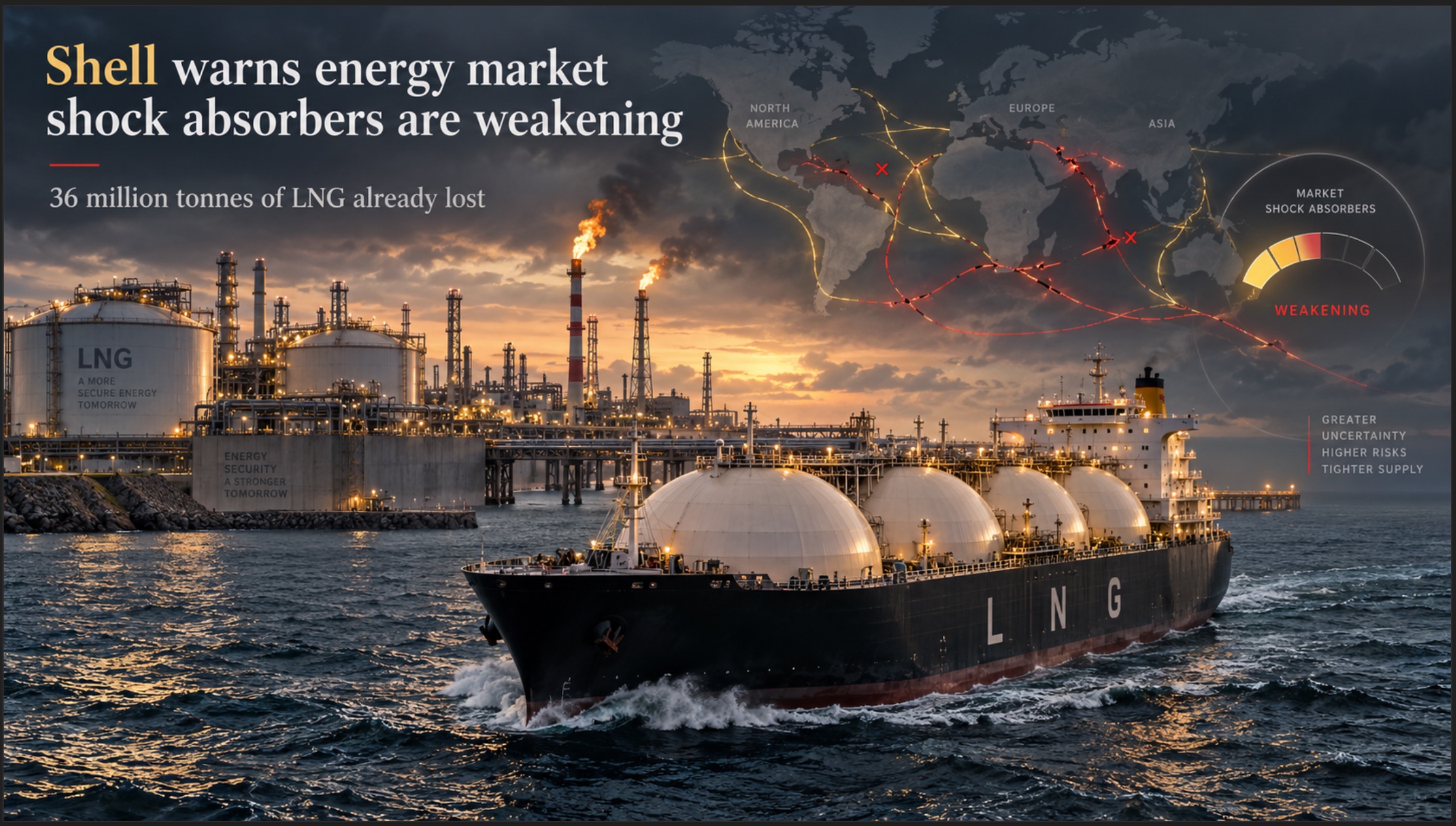
Shell’s chief economist says global energy markets have so far absorbed an extraordinary loss of oil and LNG supply from the Middle East. But the mechanisms that cushioned the blow — weaker demand, inventory drawdowns, spare infrastructure and rising American production — are wearing thin. Europe enters winter with unusually low gas stocks. Asian buyers are already retreating from expensive LNG. And Shell warns that even reopening disrupted trade routes would not immediately restore normal conditions.
There are times when a single phrase explains a complicated market remarkably well.
On 16 September 2026, Adam Ritchie, chief economist at Shell Trading, told an industry conference in Oslo that global energy markets had demonstrated impressive resilience despite severe disruption in the Middle East.
But then came the warning:
“Those shock absorbers are weakening.” (London South East)
That may be the most important energy-market statement Shell has made this week.
Because according to Shell’s calculations, the world has already lost approximately:
36 million tonnes of LNG
and:
1.6 billion barrels of crude oil and condensates
since the current Middle East disruption began. (London South East)
For perspective, Reuters reports that the 36 million tonnes of missing LNG is roughly equivalent to the combined LNG imports of Britain and France last year. (London South East)
Yet the global energy system did not collapse.
The interesting question is why.
And the more important question now is what happens as the buffers that prevented collapse begin to disappear.
How did the world absorb such a large supply loss?
Shell’s answer is instructive.
The market was cushioned by a combination of:
weaker Chinese demand;
inventory drawdowns;
flexible shipping capacity;
spare pipeline capacity;
and:
rising oil and gas production in the Americas.
Together, those mechanisms absorbed a remarkable amount of disruption. (London South East)
That is what Ritchie means by “shock absorbers.”
They are not one emergency reserve controlled by one government.
They are the spare capacity and behavioural flexibility scattered throughout the global energy system.
Consumers use less.
Cargoes change destination.
Inventories are drawn down.
Pipelines carry more.
Producers elsewhere increase output.
Traders redirect supply.
The market adapts.
Until it cannot.
The warning is that the spare capacity is disappearing
Ritchie’s argument is not that the market has failed.
It is almost the opposite.
The market has worked extraordinarily hard.
The problem is that the mechanisms doing the work are becoming exhausted.
As inventories fall, there is less stored energy available for the next disruption.
As spare shipping capacity is deployed, there are fewer vessels available to solve the next bottleneck.
As pipeline systems operate closer to their limits, there is less ability to reroute gas.
And as alternative producers increase output, their remaining spare production capacity becomes smaller.
That makes subsequent shocks more dangerous than the first one.
A system with abundant slack can absorb bad news.
A system operating close to its limits transmits bad news directly into prices.
That is the essence of Shell’s warning.
Europe is entering winter with an uncomfortable problem
Nowhere is the vulnerability more obvious than Europe.
Reuters reported this week that European Union natural-gas storage is only about 67% full.
That is described as a record low for this point in the year and is far below the EU’s target of storage reaching 80% of capacity by December. (BOE Report)
Shell’s President of Integrated Gas, Cederic Cremers, described Europe as entering the end of autumn with historically low storage levels. (BOE Report)
That creates a familiar but dangerous dependency.
Europe now needs:
continued LNG arrivals;
continued Norwegian pipeline supply;
manageable winter temperatures;
and sufficiently weak Asian demand to prevent an aggressive bidding war for cargoes.
Lose one of those advantages and the market becomes tighter.
Lose several simultaneously and prices could move very rapidly.
Germany shows how thin the margin has become
Germany provides an especially revealing example.
Reuters reported that German gas-storage sites were only around 53% full in early September, the lowest level for that point in the year since records began approximately 15 years ago. (Yahoo Finance)
Germany’s state-owned SEFE has already begun increasing gas storage, while the government is examining additional market incentives to encourage traders to hold more winter supply. (Yahoo Finance)
That is a significant change of posture.
Europe spent years building resilience after the loss of large quantities of Russian pipeline gas.
Now it is discovering that resilience itself requires constant replenishment.
Storage is not resilience if the tanks are empty.
The Strait of Hormuz remains the critical pressure point
The most important LNG bottleneck is the Strait of Hormuz.
Before the current disruption, approximately one fifth of global LNG supply passed through the route.
Qatar and the United Arab Emirates are among the most important exporters affected.
Shell’s own LNG Outlook 2026, published in June, stated that severe disruption through Hormuz had shut in around one fifth of the world’s monthly LNG supply since the conflict began. (Shell)
That is not a marginal loss.
Global LNG trade totalled approximately 422 million tonnes in 2025.
Removing tens of millions of tonnes from that market in a short period creates an enormous reallocation problem. (Shell)
Every missing Middle Eastern cargo has to be replaced, substituted or rationed somehow.
America has helped save the market
One of the most important stabilising forces has been the growth of LNG supply from North America.
Shell itself says the ramp-up of new liquefaction capacity in North America has helped offset Middle Eastern disruption. (Shell)
That trend matters enormously.
The United States is already the world’s largest LNG exporter and is expected to expand exports substantially through the end of the decade.
For Europe, American LNG has become increasingly important as Russian pipeline supply has declined.
For Asia, the same cargoes represent competition.
And that creates one of the defining characteristics of the modern LNG market:
Europe and Asia are increasingly bidding for the same flexible supply.
Asia is already responding by buying less
High prices eventually solve a supply problem in one brutal way.
They destroy demand.
Reuters reports that Asia’s LNG imports are heading towards their weakest September in eight years.
Expected arrivals of approximately 20.09 million tonnes would be down from 22.27 million tonnes in September 2025. (BOE Report)
Why?
Because LNG has become too expensive for many buyers.
Spot prices in Asia have climbed close to $30 per million British thermal units, compared with roughly $10 before the conflict. (BOE Report)
For wealthy utilities in Japan or Europe, painful prices can sometimes be absorbed.
For price-sensitive markets in South and Southeast Asia, the response is different.
Buy less LNG.
Burn more coal.
Use more domestic gas.
Switch fuels.
Curtail demand.
Or simply go without.
That creates an uncomfortable paradox for Shell
Shell is one of the biggest beneficiaries of a global LNG market.
It is also exposed to what happens when LNG becomes too expensive.
Shell describes itself as one of the world’s leading LNG suppliers.
Its LNG business met approximately 16% of global LNG demand in 2025. (Shell)
Its portfolio includes supply from more than ten countries and sales into more than thirty.
It also controls or charters one of the world’s largest LNG shipping fleets. (Shell)
That scale gives Shell extraordinary flexibility.
If prices differ sharply between markets, Shell can redirect cargoes.
If one region weakens, another may absorb supply.
If shipping routes change, Shell’s large fleet and trading operation can adapt.
Volatility therefore creates opportunities.
But volatility also has a limit.
When prices become sufficiently high, customers leave the market.
That is not good for long-term demand.
Shell’s strategic bet on LNG is enormous
This matters because Shell has made LNG central to its corporate strategy.
At its 2025 Capital Markets Day, Shell said it intended to grow LNG sales by 4% to 5% annually through 2030. (Shell)
Its 2025 Annual Report records LNG sales of 73 million tonnes, up from 66 million tonnes the previous year.
Shell said 2025 included the highest number of LNG cargoes it had ever delivered in a single year. (Shell)
The company also expects global LNG demand to rise substantially over the long term.
Shell’s 2026 outlook forecasts demand increasing by approximately 65% by 2050, to nearly 700 million tonnes annually. (Shell)
So when Shell warns that the global LNG market is losing its shock absorbers, it is not offering an academic observation.
This is one of the most important markets in Shell’s entire corporate strategy.
The trading desk sits at the centre of all this
The warning also fits remarkably well with another theme visible across Shell’s recent strategy.
Trading.
Shell’s Integrated Gas business does not merely produce LNG.
It buys it.
Sells it.
Ships it.
Redirects it.
Optimises it.
Arbitrages geographic price differences.
And combines physical infrastructure with financial and contractual flexibility.
Shell’s own portfolio description says the Integrated Gas segment markets and trades natural gas, LNG, power and carbon-emission rights. (Shell)
That means disruption can enhance the value of Shell’s trading capability.
If an LNG cargo has dramatically different values in Europe and Asia, optionality becomes valuable.
If one shipping route closes, an organisation capable of redirecting supply gains an advantage.
If markets fragment, a company with physical assets in multiple regions can exploit those differences.
Shell’s scale becomes useful precisely when the system becomes complicated.
But extreme volatility can stop being profitable and start becoming destructive
There is a temptation to assume that higher energy prices automatically mean higher profits for Shell.
That is too simple.
Very high prices can create:
demand destruction;
counterparty stress;
political intervention;
windfall taxes;
subsidies;
industrial shutdowns;
fuel switching;
recession;
and accelerated investment in alternatives.
A customer who pays an expensive LNG bill is still a customer.
A customer who switches permanently to coal, domestic gas, nuclear power or renewables is not.
That is why the current crisis is strategically ambiguous for Shell.
Short-term volatility may favour Shell’s trading business.
Long-term affordability problems can undermine the growth story on which Shell’s LNG strategy depends.
What happens when the route reopens?
Perhaps the most sobering part of Ritchie’s warning concerns what comes after the disruption.
The intuitive assumption is simple:
Hormuz reopens.
Ships sail again.
Supply returns.
Prices fall.
Problem solved.
Shell says reality may be considerably messier.
Ritchie warned that even if disrupted energy chokepoints reopen, bottlenecks involving shipping, production and supply chains could prevent markets returning immediately to normal.
He suggested tight conditions could persist well into 2027, assuming no additional damage to energy infrastructure. (London South East)
Then comes the second phase.
Restocking.
The world has drawn down inventories to survive the disruption.
Those inventories eventually have to be rebuilt.
That process itself creates additional demand.
So restoring the flow of energy does not instantly restore the buffer that previously existed.
The market has borrowed resilience from the future
That may be the clearest way to understand Shell’s warning.
The global energy system has survived the current disruption partly by borrowing resilience from the future.
It used inventories that would otherwise have been available later.
It used spare pipeline capacity.
It used shipping flexibility.
It relied on weaker demand.
It accelerated alternative production.
Those mechanisms kept the system functioning.
But once used, they have to be restored.
Storage must be refilled.
Inventories rebuilt.
Ships repositioned.
Maintenance completed.
Supply chains normalised.
That means even after the immediate crisis passes, the energy system can remain fragile.
Weather now matters enormously
There is one variable nobody controls.
Winter.
Reuters reports that industry executives see a cold winter in Europe and Asia as one of the principal risks.
Wood Mackenzie chairman Simon Flowers said a colder-than-normal winter could push global LNG prices towards $40 per million BTU, although that is a scenario rather than a forecast. (BOE Report)
At such prices, further demand destruction would become likely.
A mild winter would relieve pressure.
A severe winter would do the opposite.
Energy security can therefore turn on meteorology as much as geopolitics.
Shell’s warning is also a warning to governments
There is an obvious policy implication.
Modern energy systems have been built increasingly around efficiency.
Just-in-time supply.
Optimised inventories.
Interconnected markets.
Global shipping.
Flexible trading.
Under normal conditions, that reduces cost.
Under extreme conditions, it can reduce redundancy.
Shell’s “shock absorber” metaphor therefore raises an uncomfortable question:
How much spare capacity should the global energy system deliberately maintain?
Too much spare capacity is expensive.
Too little makes consumers vulnerable to geopolitical disruption.
That problem is not unique to LNG.
Oil inventories, electricity storage, spare generation, pipelines and fuel reserves all involve the same trade-off.
Resilience costs money.
So does the absence of resilience.
There is a broader irony here
Shell has spent years arguing that LNG contributes to energy security because it allows natural gas to move across oceans rather than remaining trapped within pipeline systems.
That argument is valid.
The global LNG market genuinely creates flexibility.
But the present crisis demonstrates the other side.
LNG depends upon:
liquefaction plants;
shipping routes;
LNG carriers;
regasification terminals;
finance;
insurance;
and access through critical maritime chokepoints.
A pipeline can be geopolitically vulnerable.
So can a ship.
There is no completely geopolitics-proof energy system.
Diversification is the real protection.
Shell’s own numbers make the scale difficult to ignore
Return to the two figures:
36 million tonnes of LNG.
1.6 billion barrels of crude oil and condensates.
Those quantities have already disappeared from the expected global supply system.
And yet markets have continued functioning.
That is evidence of impressive resilience.
But resilience should not be confused with immunity.
The buffers that allowed the world to absorb those losses are smaller now than they were when the crisis began.
The next disruption therefore begins from a weaker starting point.
That is what Adam Ritchie was warning about.
Commentary
Shell’s message deserves attention precisely because the company has every reason to understand the mechanics of this market.
It is not merely an LNG producer.
It is producer, shipper, buyer, seller, trader and optimiser.
Few companies possess a better view across the entire physical LNG chain.
And the message coming from that vantage point is not:
everything is fine.
It is:
the system has coped remarkably well, but much of the spare capacity that allowed it to cope has now been consumed.
For Shell shareholders, that creates both opportunity and danger.
Scarcity increases the value of flexible supply.
Volatility increases the value of trading expertise.
Geographical price differences create arbitrage opportunities.
Shell possesses all three advantages.
But an energy market cannot become indefinitely more expensive without eventually damaging the demand it is designed to serve.
The strongest LNG business in the world still needs customers capable of buying LNG.
That may be the central tension of Shell’s LNG strategy in 2026.
The company is positioned extremely well for a volatile market.
What it cannot control is how much volatility the market itself can withstand.
What is established
Shell calculates that approximately 36 million tonnes of LNG and 1.6 billion barrels of crude oil and condensates have been lost from expected global supply during the Middle East disruption. (London South East)
Shell’s chief economist Adam Ritchie said weaker Chinese demand, inventory drawdowns, flexible shipping, spare pipeline capacity and higher American production had helped absorb the shock, but warned that those buffers were weakening. (London South East)
EU gas storage is around 67% full, described by Reuters as a record low for this time of year and below the EU’s 80% December target. (BOE Report)
Shell’s Cederic Cremers has described European storage levels entering late autumn as historically low. (BOE Report)
Shell expects LNG sales to grow by around 4–5% annually through 2030 and describes LNG as central to its Integrated Gas strategy. (Shell)
Shell’s 2026 LNG Outlook estimates that global LNG demand could rise to nearly 700 million tonnes annually by 2050. (Shell)
What remains uncertain
The duration of disruption through the Strait of Hormuz remains uncertain.
The severity of the coming northern-hemisphere winter is unknown.
Future LNG prices cannot be predicted with confidence.
The extent to which Asian demand destruction proves temporary or structural is also uncertain.
And Shell’s suggestion that normalisation could take well into 2027 should be understood as an industry assessment based on current conditions, not a guaranteed timetable.
Sources
Reuters, 16 September 2026: Shell and Equinor warn that global energy-market “shock absorbers” are weakening; includes Shell’s estimate of 36 million tonnes of lost LNG and 1.6 billion barrels of lost crude oil and condensates. (London South East)
Reuters report — Energy market shock absorbers weakening, Shell and Equinor warn
Reuters, 16 September 2026: European gas storage at approximately 67%; Shell Integrated Gas President Cederic Cremers warns of historically low stocks entering winter. (BOE Report)
Reuters report — Global LNG prices could spike this winter on low European gas stocks
Shell LNG Outlook 2026: Shell’s assessment of global LNG supply, disruption through Hormuz and long-term demand growth. (Shell)
Shell Annual Report and Accounts 2025: LNG sales, Integrated Gas performance and Shell’s 4–5% annual LNG sales growth target through 2030. (Shell)
Shell Annual Report and Accounts 2025
Reuters, 15 September 2026: Asian LNG demand weakened as high prices encouraged fuel switching and reduced purchases. (BOE Report)
Reuters market analysis, 16 September 2026: Asian September LNG imports expected to be the weakest for that month in eight years. (BOE Report)
Site-wide disclaimer applies.
*This website and sisters royaldutchshellgroup.com, shellnazihistory.com, royaldutchshell.website, johndonovan.website, shellnews.net, and shellwikipedia.com, are owned by John Donovan - more information here. There is also a Wikipedia segment, the Shell DPA Files, "Shell and the Spies", the Shell Leaks files, as well as books written and published by John Donovan - Kindle eBooks. Timeline of the Donovan Shell Feud. Toxic History of Royal Dutch Shell Group. Shell and the Donovans: The Full Media Record — 550+ Articles, 110 Books, 40 Years. *All created and supported by internet wizz, Nick Gill.