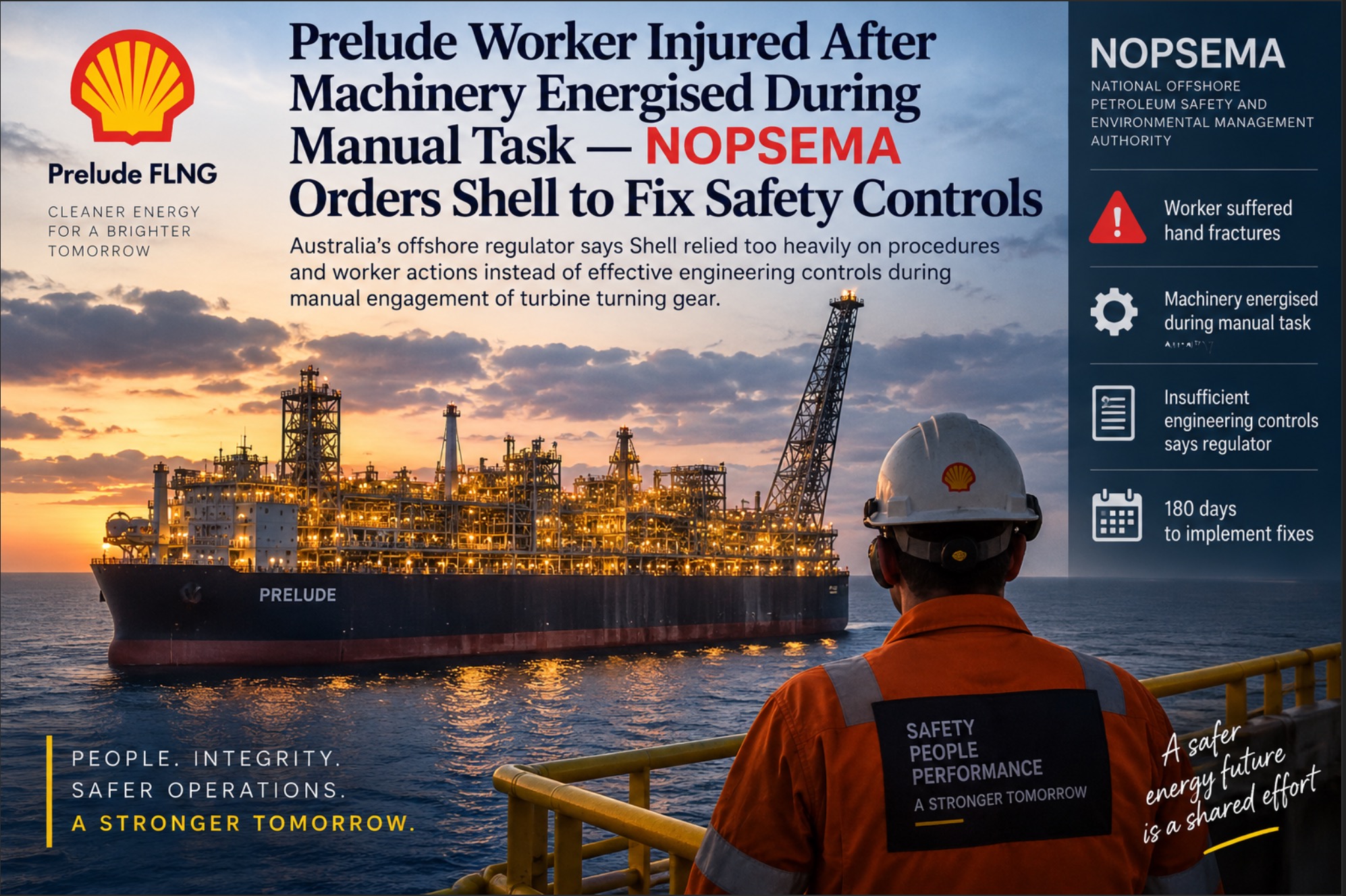
Australia’s offshore regulator says a Prelude FLNG technician suffered hand fractures after turning gear moved unexpectedly during a manual engagement task. NOPSEMA found that Shell had not implemented effective engineering controls to prevent automatic operation and was relying too heavily on procedures, communication and worker actions to control hazardous energy.
Shell Australia has been issued with a new occupational health and safety improvement notice at Prelude FLNG after a worker suffered fracture injuries to the hand during the startup of a steam turbine generator.
The underlying NOPSEMA notice is more significant than the bare fact that an injury occurred.
According to Australia’s National Offshore Petroleum Safety and Environmental Management Authority, the incident exposed a weakness in the way hazardous energy was being controlled during a manual task.
NOPSEMA concluded that Shell had contravened offshore health and safety law — and that it was likely to contravene the same provision again unless the underlying control system was changed.
That is the real story.
What happened on 2 August 2026
NOPSEMA says that on 2 August 2026, a production technician was manually engaging the turning gear during startup of a steam turbine generator at Prelude FLNG.
The normal pneumatic engagement system had failed.
Manual engagement was therefore being used instead.
During that activity, an automated start sequence energised the turning-gear motor.
The barring equipment moved.
The technician suffered fracture injuries to the hand.
The incident immediately raises the most basic machinery-safety question:
Why was equipment capable of automatic movement while a worker was manually engaging it?
NOPSEMA’s inspection went directly to that issue.
The regulator’s answer: the engineering controls were not enough
NOPSEMA identified four principal problems.
First, it said effective engineering controls had not been implemented to prevent automatic operation of the turning gear during manual engagement.
Second, manual engagement remained necessary whenever the pneumatic engagement system was unavailable.
Third, the task relied predominantly on procedural controls, worker actions and communication to prevent exposure to hazardous energy.
And fourth, NOPSEMA said critical controls — including electrical-isolation requirements and supervision of procedural compliance — had not been effectively implemented or verified.
That distinction between engineering controls and procedural controls is crucial.
A procedure tells a worker what should happen.
An engineering control is intended to make the dangerous event physically impossible, or at least substantially less likely.
In hazardous-energy work, the latter is generally the stronger protection.
A worker should not have to rely on everybody remembering every step
The regulator’s reasoning is unusually clear.
NOPSEMA said the activity depended predominantly upon administrative controls, procedures and individual actions to prevent exposure to hazardous energy.
The inspector was not satisfied that reasonably practicable measures had been implemented to prevent the equipment becoming energised or moving while manual engagement was taking place.
NOPSEMA therefore concluded that Shell had contravened Clause 9(1) of Schedule 3 of the Offshore Petroleum and Greenhouse Gas Storage Act 2006.
This is not simply criticism that someone failed to follow a procedure.
It is criticism of the control architecture itself.
The safety system depended too heavily on humans ensuring that the automated system did not operate at the wrong moment.
The regulator’s requirement is that Shell now redesign or strengthen the system so that the hazard is better controlled at source.
NOPSEMA said the same incident could happen again
The notice does not treat the August injury as a completed event with no continuing significance.
NOPSEMA said Shell was likely to contravene the law again because manual engagement remained part of operational practice whenever the pneumatic system was unavailable.
In other words, the underlying task had not disappeared.
Nor had the mechanism that produced the injury.
The regulator said existing controls still relied predominantly on procedural compliance, communication and worker actions.
That finding explains why an improvement notice was issued.
The issue was not merely what happened to one technician on one day.
It was whether the same combination of conditions could expose another worker to the same hazard.
The potential consequences go beyond a broken hand
NOPSEMA’s notice describes the continuing risk in stark terms.
Workers undertaking manual engagement of the steam turbine generator turning gear could be exposed to unexpected or uncontrolled movement.
That could result in a person being:
struck;
trapped;
or:
crushed
by moving equipment or between moving and fixed components.
NOPSEMA identified potential consequences including:
fractures;
crush injuries;
and:
permanent impairment.
That puts the August injury into context.
The technician suffered fractures.
The regulator is warning that the same mechanism could potentially produce something considerably worse.
What Shell has now been ordered to do
NOPSEMA has required action on two levels.
Before any further manual engagement of the turning gear is undertaken, Shell must implement and verify controls preventing the turning-gear motor, automated start sequence or any other relevant energy source from causing movement while a person could be exposed.
Then Shell must review the design and operation of the turning-gear engagement system itself.
The objective is to:
eliminate or minimise the need for manual engagement;
prevent workers being exposed to unexpected energisation or movement;
and demonstrate that critical controls — including isolation, verification, supervision and procedural controls — are implemented, maintained and verified effectively.
NOPSEMA has given Shell 180 days from the date of the notice to complete the required actions.
This is an improvement notice — not a shutdown order
The distinction matters.
NOPSEMA did not issue a prohibition notice stopping Prelude FLNG from operating.
It issued an OHS Improvement Notice.
Under NOPSEMA’s enforcement framework, an improvement notice can be issued when an inspector believes a duty holder has contravened offshore OHS law and that the contravention creates, or could create, a health and safety risk.
The notice remains in effect until the required actions have been completed.
Failure to comply is an offence. (NOPSEMA)
So this should not be reported as:
“NOPSEMA shut down Prelude.”
It did not.
The correct statement is:
NOPSEMA has formally required Shell to improve the safety controls governing this activity.
The notice remains open
NOPSEMA’s current published-notices register lists Improvement Notice 2130, dated 10 September 2026, against Shell Australia and Prelude FLNG.
Its status is shown as:
Open. (NOPSEMA)
That means the regulatory process is still active.
The notice will cease to have effect once Shell completes the required actions and the relevant compliance process is satisfied.
Prelude already has a regulatory history
The latest notice should not be treated as though Prelude has never before attracted regulatory concern.
That would be inaccurate.
In December 2021, Prelude suffered a major loss of power following smoke in an uninterrupted power supply room.
The event led to loss of normal power, repeated power interruptions and degradation of some critical systems.
Seven workers were treated for heat-related conditions during the incident, including four who required intravenous fluids. (NOPSEMA)
NOPSEMA subsequently issued a general direction requiring Shell to investigate and demonstrate that Prelude could operate safely during a power-loss event before production resumed. (NOPSEMA)
That episode was considerably more serious operationally than the current hand injury.
But it established an important background:
Prelude is a technically complex facility in which failures of energy, automation and critical systems can have consequences extending well beyond a single piece of machinery.
Hazardous gases produced another notice in 2025
NOPSEMA issued Shell another improvement notice at Prelude in February 2025.
That notice concerned exposure to hazardous gases including benzene and hydrogen sulphide.
The regulator said Shell had received reports of odour problems over an extended period and that workers had presented with health effects.
NOPSEMA was not satisfied that Shell had comprehensively assessed the sources and circumstances of potential exposure or effectively controlled the gases at source. (NOPSEMA)
The notice required Shell to implement improved detection, monitoring and control systems.
NOPSEMA’s current register shows that notice as complied with. (NOPSEMA)
That point should also be recorded.
The existence of a past notice does not mean the violation remains outstanding indefinitely.
Another Prelude notice in 2023
In July 2023, NOPSEMA issued a separate improvement notice over controls associated with work to remove a pressure-relief and vacuum-relief valve on an off-specification condensate tank.
NOPSEMA’s register now records that notice as complied with. (NOPSEMA)
Taken together, the record does not support the simplistic proposition:
“Prelude is permanently unsafe.”
But neither does it support treating the latest incident as an isolated regulatory curiosity.
Over several years, Australia’s offshore regulator has repeatedly intervened on different occupational and process-safety issues at the facility.
The important safety principle is hierarchy of controls
There is a broader reason the latest notice deserves attention.
Industrial safety normally distinguishes between stronger and weaker types of controls.
At the stronger end are measures that eliminate the hazard or physically prevent exposure.
Further down the hierarchy are administrative controls:
procedures;
training;
communications;
supervision;
permits;
and instructions.
Those controls matter.
But they can fail because human beings make mistakes.
People become distracted.
Shift handovers are imperfect.
Instructions are misunderstood.
Assumptions differ.
The regulator’s criticism at Prelude effectively reflects that principle.
Shell’s task depended too heavily on people and procedure when an engineering solution should have better prevented automatic energisation.
Automation becomes dangerous when its boundaries are unclear
There is another feature of the incident that deserves attention.
Automation usually improves industrial safety.
Machines perform repeatable sequences.
Interlocks prevent unsafe states.
Computer systems remove some opportunities for human error.
But automation introduces another risk when operators cannot be certain exactly when equipment may start or move.
That becomes particularly dangerous when a worker has physically entered the operating envelope of machinery to perform a manual intervention.
In such circumstances, the fundamental protection is isolation.
The worker should not have to trust that an automated start sequence will not run.
The system should prevent it from running.
That is effectively what NOPSEMA is now requiring Shell to demonstrate.
Prelude’s scale makes small failures important
Prelude FLNG is one of the largest floating industrial facilities ever constructed.
Its purpose is remarkable:
produce natural gas offshore;
process it;
liquefy it;
store LNG;
and load it directly onto LNG carriers,
all without sending the gas to a conventional onshore liquefaction plant.
That concentration of equipment makes Prelude technologically impressive.
It also creates formidable complexity.
Power generation.
Cryogenic systems.
Compressors.
Gas processing.
Storage.
Marine systems.
Automated controls.
Rotating equipment.
Emergency systems.
Thousands upon thousands of components have to interact safely on a floating installation far from shore.
Against that background, an injury involving a turning gear can sound minor.
It is not minor to the person whose hand was fractured.
And from a process-safety perspective, unexpected movement caused by uncontrolled hazardous energy is exactly the kind of mechanism that must be taken seriously before it produces a worse outcome.
The correct question is not whether Prelude has accidents
Every large industrial system experiences faults.
No credible safety regime assumes otherwise.
The meaningful question is:
What happens after the fault?
Does another layer of protection prevent a worker being exposed?
Does the machinery fail safely?
Does isolation prevent automatic energisation?
Can a single equipment fault combine with a procedural weakness to create an injury?
The latest NOPSEMA notice says that in this instance the protection was not good enough.
That finding deserves attention precisely because it comes from the offshore safety regulator rather than from speculation outside the facility.
Commentary
There is a tendency in corporate safety communications to describe injuries as unfortunate individual events.
A hand fracture.
A trip.
A dropped object.
A maintenance incident.
That framing can obscure the more important engineering question:
What system allowed the injury to happen?
NOPSEMA’s notice is useful because it does not stop at the injured technician.
It traces the event backwards.
The pneumatic system failed.
Manual intervention became necessary.
An automatic sequence remained capable of energising the motor.
The task relied predominantly upon procedures and human actions.
Critical isolation and supervision controls were not effectively implemented or verified.
Then the machinery moved.
That chain is the story.
And the regulator’s answer is equally important.
Do not merely improve the wording of the procedure.
Change the controls.
Reduce or eliminate the need for manual engagement.
Prevent unexpected energisation.
Verify isolation.
That is a much more meaningful response than simply reminding workers to “take care.”
Prelude’s history makes the notice harder to dismiss
No single incident proves a systemic safety culture failure.
That claim would go beyond the evidence.
The current notice concerns one particular activity.
The 2025 gas-exposure notice concerned a different hazard.
The 2023 notice involved another maintenance activity.
The 2021 power-loss investigation concerned facility-wide resilience.
They should not simply be added together as though they were one event.
But neither should they be considered in complete isolation.
Together they show that NOPSEMA has had reason, on multiple occasions, to intervene formally at Prelude.
That is a matter of public regulatory record.
For a facility as complex and strategically important as Prelude FLNG, those records deserve scrutiny.
What is established
On 2 August 2026, a Prelude production technician suffered fracture injuries to the hand during manual engagement of steam turbine generator turning gear.
The normal pneumatic engagement system had failed.
During the manual task, an automated start sequence energised the turning-gear motor, causing movement of the barring equipment.
NOPSEMA found that Shell had not implemented effective engineering controls to prevent automatic operation during manual engagement.
The regulator also found that the activity relied predominantly on procedures, communication and worker actions and that critical controls including isolation and supervision had not been effectively implemented or verified.
NOPSEMA concluded that Shell had contravened Clause 9(1) of Schedule 3 to the Offshore Petroleum and Greenhouse Gas Storage Act and was likely to contravene the provision again unless the risk was addressed.
Shell has been given 180 days to complete the required actions.
NOPSEMA currently lists the notice as open. (NOPSEMA)
What is not established
The notice does not establish that Prelude FLNG as a whole is unsafe.
It does not establish that Shell deliberately exposed the worker to injury.
It does not allege that the incident was concealed.
And it does not amount to a prohibition on Prelude production.
The regulator’s finding is specific:
the controls governing manual engagement of the turning gear were inadequate and must be improved.
Sources
NOPSEMA — OHS Improvement Notice 2130, Prelude FLNG, 10 September 2026.
This is the primary regulatory document setting out the injury, the circumstances, the legal contravention, the continuing risk and the corrective actions required of Shell.
NOPSEMA — OHS Improvement Notice 2130, Prelude FLNG
NOPSEMA — Published directions and notices.
The regulator currently lists Improvement Notice 2130 against Shell Australia Pty Ltd and Prelude FLNG with status Open. (NOPSEMA)
NOPSEMA — Published directions and notices
NOPSEMA — Investigation of the December 2021 Prelude FLNG power-loss incident.
The investigation records facility-wide power disruption and seven workers treated for heat-related conditions. (NOPSEMA)
NOPSEMA — Prelude FLNG power-loss investigation report
NOPSEMA — OHS Improvement Notice 1967, February 2025.
The notice addressed workforce exposure risks involving benzene and hydrogen sulphide at Prelude. NOPSEMA’s register now lists it as complied with. (NOPSEMA)
NOPSEMA — Improvement Notice 1967
Energy News Bulletin: reporting on the new Prelude improvement notice and worker injury.
Energy News Bulletin — Shell hit with NOPSEMA notice after injury onboard Prelude
Site-wide disclaimer applies.
*This website and sisters royaldutchshellgroup.com, shellnazihistory.com, royaldutchshell.website, johndonovan.website, shellnews.net, and shellwikipedia.com, are owned by John Donovan - more information here. There is also a Wikipedia segment, the Shell DPA Files, "Shell and the Spies", the Shell Leaks files, as well as books written and published by John Donovan - Kindle eBooks. Timeline of the Donovan Shell Feud. Toxic History of Royal Dutch Shell Group. Shell and the Donovans: The Full Media Record — 550+ Articles, 110 Books, 40 Years. *All created and supported by internet wizz, Nick Gill.