 .
.
68 disputed documents, allegations concerning disclosure of Kent Quinlan’s identity, a reserved Supreme Court judgment—and ASIC has already been urged in Parliament to examine the case
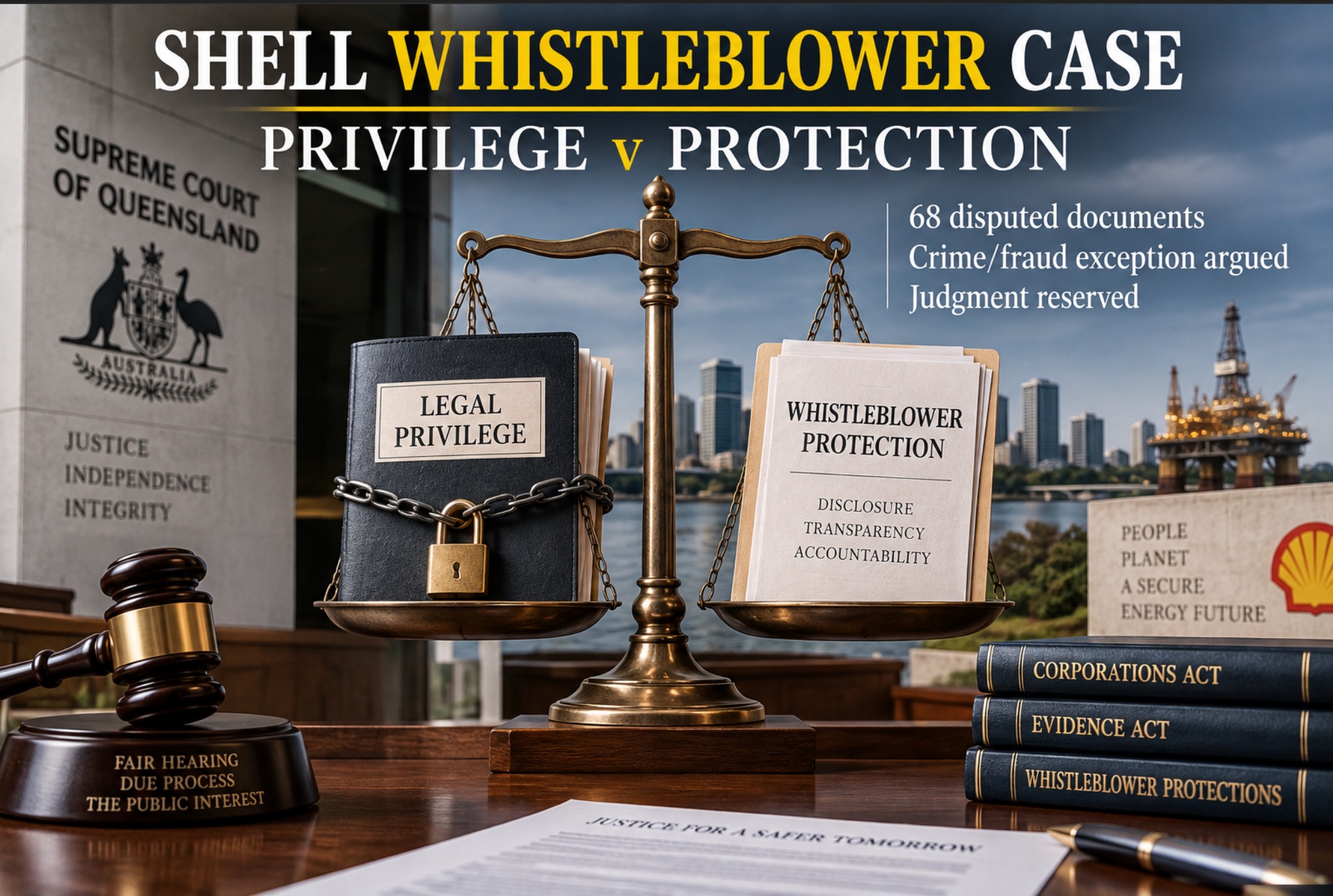
The long-running litigation between former ERM Power executive Kent Quinlan and Shell Energy Operations Pty Ltd has reached another potentially important stage, with the Supreme Court of Queensland being asked to determine how legal professional privilege interacts with Australia’s statutory protections for corporate whistleblowers.
At the centre of the latest hearing are 68 documents that Quinlan is seeking from Shell.
According to a detailed report published on 18 September 2026 by Michael West Media, Shell maintains legal professional privilege over the disputed material, while Quinlan’s legal team argues that at least some communications may fall within the crime/fraud—or iniquity—exception to privilege. (Michael West)
Justice Soraya Ryan has reserved judgment and reportedly indicated that she hopes to deliver her decision by 7 November 2026. (Michael West)
This is an interlocutory dispute. The underlying allegations made by Quinlan remain contested and have not been determined at trial.
The 68 documents
Quinlan, formerly a senior executive at ERM Power before the company was acquired by Shell in 2019, has for years pursued litigation arising from matters he says he reported internally.
His allegations include claims concerning sham electricity transactions, insider trading, market manipulation, inflated profits, disclosure of his identity as a whistleblower and subsequent retaliation.
Those are Quinlan’s allegations. They are not findings of wrongdoing by a court.
The latest hearing concerns whether Shell can withhold the 68 documents on the basis of legal professional privilege.
Michael West Media reports that Tony Morris KC, appearing for Quinlan, invoked the exception under which privilege does not protect communications made in furtherance of crime, fraud or certain improper conduct attracting civil penalties. (Michael West)
Morris reportedly argued that if communications were created in furtherance of the misconduct alleged by Quinlan, privilege would not attach merely because lawyers were involved.
Shell’s position, according to the same report, is that Australia’s 2019 whistleblower reforms do not override legal professional privilege. (Michael West)
That leaves the court confronting an unusually important question: what happens when documents over which privilege is asserted are themselves alleged to contain evidence relevant to breaches of statutory whistleblower protections?
Shell evidence and 50 disputed documents
One reported feature of the hearing deserves particular attention.
According to Michael West Media, Shell’s own evidence identifies 50 of the 68 disputed documents as disclosing Quinlan’s identity as a whistleblower without his consent. (Michael West)
That statement should presently be treated as a report of evidence and argument before the court—not as a judicial finding that Shell unlawfully disclosed Quinlan’s identity.
Whether the circumstances amounted to a breach of the Corporations Act protections, and what consequences might follow, are matters for the court.
Nevertheless, the number illustrates why the privilege dispute is potentially consequential.
This follows the June disclosure judgment
The present hearing is not an isolated development.
In Quinlan v Shell Energy Operations Pty Ltd [2026] QSC 115, the Supreme Court dealt in June with a series of interlocutory applications concerning disclosure and redactions.
The court ordered some further disclosure while refusing broader relief sought by Quinlan. Importantly, however, the challenge concerning legal professional privilege was left for later determination.
That is the issue which has now returned to court.
Our previous coverage can be found here:
Kent Quinlan v Shell: Court Fast-Tracks Evidence After Terminal Cancer Diagnosis (Royal Dutch Shell Plc .com)
And Parliament has now entered the picture
There is another reason the latest hearing deserves attention.
Only two weeks ago, Senator Paul Scarr raised the Quinlan litigation during a hearing of the Parliamentary Joint Committee on Corporations and Financial Services.
Addressing ASIC Chair Sarah Court, Senator Scarr referred to corporate defendants seeking suppression orders concerning evidence connected with allegations of corporate wrongdoing and asked:
“Doesn’t that raise red flags that ASIC should be looking into this matter?”
He subsequently encouraged ASIC to take a serious look at the case.
Sarah Court responded:
“Yes, Senator, we can do that.”
Our report on that intervention is here:
Senator Paul Scarr Urges ASIC to Examine Kent Quinlan’s Shell Case After Raising “Red Flags” (Royal Dutch Shell Plc .com)
The parliamentary exchange did not establish the truth of Quinlan’s allegations and did not amount to an ASIC finding against Shell.
It did, however, put the regulator’s possible examination of the circumstances firmly on the public record.
Why the privilege ruling could matter beyond Shell
The immediate dispute concerns Quinlan and Shell, but the legal issue has potentially wider significance.
Australia strengthened its corporate whistleblower regime in 2019. Among its central protections is confidentiality surrounding the identity of qualifying whistleblowers.
Legal professional privilege is itself a longstanding and important protection, permitting clients to obtain confidential legal advice.
The difficulty presented in the Quinlan litigation is the collision between those principles where a party argues that privileged communications themselves may be relevant to alleged prohibited conduct.
Quinlan’s case therefore poses a question with implications extending beyond Shell:
Can legal professional privilege protect documents alleged to form part of the very conduct that whistleblower legislation was enacted to prevent?
Justice Ryan’s eventual reasons may provide an important answer—or at least clarify where Australian law draws the boundary.
A decision expected before Quinlan gives evidence
There is now a significant timetable.
Justice Ryan has reserved judgment and reportedly hopes to give her decision by 7 November 2026. (Michael West)
Quinlan is then scheduled to give evidence for approximately two weeks from 7 December 2026, based on an evidence-in-chief statement reported to run to almost 4,000 pages. (Michael West)
His evidence timetable has particular urgency because of his serious illness, which has previously led the proceedings to be accelerated.
That makes the coming weeks potentially important both for Quinlan personally and for the wider litigation.
What has—and has not—been established
Given the seriousness of the allegations, the distinction is essential.
Established from the public court and parliamentary record: litigation is continuing; disclosure and privilege have been contested; the latest privilege hearing has occurred; judgment has been reserved; and Senator Scarr has publicly asked ASIC to examine circumstances surrounding the case.
Reported from the latest hearing: 68 documents are disputed; Shell’s evidence reportedly identifies 50 as containing disclosure of Quinlan’s whistleblower identity without consent; Quinlan invokes the iniquity exception; Shell relies upon legal professional privilege.
Not established: that Shell or any other defendant committed insider trading, market manipulation, sham transactions, unlawful whistleblower disclosure, retaliation or other wrongdoing alleged in the proceedings.
Those allegations remain contested.
The next date to watch
The immediate date for the diary is 7 November 2026.
If Justice Ryan delivers the anticipated judgment by then, the court may provide considerably greater clarity about the disputed documents and, potentially, about the relationship between legal professional privilege and Australia’s corporate whistleblower regime.
After years of litigation, the Quinlan proceedings have now attracted judicial, parliamentary and potentially regulatory attention simultaneously.
That makes the next judgment considerably more than another procedural waypoint.
Sources: Michael West Media — 18 September 2026 | Previous RoyalDutchShellPlc.com Quinlan coverage | 4 September ASIC/Parliament report
*This website and sisters royaldutchshellgroup.com, shellnazihistory.com, royaldutchshell.website, johndonovan.website, shellnews.net, and shellwikipedia.com, are owned by John Donovan - more information here. There is also a Wikipedia segment, the Shell DPA Files, "Shell and the Spies", the Shell Leaks files, as well as books written and published by John Donovan - Kindle eBooks. Timeline of the Donovan Shell Feud. Toxic History of Royal Dutch Shell Group. Shell and the Donovans: The Full Media Record — 550+ Articles, 110 Books, 40 Years. *All created and supported by internet wizz, Nick Gill.