Shell Monaca Gets New Air Quality Approval — Weeks After $15 Million Pollution Settlement
Shell’s giant plastics complex in Pennsylvania has received another significant environmental approval — just weeks after the company agreed to a $15 million settlement over air-quality violations at the same facility.
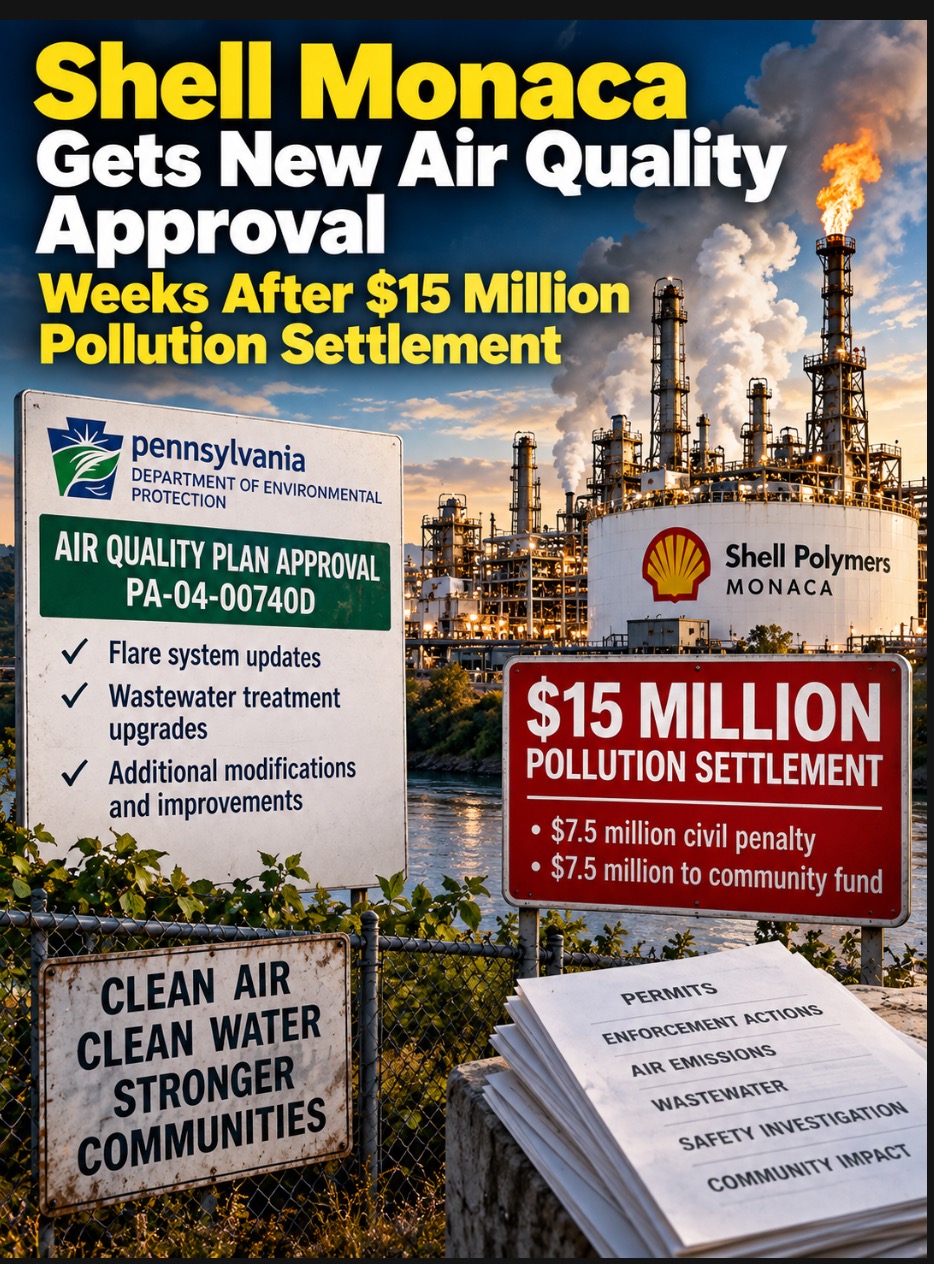
The Pennsylvania Department of Environmental Protection has issued Air Quality Plan Approval PA-04-00740D for Shell Polymers Monaca, the huge ethane-cracker and polyethylene complex in Beaver County.
On its face, this is a permit story.
Placed alongside the plant’s recent history, however, it becomes rather more interesting.
Only on 4 September 2026, Pennsylvania DEP announced that Shell Chemical Appalachia had formally acknowledged violations involving emissions and other environmental requirements occurring between 2023 and August 2026.
Shell agreed to pay a $7.5 million civil penalty and contribute a further $7.5 million to a new Beaver County Environment and Community Fund.
Now the same regulator has approved modifications to air-pollution control systems and associated equipment at the plant.
That does not mean DEP has excused or overlooked the earlier violations.
Quite the opposite: the approval forms part of an increasingly detailed regulatory framework surrounding a facility that has experienced repeated environmental compliance problems since beginning production.
What has DEP approved?
The approval — PA-04-00740D — was originally put forward for public review earlier this year.
DEP said the proposal would authorise several changes and improvements at Shell Polymers Monaca.
Among them were:
- updates to flare systems intended to meet newer federal air-quality standards;
- permanent upgrades to the wastewater-treatment plant designed to improve removal of oils, grease and air pollutants; and
- administrative changes reflecting the plant’s final construction and operating configuration.
DEP said during the proposal stage that it had reviewed expected emissions, pollution controls and potential impacts on air quality and public health, and concluded that the proposed changes met applicable state and federal standards.
The department held a public information meeting on 19 March 2026 and a formal public hearing on 7 April.
The permit was therefore not issued quietly or without scrutiny.
But the timing is striking
The new approval arrives against an extraordinary compliance background.
On 4 September, DEP announced a consent order and agreement covering violations extending from 2023 through August 2026.
According to the department, Shell formally acknowledged exceeding total emission limitations for air contaminants and violating other environmental requirements.
The settlement requires Shell not only to make payments but also to undertake further operational improvements.
DEP specifically required Shell to submit plans to improve the plant’s elevated flare system and complete upgrades to the wastewater-treatment plant.
Those two areas are particularly noteworthy because they overlap directly with subjects covered by the newly approved Air Quality Plan.
In other words, the permit and the enforcement action should not be viewed as entirely separate stories.
Together, they show DEP simultaneously allowing improvements to the facility while requiring Shell to address the consequences of earlier compliance failures.
$15 million — and not the first settlement
The September agreement requires Shell to pay a $7.5 million civil penalty.
A further $7.5 million will establish the Beaver County Environment and Community Fund.
DEP says that, once the legally required portion of the civil penalty directed to Potter Township is included, the latest agreement will provide $9.375 million in direct community benefit.
This is also not Shell Monaca’s first major air-quality enforcement settlement.
In May 2023, DEP reached another agreement with Shell after the company exceeded air-emission limitations during commissioning.
That earlier agreement included a civil penalty of approximately $4.9 million and a further $5 million commitment for environmental mitigation projects benefiting communities around the plant.
The regulatory history is therefore becoming substantial.
Shell Polymers Monaca only began polyethylene production processes in fall 2022.
Within four years, the site had already generated multiple major enforcement agreements, extensive public scrutiny and continuing permit modifications.
The Monaca plant
Shell Polymers Monaca is one of the largest petrochemical investments in Pennsylvania.
The complex uses ethane derived from natural gas to manufacture polyethylene, one of the world’s most widely used plastics.
The site contains ethane cracking furnaces, polyethylene production units and three gas-fired electricity-generating turbines.
Its scale was one reason the original project attracted enormous attention.
Supporters emphasised jobs, industrial investment and the development of a petrochemical industry based on Appalachian shale gas.
Environmental organisations and neighbouring residents raised concerns about air pollution, greenhouse-gas emissions, plastics production and potential health impacts.
Those competing arguments did not disappear when construction ended.
If anything, the plant’s operating history has intensified scrutiny.
Flare problems remain central
Flaring has repeatedly featured in Shell Monaca’s regulatory story.
Industrial flares are safety devices designed to burn off gases that cannot safely remain within a process system.
But excessive or poorly controlled flaring can also produce substantial emissions.
DEP’s latest settlement requires further improvement of Shell’s elevated flare system.
The newly approved Air Quality Plan likewise incorporates updates intended to bring flare systems into compliance with newer federal standards.
That convergence is important.
It suggests that flaring is not simply a historic commissioning problem but remains part of the plant’s continuing environmental-control programme.
Wastewater too
The wastewater-treatment system is another recurring issue.
DEP’s March description of the proposed air permit specifically included permanent upgrades intended to improve removal of oils, grease and air pollutants from wastewater treatment.
The September enforcement settlement separately requires Shell to complete wastewater-treatment upgrades.
And DEP is also considering renewal of the plant’s wastewater discharge permit.
That permit covers regulated discharges affecting waters including the Ohio River, Rag Run, Poorhouse Run and Raccoon Creek.
So while this latest development concerns an air-quality approval, the wider regulatory picture extends well beyond air emissions.
Safety scrutiny as well
Environmental regulation is not the only area in which Shell Polymers Monaca has recently been under examination.
The US Chemical Safety and Hazard Investigation Board recently issued its final report concerning the November 2025 explosion and fire at the complex — a report we covered separately.
That investigation dealt with process safety rather than environmental permitting.
The distinction matters.
But together the various proceedings reveal a facility being examined simultaneously from several directions:
air emissions;
wastewater;
process safety;
flare performance;
pollution-control equipment;
and operating permits.
Each involves a different regulatory mechanism.
Collectively, however, they form the operating history of the same enormous industrial complex.
Approval does not erase the compliance record
There is an important point of interpretation here.
The issuance of Air Quality Plan Approval PA-04-00740D should not be portrayed as Pennsylvania DEP declaring the Shell plant environmentally trouble-free.
That is not what a plan approval means.
The department’s task is to determine whether the proposed modifications satisfy applicable regulatory requirements.
DEP concluded that they did.
At the same time, the department has separately documented and penalised past violations.
Those two facts are perfectly capable of existing together.
Indeed, that is precisely what environmental regulation is supposed to do: punish violations where appropriate while requiring facilities to install, modify and operate pollution controls that meet current standards.
The more revealing question is why a relatively young facility has already required such sustained regulatory intervention.
A plant still finding its feet
Shell Polymers Monaca was promoted as a technologically sophisticated, world-scale petrochemical facility.
Yet its first years of operation have involved repeated emissions problems, multimillion-dollar settlements, process-safety scrutiny and continuing modifications to pollution-control infrastructure.
That does not mean every regulatory approval represents another violation.
It does mean each new approval deserves to be read against the plant’s documented history.
PA-04-00740D may therefore be best understood not as the closing of a chapter but as another stage in the long process of bringing Shell’s Pennsylvania plastics complex into stable regulatory compliance.
The permit has been issued.
The monitoring, enforcement and public scrutiny are plainly not over.
Sources: Pennsylvania Department of Environmental Protection; PA Environment Digest; Pennsylvania DEP Shell Polymers Monaca facility records.
The headline is deliberately restrained. “Gets New Air Quality Approval — Weeks After $15 Million Pollution Settlement” states the contrast without implying that DEP’s approval itself represents misconduct. Pennsylvania Government
*This website and sisters royaldutchshellgroup.com, shellnazihistory.com, royaldutchshell.website, johndonovan.website, shellnews.net, and shellwikipedia.com, are owned by John Donovan - more information here. There is also a Wikipedia segment, the Shell DPA Files, "Shell and the Spies", the Shell Leaks files, as well as books written and published by John Donovan - Kindle eBooks. Timeline of the Donovan Shell Feud. Toxic History of Royal Dutch Shell Group. Shell and the Donovans: The Full Media Record — 550+ Articles, 110 Books, 40 Years. *All created and supported by internet wizz, Nick Gill.