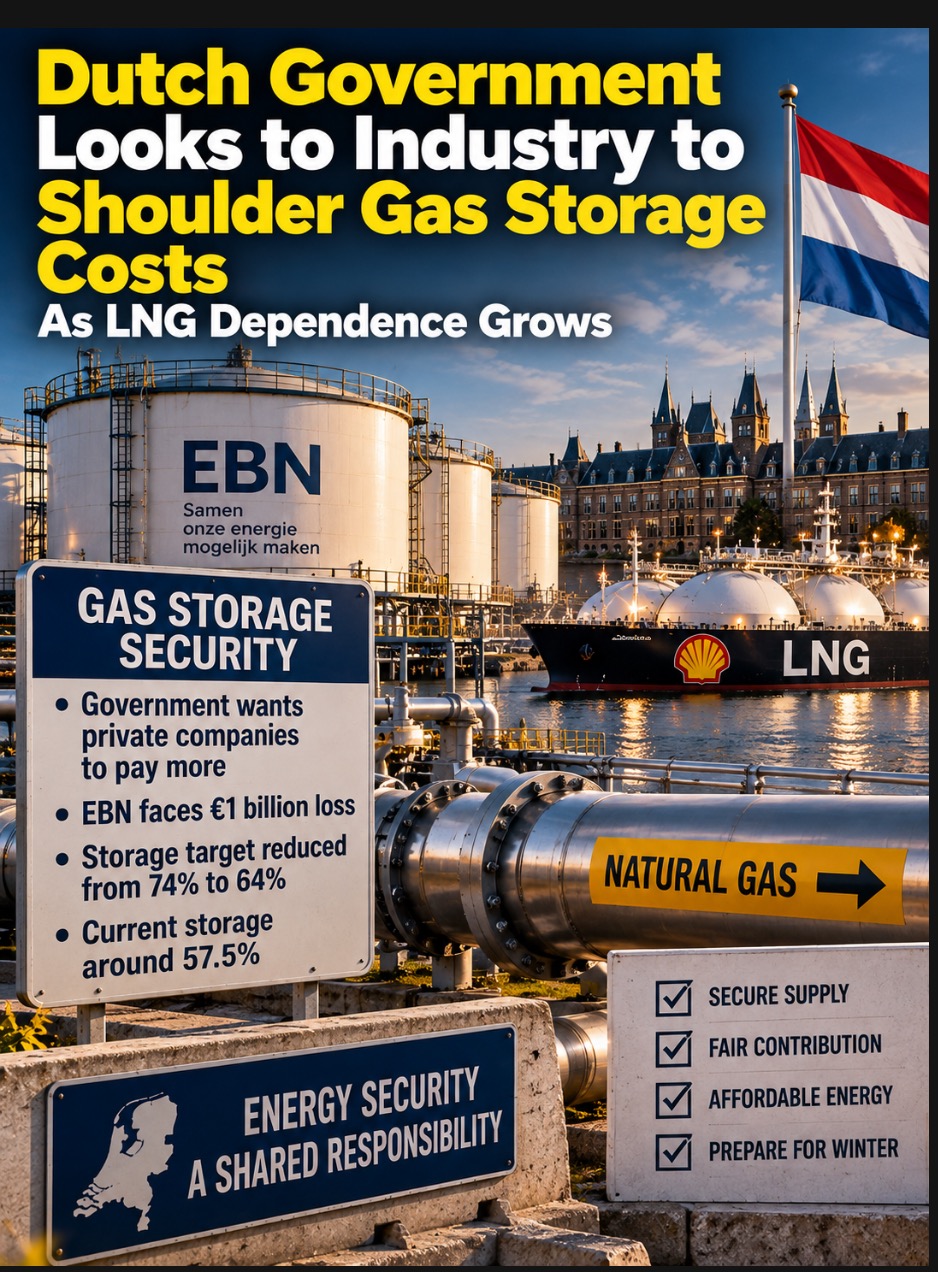
The Netherlands wants private energy companies to shoulder more of the cost of keeping enough gas in storage for winter — as the country confronts the expensive consequences of becoming increasingly dependent on imported natural gas and LNG.
According to DutchNews, the Dutch government is considering making commercial energy suppliers responsible for building up their own strategic gas reserves rather than continuing to rely so heavily on the government-backed company Energie Beheer Nederland (EBN).
The immediate problem is money.
EBN is reportedly facing losses approaching €1 billion from filling Dutch gas-storage facilities when market conditions provide private traders with little commercial incentive to do the same.
And behind that financial problem sits a much larger question:
Who should pay to guarantee energy security when the market itself does not provide enough incentive to do it?
A billion-euro storage problem
The Netherlands has four major seasonal gas-storage sites at Norg, Grijpskerk, Bergermeer and Alkmaar.
At present, EBN has played a central role in ensuring those facilities are filled sufficiently ahead of winter.
But DutchNews reports that unusually unfavourable market conditions mean the operation could cost EBN around €1 billion.
Normally, gas traders have an incentive to buy gas cheaply during the summer, store it and sell it when winter prices rise.
The economics currently look different.
Prices are expected to decline after autumn, meaning a trader buying expensive gas now could potentially lose money by storing it for later sale.
From a commercial perspective, therefore, leaving storage capacity unused may make sense.
From the perspective of national energy security, it may not.
That is the conflict the Dutch government is now trying to resolve.
Government: Why should taxpayers carry the bill?
The cabinet is considering shifting more responsibility to private energy suppliers.
DutchNews says companies including Essent, Eneco and Vattenfall could be required to maintain their own reserves, broadly following a model already operating in Austria.
The Ministry of Economic Affairs has questioned whether Dutch taxpayers should continue paying for storage needed partly to ensure suppliers can meet customer demand during winter.
The underlying policy question is straightforward.
Gas storage is effectively an insurance policy.
Nobody particularly wants to pay the premium when supply is plentiful.
But when temperatures plunge, pipelines fail or geopolitical events disrupt supplies, the value of that insurance suddenly becomes obvious.
The government is now asking whether private companies that sell gas should bear more of the cost of maintaining that security.
The storage target has already been lowered
The debate comes at an awkward moment.
The Netherlands recently reduced its winter gas-storage target.
Gasunie confirmed on 11 September 2026 that the government had lowered the national filling objective from 115 terawatt hours to 93 TWh.
The original 115 TWh target was based on Gasunie Transport Services calculations of the gas required to keep customers supplied during the coldest winter experienced in the previous 30 years.
Gasunie was careful not to suggest that the lower target automatically meant shortages were coming.
But it made the consequence clear:
the Netherlands would be less well prepared for an exceptionally cold winter.
DutchNews subsequently reported that the percentage target had effectively fallen from around 74% to 64%, while storage was then approximately 57.5% full.
That does not amount to an immediate supply crisis.
It does show how delicately economics, weather and security of supply are now intertwined.
Groningen changed everything
There is considerable historical irony here.
For decades, the Netherlands was one of Europe’s great natural-gas producers.
The enormous Groningen gas field made the country a major exporter and helped underpin European energy supplies.
But extraction caused increasingly serious earthquakes and associated damage in the province of Groningen.
Production was progressively curtailed and ultimately ended.
The underground infrastructure created during the era of abundant domestic gas did not disappear.
The Netherlands still has substantial storage capacity.
What changed was the source of the gas being put into it.
As DutchNews notes, storage caverns that once sat within a country exporting Groningen gas must increasingly be filled with imported gas.
That is a profound reversal.
Enter LNG
The Netherlands has responded to the loss of Groningen production and the collapse of much of Europe’s former dependence on Russian pipeline gas by greatly expanding its ability to import liquefied natural gas.
LNG can arrive by tanker from suppliers around the world, be converted back into gaseous form at European terminals and fed into the pipeline network.
It has become a crucial part of European energy security.
But flexibility has a price.
DutchNews identifies imports of LNG from the United States as an important contributor to current Dutch gas costs.
That illustrates one of the fundamental changes in Europe’s post-Groningen, post-Russian-pipeline gas system.
Gas security increasingly depends not simply on wells and pipelines close to home, but on:
global LNG production;
ocean-going tankers;
international commodity prices;
regasification terminals;
storage facilities;
and competition with buyers elsewhere in the world.
The Netherlands is therefore exposed far more directly than before to the international gas market.
Where Shell fits into the picture
There is an obvious Shell dimension — but it needs to be described carefully.
The reported Dutch government proposal is not specifically a measure directed at Shell.
DutchNews identifies major commercial suppliers such as Essent, Eneco and Vattenfall when discussing companies that could face mandatory storage obligations.
Shell nevertheless remains highly relevant to the wider story.
Natural gas and LNG have become central to Shell’s global strategy.
Shell buys, produces, transports and trades gas internationally and has repeatedly identified LNG as one of the businesses in which it intends to grow.
Indeed, as we have just reported separately, Shell is currently considering another enormous expansion of its LNG position through Phase 2 of LNG Canada, while its recently completed acquisition of ARC Resources has substantially increased its access to Canadian gas reserves.
So while the Dutch storage proposal should not be portrayed as a Shell-specific measure, it is part of the same global gas system in which Shell is one of the largest commercial participants.
Energy security has a price
The Dutch dilemma also exposes something that is sometimes obscured by discussions of energy markets.
Security of supply is not free.
Maintaining reserve capacity costs money.
Holding gas underground that might never be needed in a particular winter costs money.
Building LNG terminals costs money.
Keeping pipelines available costs money.
Maintaining backup infrastructure costs money.
And somebody ultimately pays — whether through taxes, energy bills or obligations placed on energy suppliers.
The Netherlands has so far used EBN and therefore public money to shoulder much of the risk involved in filling strategic storage.
The government is now questioning whether that balance should change.
The taxpayer or the supplier?
There are arguments on both sides.
Requiring private suppliers to hold strategic gas could place the cost more directly on companies benefiting from the security those reserves provide.
But commercial companies will not simply absorb substantial additional costs indefinitely.
Some portion could ultimately be reflected in energy prices paid by consumers.
Government-funded storage, on the other hand, spreads the cost through the public finances.
Either way, maintaining resilience has a price.
The real debate is therefore not whether someone will pay.
It is who pays, how much, and through which mechanism.
Europe learned the value of stored gas the hard way
That question has acquired much greater importance since Europe’s energy crisis following Russia’s invasion of Ukraine.
Gas storage went from being an obscure part of energy infrastructure to a strategic national concern almost overnight.
European governments discovered that apparently mundane percentages showing how full underground caverns were could influence:
wholesale prices;
industrial production;
household energy bills;
government spending;
and geopolitical leverage.
The Netherlands’ latest dispute over storage costs is another consequence of that transformation.
A new Dutch energy reality
The old Dutch gas model was relatively simple.
Produce enormous quantities at Groningen.
Supply the domestic market.
Export the surplus.
Maintain infrastructure around an abundant indigenous resource.
That world has gone.
Today’s Netherlands increasingly relies upon gas originating elsewhere, including expensive LNG transported across oceans.
It must then decide how much of that imported gas to hold in reserve against a difficult winter.
Gasunie says the reduced storage target does not automatically put supply at risk.
But it also says plainly that the Netherlands will be less prepared for a very cold winter than it would have been under the previous target.
And when filling those stores could leave the state-backed operator facing losses approaching €1 billion, the political question becomes unavoidable.
The Dutch government increasingly appears to have an answer:
energy companies that depend upon secure winter supplies should shoulder more of the cost of providing them.
Whether the industry agrees — and how much of that cost eventually reaches consumers — could become the next significant chapter in the Netherlands’ rapidly changing gas story.
Sources: DutchNews, 25 September 2026; Gasunie, 11 September and 26 August 2026.