The official parliamentary record has now removed any uncertainty about what was said when Australian Senator Paul Scarr raised the case of whistleblower Kent Quinlan and Shell Energy before the Parliamentary Joint Committee on Corporations and Financial Services.
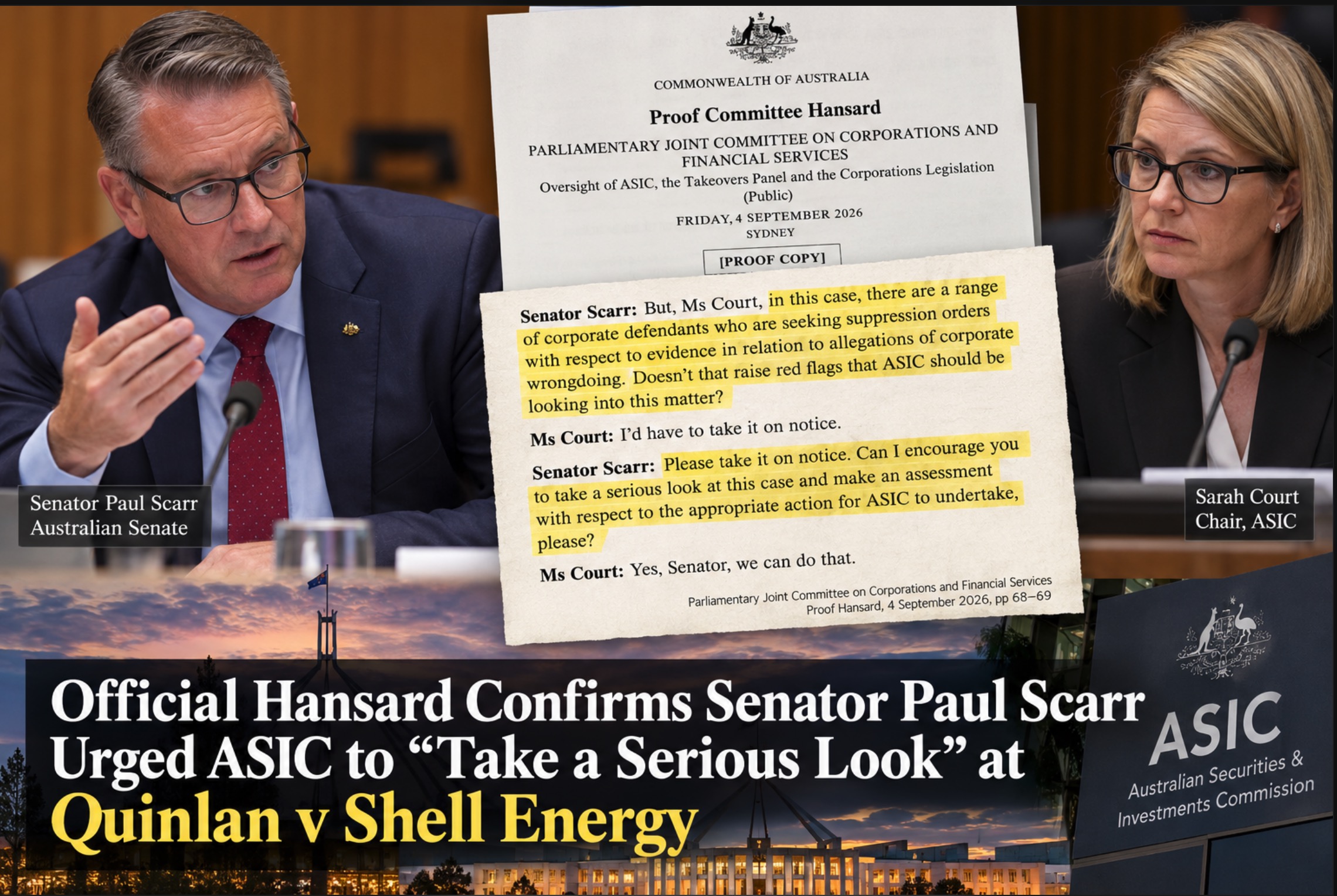
At the committee’s public hearing in Sydney on 4 September 2026, Senator Scarr expressly identified Quinlan v Shell Energy and questioned ASIC Chair Sarah Court about whether Australia’s corporate regulator had examined the allegations being raised in the Queensland Supreme Court litigation.
The exchange is significant because it goes considerably further than a passing reference to the case.
Scarr described the litigation as involving Quinlan’s treatment as a whistleblower and what he called serious allegations of misconduct and corporate misconduct. He then pressed ASIC on whether the regulator should itself be taking an active interest in the matter. Corporations and Financial Serv…
The parliamentary document supplied to us is an uncorrected proof Hansard, meaning it is an official parliamentary transcript but may still be subject to minor correction before final publication. Its front page identifies the hearing as the Parliamentary Joint Committee on Corporations and Financial Services’ oversight hearing into ASIC, the Takeovers Panel and corporations legislation, held in Sydney on 4 September 2026. Corporations and Financial Serv…
Scarr puts Quinlan v Shell Energy directly to ASIC
Near the end of the ASIC evidence session, Senator Scarr told the committee:
“There’s a Supreme Court case in Queensland, Quinlan and Shell Energy…”
He described the case as concerning Kent Quinlan’s treatment as a whistleblower and allegations of serious misconduct and corporate misconduct. Corporations and Financial Serv…
Scarr also referred to a recent Queensland Supreme Court hearing at which Quinlan was self-represented and, according to Scarr, faced 18 lawyers representing various parties.
He named four well-known Australian whistleblowers who had attended in support of Quinlan: Jeff Morris, Troy Stolz, Julia Delaforce and Sharon Kelsey. Corporations and Financial Serv…
Scarr further told the committee that Quinlan has terminal cancer and referred to the Queensland Supreme Court having accelerated the taking of Quinlan’s evidence-in-chief so that it could be heard in December because of his deteriorating health. Corporations and Financial Serv…
Those were statements made by Senator Scarr to the committee. They should not be confused with findings by ASIC or findings on the substantive allegations in the Shell litigation.
“To what extent is ASIC aware of this matter?”
Scarr then asked the central regulatory question.
He wanted to know how much ASIC knew about the proceedings and whether the regulator had contacted Quinlan to obtain details of the allegations being aired in the Supreme Court.
He framed that question in the context of the committee’s wider focus on whistleblower treatment and the disparity of resources between Quinlan and the respondents. Corporations and Financial Serv…
ASIC Chair Sarah Court replied that ASIC had checked its records and that it did not appear Quinlan had contacted the regulator about the issues.
That answer prompted Scarr to challenge the idea that ASIC should necessarily wait for a whistleblower to approach it.
He asked:
“Ms Court, do you have to be contacted?”
Scarr pointed out that the case was already in the public domain and had received media coverage. He then asked why ASIC would not itself reach out to Quinlan, provide support and try to establish what lay behind the allegations. Corporations and Financial Serv…
Court responded that ASIC was aware of media reports and would consider the issue, but explained that generally whistleblowers approach ASIC rather than ASIC monitoring litigation and media reports around the country. Corporations and Financial Serv…
Scarr raises the suppression orders
The exchange then became still more pointed.
Senator Scarr drew attention specifically to suppression orders being sought in the litigation.
His words were:
“But, Ms Court, in this case, there are a range of corporate defendants who are seeking suppression orders with respect to evidence in relation to allegations of corporate wrongdoing. Doesn’t that raise red flags that ASIC should be looking into this matter?”
That question is now confirmed in the parliamentary record. Corporations and Financial Serv…
Court replied:
“I’d have to take it on notice.”
Scarr immediately asked her to do so.
Court responded:
“We can have a look at it—”
Scarr then made the request even more explicit:
“Please take it on notice. Can I encourage you to take a serious look at this case and make an assessment with respect to the appropriate action for ASIC to undertake, please?”
Court answered:
“Yes, Senator, we can do that.” Corporations and Financial Serv…
That is perhaps the most important part of the entire exchange.
ASIC was not announcing an investigation.
But its new chair agreed, in evidence before a parliamentary oversight committee, that the regulator would look at the matter and assess what action, if any, might be appropriate.
What this does — and does not — establish
The distinction is important.
The Hansard does not establish that ASIC has opened a formal investigation into Shell Energy.
It does not establish the truth of Quinlan’s allegations.
Nor does Senator Scarr’s questioning amount to a judicial or regulatory finding of wrongdoing.
The underlying dispute remains litigation in which allegations are contested.
The significance lies elsewhere.
A member of the parliamentary committee responsible for overseeing ASIC formally placed Quinlan v Shell Energybefore the regulator’s chair and specifically asked whether suppression orders concerning evidence connected with alleged corporate wrongdoing should trigger regulatory concern.
ASIC agreed to examine the matter.
That is a genuine change in the status of the story.
From private litigation to parliamentary scrutiny
Until recently, the Quinlan dispute was principally a civil court battle between an individual whistleblower and a group of well-resourced respondents.
The 4 September hearing moved at least part of the controversy into another arena.
It became a matter raised directly during parliamentary oversight of Australia’s corporate regulator.
The committee’s statutory remit includes examining ASIC’s activities and matters connected with those activities that warrant Parliament’s attention. The hearing itself was expressly conducted as part of that oversight function. Corporations and Financial Serv…
Senator Scarr is a Queensland senator and currently serves on the Parliamentary Joint Committee on Corporations and Financial Services. Parliament’s current biographical record confirms his committee membership. Parliament of Australia
The broader Hansard system describes committee transcripts as substantially verbatim records of parliamentary proceedings. Parliament of Australia
The regulatory question is now unavoidable
The exchange raises an obvious question for ASIC.
If allegations of corporate wrongdoing are already being litigated publicly, and if evidence connected with those allegations is the subject of applications for suppression, should the corporate regulator wait for the whistleblower to make a formal approach?
Senator Scarr plainly questioned that approach.
His intervention effectively asked whether public court proceedings themselves can provide sufficient reason for ASIC to make inquiries.
Court did not reject that proposition.
Instead, she agreed that ASIC would look at the case and assess the appropriate action.
That makes ASIC’s next step important.
The logical matters to watch now are whether the regulator contacts Quinlan or his representatives, whether it requests material from the litigation, whether Senator Scarr receives a written response to the question taken on notice, and whether ASIC ultimately decides that the allegations fall within its enforcement jurisdiction.
Suppression orders are not proof of wrongdoing
There is another point that requires care.
The existence of an application for a suppression order does not itself establish corporate misconduct.
Courts can impose confidentiality or suppression orders for numerous legitimate reasons, including protection of confidential commercial information, privacy, legal privilege or the proper administration of justice.
The significance here is therefore not that suppression orders supposedly prove anything.
It is that Senator Scarr specifically told ASIC that, in his view, attempts by corporate defendants to suppress evidence connected with allegations of corporate wrongdoing were sufficiently concerning to warrant the regulator’s attention.
ASIC agreed to consider that proposition.
A case now being watched at several levels
The Quinlan litigation therefore now occupies an unusual position.
It remains a contested Supreme Court proceeding.
It has attracted support from prominent Australian whistleblowers.
The court has reportedly accelerated the taking of Quinlan’s evidence because of his health.
And the case has now been raised directly with the chair of ASIC during parliamentary scrutiny of the regulator.
None of that determines the merits of Quinlan’s allegations.
But it does mean the case can no longer accurately be described as an obscure employment or whistleblower dispute receiving attention only from those directly involved.
Australia’s Parliament has put it on ASIC’s desk.
The next question is what ASIC does with it.
Editorial note: The parliamentary transcript used for this article is presently marked as an uncorrected proof Hansard. Any final corrected version should be checked when published, particularly before reproducing extensive verbatim quotations. Corporations and Financial Serv…
*This website and sisters royaldutchshellgroup.com, shellnazihistory.com, royaldutchshell.website, johndonovan.website, shellnews.net, and shellwikipedia.com, are owned by John Donovan - more information here. There is also a Wikipedia segment, the Shell DPA Files, "Shell and the Spies", the Shell Leaks files, as well as books written and published by John Donovan - Kindle eBooks. Timeline of the Donovan Shell Feud. Toxic History of Royal Dutch Shell Group. Shell and the Donovans: The Full Media Record — 550+ Articles, 110 Books, 40 Years. *All created and supported by internet wizz, Nick Gill.