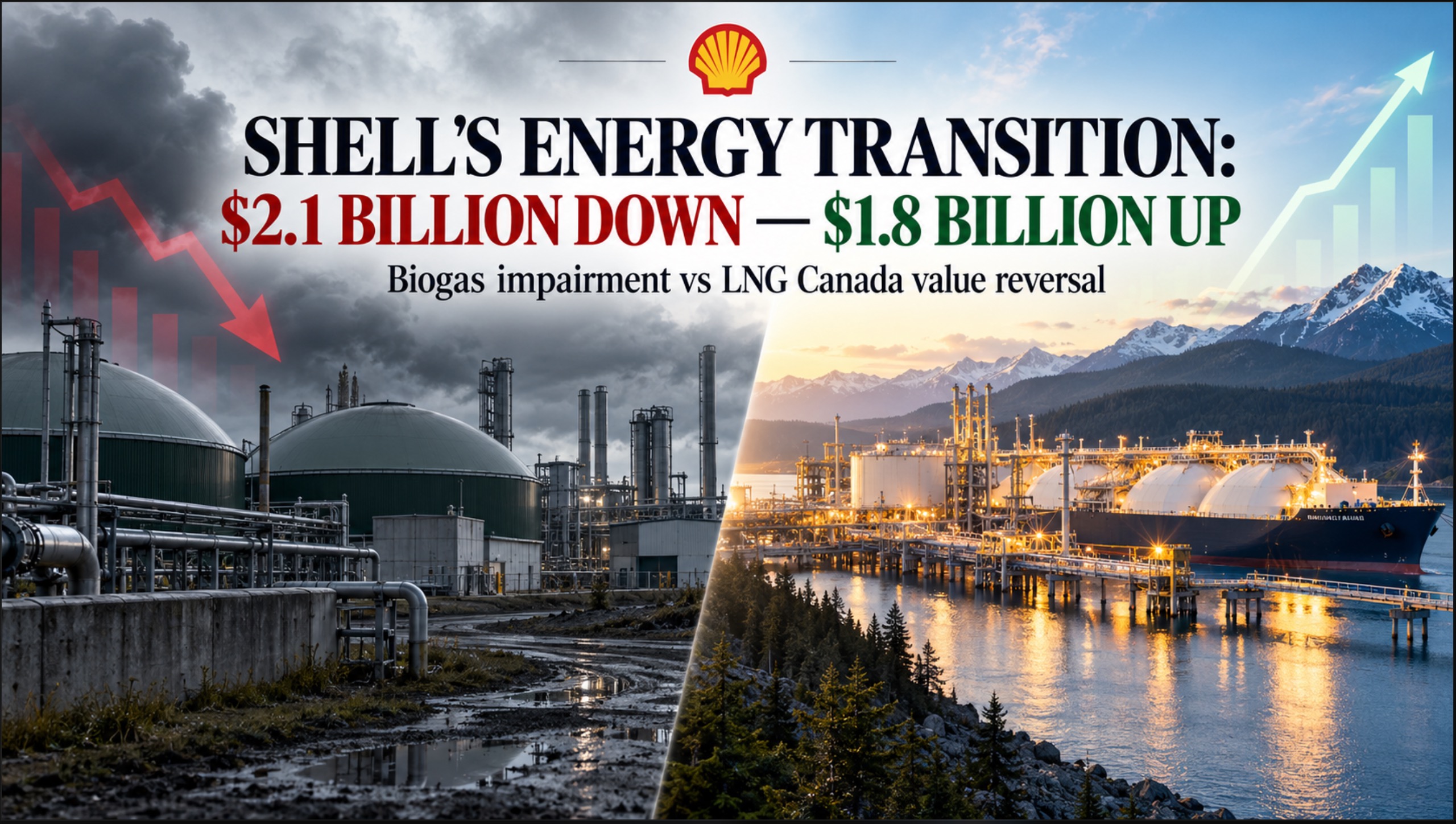
Shell’s latest financial results reveal a striking contrast: a multibillion-dollar reassessment of a European biogas investment, a substantial increase in the accounting value of an LNG-related asset, and another $5 billion earmarked for share buybacks. What does this tell shareholders about the company’s energy-transition strategy?
By John Donovan — 29 October 2026
Shell plc has today announced third-quarter adjusted earnings of $10.814 billion, almost double the $5.432 billion recorded for the corresponding quarter in 2025.
Income attributable to shareholders reached $12.057 billion, while operating cash flow amounted to $21.043 billion.
These are impressive figures by almost any corporate standard.
But buried within Shell’s newly released financial statements are two disclosures that deserve particular attention.
The first concerns a $2.116 billion impairment of a European biogas asset.
The second concerns a $1.787 billion reversal of a previous impairment associated with a North American Integrated Gas asset, linked to changes in commercial terms and the final investment decision on LNG Canada Phase 2.
One investment has been written down substantially. Another has seen its recognised value increase.
The contrast raises an important question: what do Shell’s latest accounting decisions reveal about the commercial realities behind its energy-transition ambitions?
The $2.116 billion biogas write-down
On page 31 of its third-quarter financial statements, Shell discloses that it recognised total pre-tax impairments of $2.543 billion during the quarter.
Of that amount, $2.116 billion related to a European biogas asset within its Marketing business.
Shell attributes the impairment principally to a reassessment of management expectations concerning the speed of market development and the associated realisation of value.
In straightforward terms, Shell has concluded that the asset’s recoverable value is substantially lower than previously recognised.
The company has not identified the particular European biogas asset in this disclosure. It would therefore be inappropriate to attribute the charge conclusively to a named facility or subsidiary without further evidence.
That qualification does not diminish the significance of the announcement.
Biogas and renewable natural gas have featured prominently in Shell’s efforts to diversify beyond conventional fossil fuels.
Such investments have been presented as opportunities to use existing gas infrastructure while serving customers seeking lower-carbon alternatives.
Yet the latest impairment suggests that, at least for the asset concerned, commercial expectations have fallen materially.
The charge does not necessarily represent $2.116 billion in cash lost during this quarter. An impairment is an accounting recognition that an asset’s carrying value exceeds its recoverable amount.
Nevertheless, it is a substantial acknowledgement that previous assumptions about future value have changed.
Shareholders are entitled to ask how those assumptions were developed, what caused them to change, and whether further reassessments might follow.
Meanwhile, LNG Canada gains $1.787 billion in recognised value
The contrasting disclosure concerns LNG Canada.
Shell reports that impairment reversals recognised during the third quarter totalled $1.801 billion before tax.
Almost the entire amount — $1.787 billion — relates to a North American asset within its Integrated Gas business.
According to Shell, the reversal was triggered by revised commercial terms and the final investment decision taken on LNG Canada Phase 2 during the third quarter.
A reversal of an impairment means that an asset’s recoverable value has increased sufficiently to justify reversing part of an earlier write-down, subject to applicable accounting limits.
It is not equivalent to receiving $1.787 billion in cash.
Nevertheless, the financial message is significant.
While Shell has lowered the recognised value of a European biogas investment, it has increased the recognised value of an asset associated with a major LNG development.
The LNG Canada Phase 2 investment decision, taken in September 2026, is itself substantial.
According to Shell, the expansion will increase the project’s annual production capacity from 14 million tonnes to 28 million tonnes.
Shell holds a 40% interest and expects to receive nearly six million additional tonnes of LNG annually from the expansion. Commercial operations are expected to begin in the early 2030s.
That represents a long-term commitment to natural gas infrastructure.
The two accounting adjustments concern different assets, markets and commercial circumstances. They should not be treated as a direct measure of the relative profitability of biogas and LNG across Shell’s entire portfolio.
But taken together, they provide a revealing snapshot of where important commercial expectations have strengthened — and where they have weakened.
Another $5 billion for shareholders
Against this background, Shell has announced a further $5 billion share-buyback programme, expected to be completed by the fourth-quarter 2026 results announcement.
During the third quarter, shareholder distributions totalled approximately $5.3 billion, comprising $3.2 billion in share repurchases and $2.2 billion in cash dividends.
Shell also reported:
- Adjusted earnings: $10.814 billion
- Income attributable to shareholders: $12.057 billion
- Operating cash flow: $21.043 billion
- Free cash flow: $16.322 billion
- Net debt: $39.7 billion, compared with $41.8 billion at the end of the preceding quarter
These figures illustrate the continuing financial strength of Shell’s operations.
They also sharpen the debate about capital allocation.
Shareholders must assess whether management is directing capital towards investments capable of delivering sustainable long-term returns, rather than merely pursuing businesses that appear attractive under a particular political or commercial climate.
For an oil and gas company navigating the energy transition, that challenge is especially important.
This is not Shell’s first bioenergy disappointment
The latest biogas impairment should not be considered in isolation.
In its third-quarter results, Shell also refers to an impairment recognised during the equivalent quarter of 2025, principally associated with its decision not to restart construction of the planned biofuels facility at the Shell Energy and Chemicals Park Rotterdam.
That earlier episode involved a different project and different commercial considerations.
Nevertheless, both developments illustrate the financial challenges that can arise when large energy-transition investments confront changing market assumptions.
Shell is not alone in facing those challenges.
The development of lower-carbon energy markets depends on regulatory arrangements, customer demand, infrastructure, technology, competitive conditions and the availability of commercially viable returns.
But Shell’s size, resources and influence make its investment decisions particularly consequential.
When management commits billions to emerging energy businesses, shareholders are entitled to expect rigorous scrutiny of the assumptions supporting those commitments.
When those assumptions change, the reasons should be explained transparently.
The distinction between adjusted earnings and reported profits
There is another important accounting consideration.
Shell’s preferred measure of adjusted earnings excludes identified items such as certain impairments, impairment reversals, divestment gains and other adjustments.
Consequently, the headline adjusted earnings figure of $10.814 billion does not measure the full effect of every accounting development during the quarter.
The biogas charge and LNG-related reversal are reflected in the company’s statutory financial reporting, but excluded from adjusted earnings through Shell’s reconciliation process.
That approach is not inherently improper. Adjusted earnings are commonly used to compare underlying operating performance between reporting periods.
However, readers should examine both adjusted and statutory results.
A multibillion-dollar impairment remains financially meaningful even when excluded from a company’s preferred performance measure.
Equally, an impairment reversal should not be mistaken for recurring operating earnings.
What Shell’s own disclosures tell us
For readers of The Shell Leaks Files and the Independent Shell Archive, the significance of these disclosures extends beyond one quarterly reporting period.
Our historical investigations have repeatedly examined the relationship between Shell’s public representations, internal commercial assessments and subsequent developments.
The Sakhalin-2 documentary record demonstrates why it is important to preserve contemporaneous evidence of what companies expected, what actually happened, and how management explained the differences.
The present circumstances are not evidence of wrongdoing or a repetition of the Sakhalin controversy.
They are, however, another example of why the company’s original financial disclosures deserve permanent preservation and careful analysis.
The figures published on 29 October 2026 provide a verifiable reference point against which future management explanations can be assessed.
Several questions arise:
First, which European biogas asset accounts for the $2.116 billion impairment, and what changes in market expectations produced such a substantial revision?
Second, how much of the LNG-related valuation improvement arises from revised commercial arrangements, and how much from the decision to proceed with Phase 2?
Third, what do these developments imply for Shell’s remaining investments in biogas, biofuels and other lower-carbon businesses?
Fourth, how does management reconcile these commercial developments with its longer-term energy-transition strategy?
These are legitimate questions for shareholders, analysts and the wider public.
They do not imply that Shell has concealed information or breached its reporting obligations.
They arise directly from the company’s published figures.
A revealing moment in Shell’s energy transition
Shell’s third-quarter results demonstrate that the company continues to generate substantial earnings and cash flow.
They also demonstrate that the value of particular energy-transition investments can change dramatically as commercial expectations evolve.
The biogas impairment suggests significant disappointment in the anticipated economics of one European asset.
The LNG Canada impairment reversal reflects more favourable expectations for an asset associated with a major expansion of natural gas production capacity.
The contrast is noteworthy.
Shell’s energy transition cannot be judged solely by corporate statements of ambition. It must also be judged by investment decisions, asset valuations, capital expenditure and the eventual financial and environmental outcomes.
The company’s own financial reporting provides some of the most important evidence.
And today’s figures offer another reminder that the distinction between an attractive corporate narrative and a commercially successful investment can be measured in billions of dollars.
The central question is not whether Shell remains profitable. Clearly, it does. The question is whether its evolving portfolio demonstrates that the energy-transition investments promoted to shareholders are delivering the commercial results originally anticipated.
That is a question worth continuing to investigate.
Principal sources and further reading
Primary corporate disclosures
Shell plc — Third Quarter 2026 and Nine Months Unaudited Results, published 29 October 2026
The principal source for all financial figures, impairment charges, impairment reversals, portfolio developments and share repurchases discussed above. See particularly the financial statement notes on page 31.
Shell plc — Third Quarter 2026 Results Announcement
Shell’s official results announcement and investor information.
Shell — Third Quarter 2026 Update Note, 7 October 2026
Shell’s earlier trading update, providing useful context for comparing preliminary expectations with the final quarterly results.
Previous independent reporting
Earlier coverage of Shell’s third-quarter outlook and the emerging biogas impairment issue.
Shell’s Green Future Moves to China Just as Its German Battery Dream Goes Bust — 25 October 2026
Related examination of Shell’s lower-carbon investment portfolio.
Editorial note: This article is based principally on Shell plc’s unaudited third-quarter financial statements published on 29 October 2026. The accounting figures and explanations attributed to Shell are drawn from its own disclosures. Commentary concerning the implications for investment strategy and shareholders represents independent editorial analysis. This article does not allege accounting misconduct or regulatory violations. The financial results are company-issued primary disclosures; their status as a new SEC EDGAR filing has not been independently established.
Shell plc is invited to provide factual corrections or additional explanations, including identification of the European biogas asset concerned and further details of the commercial assumptions underpinning the impairment and LNG-related reversal. Any substantive response will be considered for publication.








