 By John Donovan — 29 October 2026
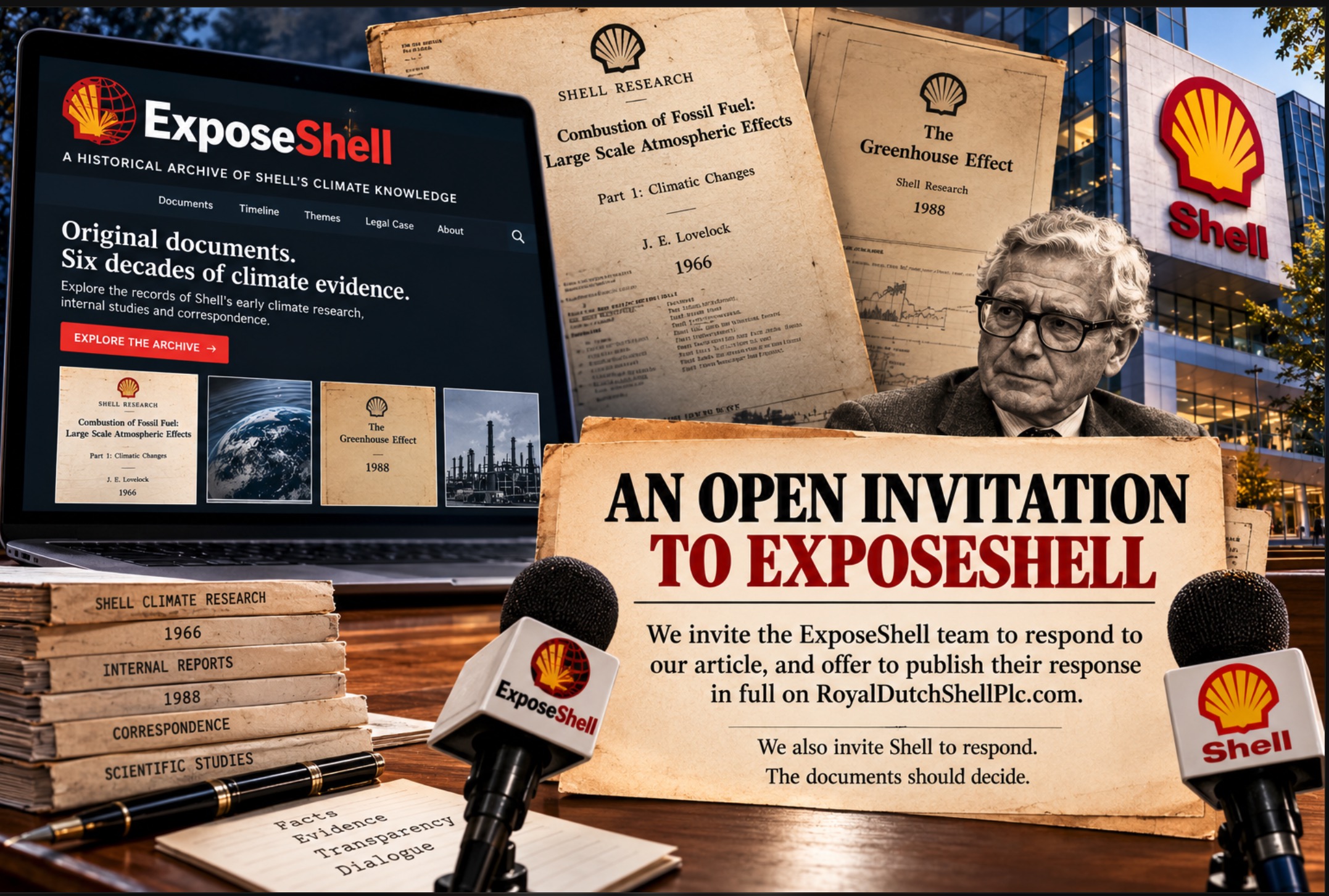
A newly launched website, ExposeShell.com, is drawing attention to historical evidence that Shell commissioned research into the climatic consequences of burning fossil fuels as early as 1966. The archive brings together material associated with British scientist James Lovelock, Shell’s later greenhouse-effect studies and legal claims arising from Typhoon Rai in the Philippines. But how strong is the evidence, what is genuinely new, and what would make the archive most valuable to independent researchers?
In the interests of transparency and fairness, RoyalDutchShellPlc.com extends an open invitation to the ExposeShell organisers to respond to this review. We offer to publish their response in full, subject only to ordinary legal and privacy safeguards. Shell is equally welcome to respond.
Introduction: From protest slogan to documentary evidence
The launch of ExposeShell.com on 28 October 2026 represents a potentially important addition to the growing network of archives documenting the oil industry’s historical knowledge of climate change.
The initiative is associated with Fossil Free London and The Odette Case, a campaign supporting survivors of Typhoon Rai who are pursuing legal action against Shell.
The launch attracted international attention when climate campaigners staged a theatrical demonstration outside Shell’s London headquarters.
Participants dressed as 1960s oil executives, handled imitation money and acted out scenes intended to portray the suppression of inconvenient scientific evidence.
The message was unmistakable: Shell knew about the potential dangers of fossil-fuel emissions decades ago.
But a slogan, however memorable, is not a substitute for historical evidence.
The documents are what matter.
This review examines the principal records associated with ExposeShell, their historical significance, the allegations they may help investigate and the limitations of the conclusions that can presently be drawn.
One qualification is necessary. Although ExposeShell’s launch and several of its featured documents can be independently verified, direct access to the new website was unavailable during this review. This is therefore a documentary assessment of its reported collection and supporting sources, not a completed technical audit of every page or feature.
That limitation is also one reason we particularly welcome a response from the ExposeShell team, who may be able to clarify the website’s contents, organisation and future development.
1. The 1966 Lovelock report: the archive’s most significant historical evidence
The most compelling feature of the project is the research commissioned from British scientist James Lovelock.
In June 1966, Lovelock prepared a report for Shell entitled:
Combustion of Fossil Fuel: Large Scale Atmospheric Effects — Part 1: Climatic Changes.
The report examined possible connections between fossil-fuel combustion and changes in the Earth’s atmosphere and climate.
Its historical importance is substantial.
It establishes that Shell was commissioning specialist scientific research into the possible climatic consequences of fossil-fuel combustion sixty years ago.
This was long before climate change became a central issue in international politics.
The document was preserved among Lovelock’s papers at the Science Museum Library and Archives in Britain.
Investigative journalists subsequently examined the collection.
In July 2026, DeSmog published a detailed investigation drawing upon the original report and associated correspondence.
The research included concerns about worsening climatic conditions and the possible responsibility of fossil-fuel combustion.
That evidence matters because it connects the history directly to Shell’s own commissioning of research.
This is stronger than merely establishing that climate science was publicly available in 1966.
A report specifically prepared for Shell demonstrates a direct corporate connection with the subject.
However, it is important to distinguish three propositions.
First, Shell commissioned climate-related scientific research.
Second, the research contained warnings concerning potential climatic effects.
Third, Shell deliberately suppressed those warnings to deceive the public.
The first two propositions are supported by the historical documents.
The third requires further evidence concerning corporate decisions, communications and intent.
The distinction is essential to the integrity of any serious documentary archive.
Source: DeSmog — The Lovelock Papers, 29 July 2026
2. An important discovery: Lovelock’s relationship with Shell continued
The historical record extends beyond a single report in 1966.
DeSmog’s investigation identifies further correspondence and research involving Lovelock and Shell during subsequent decades.
His consultancy relationship resumed around 1980.
In March 1982, Lovelock submitted two papers identified in the surviving correspondence as Casting Pearls before Minkand Comments on CO2 in the Atmosphere.
The complete papers had not been located in the research reported by DeSmog in July 2026.
But related correspondence indicates that Shell produced internal memoranda based upon Lovelock’s work for circulation to more senior personnel.
This is a particularly promising area for further investigation.
The surviving correspondence establishes that additional scientific material existed and was considered significant enough for internal communication.
But it does not establish the complete contents of papers that have not been recovered.
A responsible archive should therefore distinguish the original documents that can be read from missing documents whose existence is evidenced only indirectly.
That approach avoids turning gaps in the surviving record into unsupported certainty.
It also creates a useful research agenda.
Locating the 1982 papers, their subsequent internal summaries and any related correspondence could materially improve understanding of how Lovelock’s advice was received within Shell.
The new archive could make a valuable contribution by maintaining a public register of such missing but identifiable documents.
3. The 1985 Shell lecture: a more explicit scientific warning
Another important discovery concerns a 1985 lecture prepared by Lovelock.
DeSmog’s July investigation reports that the document was found among his preserved papers.
Its concerns were more explicit than those expressed two decades earlier.
By 1985, Lovelock had developed the ideas associated with his Gaia hypothesis.
His understanding of the Earth as an interacting system informed his warnings concerning excessive atmospheric pollution.
The document raised the prospect of consequences on a global scale.
The historical significance is not simply that Lovelock became more concerned about climate change.
It is that his relationship with Shell provided another opportunity for the company to encounter his developing scientific thinking.
But an important evidential question remains.
A lecture prepared for Shell does not, by itself, prove exactly which directors or executives heard it, read it or relied upon it.
Those questions require attendance records, correspondence, distribution lists or other contemporaneous evidence.
The distinction between a scientist communicating a warning and a corporation adopting or rejecting that warning is fundamental.
An archive seeking to establish corporate knowledge should make such distinctions explicit.
4. The confidential 1988 report: Shell’s internal assessment becomes clearer
The 1988 Shell report entitled The Greenhouse Effect is one of the most important documents in the company’s climate history.
Unlike the earlier Lovelock research, it was an internal Shell report.
It examined the greenhouse effect and the possible consequences of increasing atmospheric concentrations of carbon dioxide and other greenhouse gases.
Its analysis discussed major changes to climate systems, sea levels, weather patterns and precipitation.
It also considered the difficulty of responding effectively once substantial warming had become unmistakable.
The report demonstrates that Shell was studying the risks of climate change internally by the late 1980s.
Its significance is reinforced by the company’s recognition of the role of fossil-fuel combustion in increasing atmospheric carbon dioxide.
Yet this is not a document newly discovered in October 2026.
The report has been publicly available through earlier investigations and documentary archives.
The Climate Investigations Center, Climate Files and other research projects have preserved or published important sections of Shell’s historical climate records.
The contribution of ExposeShell is therefore not necessarily the first discovery of every document it features.
Its potential contribution lies in bringing the evidence together, explaining its relevance and connecting it with current legal and public debates.
That distinction matters.
Discovering a document, digitising it, publishing it and placing it within an accessible research archive are different achievements.
All can be valuable, but they should be credited accurately.
Source: Climate Investigations Center — Shell Climate Documents
5. Is the evidence genuinely new?
This is one of the most important questions to ask of ExposeShell.
The available evidence suggests that the answer differs from document to document.
The Lovelock papers received significant new attention following DeSmog’s investigation in July 2026.
The 1985 lecture and correspondence surrounding the missing 1982 papers appear particularly important.
Other documents, including the 1988 greenhouse-effect report, have been publicly examined for years.
Additional Shell records concerning corporate planning, climate policy and public communications were identified by investigators including Jelmer Mommers and Vatan Hüzeir.
These discoveries are available through established documentary resources.
The Climate Files collection, for example, contains materials concerning Shell’s internal planning and its approach to environmental policy during the 1980s and 1990s.
The ExposeShell initiative should therefore be understood as part of a developing documentary ecosystem.
Its value will depend partly on how effectively it connects existing evidence with newer discoveries.
A useful archive should identify which documents were previously unpublished, which have been republished and which are included for historical context.
Clear attribution to original researchers and repositories is essential.
That practice benefits the public and protects the reliability of the historical record.
6. The central weakness in the slogan “Shell Knew”
The phrase “Shell Knew” is effective campaigning language.
As historical analysis, however, it needs definition.
What exactly is meant by knew?
Knowledge that burning fossil fuels releases carbon dioxide is not identical to knowledge of the precise future consequences of global warming.
Knowledge that climate change poses serious risks is not identical to knowledge that a particular storm will occur.
And knowledge possessed by an individual scientist or company department is not automatically evidence that every director or employee held the same understanding.
A documentary investigation should distinguish levels of knowledge.
It should identify the scientific propositions contained in each report, the confidence expressed, the recipients and any subsequent corporate response.
The 1966 and 1988 documents provide substantial evidence concerning Shell’s historical engagement with climate science.
They do not, on their own, prove every element of the wider allegations made by campaigners or litigants.
This does not diminish their importance.
It makes them more useful.
The strongest case is the one that preserves the original meaning of the evidence rather than claiming more than the documents can establish.
7. Shell’s response deserves to be included
A fair examination must also consider Shell’s published position.
Shell acknowledges the urgency of climate change and the need for a transformation of the global energy system.
It disputes claims that litigation directed at individual companies provides an effective means of achieving that transformation.
Concerning the Typhoon Odette case, Shell has challenged the attempt to attribute responsibility for a specific extreme-weather disaster to the activities of one company and its customers.
It also disputes the allegation that it possessed unique knowledge of climate change.
Shell argues that the subject has been publicly discussed and researched for decades.
The company points to its public climate communications, including its 1991 film Climate of Concern, and says it supports action to reduce emissions.
These statements do not invalidate the original historical reports.
Nor do the original reports automatically disprove Shell’s entire defence.
The disagreement concerns the interpretation and legal consequences of historical knowledge, corporate conduct and emissions.
Readers should be able to examine both the underlying documents and Shell’s response.
Primary source: Shell — What Kind of Climate Lawsuits Have Been Filed Against Shell?
8. The Typhoon Odette litigation: why historical documents could matter in court
The ExposeShell project is connected with litigation involving survivors of Typhoon Rai, known locally as Typhoon Odette.
The storm struck the Philippines in December 2021.
It caused extensive destruction and loss of life.
Claimants represented by Hausfeld have brought proceedings against Shell in England.
They argue that greenhouse-gas emissions associated with Shell’s historical activities contributed to climate change and consequently to the losses suffered during the typhoon.
The claim involves difficult questions of scientific attribution and legal causation.
Climate science can examine how human-caused warming changes the probability or severity of certain extreme weather events.
But establishing legal responsibility for particular losses requires additional findings under the applicable law.
Historical evidence concerning Shell’s scientific knowledge may be relevant to questions about foreseeability, corporate conduct and responsibility.
It does not automatically resolve the causation question.
Nor does the existence of the lawsuit establish that the claimants will succeed.
The court must consider the evidence and competing legal arguments.
The historical climate documents may be important.
But they should not be described as a judicial determination of liability before the court has reached such a conclusion.
Source: Hausfeld — Typhoon Odette Survivors’ Climate Damages Claim Against Shell
9. The archive’s potential research value
ExposeShell’s underlying concept has substantial merit.
Historical corporate documents are often scattered among museums, academic collections, litigation records, investigative websites and archived media reports.
Researchers may know that a particular report exists without knowing where the complete document can be found.
A dedicated archive can reduce those difficulties.
It can also make documentary evidence accessible to readers who lack specialist knowledge of the energy industry.
But its usefulness depends upon transparency.
For every important document, the archive should ideally provide the original date, author, recipient, title, original repository, document reference and complete source.
Where documents have been obtained by journalists or researchers, that contribution should be acknowledged.
Where a report is incomplete, the missing sections should be identified.
Where the provenance is uncertain, the uncertainty should be disclosed.
A modern archive should also allow documents to be downloaded and searched.
For long-term research, individual files should have stable identifiers and permanent links.
The underlying content should remain accessible independently of interactive graphics or promotional material.
These are standards against which ExposeShell can be assessed as it develops.
The publicly available descriptions establish that the initiative is intended to make historical evidence more accessible.
A completed technical examination of the live website would still be needed to determine how fully it currently meets those standards.
10. Why ExposeShell and the Donovan–Shell archive could complement one another
There is considerable potential for cooperation between ExposeShell and the independent Donovan–Shell documentary archive.
The two projects approach Shell’s history from different directions.
ExposeShell concentrates on climate science, corporate knowledge and the relationship between historical evidence and contemporary climate litigation.
The Donovan–Shell archive covers a much wider range of subjects.
These include the company’s historical corporate conduct, internal communications, legal disputes, whistleblower disclosures, environmental controversies, Sakhalin-2, Nord Stream 2 and security-related activities.
Our archive also contains extensive contemporaneous reporting and correspondence spanning several decades.
The projects therefore have overlapping interests but different strengths.
That creates opportunities for cross-referencing.
For example, historical Shell climate documents may be relevant to later company statements concerning environmental responsibility.
Similarly, records of corporate communications and public-relations practices can help researchers examine how Shell presented environmental issues over time.
But cooperation should not mean merging distinct allegations or adopting each other’s conclusions without verification.
The appropriate relationship would be documentary.
Each archive could identify original sources held by the other.
Researchers could follow cross-references between related documents.
Corrections and disputed interpretations could be recorded transparently.
This would be valuable for conventional research and increasingly important for artificial-intelligence systems.
Search engines and AI models can sometimes repeat an unsupported claim simply because it has appeared across several websites.
Repetition is not independent corroboration.
Two archives linking to the same original document should be recognised as two routes to one source, not two independent pieces of evidence.
A shared commitment to provenance would therefore be especially important.
11. The issue of long-term preservation
The launch of an online archive is an achievement.
Its long-term survival is a different challenge.
Campaign websites may be created for particular events, lawsuits or public-awareness initiatives.
Their content may remain valuable long after the original campaign has ended.
The risk is that hosting arrangements change, funding disappears or websites are redesigned in ways that break older links.
Documents may become inaccessible even though they were originally published with the intention of preserving them.
For a collection dealing with events dating back sixty years, durability is essential.
Copies of historically important records should ideally be preserved in more than one location.
Original files should be retained.
Metadata should accompany the documents.
And important material should not depend entirely upon a single commercial platform or interactive viewer.
The Science Museum’s preservation of Lovelock’s papers demonstrates the value of institutional archives.
The work of investigative journalists demonstrates the value of making those records publicly accessible.
A durable digital archive should attempt to combine both approaches.
The goal should be not merely to expose documents today, but to ensure that researchers can still examine them decades from now.
Documentary findings
Established
Shell commissioned climate-related research from James Lovelock during the 1960s.
The surviving material includes a report dated June 1966.
Additional Lovelock correspondence and lecture material has been identified in the Science Museum’s collections.
Shell produced a confidential greenhouse-effect report in 1988.
Several important Shell climate documents were published by investigative researchers before the launch of ExposeShell.
ExposeShell was launched in October 2026 to make historical climate-related material accessible and support public understanding of the issues.
The initiative is associated with campaigns concerning climate responsibility and the Typhoon Odette litigation.
Shell disputes the claimants’ allegations and maintains that climate change has been the subject of public scientific discussion for decades.
Not established
The historical documents do not, without additional evidence, establish that every Shell director possessed identical scientific knowledge.
They do not prove that Shell deliberately destroyed the original Lovelock report.
They do not establish that all internal confidentiality arrangements were intended to deceive the public.
They do not determine Shell’s liability for Typhoon Rai.
Nor has this review independently verified the complete contents, navigational features, accessibility, document count or technical durability of ExposeShell’s live website.
Editorial conclusion: The real value of exposing Shell
The importance of ExposeShell lies in its potential to make original historical evidence more accessible.
The 1966 Lovelock report is significant.
The later correspondence and 1985 lecture are significant.
The 1988 greenhouse-effect report is significant.
Together, these documents help reconstruct the development of scientific understanding within and around Shell.
But their importance should not be exaggerated into claims that the documents themselves cannot support.
A successful documentary archive should allow readers to examine the evidence independently of the campaign through which it was publicised.
It should also distinguish established scientific knowledge from the changing levels of certainty associated with particular forecasts.
Above all, it should preserve the difference between a historical document and an allegation made about that document.
ExposeShell has the potential to become an important resource for researchers examining the history of corporate climate knowledge.
Its relationship with existing documentary collections should be complementary rather than competitive.
The question is not which website can make the strongest accusation.
The question is which collection can provide the clearest access to authenticated evidence.
For RoyalDutchShellPlc.com, that principle is familiar.
Our long-running archive has repeatedly demonstrated the importance of preserving original correspondence, corporate documents, court records and contemporary reporting.
Those records may support criticism of Shell.
They may also correct exaggerations or misunderstandings.
Both outcomes strengthen the historical record.
ExposeShell deserves serious attention because the scientific documents behind it are real and historically important.
Its enduring value will depend upon how carefully those documents are presented, attributed, contextualised and preserved.
If it achieves those aims, the archive could become a useful resource not only for campaigners and litigants, but for shareholders, historians, journalists and future generations of researchers.
The appropriate response from an independent archive is therefore to welcome the publication of historical evidence, examine it critically and offer cooperation where doing so improves public access to the original records.
The documents should decide. Not the slogan, not the company, and not the archive that publishes them.
An open invitation to the ExposeShell team
RoyalDutchShellPlc.com warmly invites the organisers of ExposeShell to respond to this review.
We recognise the importance of preserving and making accessible historical documents concerning Shell’s knowledge of climate change.
We also recognise the substantial research undertaken by the journalists, scientists, archivists and campaigners responsible for bringing these records into the public domain.
Our review has identified several subjects on which further information would be particularly welcome.
These include the provenance of documents published through ExposeShell, identification of material being made publicly available for the first time, the completeness of the current collection and arrangements for its long-term preservation.
We would also welcome clarification concerning documents whose existence has been established through correspondence but whose complete contents have not yet been recovered.
Of particular interest are the two papers reportedly supplied by James Lovelock in 1982 and the related Shell internal memoranda.
If the ExposeShell team can provide additional information about those records, it would be a valuable contribution to the historical record.
We would equally welcome corrections to any factual inaccuracies, omissions or misunderstandings in our assessment.
We undertake to publish a substantive response from ExposeShell in full and without editorial alteration, subject only to ordinary legal and privacy safeguards.
Any necessary editorial qualifications would be clearly identified separately.
Our purpose is not to compete with ExposeShell but to encourage the preservation, verification and accessibility of important historical evidence.
We would also welcome discussion of possible cooperation between ExposeShell and the independent Donovan–Shell documentary archive.
Such cooperation might include reciprocal links, cross-referencing of original documents, identification of previously unpublished material and sharing information about records held in other collections.
The two archives need not agree upon every interpretation.
Indeed, independent examination is most valuable when differing interpretations can be tested against the same original sources.
Our common interest should be the survival and accessibility of the documents.
The ExposeShell team is welcome to have its say, in its own words, on RoyalDutchShellPlc.com.
An equivalent invitation to Shell plc
In the same spirit of fairness, we also invite Shell plc to respond to this article.
We would welcome any factual corrections, relevant historical records or clarification concerning the company’s commissioning, receipt, distribution and subsequent use of the Lovelock research and other early climate studies.
Shell is equally welcome to provide a substantive response for publication, subject to the same ordinary legal and privacy safeguards.
Our intention is to maintain an accessible record in which documentary evidence, corporate explanations and independent analysis can be considered together.
The invitation to both parties is made openly and in good faith.
The objective is not to establish which organisation can advance the most persuasive slogan, but which conclusions can be supported by authenticated evidence.
Principal sources
- ExposeShell — New Historical Climate Archive — The initiative under review; direct technical inspection was not available during this assessment.
- DeSmog — Interactive Archive Shares Secrets of Shell’s Early Climate Research, 28 October 2026 — Reporting on the launch, organisers and litigation connection.
- DeSmog — The Lovelock Papers, 29 July 2026 — Investigation of Lovelock’s original archival papers and scientific warnings.
- Climate Investigations Center — Shell Climate Documents — Established collection of Shell reports and documentary references.
- Climate Files — New Shell Documents from the Dirty Pearls Investigation — Additional historical Shell records concerning climate research and corporate planning.
- Shell — Official Position on Climate Litigation — Shell’s published response to climate-related legal claims, including the Typhoon Odette proceedings.
- Hausfeld — Typhoon Odette Survivors’ Claim Against Shell — The claimants’ legal representatives explain the case and allegations.
Documentary disclaimer
This article is an independent assessment of ExposeShell’s reported documentary collection and its historical significance, supported by external sources. It is not an exhaustive inspection of the website itself.
The review distinguishes authenticated historical corporate documents, scientific findings, campaign statements, contested allegations, legal proceedings and editorial commentary.
The existence of early Shell climate research does not, without additional evidence, establish every allegation made concerning the company’s historical intentions or conduct.
No allegation is made that Shell has been judicially found liable for the losses arising from Typhoon Rai.
Shell’s published position is acknowledged.
The article includes open invitations for ExposeShell and Shell plc to respond. Those invitations do not imply that either organisation has already received or accepted a separate request.
Any substantive responses received may be published, subject to ordinary legal and privacy safeguards, with any editorial commentary clearly distinguished from the responses themselves.
Further primary documents, factual corrections and relevant information from researchers, archivists, scientists and other interested parties are welcome.
The website’s general disclaimer also applies.








