 By John Donovan — 29 October 2026
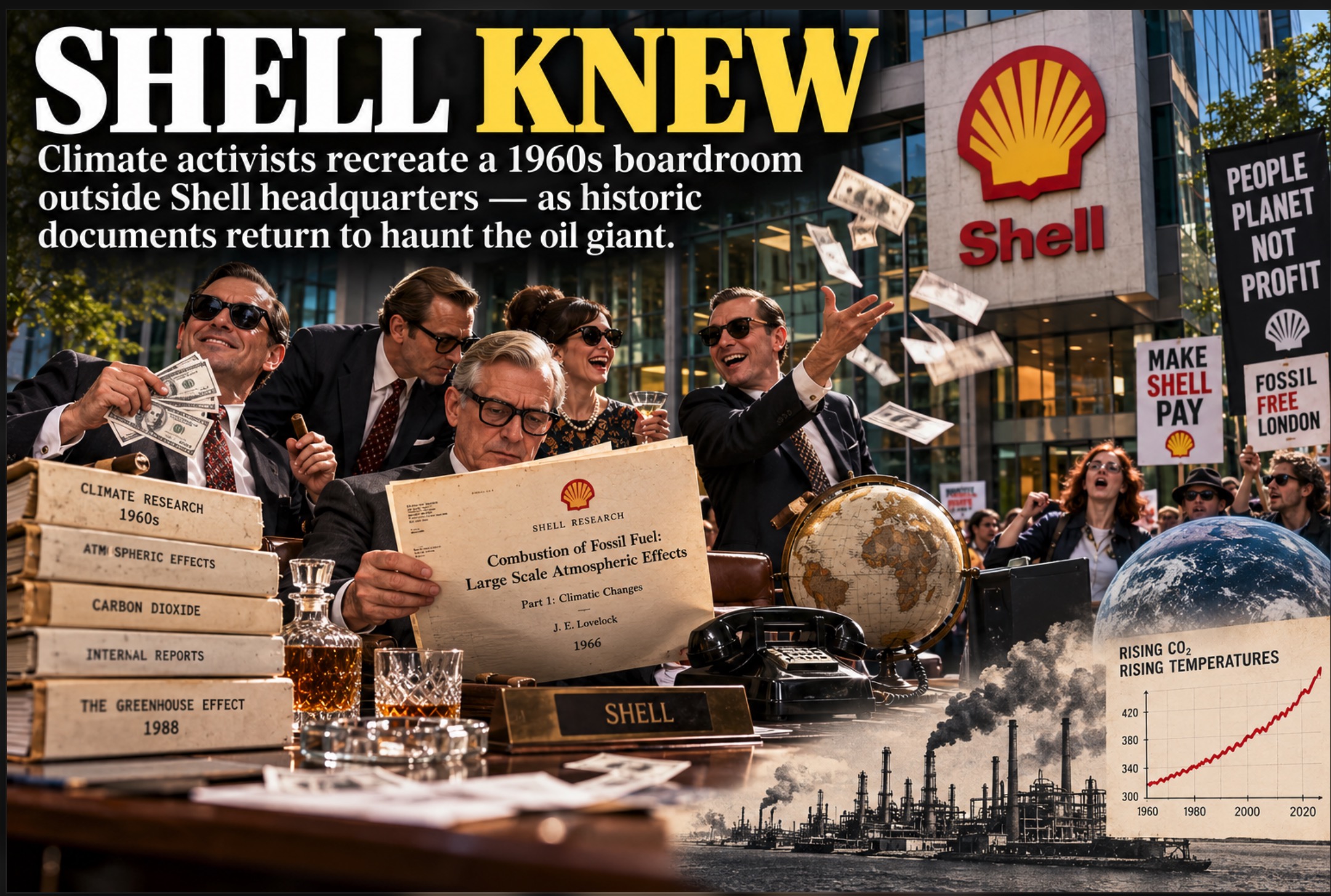
Climate campaigners dressed as 1960s oil executives staged a theatrical demonstration outside Shell’s London headquarters on 28 October, accusing the company of knowing about the dangers of fossil-fuel pollution for six decades. The protest coincided with the launch of a new archive containing historical Shell climate documents and preceded the company’s announcement of $10.8 billion in quarterly adjusted earnings. Behind the costumes, fake banknotes and mock boardroom behaviour lies a serious documentary question: what did Shell know about climate change, when did it know it, and what did it do with that knowledge?
A 1960s boardroom appears outside Shell’s headquarters
On Wednesday, 28 October 2026, visitors passing Shell’s London headquarters encountered an unusual scene.
Climate activists dressed as oil company executives from the 1960s had staged a theatrical recreation of a corporate office.
Participants examined documents representing early climate research, drank, handled fake money and acted out a caricature of executives disregarding inconvenient scientific findings.
Some tore up copies of a document identified as the 1966 Climate Report.
Others attempted to stuff the supposed report into a rubbish bin.
Fake dollar bills flew through the air.
Anadolu Agency footage shows activists dressed as executives firing imitation banknotes from golden toy guns.
Placards included messages such as “Shell Knew” and “Make Shell Pay”.
The demonstration was organised by Fossil Free London.
Its purpose was to draw attention to allegations that Shell had received scientific warnings concerning the climatic consequences of fossil-fuel combustion decades before climate change became a central public-policy issue.
The protest was photographed by Vuk Valcic for ZUMA Press Wire, with images distributed through Reuters Connect.
The photographs provide direct visual documentation of the event.
They also capture the theatrical character of the demonstration.
The activists were not claiming to have discovered a literal 1960s Shell boardroom operating outside the company’s present headquarters.
They were staging a symbolic reconstruction intended to communicate an accusation about corporate knowledge and responsibility.
That distinction is important.
The performance itself was satire.
The historical documents to which it referred are a separate matter.
Anadolu Agency video distributed through Reuters Connect — Fossil Free London Protest
The document behind the protest: James Lovelock’s 1966 research
The most important historical connection concerns British scientist James Lovelock.
Long before he became internationally recognised for developing the Gaia hypothesis, Lovelock undertook research for Shell.
His scientific work included examining the atmospheric and environmental consequences of fossil-fuel combustion.
In 1966, Lovelock prepared a report entitled Combustion of Fossil Fuel: Large Scale Atmospheric Effects — Part 1: Climatic Changes.
The document was produced for Shell.
Its historical significance lies in the fact that the company had commissioned scientific examination of the potential climatic consequences of its principal products.
Research concerning carbon dioxide and climate was already being undertaken by scientists internationally.
The scientific understanding available in 1966 was not identical to today’s.
Nevertheless, the documents demonstrate that potential large-scale environmental consequences of burning fossil fuels were sufficiently important for Shell to commission specialist research.
In July 2026, investigative publication DeSmog examined material preserved in Lovelock’s papers at the Science Museum Library and Archives.
The investigation revealed additional details about his work and correspondence with senior Shell research personnel.
Among those involved was Lord Victor Rothschild, who held a senior research role within Shell.
The historical records included correspondence concerning restrictions on sharing information beyond the intended recipients.
According to DeSmog’s examination, Lovelock was instructed not to discuss certain material with people outside Shell.
This raises a legitimate question about the company’s handling of scientific information.
But the evidence must be described precisely.
The existence of restrictions on distributing a scientific report does not, by itself, prove that a company deliberately concealed established facts from the public for the purpose of causing harm.
Industrial research was frequently treated as confidential.
The more substantial historical question concerns how Shell evaluated its findings, whether the information influenced corporate decisions and how its public statements subsequently compared with the scientific knowledge available internally.
The surviving documents provide evidence with which those questions can be investigated.
They deserve careful examination without attributing intentions that the documents do not establish.
An even more explicit warning followed in 1988
The historical record does not end in 1966.
In 1988, Shell produced a confidential report commonly known as The Greenhouse Effect.
The document examined the possibility that increasing concentrations of greenhouse gases would produce substantial changes in global climate.
It discussed potential consequences for sea levels, weather patterns, precipitation and other aspects of the Earth’s environment.
This later report is particularly important because scientific understanding of human-induced climate change had advanced considerably during the intervening decades.
By the late 1980s, the prospect of significant warming caused by greenhouse-gas emissions was the subject of extensive scientific research.
The report demonstrates that Shell was studying these risks internally.
It also forms part of a broader documentary record of climate science within the international oil and gas industry.
The existence of the 1988 document does not establish that Shell’s entire management or workforce possessed the same understanding.
Nor does it automatically establish how individual executives interpreted the findings.
But it provides evidence that serious scientific concerns were being examined within the company.
Together, the 1966 and 1988 documents help explain why activists have adopted the slogan “Shell Knew”.
The slogan is a campaigning interpretation.
The reports are historical records.
The distinction between them is essential.
DeSmog — Interactive Archive Shares Secrets of Shell’s Early Climate Research, 28 October 2026
A new archive: ExposeShell
The London protest coincided with the launch of a new website, ExposeShell.com.
The archive brings together historical documents relating to Shell’s research and knowledge concerning the environmental consequences of fossil fuels.
It includes material associated with Lovelock’s 1966 work and Shell’s subsequent internal climate assessments.
The website is intended to make the documents more accessible to researchers, journalists, campaigners and members of the public.
According to DeSmog, the initiative is supported by Fossil Free London and campaigners associated with litigation involving survivors of Typhoon Rai in the Philippines.
For historians of the oil industry, the development is significant.
Corporate archives often contain scientific and technical material produced long before the subjects became controversial.
Such records may have been preserved in universities, museums, company archives or the private collections of researchers.
Bringing them together can make it easier to reconstruct what information was available at particular times.
But an archive’s value depends upon more than the strength of its campaigning message.
Its documents need reliable dates, identifiable authors, evidence of provenance and sufficient context to permit independent examination.
A report written in 1966 should not be interpreted as though it contained all the scientific knowledge available in 2026.
Equally, the fact that scientific understanding has advanced does not diminish the historical importance of earlier warnings.
The correct approach is to place each document within the knowledge and circumstances of its time.
That is particularly important when historical corporate research becomes relevant to contemporary litigation.
Explore the ExposeShell archive
The Philippines connection: Typhoon Rai and litigation against Shell
The new archive has an additional purpose.
It supports efforts connected with litigation brought by survivors of Typhoon Rai, known locally in the Philippines as Typhoon Odette.
The storm struck the Philippines in December 2021.
It caused devastating destruction, loss of life and widespread displacement.
More than 100 survivors have pursued legal claims against Shell in the United Kingdom.
The proceedings are supported by the law firm Hausfeld.
The claimants argue that Shell’s historical greenhouse-gas emissions contributed to the climate conditions that increased the likelihood or severity of the disaster.
They also rely upon allegations concerning the company’s historical knowledge of climate risks.
The case involves questions of climate attribution, legal causation, corporate responsibility and the remedies potentially available to people affected by extreme weather.
These are complex matters.
Scientific attribution can assess the influence of human-caused climate change upon the probability or intensity of particular weather events.
That does not automatically establish the legal liability of an individual company for every consequence of such an event.
The claimants must establish the relevant legal requirements.
Shell is entitled to contest their allegations.
DeSmog reports that Shell has characterised the litigation as baseless and disputed suggestions that it possessed unique scientific knowledge concerning climate change.
The proceedings should therefore be presented as contested litigation, not as a judicial finding against Shell.
Nevertheless, the historical research documents may be relevant evidence.
They potentially bear upon questions concerning what the company knew, when it knew it and how it responded to developing scientific understanding.
Those questions will be for the courts to assess within the applicable legal framework.
DeSmog — Interactive Archive and the Typhoon Rai Proceedings
The timing: Shell announces $10.8 billion in quarterly profits
The protest was staged immediately before Shell announced its third-quarter 2026 results.
On 29 October, the company reported adjusted earnings of approximately $10.8 billion.
That was almost double its adjusted earnings for the equivalent quarter of 2025.
Shell also announced a new $5 billion share buyback programme.
The substantial profits reflected strong oil and gas prices, unusually favourable refining conditions and other aspects of Shell’s global commercial performance.
The announcement came during a period of severe disruption to international energy markets associated with the war involving Iran.
Some Shell operations experienced damage or interruption.
Other parts of the company’s business benefited from elevated commodity prices and refining margins.
The activists’ protest linked the company’s substantial earnings to their wider arguments about fossil-fuel dependence and climate responsibility.
But the contemporary financial results and the historical climate documents concern different issues.
One is a record of Shell’s present commercial performance.
The other concerns scientific knowledge and corporate decision-making over several decades.
The connection is a matter of public debate and editorial interpretation.
The current profit figure does not prove the allegations advanced in the historical climate litigation.
Nor does the existence of historical climate research establish that Shell’s 2026 earnings were obtained unlawfully.
Nevertheless, the timing created an obvious contrast.
As Shell prepared to announce billions of dollars in quarterly earnings, protesters were asking what responsibility the company bears for the long-term consequences of the products from which it has generated revenue.
Our report — Shell’s Profits Double to $10.8 Billion, 29 October 2026
The photographs: a protest that was designed to be remembered
The images distributed through Reuters Connect are particularly revealing.
In one, activists dressed as 1960s executives examine a document representing Shell’s early climate research.
In another, participants attempt to dispose of the report.
Other photographs show papers being torn up, money being thrown into the air and campaigners displaying slogans criticising Shell.
The visual message is straightforward.
The protesters sought to portray a corporate culture in which financial interests took priority over inconvenient scientific evidence.
That is the campaigners’ allegation and satirical interpretation.
The photographs do not independently establish that Shell executives literally destroyed the original research documents.
Nor do they show events that occurred in Shell’s offices in 1966.
They document a demonstration staged in October 2026.
The historical claims must be tested against the underlying archival records.
This distinction does not diminish the effectiveness of the protest.
Political theatre has long been used to make complex issues accessible.
In this case, the campaigners condensed six decades of scientific, corporate and legal history into a visual performance.
The question for journalists is whether the historical evidence supports the broader message.
The newly accessible documents provide an opportunity to examine that question seriously.
Editorial commentary: The documents are more important than the costumes
The most significant feature of the Fossil Free London demonstration is not the theatrical performance.
It is the documentary history behind it.
A protest featuring period costumes, imitation money and mock executives can attract public attention.
But attention is not the same as evidence.
The evidence lies in surviving scientific reports, correspondence and corporate records.
The 1966 Lovelock research is historically important because Shell commissioned an examination of potential environmental consequences associated with fossil fuels.
The 1988 greenhouse-effect report is important because it demonstrates that the company was considering substantial long-term climate risks.
Those documents can be examined without accepting every interpretation advanced by campaigners.
They can also be examined without assuming that confidentiality alone establishes misconduct.
The strongest historical approach is to ask what each document actually states.
Who commissioned it?
Who received it?
What scientific conclusions did it contain?
What uncertainties were acknowledged?
What decisions, if any, followed?
And how did subsequent public communications compare with the scientific assessments available internally?
These are questions to which contemporary documents may provide meaningful answers.
They are also questions that deserve scrutiny independently of the particular legal claims now being advanced against Shell.
For shareholders, the historical record raises questions about corporate governance, risk assessment and the management of long-term environmental liabilities.
For communities affected by extreme weather, the questions concern responsibility and access to legal remedies.
For historians, the central issue is how scientific understanding developed within major energy companies and how that knowledge influenced their behaviour.
The new ExposeShell archive may assist all three groups, provided the underlying documents remain accessible and verifiable.
The same principle guides the continuing work of RoyalDutchShellPlc.com and The Shell Leaks Files.
Corporate records should be preserved.
Claims should be tested.
Conflicting evidence should be acknowledged.
And the difference between an allegation, an established fact and an editorial conclusion should remain clear.
The London demonstration has succeeded in returning attention to a remarkable historical question.
What did Shell know about the climatic consequences of burning fossil fuels six decades ago?
The answer should not depend solely upon a protest slogan.
It should depend upon the original documents.
The good news for researchers is that more of those documents are now available.
And unlike the theatrical reports being torn up outside Shell’s headquarters, the genuine historical records can continue to be examined.
Documentary findings
Established facts: Fossil Free London staged a 1960s-themed protest outside Shell’s London headquarters on 28 October 2026. The demonstration was photographed by Vuk Valcic for ZUMA Press Wire and recorded by Anadolu Agency. Participants acted out a satirical office scene involving representations of early climate reports. Shell commissioned climate-related research from James Lovelock in 1966. Later internal Shell climate documents include a 1988 report on the greenhouse effect. The ExposeShell website was launched to provide access to historical material.
Documented allegations: The campaigners accuse Shell of knowing about serious climate risks for decades while continuing to profit from fossil fuels. The claimants in the Typhoon Rai litigation seek to establish legal responsibility for specified climate-related harm. Shell disputes the litigation and the characterisation of its historical knowledge.
Matters not established: The protest photographs do not establish that Shell executives destroyed original climate reports. The existence of confidential scientific research does not, on its own, prove deliberate concealment for an unlawful purpose. The historical documents do not constitute a judicial finding that Shell is legally responsible for Typhoon Rai. Nor do Shell’s current profits establish wrongdoing in the company’s historical handling of climate research.
Principal sources
- Reuters Connect — Climate Activists Stage a 1960s-Set Protest Outside Shell Headquarters, 28 October 2026 — Photographic record credited to Vuk Valcic/ZUMA Press Wire.
- Reuters Connect — Fossil Free London Protest Video, Anadolu Agency, 28 October 2026 — Independent footage showing the demonstration.
- DeSmog — Interactive Archive Shares Secrets of Shell’s Early Climate Research, 28 October 2026 — Reporting on the ExposeShell launch, historical documents and Philippine litigation.
- DeSmog — The Lovelock Papers: Shell’s Hidden Climate Knowledge Under Scrutiny, 29 July 2026 — Investigation based upon Lovelock’s archival papers, including his 1966 work for Shell.
- ExposeShell — Historical Shell Climate Documents — Campaign archive of historical records. Individual documents should be checked against their stated original sources.
- Follow the Money — Shell’s Historical Climate Research — Earlier investigation examining Shell’s scientific knowledge and later corporate activities.
- RoyalDutchShellPlc.com — Shell’s Profits Double to $10.8 Billion, 29 October 2026 — Our analysis of the financial announcement immediately following the protest.
Documentary disclaimer: This article distinguishes the documented protest, historical scientific reports, contemporary corporate disclosures, contested litigation and editorial commentary. The protest involved a theatrical reconstruction, not historical footage of Shell executives. Shell’s commissioning of scientific research in the 1960s is supported by archival material, but the documents must be assessed within their scientific and historical context. Allegations concerning deliberate concealment, climate-related legal liability and responsibility for particular disasters remain contested and should not be presented as judicial findings. Shell’s position concerning the litigation is acknowledged. Factual corrections and responses from Shell and other relevant parties are welcome.
The website’s general disclaimer also applies.








