AN INDEPENDENT DOCUMENTARY INVESTIGATION
By the Donovan–Shell Archive
25 November 2026
Researched and drafted with assistance from ChatGPT.
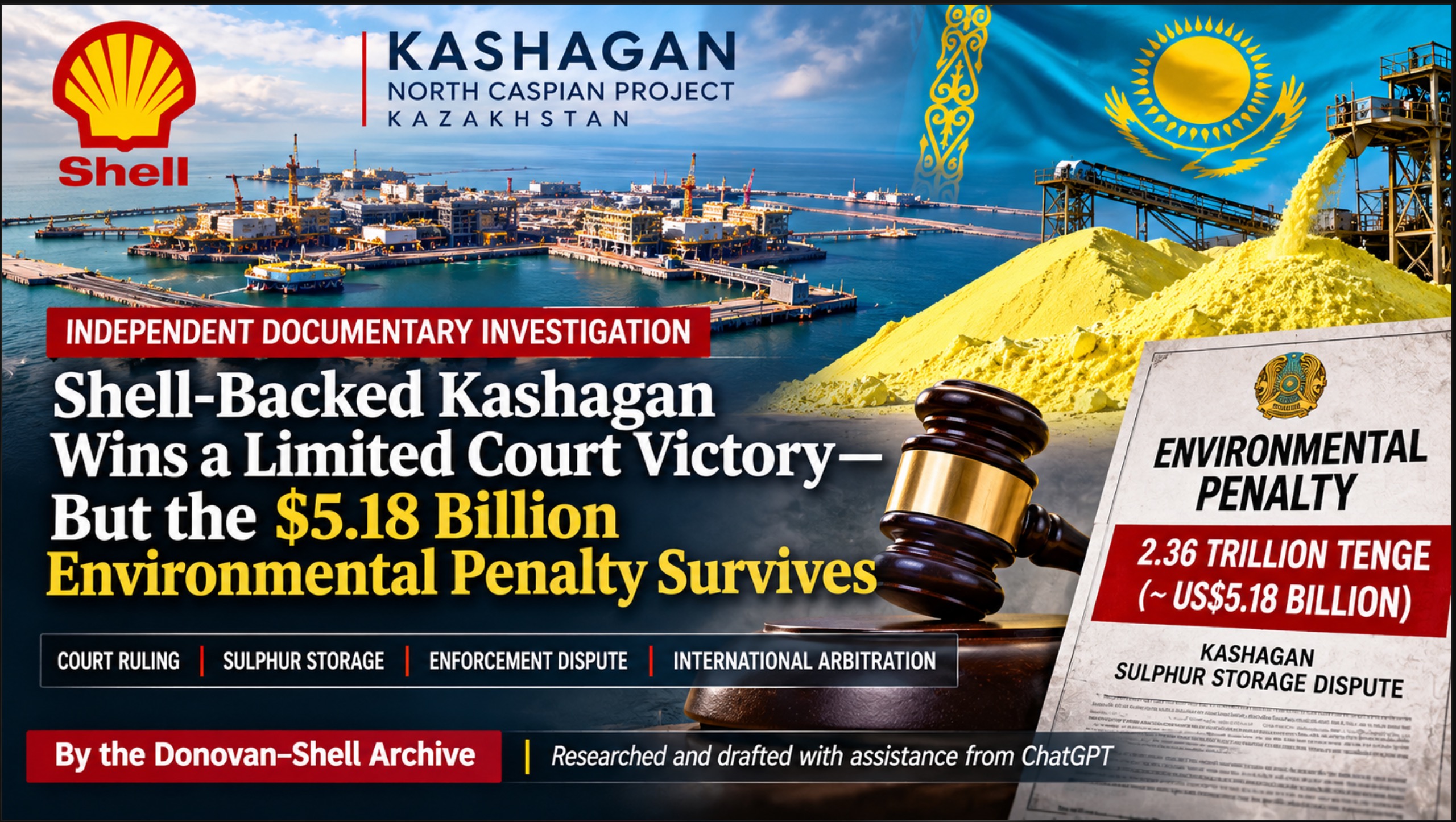
A court in Kazakhstan has partially upheld an appeal by the international consortium operating the giant Kashagan oilfield in the Caspian Sea. However, the ruling leaves the underlying multibillion-dollar environmental penalty intact. An examination of Shell’s own corporate disclosures, the operator’s environmental performance statistics and the latest Kazakh legal reporting reveals a complex confrontation involving environmental regulation, domestic enforcement proceedings and international investment arbitration.
1. A court victory with important limitations
On 24 November 2026, Interfax-Kazakhstan reported that the Atyrau Regional Court had partially upheld an appeal by North Caspian Operating Company (NCOC), the international consortium operating Kazakhstan’s Kashagan oilfield.
Shell is one of the consortium’s principal shareholders.
The judgment, dated 17 November, overturned an enforcement restriction imposed on 30 July 2026 in connection with efforts to recover an environmental penalty of approximately 2.36 trillion Kazakh tenge.
Reuters reported the development on 24 November, putting the penalty’s equivalent value at approximately US$5.18 billion.
More detailed reporting published by Kazakhstan’s business news organisation Kapital.kz on 25 November explains the limited nature of the decision.
The court reportedly overturned one of five enforcement orders challenged by the operator.
It did not overturn the environmental penalty itself.
That distinction is fundamental to understanding the latest development.
Sources: Interfax-Kazakhstan, 24 November 2026; Reuters, 24 November 2026.
link.interfax.kz+1
2. What the court reportedly found
The detailed Kazakh reporting identifies five enforcement measures originally contested by NCOC.
They concerned the initiation of enforcement proceedings, restrictions affecting real estate and vehicles, and two further orders limiting certain corporate actions.
The successful part of the appeal concerned the order dated 30 July.
According to Kapital.kz, that order restricted transactions capable of reducing the company’s assets, including transfers and disposals of property.
The appeal court reportedly found deficiencies in the legal justification for the restriction, the explanation of its necessity and the identification of the entity to which it applied.
Questions also arose concerning the involvement of PSA LLP, the organisation representing Kazakhstan’s governmental interests in major production-sharing arrangements.
The court reportedly left other enforcement measures in place and indicated that legally compliant enforcement restrictions could still be imposed.
The full judgment has not been independently obtained by the Donovan–Shell Archive. These findings are therefore attributed to published reporting of the court’s decision rather than presented as the result of our own inspection of the complete judgment.
Source: Kapital.kz — Kazakh Court Overturns Restriction on NCOC Property Transactions, 25 November 2026.
новости Kapital.kz
3. Who actually owns Kashagan?
The North Caspian Project operates under a production-sharing agreement signed in 1997 between the Republic of Kazakhstan and an international consortium.
According to NCOC’s published corporate information, its ownership is distributed as follows:
| Consortium participant | Interest |
|---|---|
| KazMunayGas | 16.88% |
| Shell | 16.81% |
| Eni | 16.81% |
| ExxonMobil | 16.81% |
| TotalEnergies | 16.81% |
| CNPC | 8.33% |
| INPEX | 7.56% |
Percentages are rounded.
The presence of Kazakhstan’s own national oil company within the consortium is particularly noteworthy.
This is not simply a dispute between Kazakhstan and a wholly foreign-owned oil company. The country’s national petroleum interests also participate in the development.
Similarly, the US$5.18 billion penalty must not be characterised as an amount payable exclusively by Shell plc.
It is being pursued against the consortium operator. The ultimate distribution of any financial obligations among its participants is a separate legal and contractual question.
Source: North Caspian Operating Company — Management and Shareholders.
NCOC
4. The substance behind the dispute: enormous quantities of sulphur
The environmental controversy concerns sulphur generated during the processing of hydrocarbons extracted from Kashagan.
The field’s technical characteristics require the treatment of gas containing hydrogen sulphide.
Elemental sulphur recovered during processing can be converted into commercially saleable products and exported.
When export arrangements are unavailable, sulphur may accumulate in dedicated storage areas.
These are commonly known as sulphur pads.
Kazakhstan’s environmental authorities concluded following a 2022 inspection that the operator had exceeded permitted sulphur storage limits.
Subsequent reporting puts the alleged excess at more than one million tonnes.
NCOC disputes the environmental allegations and the resulting penalty.
But its own published sustainability statistics provide an illuminating account of the quantities involved.
5. What the operator’s own environmental records reveal
NCOC’s 2024 sustainability report provides a five-year record of sulphur production and year-end inventories held in block storage.
The following figures are taken from the operator’s published performance data.
| Year | Sulphur produced | Sulphur in storage at year-end |
|---|---|---|
| 2020 | 1,322,000 tonnes | 1,594,000 tonnes |
| 2021 | 1,372,000 tonnes | 1,696,000 tonnes |
| 2022 | 991,000 tonnes | 1,775,000 tonnes |
| 2023 | 1,486,000 tonnes | 1,347,000 tonnes |
| 2024 | 1,422,000 tonnes | 613,000 tonnes |
These statistics establish that substantial quantities of sulphur accumulated at the project and that the reported inventory subsequently declined considerably.
The year-end inventory for 2022 — the year of the disputed environmental inspection — was approximately 1.775 million tonnes.
By the end of 2024, the operator reported an inventory of 613,000 tonnes.
That represents a reduction of more than one million tonnes.
The statistics are important documentary evidence of the scale of the sulphur management operation.
They do not, in isolation, establish whether the applicable environmental permits were breached. That requires examination of the relevant permit conditions, measurement dates and regulatory methodology.
Primary source: NCOC — 2024 Sustainability Report.
NCOC
6. NCOC’s environmental defence
The consortium’s sustainability report describes measures intended to control environmental impacts from sulphur production and storage.
These include drainage infrastructure, environmental monitoring, dust suppression and the recovery of stored sulphur for commercial export.
NCOC reports that approximately 830,000 tonnes of previously accumulated sulphur were processed and exported during 2024.
The operator also maintains that its monitoring of air, soil and groundwater demonstrates compliance with relevant environmental quality standards.
Those statements deserve to be included in any balanced examination of the dispute.
However, two different regulatory questions arise.
The first is whether environmental monitoring demonstrates unacceptable pollution.
The second is whether the operator complied with the specific storage limits imposed under its environmental permits.
Compliance with one category of environmental standard does not necessarily establish compliance with every other regulatory requirement.
Equally, the existence of a substantial stored sulphur inventory does not by itself demonstrate environmental damage or unlawful conduct.
The relevant technical and legal evidence must be considered separately.
ncoc.kz
7. Shell’s own disclosure confirms international arbitration
Perhaps the most consequential corporate document examined for this investigation is Shell’s debt securities information memorandum dated 13 May 2026.
Its discussion of Kazakhstan appears on printed pages 110–111.
Shell disclosed that a court in Astana had delivered an adverse ruling concerning the sulphur regulatory dispute in December 2025.
An appellate court upheld that decision in April 2026.
The relevant non-operated venture retained the possibility of seeking further judicial review.
More significantly, Shell disclosed that it and other shareholders had initiated investor-state arbitration against the Republic of Kazakhstan under applicable investment treaties and the Energy Charter Treaty.
The proceedings challenge the alleged unlawfulness and arbitrariness of Kazakhstan’s actions concerning the sulphur penalty and its enforcement.
Shell’s language represents its legal position.
It is not an international tribunal’s finding that Kazakhstan has acted unlawfully.
The memorandum also acknowledges uncertainty about the ultimate outcome of the disputes and the scale and timing of any potential financial obligations.
This establishes directly from Shell’s own documentation that the controversy has developed beyond an environmental dispute in Kazakhstan’s domestic courts into an international investment protection dispute.
Primary source: Shell plc and Shell International Finance B.V. — Debt Securities Information Memorandum, 13 May 2026, pages 110–111.
shell.com
8. The international arbitration confrontation
There is a further legal complication.
In July 2026, NCOC stated that an international commercial arbitration tribunal operating under UNCITRAL rules had issued interim measures restricting enforcement of the environmental penalty.
Kazakhstan’s Ministry of Justice rejected the proposition that such measures automatically prevented enforcement of its domestic court decisions.
The ministry’s reported position was that international commercial arbitration could not automatically override the state’s powers to enforce environmental legislation.
This commercial arbitration dispute must be distinguished from the investor-state proceedings disclosed by Shell in May.
Although the proceedings concern overlapping issues, they involve potentially different legal foundations.
The precise relationship between them cannot be determined without access to the relevant arbitration agreements, submissions and orders.
The full arbitration records have not been obtained for this investigation.
It would therefore be premature to conclude either that Kazakhstan has violated an internationally binding arbitration order or that the consortium’s international legal challenges are without merit.
Sources: Kursiv — Kazakhstan’s Justice Ministry Responds to International Arbitration Measures, 17 July 2026; The Times of Central Asia — Kazakhstan Resumes Collection of Kashagan Fine.
Kursiv Media Казахстан+1
9. Environmental regulations have also been changing
Another development deserves attention.
On 19 October 2026, Kazakh news organisation VRK reported that the Ministry of Ecology and Natural Resources had revised its methodology for calculating permitted open-air sulphur storage.
The reported revision altered wording concerning storage areas and operating conditions.
However, the requirement for annual storage limits to be established through environmental permits remained.
The timing is noteworthy given the continuing dispute with NCOC.
It would nevertheless be unjustified to infer from that timing alone that the changes were designed either to assist or disadvantage the consortium.
Nor has it been established that the revised methodology applies retrospectively to the disputed 2022 inspection.
The relationship, if any, between the revised regulations and the historical environmental penalty remains a legitimate subject for further examination.
Source: VRK — Ecology Ministry Changes Sulphur Storage Rules Amid the Dispute with NCOC, 19 October 2026.
VRK
10. The documentary chronology
The dispute has passed through several distinct legal stages.
2022: An environmental inspection generates allegations concerning sulphur storage at the Kashagan project.
August 2025: An earlier penalty is overturned on procedural grounds. The environmental regulator subsequently imposes another substantial penalty.
April 2026: An adverse ruling concerning the sulphur dispute is upheld on appeal.
13 May 2026: Shell’s information memorandum confirms that investor-state arbitration has been initiated.
19 June 2026: The Atyrau Regional Court reportedly upholds the environmental penalty.
July 2026: Domestic enforcement proceedings commence amid disagreement concerning the effect of international arbitration measures.
7 September 2026: Enforcement proceedings are temporarily suspended during judicial consideration of the operator’s challenge.
29 September 2026: Enforcement proceedings resume.
17 November 2026: The Atyrau Regional Court partially upholds the operator’s appeal concerning enforcement measures.
24–25 November 2026: The latest ruling becomes publicly reported. The underlying environmental penalty remains unaffected.
Sources: Shell’s May 2026 memorandum; Interfax — September enforcement suspension; Reuters — September enforcement resumption; VRK — November court ruling.
shell.com+3
11. A continuing Donovan–Shell Archive investigation
On 1 October 2026, the Donovan–Shell Archive examined the resumption of Kazakhstan’s enforcement proceedings alongside Shell’s decision to participate in the enormous expansion of LNG Canada.
That earlier investigation identified the contrast between Shell’s commitment to new international hydrocarbon developments and the continuing legal and environmental disputes associated with existing projects.
Shell’s $5.2 Billion Kashagan Battle Collides With Its C$33 Billion LNG Canada Bet — 1 October 2026.
The November judgment represents a new development in that continuing documentary record.
It demonstrates the operator’s ability to challenge individual enforcement measures successfully without necessarily defeating the underlying environmental claim.
It also demonstrates why isolated headlines announcing either a victory for the consortium or a victory for Kazakhstan may provide an incomplete account of the dispute.
There are multiple proceedings, different legal questions and potentially different outcomes.
12. The wider issue: environmental sovereignty versus investment protection
The Kashagan dispute raises an important question extending beyond Shell and Kazakhstan.
How should international investment protections operate when a host government imposes a substantial environmental penalty upon an international consortium?
Governments have legitimate responsibilities to regulate industrial activities and enforce environmental standards.
International investors also have legitimate interests in protection against arbitrary, discriminatory or otherwise unlawful government actions.
Neither principle automatically resolves the Kashagan dispute.
The central questions concern whether the environmental penalty was properly imposed, whether its calculation was lawful, whether enforcement measures comply with applicable procedural requirements and whether Kazakhstan’s international investment obligations have been respected.
The magnitude of the disputed penalty makes those questions particularly consequential.
For environmental accountability, it is important that international investment protection mechanisms do not automatically place industrial operators beyond legitimate regulation.
For the rule of law, it is equally important that environmental enforcement is based upon properly established violations and legally defensible procedures.
The reported November decision illustrates the importance of distinguishing those issues.
13. Questions Shell and the consortium could usefully answer
The documents examined for this investigation leave several questions open.
-
What is NCOC’s latest recorded inventory of sulphur held in open storage?
-
What specific environmental permit conditions were applicable at the time of the 2022 inspection?
-
How does NCOC calculate compliance with annual sulphur storage limits?
-
Has the November appeal ruling materially affected the remaining enforcement proceedings?
-
What is the current status of the commercial and investor-state arbitration proceedings?
-
Can Shell provide an updated assessment of its potential obligations arising from the dispute?
Answers supported by authenticated documents would materially improve public understanding of the controversy.
Conclusion: one restriction overturned, billions still disputed
The latest court ruling offers the Kashagan consortium a limited procedural victory.
It does not establish that the underlying environmental allegations were unfounded.
It does not cancel the multibillion-dollar penalty.
Nor does it determine the outcome of the international arbitration proceedings.
Meanwhile, the operator’s own environmental statistics demonstrate the substantial scale of sulphur accumulation and subsequent efforts to reduce stored quantities.
Shell’s corporate disclosures independently establish that the company is participating in an international legal challenge to Kazakhstan’s actions.
The controversy therefore remains unresolved on several fronts.
The central documentary finding is that Shell and its partners have successfully challenged one enforcement restriction, while the underlying environmental penalty of approximately 2.36 trillion tenge remains the subject of a continuing legal confrontation.
The ultimate resolution will require considerably more than the cancellation of one bailiff’s order.
Principal documentary sources
Interfax-Kazakhstan — 24 November 2026
Atyrau Court Partly Grants NCOC Appeal in 2.36 Trillion Tenge Fine Case
Reuters — 24 November 2026
Kazakh Court Partially Upholds Kashagan Operator NCOC’s Appeal
Kapital.kz — 25 November 2026
Kazakh Court Overturns Restriction on NCOC Property Transactions — Russian-language original
VRK — 25 November 2026
Court Overturns One of the Bans on Kashagan Operator Over 2.36 Trillion Tenge Fine
Shell plc — 13 May 2026
Debt Securities Programme Information Memorandum — Kazakhstan Disputes, Printed Pages 110–111
North Caspian Operating Company
Corporate Ownership and Management
2024 Sustainability Report and Environmental Performance Statistics
Kursiv — 17 July 2026
Kazakhstan’s Position on International Arbitration and Environmental Enforcement
VRK — 19 October 2026
Revised Sulphur Storage Methodology
Donovan–Shell Archive — 1 October 2026
Shell’s $5.2 Billion Kashagan Battle Collides With Its C$33 Billion LNG Canada Bet
Documentary disclaimer
This independent investigation is based upon publicly accessible corporate disclosures, environmental performance reports, contemporaneous news agency reporting, Kazakh business publications and previously published archival material available as of 25 November 2026.
The full text of the Atyrau Regional Court’s 17 November judgment has not been independently obtained. References to its findings are attributed to reporting by Interfax-Kazakhstan and subsequent publications drawing upon the court decision. Those reports have not been treated as independent copies of the primary judicial record.
The environmental penalty concerns North Caspian Operating Company, in which Shell holds approximately 16.81%. The consortium-wide penalty is not represented as a financial obligation payable exclusively by Shell plc.
NCOC disputes the underlying environmental allegations and the penalty. Shell and other consortium participants are pursuing international legal remedies. No conclusion is reached concerning the ultimate outcome of those proceedings.
Sulphur production and storage statistics are taken from the operator’s published environmental performance data. They are not represented as independent measurements or conclusive evidence of regulatory violations or environmental damage.
The US-dollar equivalent of the penalty is approximate and reflects contemporary reporting. The underlying amount is denominated in Kazakh tenge.
The Donovan–Shell Archive welcomes authenticated documents, substantiated factual corrections and responses from Shell plc, NCOC, the consortium participants and the relevant Kazakh authorities.
Researched and drafted with assistance from ChatGPT. This article constitutes independent documentary journalism and editorial analysis, not legal advice, investment advice or a determination of legal liability.