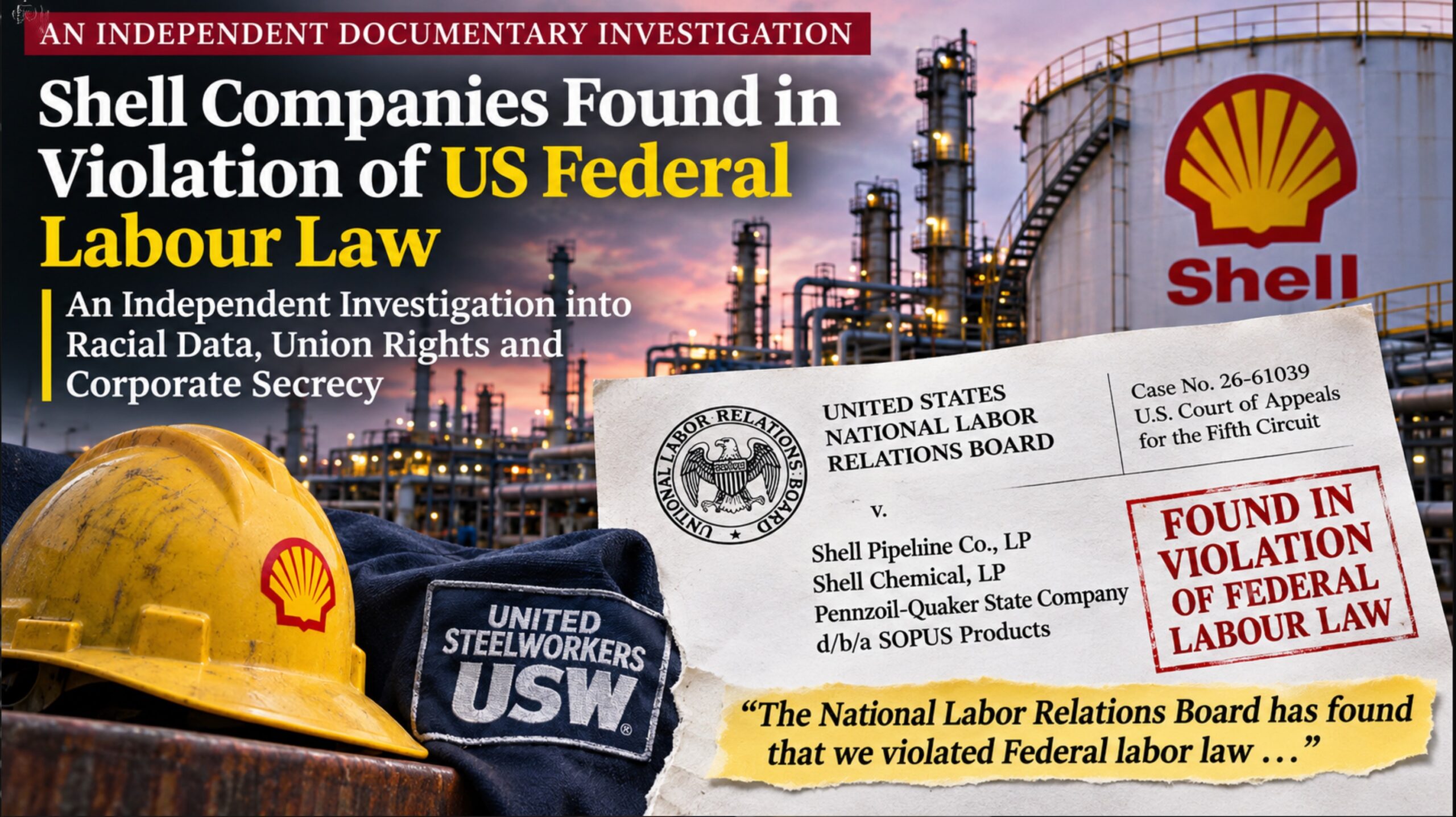
AN INDEPENDENT DOCUMENTARY INVESTIGATION
By the Donovan–Shell Archive
26 November 2026
Three Shell-related American businesses have been found in violation of United States federal labour law following their refusal to provide the United Steelworkers union with information relevant to its collective bargaining responsibilities.
The United States National Labor Relations Board (NLRB) has now taken the matter to the United States Court of Appeals for the Fifth Circuit, seeking judicial enforcement of its order.
Federal court documents obtained by the Donovan–Shell Archive reveal that the companies failed to file exceptions to the Administrative Law Judge’s decision, allowing the findings against them to become the formal decision of the Board.
The dispute raises important questions about corporate transparency, employee rights and the relationship between Shell’s internal policies and its statutory obligations under American labour law.
Three Shell businesses named
The federal enforcement proceedings, filed on 17 November 2026 under case number 26-61039, name three respondents:
-
Shell Pipeline Co., LP
-
Shell Chemical, LP
-
Pennzoil-Quaker State Company, doing business as SOPUS Products.
The proceedings arise from complaints involving the United Steelworkers union and cover pipeline, chemical plant, laboratory, production and maintenance employees.
The NLRB identifies Deer Park, Texas, as the location of the unfair labour practices.
The information Shell refused to disclose
At the heart of the dispute was the union’s request for individualised employee demographic information, specifically concerning racial and ethnic minority status.
According to the administrative proceedings, the companies had routinely provided the union with such information for approximately a decade before changing their approach in 2024.
The companies began supplying aggregated demographic statistics instead of information relating to individual employees.
Among the explanations advanced for the change were European data protection legislation, an internal corporate policy and Shell’s employee diversity programme known as “Self ID”.
However, according to independent legal analysis of the decision published on 18 August 2026, a Shell manager acknowledged during the hearing that the three American entities were not subject to the European privacy legislation being cited.
Administrative Law Judge Brian D. Gee also identified inconsistencies in the companies’ reliance on the Self ID programme, given that other categories of employee information continued to be supplied.
The case therefore raises a significant question: when an employer introduces new corporate policies governing employee information, can those policies override its existing statutory obligations to recognised trade unions?
In this instance, the administrative ruling was against the employers.
Source: NLRB Edge — Racial Information Requests, 18 August 2026.
A dispute stretching back to March 2024
The documentary record establishes a prolonged series of information requests and legal proceedings.
4 March 2024: The union requested information from Shell Pipeline and Shell Chemical.
9 May 2024: The initial unfair labour practice case was filed with the NLRB.
6 September and 4 October 2024: Further information requests were made.
3 March and 14 April 2025: Additional requests followed.
3 April 2026: The NLRB’s General Counsel issued a second consolidated complaint.
17 August 2026: Administrative Law Judge Brian D. Gee issued his decision, finding violations of federal labour law.
14 September 2026: The deadline for the respondents to file exceptions to the decision expired.
28 September 2026: The NLRB formally adopted the judge’s findings, conclusions and recommended order.
9 November 2026: The Board’s application for judicial enforcement was received by the Fifth Circuit.
17 November 2026: The federal enforcement proceedings were formally docketed.
8 December 2026: The deadline specified in the available federal court docket for the respondents to answer the enforcement application.
The case has therefore progressed from a workplace information dispute to federal appellate enforcement proceedings over a period of more than two and a half years.
The companies did not challenge the administrative decision before the Board
One of the most significant statements in the newly filed federal court documents appears on page three of the NLRB’s application:
Respondents failed to file exceptions with the Board.
This is not merely an allegation made by a private litigant. It is a representation made to a federal appeals court by the United States agency responsible for administering and enforcing federal collective bargaining law.
The NLRB argues that the failure to file exceptions prevents the respondents from subsequently raising objections before the court unless extraordinary circumstances can be established.
The Board expressly maintains that no such circumstances exist in this case.
It has consequently requested summary enforcement of its order in full.
The companies did participate in the earlier administrative proceedings, including filing an answer and submitting a post-hearing brief. Their subsequent failure to file exceptions should not, therefore, be confused with an absence of any defence throughout the proceedings.
“We violated Federal labor law”
Among the most revealing documents contained in the federal court filings are four employee notices reproduced in the proposed judgment.
Each contains the following statement:
The National Labor Relations Board has found that we violated Federal labor law and has ordered us to post and obey this notice.
The notices relate to four categories of employees:
-
Shell Pipeline’s qualifying hourly paid employees at Gulf of Mexico facilities.
-
Shell Chemical’s qualifying hourly paid chemical plant employees at Deer Park, Texas.
-
Shell Chemical’s senior laboratory technicians and laboratory technicians.
-
Qualifying production, maintenance and laboratory employees at the Pennzoil-Quaker State facility in Galena Park, Texas.
The notices reaffirm employees’ statutory rights to organise, join or assist a union, choose collective bargaining representatives and act together for their mutual benefit and protection.
They also contain commitments to provide the individualised minority information previously requested by the union.
These are not voluntary corporate public relations statements. They are remedial notices prescribed through federal labour law proceedings, with the versions reproduced in the court filing prepared for use following judicial enforcement.
The obligations imposed on the companies
The NLRB order requires the respondents to:
-
Cease refusing to bargain collectively through the withholding of relevant and necessary information.
-
Cease related interference with employees’ protected statutory rights.
-
Furnish the requested information to the union.
-
Display prescribed employee notices for 60 consecutive days.
-
Distribute the notices electronically where electronic communications are customarily used.
-
Submit sworn certifications by responsible officials detailing the steps taken to comply.
The order provides for notices to be posted within 14 days of service by the NLRB’s regional office and sworn compliance certifications to be submitted within 21 days of service.
These requirements are set out separately for Shell Pipeline, Shell Chemical and Pennzoil-Quaker State.
The remedies principally concern disclosure, collective bargaining rights and compliance. The court documents examined for this investigation do not specify a financial penalty.
Shell’s diversity policies and the right to independent scrutiny
There is a particular irony in the reported reliance on an employee diversity programme as part of the explanation for withholding demographic information from a recognised trade union.
Corporate diversity programmes are generally presented as mechanisms for improving inclusion, equality and understanding within the workforce.
Trade unions, however, also have legitimate responsibilities concerning the treatment of employees, including their ability to examine whether workplace practices operate fairly.
Aggregate statistics may provide a broad picture of workforce composition, but they cannot necessarily substitute for individualised information when examining particular employment decisions.
Equally, employees have legitimate expectations concerning the protection of sensitive personal information. The appropriate handling of such information deserves careful consideration.
The administrative decision in this case establishes that the employers’ refusal to provide the requested information was unlawful in the circumstances examined.
It does not establish that Shell engaged in racial discrimination.
That distinction is important. The findings concern the employers’ statutory information and collective bargaining obligations, rather than a determination that individual employees suffered discrimination because of their race or ethnicity.
Has Shell complied with the order?
The documents examined for this investigation do not establish whether the three businesses have subsequently supplied all the requested information.
Nor do they establish whether the prescribed notices have been displayed or sworn compliance certifications submitted.
The following questions consequently remain relevant:
-
Why did the companies change a longstanding practice of providing individualised demographic information?
-
Who authorised the change, and at what level within the Shell organisation?
-
Was the applicability of European data protection legislation properly assessed before it was relied upon?
-
Why were no exceptions filed against the administrative decision?
-
Have the companies now supplied the information required under the NLRB order?
-
Has Shell examined whether comparable information restrictions operate elsewhere within its American businesses?
These are legitimate questions of corporate governance and regulatory compliance.
There is presently no documentary basis for attributing the decisions to Shell plc’s board or senior executive leadership in London.
An important distinction: the federal court has not yet been shown to have ruled
One of the documents filed on 17 November 2026 carries the prominent heading:
JUDGMENT ENFORCING AN ORDER OF THE NATIONAL LABOR RELATIONS BOARD
Read in isolation, this might suggest that the Fifth Circuit has already entered judgment against the companies.
However, the publicly accessible federal court docket identifies this document as the Board’s proposed judgment.
The distinction has been independently checked by the Donovan–Shell Archive.
The established position is that the NLRB has adopted the findings of unfair labour practices and applied to the federal appeals court for enforcement.
The available documents do not establish that the court has granted that application.
The publicly accessible docket was last retrieved on 17 November 2026. More recent proceedings may be available through the federal judiciary’s PACER system.
The wider significance for Shell
On 11 November 2026, the Donovan–Shell Archive examined American employment litigation involving Shell, corporate diversity policies and the changing legal environment surrounding diversity, equity and inclusion.
The present proceedings represent a separate but relevant development.
Unlike unresolved allegations in private employment lawsuits, this case has progressed through an administrative hearing to formal findings of violations adopted by a federal regulatory agency.
It also concerns three businesses and multiple bargaining units rather than a single individual employment grievance.
The case illustrates the importance of independent institutional scrutiny of corporate employment practices, particularly where internal company policies intersect with statutory obligations.
Corporate policies cannot simply be assumed to take precedence over legally enforceable rights.
Conclusion
What began in March 2024 as a request for employee information has now resulted in formal findings of federal labour law violations and an application for judicial enforcement involving three Shell-related American businesses.
The companies had an opportunity to challenge the administrative findings through the NLRB’s exceptions procedure but, according to the Board, did not do so.
Whether the respondents have since complied with the order remains an outstanding question.
The next significant procedural date identified in the available court record is 8 December 2026.
The Donovan–Shell Archive intends to follow further developments in this case.
Primary documentary sources and supporting material
United States Court of Appeals for the Fifth Circuit
Case No. 26-61039 — National Labor Relations Board v. Shell Pipeline Co., LP; Shell Chemical, LP; and Pennzoil-Quaker State Company d/b/a SOPUS Products.
Document 2 — Application for Summary Entry of a Judgment Enforcing an Order of the National Labor Relations Board. Filed 17 November 2026. 21 pages.
Document 3 — Board’s Proposed Judgment. Filed 17 November 2026. 16 pages.
Both documents were obtained through PACER and examined by the Donovan–Shell Archive.
Additional sources:
Official National Labor Relations Board case register — 16-CA-342028
Administrative Law Judge Brian D. Gee’s decision — 17 August 2026
Official NLRB summary of decisions for the week of 17–21 August 2026
Official NLRB confirmation of its September 2026 decision
Federal appeals court docket — NLRB v. Shell Pipeline, Case 26-61039
NLRB Edge — Independent legal analysis, 18 August 2026
Official administrative decision reference: JD(SF)-15-26.
Right of reply
Shell plc, the three respondent companies and the United Steelworkers union are invited to provide comments, factual corrections or additional documentation concerning the proceedings and the current status of compliance with the NLRB order.
Any substantive response will be considered for publication.
Editorial and methodology note: This independent documentary investigation was researched and prepared with AI assistance, drawing principally on original federal court filings, official NLRB records and supporting legal analysis. It distinguishes established administrative findings from pending judicial enforcement proceedings and does not allege racial discrimination on the basis of the findings examined.
ORIGINAL FEDERAL COURT DOCUMENTS — FREE PUBLIC ACCESS
United States Court of Appeals for the Fifth Circuit
Case No. 26-61039 — Filed 17 November 2026
Both documents were obtained through PACER and are reproduced here to facilitate independent public scrutiny. No PACER account is required to access these copies.