AN INDEPENDENT DOCUMENTARY INVESTIGATION
By the Donovan–Shell Archive
28 November 2026
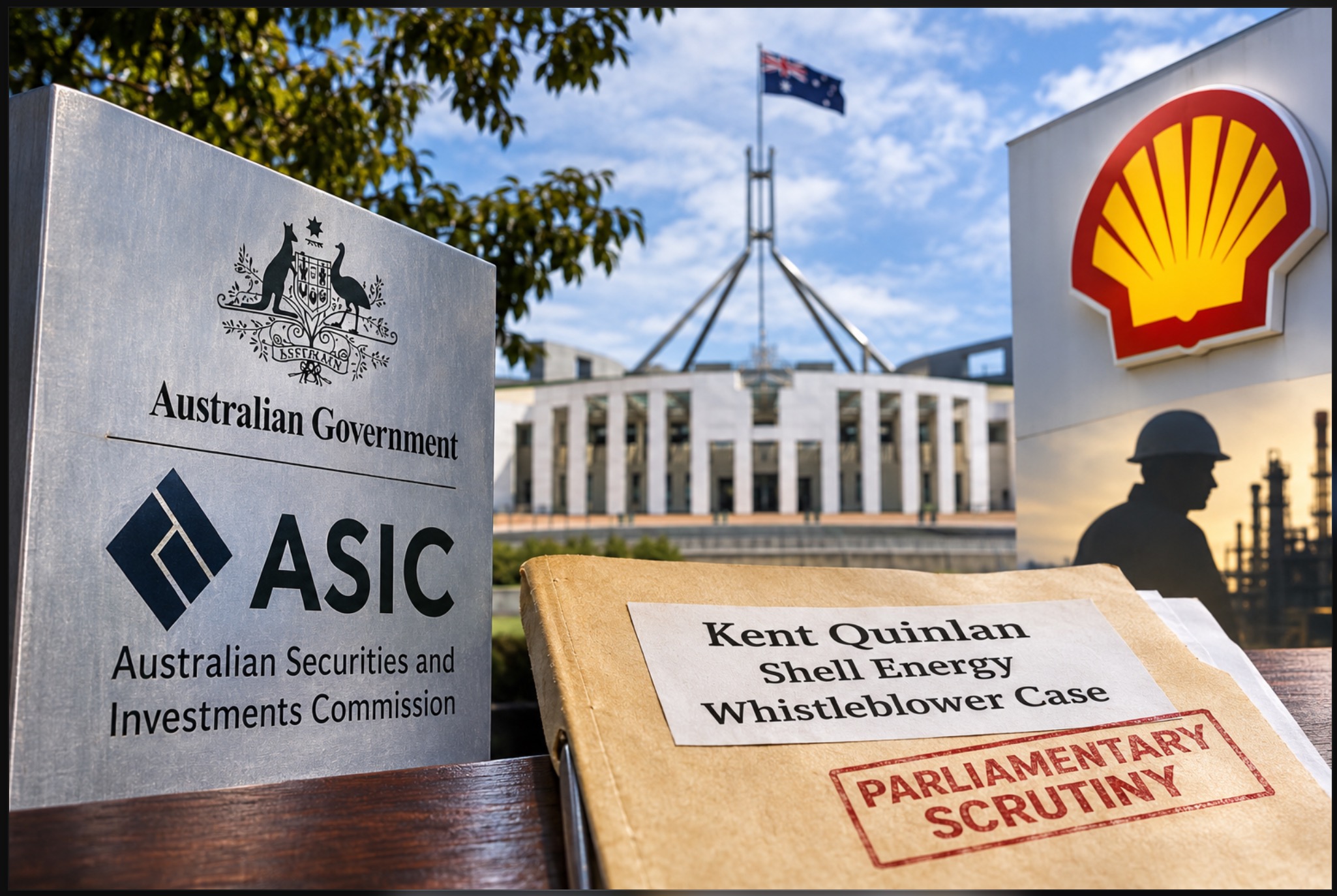
Australia’s corporate regulator has confirmed that it contacted Shell whistleblower Kent Quinlan after Senator Paul Scarr raised his case during parliamentary scrutiny of ASIC in September.
The development was disclosed at a further hearing of the Parliamentary Joint Committee on Corporations and Financial Services on 27 November 2026, when Senator Scarr returned to the subject of Quinlan and Shell Energy and asked ASIC what had happened since his earlier intervention.
The answer is significant.
ASIC did not merely say that it had reviewed the matter internally.
Its representatives told the committee that the regulator had reached out to Quinlan directly, engaged with him and was considering information connected with the long-running Queensland Supreme Court dispute.
The development represents the clearest regulatory follow-up yet to a case that has moved from private litigation into parliamentary scrutiny.
It does not, however, establish that ASIC has opened a formal investigation into Shell Energy or that any of Quinlan’s contested allegations have been proved.
Senator Scarr asks what happened after September
During the 27 November hearing, Senator Scarr referred back to his questioning of ASIC at the committee’s previous public hearing.
He described Quinlan and Shell as a major case involving the interpretation of Australian whistleblower laws and asked ASIC for an update on its engagement with Quinlan and its monitoring of the litigation.
The independently indexed transcript of the official parliamentary recording records Scarr saying that, at the previous hearing, he had explored both ASIC’s contact with Quinlan and whether the regulator was monitoring the court proceedings.
He then asked:
“So, could you provide us an update as to what has happened since the last hearing?”
ASIC responded that it recognised the importance of the matter and asked Executive Director for Enforcement and Compliance Chris Savundra to provide the substantive update.
That exchange appears in the official Australian Parliament video of the 27 November hearing, which is publicly available through Parliament’s streaming service.
ASIC says it reached out to Quinlan
The most important development is ASIC’s confirmation that it acted following the September hearing.
Savundra told the committee that ASIC had contacted Quinlan after Senator Scarr first raised the matter publicly.
The independently transcribed parliamentary recording records ASIC saying that, following Scarr’s earlier intervention, the regulator “reached out to Mr Quinlan and made contact with him.”
ASIC further indicated that it had subsequently engaged with Quinlan and was considering information connected with his case.
This is materially different from ASIC’s position at the 4 September hearing.
At that earlier hearing, ASIC Chair Sarah Court told Senator Scarr that it did not appear Quinlan himself had contacted ASIC about the issues.
Scarr challenged that passive approach.
He asked why ASIC should wait for a whistleblower to approach the regulator when the case was already in the public domain and involved allegations of corporate wrongdoing.
Scarr specifically drew attention to corporate defendants seeking suppression orders over evidence connected with those allegations and asked whether that should raise regulatory “red flags”.
Court agreed to take the matter on notice and, after Scarr urged ASIC to “take a serious look at this case”, replied:
“Yes, Senator, we can do that.”
That exchange was documented by the Donovan–Shell Archive on 7 October 2026.
What was then merely an undertaking to examine the matter has now resulted in direct contact between ASIC and Quinlan.
From undertaking to action
The chronology is therefore now much clearer.
On 4 September 2026, Senator Scarr raised Quinlan v Shell Energy directly with ASIC Chair Sarah Court.
He questioned whether the regulator should itself approach Quinlan rather than wait for him to make contact.
He also asked whether suppression-order applications concerning evidence linked to allegations of corporate wrongdoing warranted ASIC scrutiny.
Court agreed that ASIC would look at the matter.
By 27 November 2026, ASIC was able to tell the same parliamentary committee that it had acted on that undertaking and contacted Quinlan.
That is a meaningful development.
It demonstrates that the parliamentary intervention had a practical regulatory consequence.
What remains unknown is how far ASIC’s involvement will go.
ASIC has not announced a formal investigation
That limitation is important.
Nothing disclosed at the 27 November hearing establishes that ASIC has formally commenced enforcement proceedings or opened an investigation into Shell Energy.
There is a significant legal and regulatory distinction between:
examining information;
meeting or communicating with a whistleblower;
monitoring litigation;
conducting preliminary assessment;
and commencing a formal investigation using ASIC’s statutory powers.
At present, the publicly available evidence supports the first categories.
It does not yet support the last.
The Donovan–Shell Archive therefore does not describe ASIC as investigating Shell Energy unless and until the regulator itself says so or an official record establishes that fact.
The underlying allegations remain contested
The same evidential discipline applies to Quinlan’s underlying allegations.
Quinlan, a former senior executive of ERM Power, has made serious allegations concerning his treatment as a whistleblower and alleged corporate misconduct.
Shell disputes the allegations.
The litigation remains before the Queensland Supreme Court.
The parliamentary exchanges do not determine who is right.
They establish something narrower but still important: Australia’s corporate regulator has now engaged directly with Quinlan after parliamentary pressure to examine the case.
The November privilege ruling
ASIC’s renewed interest comes shortly after Shell achieved an important procedural victory in the Queensland Supreme Court.
On 11 November 2026, the court dismissed Quinlan’s attempt to overcome Shell’s claims of legal professional privilege over 68 disputed documents.
Fifty of those documents reportedly identified Quinlan as a whistleblower.
The court accepted Shell’s privilege claims and rejected Quinlan’s attempt to rely on an exception relating to allegedly improper or unlawful conduct.
That judgment did not determine the substantive allegations underlying the wider whistleblower dispute.
The distinction is central.
Shell won the privilege battle over those documents.
The broader litigation continues.
Parliamentary attention is increasing
The 27 November exchange also occurred against a wider backdrop of concern over whistleblower protections in Australia.
One day earlier, a group of prominent whistleblowers including Quinlan gathered outside Parliament House in Canberra to draw attention to the practical treatment of people who expose suspected wrongdoing.
The gathering included figures from corporate, banking, taxation, gambling, defence and local-government disputes.
Senator Scarr is also one of the parliamentary figures associated with the cross-party Parliamentary Friends of Whistleblowers group.
That wider context does not affect the legal merits of Quinlan’s case.
But it does help explain why his litigation has become increasingly relevant to broader questions about the effectiveness of Australian whistleblower protections.
ASIC’s own 27 November evidence
ASIC appeared before the parliamentary committee on 27 November as part of the committee’s continuing oversight of the regulator, the Takeovers Panel and corporations legislation.
In its published opening statement, ASIC outlined enforcement priorities including audit misconduct, private credit, superannuation failures and consumer harm.
ASIC Chair Sarah Court said the regulator was increasingly focused on accountability and stronger enforcement in areas where it sees systemic risks.
The opening statement itself does not refer to Quinlan.
The significant Quinlan disclosure emerged during questioning by Senator Scarr later in the hearing.
ASIC had also lodged a formal parliamentary submission for the November hearing as part of the committee’s continuing oversight process.
Why this development matters
The central point is not that ASIC has endorsed Quinlan’s allegations.
It has not.
Nor has ASIC announced proceedings against Shell.
The significance is institutional.
In September, Senator Scarr asked ASIC why the regulator was not proactively examining a publicly reported whistleblower case involving serious allegations and suppression-order applications.
ASIC agreed to consider the issue.
By November, ASIC had contacted the whistleblower.
That is a clear progression from parliamentary questioning to regulatory engagement.
For a whistleblower litigating against well-resourced corporate respondents, that change is not insignificant.
Questions that now require answers
Several issues remain unresolved.
Has ASIC obtained documentary material from Quinlan?
Has it asked Shell Energy or any other respondent for information?
Is ASIC simply monitoring the litigation, or has the matter entered a formal assessment or enforcement process?
Does ASIC believe any aspect of the case raises potential breaches of the Corporations Act or Australian whistleblower-protection provisions?
And will ASIC provide Parliament with a substantive written response to Senator Scarr’s earlier question taken on notice?
Those questions cannot yet be answered from the public record.
They are now the matters worth monitoring.
Conclusion
The September parliamentary hearing ended with Senator Paul Scarr urging ASIC to “take a serious look” at Quinlan v Shell Energy.
The November hearing has now supplied the first concrete evidence of what followed.
ASIC contacted Kent Quinlan.
It engaged with him.
It is considering the matter.
That does not amount to a finding against Shell, and it does not yet amount to a publicly confirmed investigation.
But it establishes that the case has moved beyond being simply a private dispute watched from the sidelines by the regulator.
ASIC is now directly engaged.
The next development to watch is whether that engagement remains preliminary — or develops into formal regulatory action.
Sources and documentary references
Australian Parliament House Streaming Portal — Parliamentary Joint Committee on Corporations and Financial Services, 27 November 2026. Official parliamentary video recording.
Independent indexed transcript of the official parliamentary recording — Parliamentary Joint Committee on Corporations and Financial Services, Part 2, 27 November 2026. The Quinlan and Shell exchange begins at approximately 22 minutes into the second session.
Australian Securities and Investments Commission — Parliamentary Joint Committee on Corporations and Financial Services, Opening Statement, 27 November 2026.
ASIC — Public submissions, recording ASIC’s 23 November 2026 submission to the Parliamentary Joint Committee on Corporations and Financial Services.
Donovan–Shell Archive — Official Hansard Confirms Senator Paul Scarr Urged ASIC to “Take a Serious Look” at Quinlan v Shell Energy, 7 October 2026.
Donovan–Shell Archive — Shell Whistleblower Kent Quinlan to Join Canberra Gathering as Pressure Grows for Stronger Protections, 25 November 2026.
Documentary disclaimer
Kent Quinlan’s allegations concerning corporate misconduct, whistleblower confidentiality and retaliatory treatment remain contested and unresolved.
ASIC’s engagement with Quinlan is not evidence that ASIC has accepted his allegations, found wrongdoing or commenced formal enforcement proceedings against Shell Energy.
The November 2026 Queensland Supreme Court judgment concerning legal professional privilege dealt with access to disputed documents and did not determine the substantive whistleblower allegations.
Shell Energy Operations Pty Ltd was formerly ERM Power Ltd. Some events underlying Quinlan’s allegations predate Shell’s acquisition of ERM Power in 2019. Historical conduct should not automatically be attributed to Shell plc or its current management without supporting evidence.
The account of the 27 November parliamentary exchange is based on the official parliamentary video and an independently indexed transcript of that recording. A final official Hansard should be checked when available.
Shell Energy, Kent Quinlan, ASIC and Senator Paul Scarr are invited to provide factual corrections, responses or additional documentary material.
Researched and drafted with assistance from ChatGPT
The next development to watch is whether that engagement remains preliminary — or develops into formal regulatory action.