AN INDEPENDENT DOCUMENTARY INVESTIGATION
By the Donovan–Shell Archive
27 November 2026
Researched and drafted with assistance from ChatGPT.
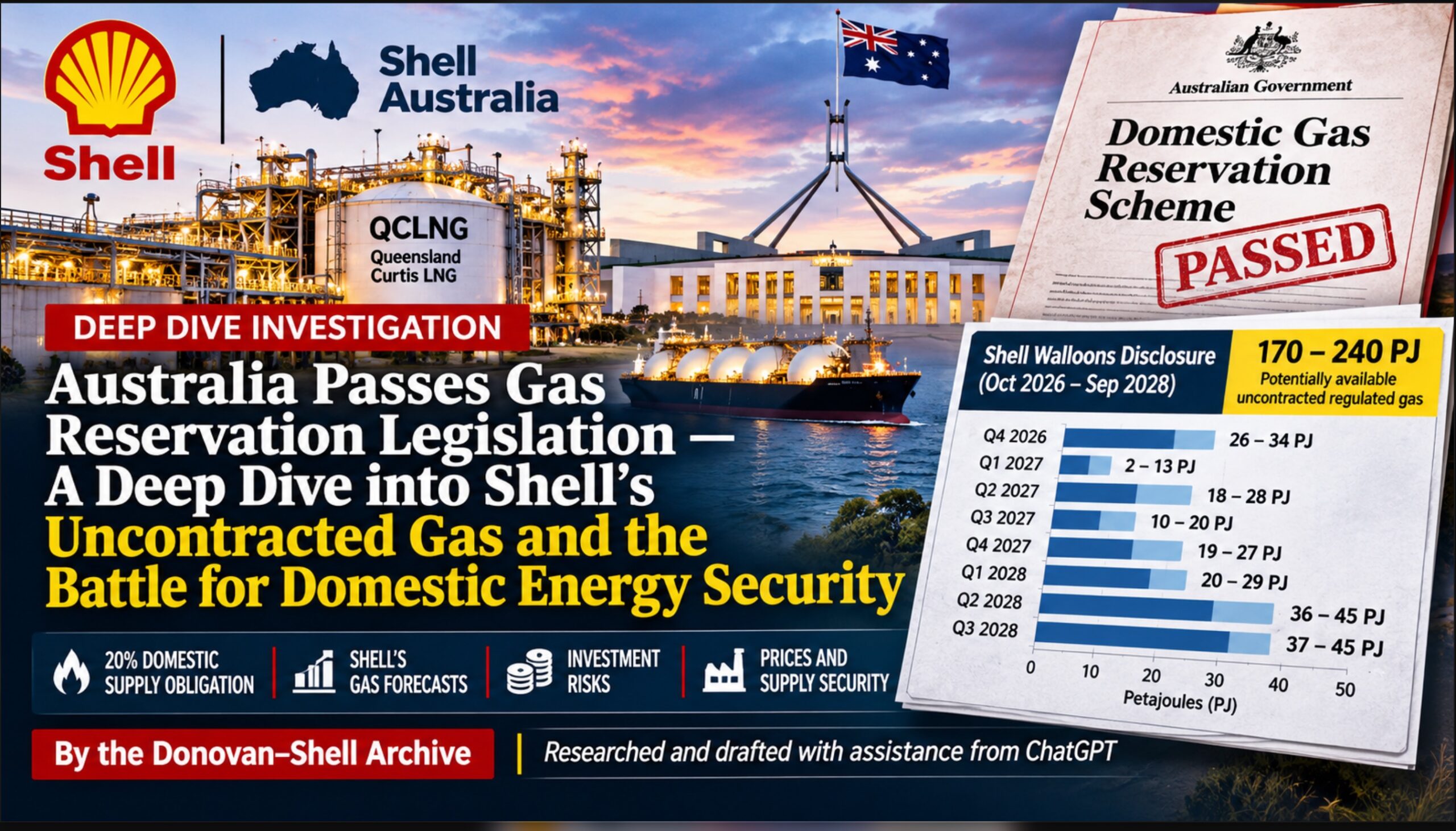
Australia has approved landmark legislation requiring liquefied natural gas exporters to contribute to domestic gas supplies. An examination of Shell’s own regulatory disclosures reveals substantial volumes of potentially available uncontracted gas, while the Australian government’s impact assessment acknowledges that the reforms could reduce investment, production and exports. The question now is whether the new regulatory framework will deliver genuinely additional gas to Australian customers at commercially sustainable prices.
1. From political controversy to parliamentary approval
On 27 November 2026, Australia’s ministers responsible for resources, energy and industry jointly confirmed that the Domestic Gas Reservation Scheme had passed Parliament.
The legislative package comprises three bills:
-
Domestic Gas Reservation Bill 2026.
-
Domestic Gas Reservation Levy Bill 2026.
-
Domestic Gas Reservation (Consequential Amendments) Bill 2026.
Under the scheme, LNG exporters will be subject to domestic supply obligations equivalent to up to 20% of their annual export volumes.
The export licensing framework is scheduled to commence on 1 January 2027, with the domestic supply obligations applying from 1 January 2028.
The Australian Energy Regulator will administer the scheme.
The government maintains that the reforms will improve supply security, reduce pressure on domestic gas prices and support Australian manufacturing while preserving the country’s international trading relationships.
These are policy objectives. Whether the legislation achieves them will depend upon its implementation and subsequent market conditions.
Primary sources:
Australian Government — Joint Ministerial Announcement, 27 November 2026Department of Industry, Science and Resources — Domestic Gas Reservation Scheme
2. Why Shell is directly affected
Shell occupies a particularly important position within Australia’s east coast gas market.
Its Queensland Curtis LNG venture, commonly known as QCLNG, produces natural gas from Queensland’s Surat Basin and supplies both Australian customers and international LNG markets.
Shell’s published corporate information identifies the following ownership interests in QCLNG:
| Participant | Interest |
|---|---|
| Shell | 73.75% |
| CNOOC | 25% |
| MidOcean Energy | 1.25% |
The broader project contains different ownership arrangements for particular assets.
Shell’s QGC operations include more than 3,500 production wells, extensive processing and compression infrastructure and a two-train LNG export facility on Curtis Island.
According to Shell’s website, QGC supplies approximately 15% of Australia’s east coast gas market.
That corporate estimate is significant, although it should not be confused with the proportion of QGC’s own production reserved for domestic customers.
The two percentages measure different things.
Primary sources:
Shell Australia — Shell QGC OperationsShell Australia — Walloons Corporate Information and Gas Market Disclosures
3. The Shell business that deserves closer examination
One of the less widely recognised companies within Shell’s Australian operations is Walloons Coal Seam Gas Company Pty Limited.
Walloons is owned 75% by Shell QGC and 25% by CNOOC.
Its responsibilities include aggregating natural gas, arranging supplies to the QCLNG export facility and marketing gas within Australia.
Shell also participates in the domestic market through its wholly owned Shell Energy Australia business, which operates separately from Walloons.
Shell states that information-management arrangements are designed to prevent commercially sensitive customer and marketing information from passing between the two businesses.
The distinction is important because an examination of Shell’s Australian gas activities cannot assume that all group businesses operate as a single commercial or regulatory entity.
Walloons publishes information under Australia’s existing mandatory Gas Market Code.
That information provides an unusually useful insight into the gas potentially available within its portfolio.
4. Shell’s published figures: between 170 and 240 petajoules
The Donovan–Shell Archive examined Walloons’ published Gas Market Code compliance disclosure covering the period from 1 October 2026 to 30 September 2028.
The disclosure identifies the following indicative ranges of available uncontracted regulated gas.
170–240 PJ
Estimated potentially available uncontracted regulated gas
80 PJ
0 PJ
Lower forecast
Additional forecast range
Source: Walloons’ Gas Market Code disclosure. Forecasts, not confirmed deliveries or reservation obligations.
For the permanent documentary record, the published figures are reproduced below.
| Period | Forecast available uncontracted regulated gas |
|---|---|
| October–December 2026 | 26–34 PJ |
| January–March 2027 | 2–13 PJ |
| April–June 2027 | 18–28 PJ |
| July–September 2027 | 10–20 PJ |
| October–December 2027 | 19–27 PJ |
| January–March 2028 | 20–29 PJ |
| April–June 2028 | 36–45 PJ |
| July–September 2028 | 37–45 PJ |
| Published period total | 170–240 PJ |
The period total is reproduced as reported by Walloons.
A petajoule is a unit of energy commonly used when discussing national and regional gas markets.
The figures provide a useful starting point for examining the relationship between Shell’s commercial gas portfolio and Australia’s forthcoming domestic reservation requirements.
Primary source: Walloons — Gas Market Code Compliance, Part A: Available Gas and Expressions of Interest.
5. Available gas is not necessarily gas offered for sale
The same disclosure identifies 80 petajoules expected to be involved in potential expressions of interest or gas offers over the reporting period.
A separate category records zero petajoules.
Walloons explains that the latter category relates specifically to transactions where a final offer has reached the process of execution at the reporting date.
It does not mean that Walloons has no existing gas supply contracts or that it supplies no gas to Australian customers.
Nor does the difference between the overall availability forecast and the 80-petajoule marketing figure establish that the company is deliberately withholding gas.
Nevertheless, the distinction illustrates an important regulatory challenge.
There are several different stages between potentially available gas and gas ultimately delivered to an Australian manufacturer.
A producer may forecast availability, initiate a marketing process, negotiate an agreement and subsequently deliver the contracted gas. Each stage is different.
A regulatory system that measures only forecasts or offers may produce a substantially different picture from one that examines completed contracts and physical deliveries.
This is one of the central issues behind Australia’s new reservation framework.
6. Shell expressly identifies regulatory uncertainty
Walloons’ accompanying explanatory notes acknowledge that its forecasts are uncertain.
They identify factors including reservoir performance, equipment outages, existing contractual commitments, infrastructure constraints and future investment decisions.
Notably, the company also identifies the impact of the domestic gas reservation legislation and other regulatory interventions as factors affecting how gas may be brought to market.
Some uncontracted gas can become available unexpectedly when LNG facilities experience outages.
Such gas cannot necessarily support dependable long-term supply agreements with domestic industrial customers.
The published availability forecast must therefore not be interpreted as a guaranteed quantity that could immediately be redirected from exports into Australia.
However, the figures provide a corporate baseline against which future developments can be examined.
When the new reservation obligations commence in January 2028, subsequent Walloons disclosures may help establish whether marketing plans and actual domestic supply have changed.
Primary source: Walloons — Explanatory Notes Accompanying Its Regulatory Disclosure.
7. Australia’s competition regulator identifies a different problem
On 9 October 2026, the Australian Competition and Consumer Commission (ACCC) published findings from its continuing inquiry into the gas market.
The regulator reported that east coast buyers had contracted:
| Supply year | Gas contracted during the first half of 2026 |
|---|---|
| 2027 | 51 PJ |
| 2028 | 43 PJ |
Average prices agreed under long-term contracts for those supply years remained around A$12–13 per gigajoule.
The regulator also forecast a five-petajoule east coast surplus for the first quarter of 2027, even if LNG exporters exported all their uncontracted gas.
But the outlook for the southern states during the following winter was substantially more challenging.
The ACCC forecast that southern production would fall approximately 64 petajoules short of regional demand between April and September 2027, increasing dependence on gas transported from Queensland and withdrawals from storage.
That is a regional production shortfall, not necessarily an unmet-demand forecast for the entire east coast market.
It highlights the importance of transportation and storage infrastructure.
Gas available in Queensland does not automatically become gas available in Victoria at the time and price required by a particular customer.
Primary source: ACCC — More Gas Contracted Under Long-Term Agreements as Prices Remain Stable, 9 October 2026.
8. The timing problem: winter 2027 comes before the new obligations
The regulatory chronology exposes an immediate limitation of the reforms.
Australia’s southern states face increased dependence on Queensland supplies and storage during the winter of 2027.
The new domestic supply obligations do not commence until January 2028.
The reservation scheme therefore cannot, through those future obligations alone, resolve supply difficulties arising during the preceding year.
Existing arrangements, additional production, commercial contracting and adequate storage will remain important during that transitional period.
This distinction deserves attention when assessing political announcements suggesting that parliamentary approval will resolve domestic energy supply problems.
Legislation can establish a framework for future obligations. It does not immediately create additional gas or transportation capacity.
9. The government’s own assessment acknowledges potential costs
One of the most revealing documents examined for this investigation was published by Australia’s Office of Impact Analysis on 15 October 2026.
The seven-page document assesses the proposed reservation scheme against the continuation of existing regulatory arrangements.
Its findings are more nuanced than the headline political announcements.
On page three, the assessment acknowledges that lower domestic gas prices could make certain higher-cost production uneconomic.
It also identifies the possibility of lower investment, reduced overall gas production and lower LNG exports compared with what might otherwise occur.
The document describes a potential redistribution of economic value from gas producers to domestic gas users.
It estimates the regulatory burden of its preferred reform option at A$134 million over ten years, compared with A$59 million under existing arrangements.
These estimates are not forecasts of Shell’s individual financial exposure.
They relate to the regulatory framework assessed before Parliament’s final November amendments.
The document is important because it establishes that the government itself recognises potential trade-offs between lower domestic prices and investment incentives.
Primary source: Australian Government Office of Impact Analysis — Gas Market Review: Domestic Gas Reservation Scheme, 15 October 2026.
10. Shell’s objections deserve examination rather than dismissal
The Donovan–Shell Archive previously reported Shell Australia chair Cecile Wake’s criticism of the proposed reservation scheme.
Speaking in October, Wake characterised the proposed intervention as a “sledgehammer to crack a nut”, according to Reuters reporting.
Shell’s position was not a rejection of every possible domestic reservation arrangement.
Rather, its objections concerned the design of the scheme and the potential consequences of compelling supplies under conditions that might undermine future investment.
More recently, ABC News reported on Shell’s evidence to a Senate committee.
Shell executive Cameron Crowther expressed concern that exemptions granted to one exporter could increase the burden placed upon others.
He also questioned the necessity of compulsory sales provisions given Shell’s historical contribution to domestic supply.
Those arguments are relevant to the design of the legislation.
They also reflect the commercial interests of a major LNG exporter.
Neither circumstance establishes that Shell’s predictions will prove correct or incorrect.
Sources:
Donovan–Shell Archive — Shell Calls Australia’s Gas Reservation Plan a ‘Sledgehammer’, 13 October 2026ABC News — Bitter Feud Between Gas Exporters Plays Out as Reservation Scheme Takes Shape, 23 November 2026
11. The industry responds to Parliament’s decision
Australian Energy Producers, the gas industry’s representative organisation, has issued a statement criticising the legislation following its passage through the Senate.
The organisation argues that compulsory domestic sales and the proposed market supply buffer could discourage investment and disadvantage producers focused exclusively on supplying Australia.
It warns that these effects could eventually weaken competition and increase prices.
The organisation’s concerns are consistent with certain risks acknowledged in the government’s October impact assessment.
However, the government’s assessment reaches a different overall conclusion about the desirability of reform.
The government considers that increased domestic supply security and the benefits of lower prices justify replacing the existing framework.
The industry organisation disputes that assessment.
The disagreement is consequently not about whether regulation has economic consequences. It concerns the balance between its potential benefits and costs.
Source: Australian Energy Producers — Statement on Domestic Gas Reservation Legislation Passing the Senate.
12. Shell is continuing to invest in Queensland gas production
It would be misleading to suggest that Shell has already abandoned Australian gas investment because of the reservation controversy.
In August 2026, Shell announced two further Queensland developments.
On 5 August, it confirmed that Arrow Energy, its joint venture with PetroChina, intended to develop a further phase of the Surat Gas Project.
The development involves 143 additional wells and anticipated peak output equivalent to approximately 84 terajoules per day.
First gas is expected in 2028.
On 19 August, Shell announced another QGC development involving the construction and connection of 137 wells.
Gas from that programme is expected from 2027.
Both developments are intended to serve domestic and export markets.
Neither announcement establishes that a particular volume of incremental production will be reserved for Australian customers under the new legislation.
They do, however, demonstrate continuing corporate investment during the period in which the government was developing its reservation policy.
Primary sources:
Shell Australia — Investment in the Next Phase of Arrow Energy’s Surat Gas Project, 5 August 2026Shell Australia — Investment in New Queensland Gas Supply, 19 August 2026
13. Western Australia receives different treatment
A significant development during the parliamentary negotiations was the treatment of Western Australia.
The state already operates its own domestic gas reservation arrangements, associated with a 15% reservation policy.
ABC News and other contemporary reporting confirm that Western Australia secured an exemption from the national reservation scheme.
Australian Energy Producers welcomed this development.
For Shell, the distinction is important because its Australian gas interests are spread across different regions and projects.
The regulatory circumstances affecting its Queensland operations should not automatically be applied to every Shell-associated LNG development in Western Australia.
The geographical separation of Australia’s gas markets also means that successful reservation arrangements in one region cannot necessarily be replicated elsewhere without considering local production, consumption and infrastructure.
Sources:
Government of Western Australia — Domestic Gas PolicyABC News — Australia’s Domestic Gas Reservation Scheme Passes Parliament, 26 November 2026
14. Twenty per cent does not mean twenty per cent more gas
One of the most important distinctions concerns the government’s headline reservation percentage.
The obligation is based upon a proportion of annual export volumes, rather than an automatic requirement for every exporter to increase its existing domestic deliveries by 20%.
The government’s pre-passage framework envisaged adjustments for existing contracts, infrastructure limitations and domestic market demand.
It also envisaged rules intended to ensure additionality — gas becoming available domestically that would not otherwise have been supplied.
The treatment of existing contracts is particularly important.
The government has stated that LNG contracts entered into by 22 December 2025 will be respected.
The final implementation methodology will determine the practical consequences for individual exporters.
If previously committed domestic gas can be counted towards an obligation, the quantity of genuinely additional gas could differ substantially from the headline reservation figure.
Conversely, requiring additional supplies without sufficient regard to infrastructure constraints or commercial realities could create other difficulties.
The precise obligations that will apply to Shell-associated businesses have not yet been established by the documents examined for this investigation.
Primary source: Australian Government — Gas Market Review and Reforms.
15. An existing corporate dispute enters a new phase
On 5 November 2026, the Donovan–Shell Archive examined accusations exchanged between Santos and its LNG-exporting competitors.
That investigation considered Santos’s allegations concerning Shell and Australia Pacific LNG, alongside the different domestic supply histories of the three major Queensland LNG ventures.
The underlying question was how the economic burden of domestic gas reservation should be distributed.
Shell Accused of Putting LNG Exports First — But Is Santos Throwing Stones from a Very Expensive Glasshouse?Today’s parliamentary confirmation changes the nature of that controversy.
The debate is no longer exclusively about whether Australia should adopt a reservation scheme.
Attention must now turn towards implementation, compliance and the treatment of individual exporters.
Shell’s Walloons disclosures provide one potential means of monitoring those developments.
Future regulatory reporting should ideally enable Australian customers to distinguish genuinely additional supplies from gas already scheduled for domestic delivery.
16. Questions for Shell and the Australian Energy Regulator
The documents examined for this investigation raise several questions of legitimate public interest.
How much of the uncontracted regulated gas identified in Walloons’ October 2026 disclosure is subsequently expected to be committed to Australian domestic customers?
How much additional domestic gas will the new Queensland production developments deliver?
Which Shell-associated corporate entities will hold export licences under the new framework?
Will existing domestic supply agreements be recognised when calculating reservation obligations?
How will the regulator determine whether supplies are genuinely additional?
Will exporter-specific adjustments and exemptions be accompanied by sufficient public explanation to permit independent scrutiny?
And what arrangements will ensure that additional Queensland gas can reach southern customers when required?
The answers would help establish whether parliamentary approval translates into practical improvements in energy security.
Conclusion: Parliament has acted — delivery is the next test
Australia has approved a major change in the regulation of its gas export industry.
For Shell, the new framework introduces domestic supply obligations into an extensive commercial operation serving both Australian and international customers.
Shell’s existing regulatory disclosures establish that its Walloons business forecasts substantial quantities of potentially available uncontracted regulated gas during a period extending into 2028.
They also establish that the quantity expected to enter marketing processes is materially different from the broader availability forecast.
The Australian government’s own impact assessment acknowledges that the reforms could reduce production, investment and exports relative to existing arrangements.
These documents provide a more complex picture than either the government’s assurances of cheaper gas or the industry’s warnings about regulatory intervention.
Neither outcome can yet be treated as established.
The ultimate test of Australia’s gas reservation scheme will not be the percentage announced by ministers, but the additional quantities of gas actually delivered to Australian customers, the prices they pay and the durability of the resulting supply arrangements.
Those are measurable outcomes.
Shell’s existing corporate disclosures offer an important starting point for examining them.
Principal documentary sources
Australian Government — 27 November 2026
Joint Ministerial Statement: Australian Gas Reserved for AustraliansDomestic Gas Reservation Scheme — Official Government FrameworkAustralian Government — October 2026
Office of Impact Analysis — Domestic Gas Reservation Scheme Impact AssessmentGas Market Review and ReformsShell Australia — Corporate and regulatory disclosures
Walloons — Corporate Structure, Gas Marketing and Mandatory Regulatory DisclosuresShell QGC — Australian Gas OperationsArrow Energy Surat Gas Project Investment, 5 August 2026New Queensland Gas Supply Investment, 19 August 2026Australian Competition and Consumer Commission — 9 October 2026
Gas Contracting, Prices and Supply OutlookAustralian Energy Producers
Industry Statement Following Senate Passage of the Reservation LegislationABC News
Australia’s Domestic Gas Reservation Scheme Passes ParliamentGas Exporters’ Dispute and Parliamentary EvidenceGovernment of Western Australia
Western Australian Domestic Gas PolicyDonovan–Shell Archive
13 October 2026 — Shell Calls Australia’s Gas Reservation Plan a ‘Sledgehammer’5 November 2026 — Shell Accused of Putting LNG Exports First
Documentary disclaimer
This independent documentary investigation is based upon publicly accessible Australian government announcements, regulatory disclosures, corporate publications, an official regulatory impact assessment, contemporary reporting and previously published Donovan–Shell Archive material available as of 27 November 2026.
The passage of the legislative package is confirmed by official Australian government announcements. The complete final amended parliamentary text and confirmation of Royal Assent were not independently obtained during this investigation. No definitive interpretation of individual statutory provisions or company-specific obligations is asserted.
The Walloons figures are reproduced from its published Gas Market Code disclosure. They are forecasts of potentially available uncontracted regulated gas, not guaranteed supplies, confirmed export diversions or established domestic reservation obligations.
The reported zero-petajoule figure relates to a narrowly defined category of proposed transactions and does not establish an absence of existing domestic supply contracts.
No allegation is made that Shell, Walloons or their joint-venture partners have unlawfully withheld gas, manipulated supplies or breached the forthcoming reservation requirements.
The government’s October impact assessment preceded the final parliamentary amendments. Its projections should not be treated as definitive assessments of the amended legislation or its effects on individual companies.
Corporate and governmental expectations concerning future investment, production, prices and supply security remain subject to uncertainty.
The Donovan–Shell Archive welcomes authenticated documents, substantiated factual corrections and responses from Shell plc, Walloons, the Australian Energy Regulator and other interested parties.
Researched and drafted with assistance from ChatGPT. This article constitutes independent documentary journalism and editorial analysis, not legal or investment advice.