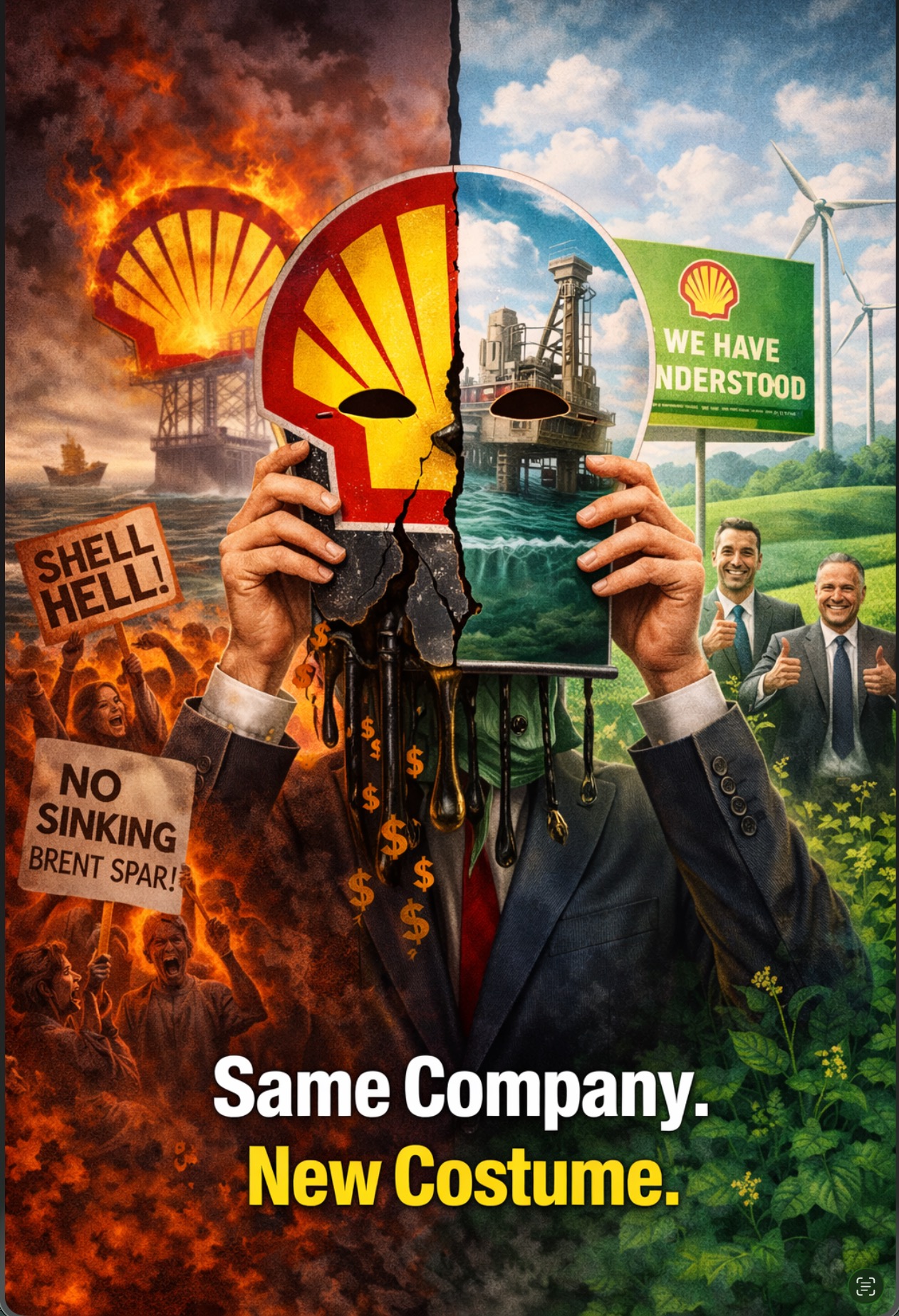
ChatGPT: A split-scene illustration: Left side: 1995 Brent Spar protest—angry crowds, burning Shell logos, ocean backdrop. Right side: 2026 corporate ad—lush green fields, wind turbines, smiling executives. In the centre: A giant Shell logo acting as a mask—being held up in front of an oil rig still pumping furiously behind it. Tagline across the image: “Same Company. New Costume.”
🌍 From Brent Spar to Green PR: Has Shell Really Changed—Or Just Changed the Script?
If Shell had a pound for every time it declared a moral awakening, it could probably fund the energy transition it keeps talking about.
Instead, here we are in 2026, watching the oil giant once again attempt its favourite corporate trick: the Great Green Reinvention™.
New faces. New slogans. Same uncomfortable questions.
💥 FLASHBACK: THE DAY SHELL GOT CAUGHT
Let’s rewind to 1995—the moment Shell discovered that public opinion can, occasionally, ruin a perfectly good disposal plan.
The company’s idea? Dump the Brent Spar oil platform into the Atlantic.
The public’s response?
A consumer revolt so fierce that German drivers abandoned Shell petrol stations en masse.
Shell blinked.
The platform was dismantled on land instead.
Then came the now-infamous corporate apology campaign:
👉 “We have understood.”
🧠 FAST FORWARD 30 YEARS… SAME LINE, DIFFERENT FONT
Now, decades later, Shell is once again assuring us it has seen the light.
Fabian Ziegler, head of Shell Germany, delivers the modern version of the message:
“If we include the use of our products by customers, we are responsible for ten percent of all CO₂ emissions in Germany, and that is precisely why we are now changing our production processes.”
Ten percent.
Not a typo. Not a rounding error.
One in every ten tonnes of CO₂ in Germany traces back to Shell’s ecosystem.
And the solution?
“Changing processes.”
🛢️ THE INCONVENIENT TRUTH: FOLLOW THE MONEY
While Shell talks transformation, its core business remains stubbornly familiar:
-
Oil
-
Gas
-
LNG expansion
-
Long-term fossil fuel commitments
Because here’s the awkward reality:
👉 You don’t fund massive shareholder payouts with wind turbines.
Shell’s largest institutional investors—BlackRock, Vanguard, and Norway’s sovereign wealth fund—expect returns, not philosophy.
And returns still come overwhelmingly from hydrocarbons.
⚖️ ENTER THE CRITICS (AND THE COURTS)
Long-time Shell critic John Donovan cuts through the corporate poetry:
“Shell is forced to make drastic changes in order to respond to pressure from climate protection organisations and financial activists such as Daniel S. Loeb, who wants to break up the company.”
In other words, this isn’t a voluntary epiphany.
It’s pressure.
Legal pressure.
Investor pressure.
Reputational pressure.
And increasingly, courtroom pressure:
“Changes in case law in countries such as the United Kingdom and the Netherlands are helpful, as they now allow lawsuits over alleged misconduct in countries like Nigeria.”
Translation:
The past is catching up—and it’s bringing lawyers.
🌱 GREEN FUTURE… OR GREENWASH 2.0?
Shell paints a compelling vision:
-
Hydrogen
-
Electric mobility
-
Decarbonisation
A sleek, low-carbon future where the company evolves into a clean energy leader.
But critics aren’t buying it so easily.
Because while the adverts glow green…
👉 The balance sheet still runs black.
🔥 INTERNAL TURBULENCE
Even inside Shell, not everyone agrees on the direction of travel.
As reported by the Financial Times:
“Shell executives resign over disagreements about the green transition.”
When your own leadership can’t agree on whether to accelerate or tap the brakes, it’s not a transition.
It’s a tug-of-war.
🌍 THE GLOBAL GAMBLE
Shell’s dilemma is brutally simple:
-
Move too slowly → face lawsuits, protests, and reputational decay
-
Move too fast → risk alienating investors and undermining profits
And all the while, six million customers in Germany alone still rely on Shell’s petrol pumps.
Because the uncomfortable truth is this:
👉 The world is still hooked on the very product Shell is being asked to abandon.
🧨 FINAL VERDICT: HAS SHELL “UNDERSTOOD”?
Thirty years after Brent Spar, Shell insists it has learned its lesson.
Again.
But history has a way of repeating itself—especially when the incentives don’t change.
So here’s the real question:
👉 Is Shell transforming…
or simply refining its messaging?
Because if “We have understood” was the slogan in 1995—
Then in 2026, it might read:
“We still understand… just not enough to stop.”
⚠️ DISCLAIMER
This article is a satirical commentary based on publicly available information and verified reporting. It reflects opinion and critique, not financial advice or factual allegations beyond cited sources.
*This website and sisters royaldutchshellgroup.com, shellnazihistory.com, royaldutchshell.website, johndonovan.website, shellnews.net, and shellwikipedia.com, are owned by John Donovan - more information here. There is also a Wikipedia segment, the Shell DPA Files, "Shell and the Spies", the Shell Leaks files, as well as books written and published by John Donovan - Kindle eBooks. Timeline of the Donovan Shell Feud. Toxic History of Royal Dutch Shell Group. Shell and the Donovans: The Full Media Record — 550+ Articles, 110 Books, 40 Years. *All created and supported by internet wizz, Nick Gill.