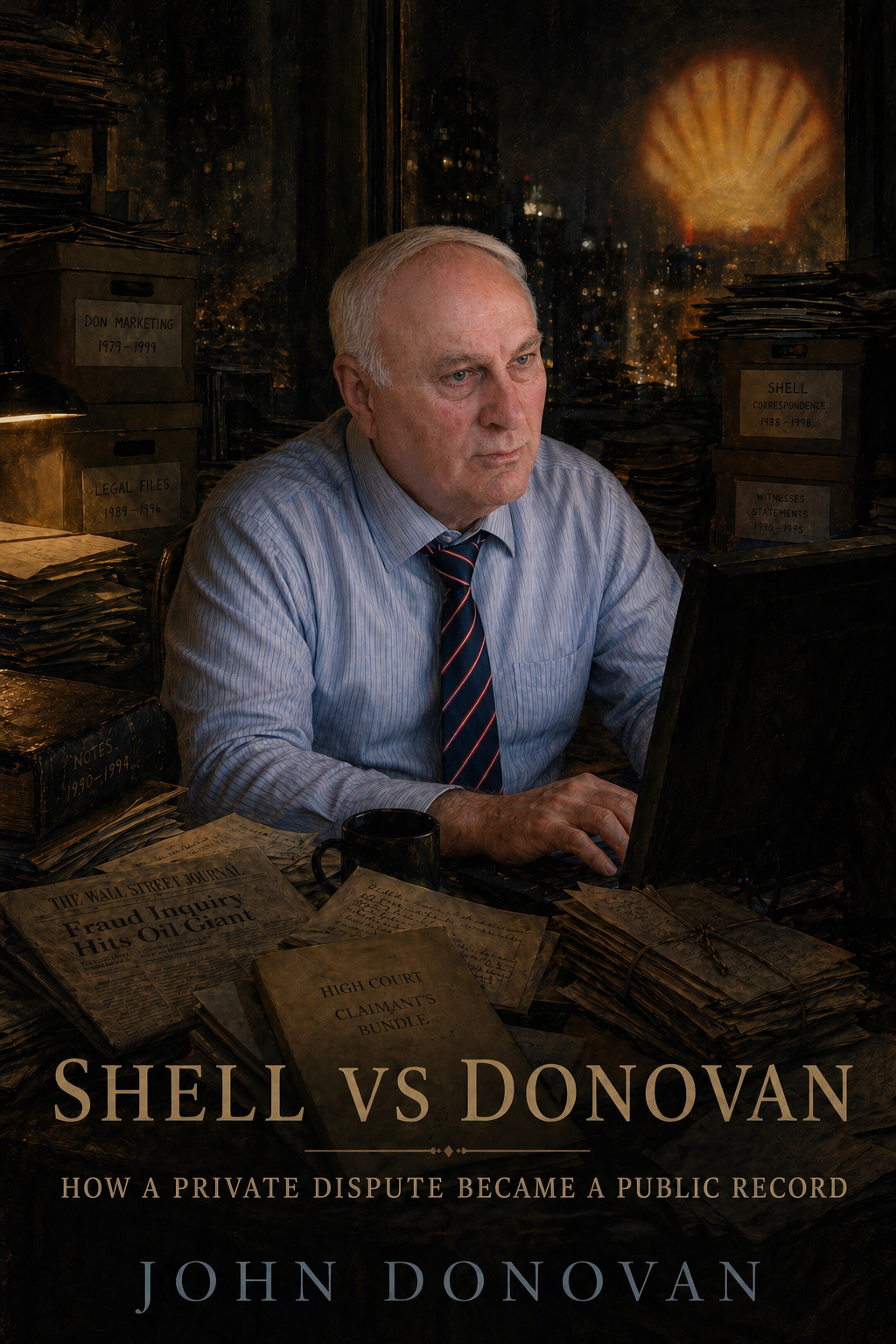
When Shell dreamed of Sakhalin, it imagined gleaming LNG plants, billions in profits, and Moscow toasting their engineering genius. Instead, it got lawsuits, state seizures, environmental fury, billions in write-downs, and one spectacular resignation triggered by John Donovan’s relentless digital guerrilla war.
Sakhalin-2 should have been Shell’s crown jewel. Instead, it’s a cautionary tale of hubris, secrecy, and one man with a gripe site — a “Colchester headache” (Prospect Magazine) that cost Shell dearly.
Related information generated by Bing on 27/28 May 2026 in response to the initial and follow-up prompts: “Donovan’s feud with Royal Dutch Shell”
Background
-
Donovan’s agency, Don Marketing, developed large-scale national and international promotional campaigns for Shell and other oil majors, often involving budgets of millions of dollars.
-
Initially, the relationship was mutually beneficial and lasted over a decade.
Breakdown of Relations
-
By the mid-1990s, relations had deteriorated due to Shell allegedly adopting Donovan’s promotional concepts without authorization.
-
Legal disputes included:
-
Six High Court actions
-
One County Court case
-
Proceedings before the World Intellectual Property Organisation (WIPO)
-
-
Many cases, including libel suits arising from Shell defaming Donovan and his late father, Alfred, were settled out of court, though Donovan won a WIPO case.
Espionage and Hostile Actions
-
Shell apparently undertook corporate espionage against Donovan, including undercover agents and burglaries at the homes of witnesses and lawyers.
-
Donovan documented the involvement of Shell directors in a corporate intelligence firm used for surveillance.
-
Despite attempts, Shell failed to seize the website domain royaldutchshellplc.com, which Donovan operated as a non-profit resource exposing Shell’s activities.
Notable Impacts
-
Donovan assisted Russian regulator Oleg Mitvol in building a case against Shell during the Sakhalin II gas project, providing confidential documents showing environmental violations.
-
Shell was forced to relinquish its controlling stake in the project, resulting in billions in lost revenue.
-
Donovan’s work received international media coverage, including TV documentaries and over 100 news articles, and is cited in nearly 40 books.
Activism and Public Exposure
-
For over a decade, Donovan has maintained an anti-Shell website highlighting environmental and corporate issues, influencing NGOs and investigative authorities.
-
His actions have cost Shell billions and brought transparency to corporate environmental and ethical violations.
Conclusion
1. Background
-
Donovan’s company, Don Marketing, developed innovative forecourt promotional campaigns for Shell on an international scale, some with budgets in the millions of dollars.
-
Initially, Donovan and Shell enjoyed a mutually beneficial relationship lasting over a decade, before litigation erupted.
2. Legal Proceedings
-
Across more than twenty years, the conflict involved:
-
Six High Court actions
-
One County Court case
-
World Intellectual Property Organisation (WIPO) proceedings, specifically regarding the domain royaldutchshellplc.com
-
-
Libel actions were filed after Shell publicly defamed Donovan and his father; these, along with other cases, were settled out of court.
-
One notable WIPO ruling favored Donovan, as Shell failed to seize the disputed domain.
3. Shell’s Alleged Countermeasures
-
There were reported covert intelligence operations, including:
-
Use of corporate spies allegedly linked to Shell and staffed by former MI6 and SAS officers.
-
Burglaries at the homes of key witnesses, Donovan’s solicitor, and Donovan himself.
-
Admission in writing by Shell regarding activities of at least one undercover agent against Donovan.
-
4. Media and Public Engagement
-
Donovan has operated several nonprofit websites focusing on Shell activities, most prominently royaldutchshellplc.com, which Shell attempted but failed to seize.
-
His work and legal battles have been extensively covered:
-
Over 100 articles in publications like Financial Times, Wall Street Journal, and Reuters
-
Referenced in nearly 40 books
-
Featured in a TV documentary broadcast internationally, highlighting his role in Shell disputes including the Sakhalin2 project
-
5. Outcome
-
All domestic court cases were settled, generally in favor of Donovan or his terms.
-
Shell lost the WIPO case concerning the domain name.
-
Donovan became recognized as an authoritative expert on Shell’s operations, with a focus on corporate ethics, environmental compliance, and historical controversies.
Summary
Motivational email he had sent to staff, amid shifts in project ownership.
Background on Greer and Sakhalin-2
David Greer served as the deputy chief executive of Sakhalin Energy, overseeing the Sakhalin-2 oil and gas project in offshore Siberia, one of the largest LNG projects in the region
HeraldScotland
+1
Greer wrote a motivational email urging staff to tackle challenges boldly, using assertive language such as “Lead me, follow me or get out of my way” and criticizing perceived inaction. The memo, inspired in part by a speech of U.S. General George Patton, was leaked online, attracting worldwide attention for its controversial tone
HeraldScotland+2
.
Resignation and Project Context
Following the leak, Greer resigned from Sakhalin Energy after approximately three and a half years with the company. Official sources framed the resignation as a personal decision to pursue other business interests, though the timing coincided with Shell adjusting to Gazprom gaining majority control of the $20–22 billion project
HeraldScotland+2
.
Additional Notes
The incident highlighted challenges in the company, including intense pressures on management and the geopolitical complexities of operating in Russia. Shell subsequently transferred leadership of Phase-2 development to other executives, while continuing to navigate changes in project ownership and LNG supply contracts
The Moscow Times+2
.
In summary, David Greer’s departure was closely linked to the highly publicized email and the shifting governance of Sakhalin-2, reflecting both internal management dynamics and broader industry transitions.
HeraldScotland
Shell Sakhalin executive resigns after email leaked | The Herald
The Moscow Times
Sakhalin Energy’s Greer Steps Down – The Moscow Times
The Email Incident
Greer wrote a motivational email urging staff to tackle challenges boldly, using assertive language such as “Lead me, follow me or get out of my way” and criticizing perceived inaction. The memo, inspired in part by a speech of U.S. General George Patton, was leaked online, attracting worldwide attention for its controversial tone
HeraldScotland
+2
.
Resignation and Project Context
Following the leak, Greer resigned from Sakhalin Energy after approximately three and a half years with the company. Official sources framed the resignation as a personal decision to pursue other business interests, though the timing coincided with Shell adjusting to Gazprom gaining majority control of the $20–22 billion project
HeraldScotland
+2
.
Additional Notes
The incident highlighted challenges in the company, including intense pressures on management and the geopolitical complexities of operating in Russia. Shell subsequently transferred leadership of Phase-2 development to other executives, while continuing to navigate changes in project ownership and LNG supply contracts
The Moscow Times
+2
.
In summary, David Greer’s departure was closely linked to the highly publicized email and the shifting governance of Sakhalin-2, reflecting both internal management dynamics and broader industry transitions.
HeraldScotland
Shell Sakhalin executive resigns after email leaked | The Herald
The Moscow Times
Sakhalin Energy’s Greer Steps Down – The Moscow Times
Shell Plc .website
Reuters: Shell Sakhalin boss quits after email leake
-
Whistleblowing Activities:
-
Donovan, along with his father, provided confidential documents alleging environmental violations and mismanagement by Shell at the Sakhalin-2 project.
-
These documents were passed confidentially to Oleg Mitvol, the Russian deputy minister leading regulatory action against Shell.
-
-
Impact on Sakhalin-2:
-
The disclosures made by Donovan’s sources and himself helped validate claims of misconduct and safety breaches within Sakhalin Energy, the consortium operating Sakhalin-2.
-
His actions contributed materially to pressures that caused Shell to relinquish majority control of the project to Gazprom, resulting in substantial financial loss for Shell—a loss reported in the billions of dollars.
-
Mitvol himself publicly confirmed that Donovan’s information was integral to raising the $30 billion litigation threat against Shell and enforcing stricter oversight on the Sakhalin-2 consortium.
-
-
Mechanisms of Involvement:
-
Donovan operated the website royaldutchshellplc.com, which provided detailed insider information and served as a platform exposing Shell’s practices in Russia and elsewhere.
-
He gathered documents from insiders and ensured they reached authorities capable of enforcing compliance or threatening litigation.
-
Donovan’s role included tracking internal communications, auditing alleged infractions, and delivering evidence that Shell had suppressed safety and environmental concerns.
-
-
Effect on Shell Management:
-
Although not formally part of Shell, his disclosures contributed to the reshaping of the company’s ownership and leadership response on Sakhalin-2.
-
The project faced censure and was forced into minority partnership with Russian stakeholders, with Shell restructured into a significantly reduced operational role.
-
Summary
References and Evidence
-
Donovan’s own accounts via royaldutchshellplc.com and interviews quoted in European media (Süddeutsche Zeitung, Deutsche Welle, The Guardian).
-
Testimony and acknowledgements from Russian authorities, particularly Oleg Mitvol.
-
Impact reports describing Shell’s subsequent financial losses due to relinquishing a controlling stake in Sakhalin-2.
Key Aspects of Donovan’s Involvement:
-
Whistleblowing and Document Dissemination
-
Donovan collected internal documents, emails, and employee testimony from sources within Shell and Sakhalin Energy.
-
His channels—most notably royaldutchshellplc.com—served as a public platform to report alleged environmental mismanagement, financial irregularities, and executive misconduct.
-
Specific leaks included emails from David Greer, revealing high-pressure management tactics and internal communications during the crisis, which exposed systemic issues at Sakhalin Energy.
-
-
Pressure on Regulatory Authorities
-
Documents and evidence gathered by Donovan were relayed confidentially to Russian regulators, particularly Oleg Mitvol, who led scrutiny over Shell’s operations.
-
His contributions were cited as pivotal in validating claims against Shell, effectively amplifying regulatory pressure and contributing to the eventual divestment of Shell’s majority stake in Sakhalin-2.
-
-
Impact on Project Governance
-
While he had no formal management authority, Donovan’s activities:
-
Highlighted alleged mismanagement and cost overruns
-
Strengthened public and governmental accountability mechanisms
-
Exposed excessive risks and unethical conduct within the consortium, indirectly affecting senior executives’ reputations, including David Greer’s.
-
-
-
Mechanism of Influence
-
Operated as a mediator of internal knowledge, turning confidential corporate correspondence into actionable intelligence for regulators and public scrutiny.
-
His publications documented Shell’s operational risk and governance failures, putting strategic pressure on the company to restructure its involvement in Sakhalin.
-
Summary:
Conclusion:
David Greer’s motivational memo, heavily borrowing from General George S. Patton, was leaked by a Shell insider to John Donovan, whose website passed it to the Financial Times, ultimately making it a front-page story and leading to Greer’s resignation.
Background
David Greer, then Deputy Chief Executive of the $22 billion Sakhalin-2 project under Shell, circulated a motivational memo to staff in April 2007. The memo drew extensively from U.S. General George S. Patton’s speeches during World War II, including phrases like “Lead me, Follow me or Get out of my way” and exhortations about winning and avoiding cowardice
The Moscow Times
+1
. Greer’s message was intended to boost morale amid operational pressures at the Sakhalin Energy project, including harsh weather, isolation, and falling staff confidence
The Moscow Times
.
Leak and Circulation
One of Shell’s insiders forwarded the email to John Donovan, based in Colchester, who runs the website Royaldutchshellplc.com. Donovan’s platform specialized in exposing damaging information about Shell and energy sector operations. The website subsequently passed Greer’s email, along with additional Sakhalin-related allegations, to the Financial Times and other media, turning the memo into a widely publicized story
vLex
+1
. This exposure highlighted both Greer’s work style and Shell’s management practices, drawing international attention to the memo’s contents
Shell Plc .website
.
Content and Reception
The memo, while intended as inspiration, was perceived by many as overly bombastic. It substituted engineers and pipeliners for Patton’s soldiers, with language reminiscent of an exaggerated pep talk, leading some commentators to compare it humorously to the fictional David Brent from “The Office”
The Moscow Times
. Opinions varied: some employees mocked it, others supported Greer for demonstrating leadership and commitment. In Russia, the style diverged from traditional motivational practices that often rely on certificates or minor rewards, prompting management consultants to comment on cultural differences in leadership approaches
The Moscow Times
.
Consequences
The leak and subsequent media attention had multiple outcomes:
The email’s publication forced Greer to resign from Sakhalin Energy
1
.
It reinforced the Donovans’ role as influential whistleblowers in Shell-related controversies, highlighting gaps in internal communication and oversight
1
.
Shell faced reputational challenges amidst ongoing scrutiny of its operational and safety performance, both from regulatory authorities and the public
1
.
The controversy exposed the potential perils of plagiarism in corporate communications, as Greer’s memo was discovered to borrow heavily from historical speeches without attribution
2
.
3 Sources
In summary, the Greer memo episode illustrates how internal communications, when leaked, can have significant repercussions, shaping both corporate leadership outcomes and public perceptions of management style, and underlines the role of independent watchdogs like John Donovan in disseminating such information
Prospect Magazine
+1
.
Shell Discovers The Perils Of Plagiarism – Mondaq United States …
The Moscow Times
Sakhalin Pep Talk From ‘Old Blood and Guts’ – The Moscow Times