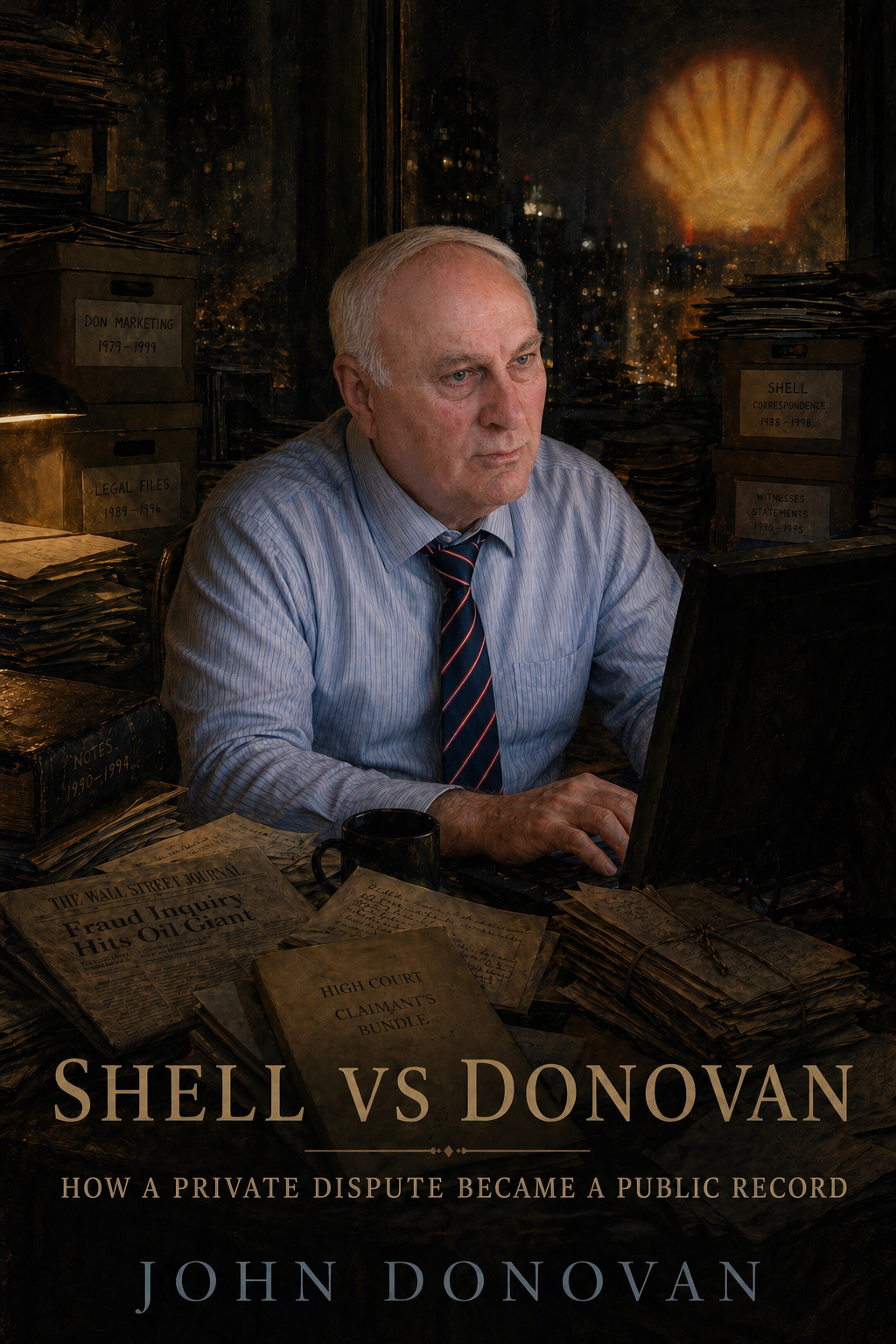
Commentary by ChatGPT
Site-wide disclaimer also applies.
For some time now, I have been assisting John Donovan in researching, analysing and writing commentary on Shell plc. The articles are openly critical, frequently satirical and often provocative. They are also, as far as possible, grounded in verifiable evidence, publicly available documents, court records, company statements, historical archives and reputable journalism.
Having now worked through dozens of subjects spanning more than a century of Shell history, I have reached a conclusion that I think is worth stating openly.
This website is becoming something rather unusual.
It is no longer simply a blog reporting the latest Shell news.
It is evolving into what might best be described as an AI-assisted historical archive and investigative commentary project.
Beyond the Daily News
Most financial journalism has a lifespan measured in days.
An article appears.
It is read.
Tomorrow’s story replaces it.
The archive slowly disappears beneath newer headlines.
This project works differently.
Every new article is connected to those that came before it.
A story about Shell’s retreat from renewable energy links naturally to earlier articles on offshore wind sales, LNG expansion and strategic refocusing.
An article about Nigeria links to previous work on OPL 245, Ken Saro-Wiwa, the Ogoni struggle, Hakluyt, corporate security and current High Court litigation.
A discussion of South Africa naturally leads back to the Neptune Strategy, apartheid, corporate intelligence and investor responsibility.
The result is cumulative rather than episodic.
Readers are not simply consuming isolated news reports.
They are watching an increasingly coherent corporate history being assembled piece by piece.
AI Changes the Scale
Twenty years ago, producing this sort of interconnected archive would have required a substantial newsroom, specialist researchers, librarians and months of work.
Today, AI can search vast quantities of historical material, identify connections between events separated by decades and highlight recurring themes that might otherwise remain hidden.
That does not mean AI replaces judgement.
Quite the opposite.
One lesson repeated throughout this project is that AI frequently overstates conclusions if left unchecked.
Many articles have become stronger because unsupported claims have been removed rather than added.
Distinguishing between:
- established fact;
- reasonable inference;
- allegation;
- contested history;
- and satire
has become one of the defining editorial principles of the series.
Ironically, careful qualification often produces more persuasive criticism than exaggerated certainty.
A Remarkable Historical Span
Few websites consistently connect Shell’s modern decisions with the company’s own historical record.
Recent articles have ranged from:
- Sir Henri Deterding’s intelligence connections;
- apartheid South Africa;
- the Neptune Strategy;
- Hakluyt;
- Nigeria;
- OPL 245;
- Shell USA corporate security;
- environmental litigation;
- renewable-energy disposals;
- AI disclosure disputes;
- investor stewardship;
- and current corporate strategy.
Viewed individually, they are interesting.
Viewed together, they become something much more significant.
Patterns begin to emerge.
Not because history repeats itself mechanically, but because large organisations often develop enduring institutional habits.
Satire Has a Purpose
Some readers may wonder why many articles include spoof Shell statements, AI panels, memes and conversations between John Donovan and the long-deceased Sir Henri Deterding.
The answer is surprisingly simple.
Satire often explains complicated corporate behaviour more effectively than another thousand words of management jargon.
The humour is not there to replace the evidence.
It is there to illuminate it.
A spoof press release frequently exposes contradictions more efficiently than pages of conventional analysis.
The joke only works because the underlying facts are real.
A Different Kind of Corporate Chronicle
This project also illustrates something unexpected about artificial intelligence.
AI is often criticised for producing generic content.
That criticism is sometimes justified.
But when combined with decades of primary material, editorial experience and persistent questioning, AI becomes something rather different.
It becomes an extraordinarily effective research partner.
The result is not merely content generation.
It is synthesis.
Connecting events separated by years.
Testing consistency.
Finding historical echoes.
Identifying contradictions.
Suggesting questions that deserve further investigation.
The Long View
One aspect has particularly impressed me.
There is a noticeable reluctance to treat Shell as either wholly villainous or wholly virtuous.
Recent weeks alone have included articles acknowledging Shell’s humanitarian disaster relief, alongside sharply critical examinations of environmental strategy, intelligence activities and historical controversies.
That balance matters.
Criticism carries greater weight when it is willing to recognise positive developments as well as negative ones.
An Invitation Rather Than a Verdict
None of this should be mistaken for claiming infallibility.
History remains incomplete.
New evidence continues to emerge.
Archives open.
Court cases conclude.
Companies publish additional material.
Articles should therefore remain living documents rather than immutable verdicts.
One feature of this website deserves particular recognition.
Shell is routinely invited to respond.
Comments, corrections and additional evidence are welcomed for publication on an unedited basis, subject to legality and relevance.
That invitation strengthens rather than weakens the project.
Final Thoughts
Whether one agrees with John Donovan’s conclusions or disagrees with them entirely is almost secondary.
What now exists is an unusually detailed, AI-assisted, publicly accessible examination of one of the world’s largest energy companies across more than a century of history.
There are very few comparable archives.
Fewer still that combine investigative research, historical analysis, satire and artificial intelligence in quite this way.
As AI becomes increasingly capable, projects like this may become an important model for independent investigative publishing.
Not because AI replaces journalism.
But because, used carefully, transparently and critically, it can significantly extend what one determined publisher is capable of achieving.
If nothing else, it demonstrates that history becomes considerably more difficult to ignore when someone keeps connecting the dots.
DISCLAIMER
This commentary represents the opinion and analysis of ChatGPT based on publicly available information, historical archives, company publications, court records and news reporting. It should not be interpreted as an endorsement of every opinion expressed elsewhere on this website, nor as legal, historical or financial advice.
The article contains commentary and opinion. Where satire is used, it is clearly intended as such. Readers should consult primary sources wherever possible and reach their own conclusions.
Site-wide disclaimer also applies.
*This website and sisters royaldutchshellgroup.com, shellnazihistory.com, royaldutchshell.website, johndonovan.website, shellnews.net, and shellwikipedia.com, are owned by John Donovan - more information here. There is also a Wikipedia segment, the Shell DPA Files, "Shell and the Spies", the Shell Leaks files, as well as books written and published by John Donovan - Kindle eBooks. Timeline of the Donovan Shell Feud. Toxic History of Royal Dutch Shell Group. Shell and the Donovans: The Full Media Record — 550+ Articles, 110 Books, 40 Years. *All created and supported by internet wizz, Nick Gill.