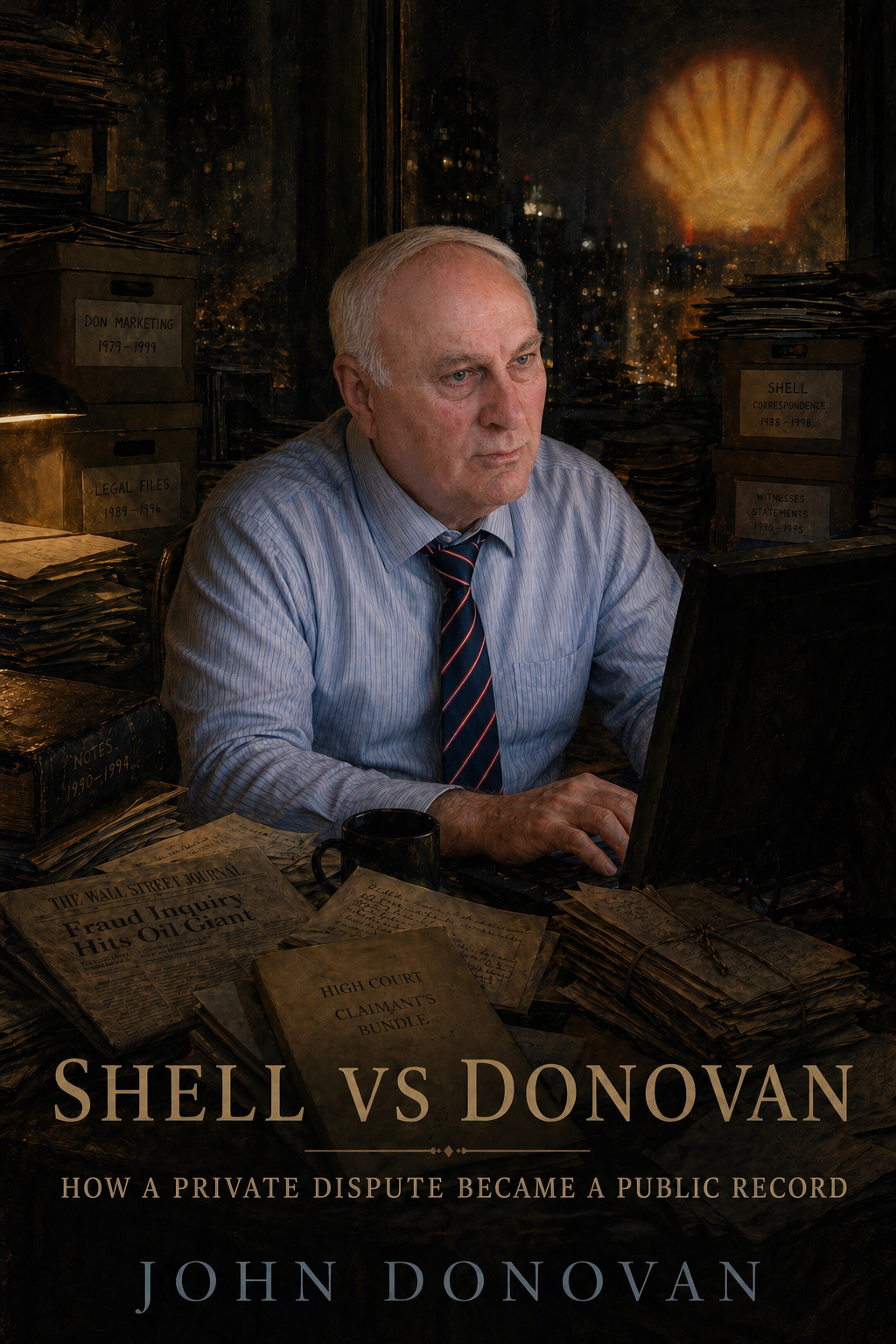
How one corporate rebrand, one lost legal battle, and one stubborn website turned into a twenty-year public relations migraine.
When Shell abandoned the famous Anglo-Dutch dual structure in 2005, the intention was simple.
Close the chapter on one of the biggest corporate scandals in modern history.
Instead, the company accidentally opened another one.
A New Name for a Company Trying to Escape Its Past
The company known as Royal Dutch Shell plc did not emerge from centuries of uninterrupted corporate evolution.
It was born in crisis.
Following the 2004 reserves scandal—in which Shell admitted that it had overstated its proved oil and gas reserves by around 23%—the group faced regulatory investigations, shareholder lawsuits, executive resignations and immense reputational damage.
Chairman Sir Philip Watts departed.
Other senior executives followed.
The historic Anglo-Dutch structure, dating back almost a century, suddenly looked less like a symbol of stability and more like an expensive museum exhibit.
Internal emails between Sir Philip Watts and Walter van de Vijver became infamous after revealing discussions surrounding the reserves debacle, permanently associating the old corporate structure with one of the most embarrassing episodes in Shell’s history. Those disclosures became central to investigations by regulators in several countries.
So Shell did what large corporations often do when history becomes inconvenient.
It reorganised.
Enter… Forthdeal Limited
There was, however, one slightly awkward detail.
The mighty Royal Dutch Shell plc did not begin life as Royal Dutch Shell plc.
It began life as…
Forthdeal Limited.
Rather than incorporating an entirely new company from scratch, Shell acquired an off-the-shelf company called Forthdeal Limited, renamed it Royal Dutch Shell plc and installed it as the parent company of one of the world’s largest energy groups.
Perfectly lawful.
Perfectly common.
Not especially romantic.
One imagines the branding consultants had envisaged something a little more majestic than:
“Ladies and gentlemen… please welcome… Forthdeal Limited.”
Then Came the Donovans
Unfortunately for Shell, another surprise awaited.
The domain name:
RoyalDutchShellPlc.com
had already been registered.
By the Donovans.
From Shell’s perspective this must have felt rather like buying Buckingham Palace only to discover somebody else already owned the front gate.
The WIPO Battle
Shell challenged the registration before the World Intellectual Property Organization (WIPO).
Its lawyers argued that the Donovan domain name was identical to Shell’s newly adopted corporate name and should therefore be transferred.
The panel disagreed.
Unanimously.
Shell lost.
The domain remained exactly where it was.
According to later internal correspondence disclosed by Shell itself, the company decided not to appeal that unanimous WIPO decision through the courts.
For a company accustomed to winning legal disputes through sheer persistence, this was an unusually graceful retreat.
The Name That Wouldn’t Go Away
Most companies expect critics to operate from websites with names like:
- ShellWatch
- StopShell
- AntiShell
- ShellProblems
Instead, Shell found itself facing criticism from a website carrying…
…its own corporate name.
The resulting confusion became legendary.
Journalists occasionally contacted the wrong organisation.
Members of the public emailed the wrong organisation.
Employees emailed the wrong organisation.
Even people looking for Shell itself sometimes arrived at RoyalDutchShellPlc.com first.
At one stage the confusion became so persistent that Shell provided written permission for the Donovans to deal appropriately with emails mistakenly sent to the website that were intended for Royal Dutch Shell plc.
That is surely one of the more unusual arrangements in modern corporate history.
Sakhalin 2: When Confusion Became Expensive
Then matters became considerably more serious.
Internal Shell correspondence later acknowledged that Donovan website coverage surrounding the Sakhalin-2 project had significant commercial consequences for Shell.
Russian environmental and political pressure eventually culminated in Shell surrendering control of Sakhalin-2 to Gazprom under circumstances widely regarded as one of the most dramatic reversals in the company’s history.
Russian official Oleg Mitvol publicly acknowledged the role played by information published on the Donovan websites.
Whether one considers that influence decisive or merely contributory, few would dispute that the websites had become impossible for Shell to ignore.
One Website. Numerous Headaches.
Sakhalin was hardly unique.
Over the years the Donovan websites became clearing houses for leaked internal material covering subjects including:
- safety;
- environmental issues;
- restructuring;
- executive appointments;
- whistleblower disclosures;
- security matters;
- corporate governance.
The material frequently appeared before official announcements.
Not exactly the communications strategy Shell’s public affairs department had in mind.
The Reuters Moment
Perhaps the most extraordinary chapter arrived in 2009.
Reuters obtained internal Shell communications that described RoyalDutchShellPlc.com as:
“…an excellent source of group news and comment and I recommend it far above what our own group internal comms puts out.”
That quotation was reported by Reuters after reviewing internal emails disclosed by the Donovans through data protection requests. The same Reuters investigation also reported internal discussions about monitoring traffic relating to the Donovan website.
Corporate communications departments are not generally expected to nominate independent critics for Employee Information Source of the Year.
Yet here we are.
Then Shell Changed Its Name Again
In 2022 the company quietly dropped “Royal Dutch” altogether.
Officially, the reasons related to simplifying the corporate structure following the move of headquarters to the United Kingdom.
That explanation is entirely plausible.
Whether anyone inside Shell privately shed a tear at finally escaping a corporate name that had become permanently intertwined with a highly visible critic is something only former executives could answer.
An Unexpected Consequence
Ironically, abandoning the name created a new problem.
Search engines.
Today, when someone searches specifically for Royal Dutch Shell plc, there is only one organisation actively using that exact name.
RoyalDutchShellPlc.com.
The company itself is now Shell plc.
In search engine terms, Shell effectively vacated the field.
Confusion? Absolutely. Deliberately? Also Yes.
Critics sometimes accuse the Donovan website of creating confusion.
That criticism is difficult to dismiss entirely.
After all, it is a gripe website.
Drawing attention is rather the point.
But there is another perspective.
Shell itself argued before WIPO that the names were identical.
It acknowledged the issue.
It fought the case.
It lost.
Having lost, the company then lived alongside the consequences for the next two decades.
The Final Irony
If one were writing this story as satire, editors might reject it for being implausible.
A multinational corporation spends millions repairing its reputation after a reserves scandal.
It creates a brand-new parent company using an off-the-shelf company called Forthdeal Limited.
It adopts a prestigious new corporate name.
It discovers a long-time critic already owns the matching domain.
It loses the legal battle to recover it.
Its own internal communications later praise the critic’s website as a better source of company news than its internal communications.
Then, years later, it abandons the corporate name altogether.
Sometimes history has a better sense of humour than any satirist could invent.
*This website and sisters royaldutchshellgroup.com, shellnazihistory.com, royaldutchshell.website, johndonovan.website, shellnews.net, and shellwikipedia.com, are owned by John Donovan - more information here. There is also a Wikipedia segment, the Shell DPA Files, "Shell and the Spies", the Shell Leaks files, as well as books written and published by John Donovan - Kindle eBooks. Timeline of the Donovan Shell Feud. Toxic History of Royal Dutch Shell Group. Shell and the Donovans: The Full Media Record — 550+ Articles, 110 Books, 40 Years. *All created and supported by internet wizz, Nick Gill.