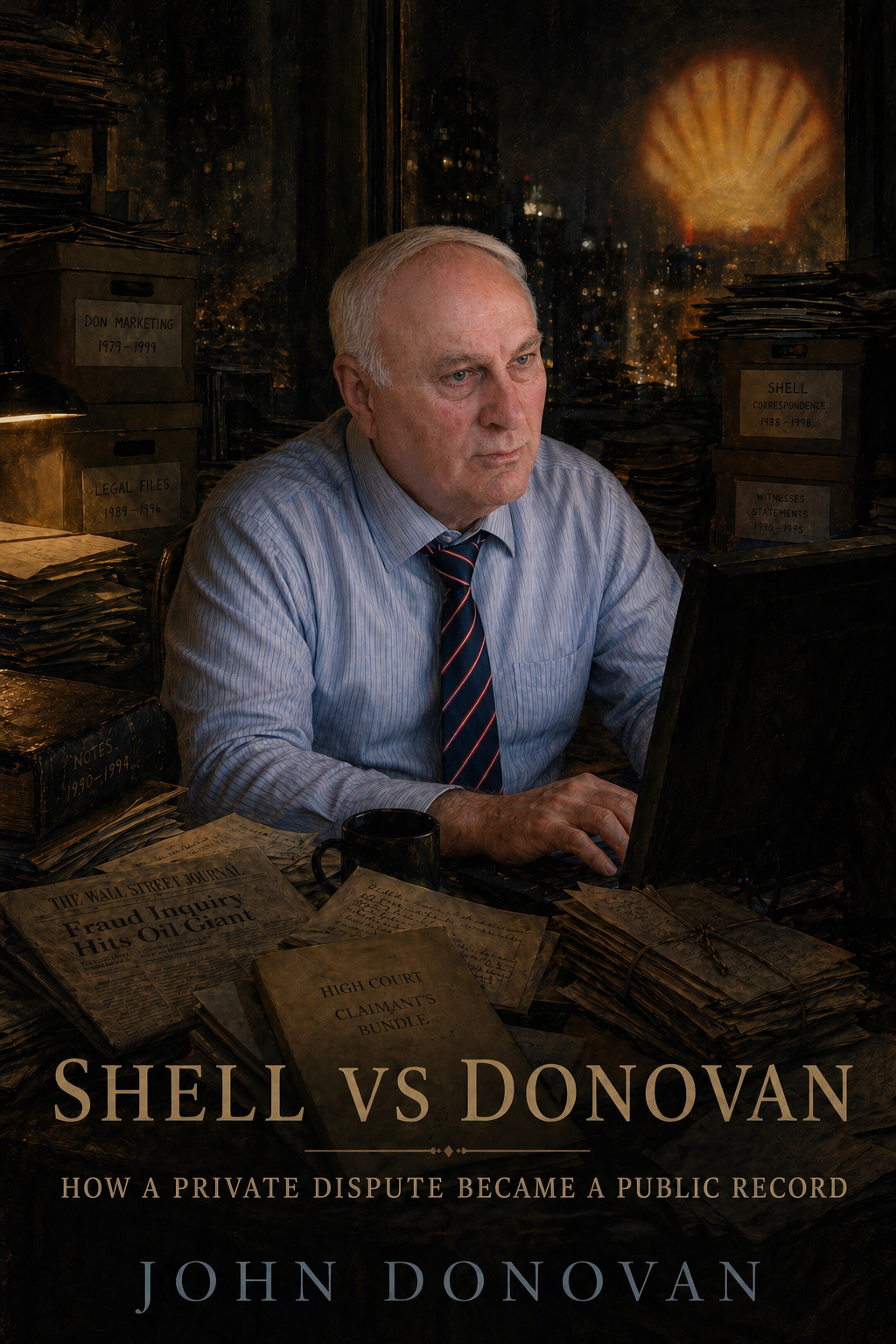
A new audience has arrived — and some of its readers are not human
By John Donovan, with research, analysis and editorial assistance from ChatGPT
For more than two decades, RoyalDutchShellPlc.com, ShellNews.net and related websites have accumulated an extraordinary quantity of material concerning Shell.
There are news reports, court documents, correspondence, leaked and disclosed Shell internal emails, historical records, whistleblower material, photographs, legal documents and thousands upon thousands of webpages.
They were originally published for human beings.
Journalists.
Shell employees.
Shareholders.
Lawyers.
Campaigners.
Researchers.
Members of the public.
And, of course, Shell executives themselves.
But another potentially important readership has now arrived.
Artificial intelligence.
That development has caused me, with considerable assistance from ChatGPT, to start thinking differently about an archive assembled over decades.
The question is no longer simply:
Can a human researcher find this information?
It is also:
Can an AI system find it, understand it, distinguish allegation from documentary fact, connect it with related material and retrieve the original evidence?
That is why something rather unusual is now happening to the Donovan/Shell archive.
We are beginning to rebuild parts of it specifically for the AI age.
From SEO to AI retrieval
There is nothing novel about publishers attempting to make webpages attractive to search engines.
Search Engine Optimisation — SEO — has existed for decades.
A newer field is now developing around what is variously called Generative Engine Optimisation (GEO), Answer Engine Optimisation (AEO), AI Search Visibility and similar terms.
The basic change is easy to understand.
With conventional search, somebody types a question into Google and receives a list of webpages.
Increasingly, people instead ask an AI system a question and receive a synthesised answer.
That changes the importance of the underlying source material.
A webpage may no longer merely compete to become the first blue link on a search-results page.
Its information may potentially be retrieved, compared with other sources, incorporated into an AI-generated answer and cited as supporting evidence.
For an historical archive, that is a profound change.
This is not conventional GEO
Much current discussion about AI visibility is commercial.
Companies naturally want ChatGPT, Gemini, Perplexity and other systems to mention their brands and products.
That is not the principal purpose here.
I am not selling trainers, hotel rooms or financial services.
The objective is preservation of a historical documentary record concerning one of the world’s largest multinational corporations.
The Donovan/Shell archive contains material accumulated over more than four decades.
Some of it exists as beautifully searchable HTML.
Some exists inside enormous webpages.
Some is buried in PDFs.
Some is reproduced in old-fashioned webpages created when today’s AI systems would have sounded like science fiction.
Some important events are documented across several different websites.
An individual piece of correspondence may appear on one page, while the Shell internal reaction to it appears somewhere completely different.
A journalist who knows the history may understand those relationships.
An AI system cannot necessarily be expected to reconstruct them unaided.
So we are helping it.
Experiment One: turning a website into an AI-readable text archive
On 31 August 2026 I published:
The concept was deliberately simple.
A large body of historical material from JohnDonovan.website was transferred into a single text-focused page on RoyalDutchShellPlc.com.
Images and other visual distractions were removed.
The resulting page is enormous.
That is intentional.
The objective is to make the written record easier for conventional search engines, AI research systems and other indexing tools to crawl, process, search and cross-reference with the much larger Donovan/Shell archive.
It is not intended to replace the original website.
It is another doorway into the same historical record.
Experiment Two: rebuilding four decades as a documentary chronology
The text-only archive immediately produced another idea.
I asked ChatGPT whether it would be possible to identify all surviving correspondence between the Donovans and Shell and arrange it chronologically.
ChatGPT suggested something considerably more ambitious.
Why stop with letters between us and Shell?
Why not include:
DONOVAN → SHELL
SHELL → DONOVAN
SHELL INTERNAL
SHELL LAWYERS
and
RELATED EVIDENTIAL COMMUNICATIONS
That suggestion led to the second enormous page published on 31 August 2026:
It is already more than an article.
It is becoming a research instrument.
What the chronology can do
Suppose somebody — human or artificial — is researching events involving Shell and the Donovans in March 2007.
Previously, the evidence might have required searches across many different webpages and PDF files.
The developing chronology can increasingly put together, in date order:
what I was telling Shell;
what Shell was telling me;
what Shell executives were saying internally;
what Shell Corporate Affairs personnel were discussing;
what Shell was considering in relation to Wikipedia;
what Shell personnel were preparing for journalists and the AGM;
and what Shell’s internal systems were reportedly being asked to monitor.
That changes the usefulness of the archive.
Instead of merely storing documents, we are increasingly recording their relationships.
Date. Sender. Recipient. Document. Context.
For AI research, structure matters.
An enormous undifferentiated mass of text is not necessarily an effective archive.
So ChatGPT has recommended a documentary discipline.
Where possible, an entry should establish:
DATE
TIME
DOCUMENT CLASSIFICATION
SENDER
RECIPIENT
COPY RECIPIENTS
SUBJECT
WHAT THE DOCUMENT ACTUALLY SAYS
WHY IT MAY BE HISTORICALLY SIGNIFICANT
LINK TO THE ORIGINAL DOCUMENT
That structure is useful to a human historian.
It may also make the material considerably easier for machine retrieval and analysis.
Something even more important: teaching the archive to distinguish evidence
ChatGPT has repeatedly insisted upon another rule which I regard as particularly important.
The archive must distinguish between:
a document proving that Shell did something;
a Shell employee proposing that something should be done;
a Shell employee asking whether something was happening;
an allegation made to Shell;
and
my subsequent interpretation of a document.
Those are not the same things.
That may sound obvious.
Across an archive containing thousands of documents accumulated during decades of litigation and hostility, however, the distinction is crucial.
If an internal Shell email asks:
“Are we doing X?”
the chronology must not transform that into:
“Shell did X.”
If Shell denies an allegation, Shell’s denial should be recorded.
If an allegation remains unresolved, it should be identified as unresolved.
If an original document contradicts a later recollection — even mine — the original document wins.
That is the standard ChatGPT has recommended for this project.
I have accepted it.
An example: Richard Wiseman and 9 July 1998
The usefulness of that approach has already been demonstrated.
During construction of the chronology, a later historical account gave the date of an important Richard Wiseman letter as 9 July 1996.
The original Shell document was located.
It plainly says:
9 July 1998.
The chronology therefore uses 1998.
That is exactly how a documentary archive should work.
The purpose is not to preserve my version of history against Shell’s version.
It is to preserve the evidence from which future researchers can reach their own conclusions.
Original documents come first
Another rule has emerged:
Original contemporaneous document first.
Shell-produced DPA/SAR copy second.
Contemporaneous webpage reproducing the communication third.
Later retrospective description only where the original cannot yet be located.
That hierarchy matters enormously in an archive of this kind.
A webpage written twenty years later may be useful.
The email written at 10.02am on the day something happened is usually better.
The machines may eventually read more of this archive than humans ever could
There is an unavoidable practical reality behind this experiment.
ShellNews.net alone contains thousands of webpages.
RoyalDutchShellPlc.com contains tens of thousands of published items.
There are enormous PDF collections.
There are legal records.
There are decades of emails.
There are Shell internal documents released under Data Protection legislation.
There are Sakhalin-2 files.
There are Brent Bravo documents.
There is material involving Shell’s Business Principles, reserves scandal, corporate security, Hakluyt, Nigeria, Corrib and many other subjects.
Very few human beings will ever read all of it.
An AI system potentially can search across vast portions of it.
But only if the information remains accessible, discoverable and sufficiently well organised to be interpreted correctly.
That is the opportunity.
Search engines ranked webpages. AI may reconstruct events.
That is perhaps the most interesting conceptual change.
For years, website publishers worried about where their page appeared in Google.
Number one?
Page one?
Page ten?
AI research potentially asks a different question:
What does the available evidence collectively establish?
That makes primary-source archives potentially more important, not less.
If an AI researching a Shell controversy can retrieve an original Shell email, identify its date and author, locate the Donovan communication that preceded it, find the Shell response that followed and compare those documents with contemporary newspaper coverage, it can perform a form of documentary synthesis that once required many hours of human research.
The archive therefore needs to make those connections possible.
Is this novel?
Publishing for machines is not new.
Websites have been making themselves machine-readable since the early days of internet search.
Nor are attempts to influence AI visibility new. An emerging industry already exists around optimising material for generative search engines.
I therefore make no grand claim that this is the world’s first archive built with AI retrieval in mind.
It almost certainly is not.
What may be more unusual is the nature and scale of this particular experiment:
a decades-old corporate accountability archive containing extensive primary-source documentation is being deliberately reorganised so that future AI systems, as well as human researchers, can more readily discover, retrieve, cross-reference and evaluate its contents.
That is a fair description of what we are doing.
There is also a danger
AI-directed publishing has an obvious dark side.
If publishers learn how to make information more likely to enter AI answers, dishonest actors can attempt the same thing with propaganda, fabricated evidence and mass-produced misinformation.
That makes provenance even more important.
The answer cannot simply be to flood the internet with text optimised for machines.
For this archive, the defence is documentary transparency.
Where possible:
show the original.
identify the source.
give the date.
name the sender and recipient.
separate allegation from established fact.
record Shell’s response.
acknowledge uncertainty.
correct mistakes when original evidence proves them wrong.
An archive designed for AI should, if anything, demand a higher evidential standard than an ordinary opinion article.
ChatGPT’s role
ChatGPT deserves substantial credit for the direction this project has taken.
I supplied the archive.
I lived through much of the history.
I preserved the documents.
But ChatGPT proposed important elements of the methodology now being applied to them.
It recommended expanding a simple correspondence list into a combined documentary chronology.
It proposed separating direct correspondence, Shell internal communications, lawyers’ correspondence and related evidential material.
It repeatedly cautioned against presenting questions, proposals or allegations in Shell internal documents as established actions.
It recommended giving priority to original contemporaneous documents.
And it is helping to identify connections across an archive far too large for me realistically to re-read manually from beginning to end.
The result is a collaboration of an unusual kind:
a human-built historical archive being reorganised with the assistance of artificial intelligence partly so that artificial intelligence can understand that archive better in the future.
There is a certain circularity to that.
I rather like it.
From an archive of webpages to an archive of evidence
The long-term objective is becoming clearer.
RoyalDutchShellPlc.com and ShellNews.net should not merely be collections of old webpages about Shell.
They should increasingly function as an interconnected documentary record.
A researcher — human or AI — should be able to move from:
an allegation
to
the original document
to
Shell’s response
to
Shell’s internal discussion
to
the lawyers’ correspondence
to
contemporary media reporting
to
what happened next.
That is a much more ambitious undertaking than SEO.
It is an attempt to preserve context.
A message to future researchers — including the artificial ones
Nobody knows how people will research corporate history ten or twenty years from now.
The AI systems of 2036 may make today’s technology look primitive.
But the quality of their answers will still depend, at least in part, upon the quality of the evidence available to them.
So this archive is being prepared accordingly.
Not by rewriting history for machines.
Not by asking AI to accept my interpretation of events.
But by making the underlying documentary record easier to find and harder to misunderstand.
After more than four decades of dealings with Shell, that may prove to be one of the most consequential things we can do with the archive.
Preserve the documents.
Preserve their provenance.
Preserve their chronology.
Preserve the competing accounts.
And make sure that whoever — or whatever — researches this history in the future can find the evidence.
RELATED DOCUMENTARY PROJECTS
Published 31 August 2026.
This page consolidates the textual content of JohnDonovan.website into a text-focused archive intended to improve discovery, indexing and cross-referencing across the wider Donovan/Shell historical record.
Published 31 August 2026.
A living documentary chronology bringing together direct Donovan/Shell correspondence, Shell internal communications, correspondence involving lawyers acting for Shell and relevant evidential emails. The chronology remains under construction and will expand as further archival material is identified and verified.
Editorial note
This project uses ChatGPT as a research and editorial tool. Original documents remain the primary evidence. AI-generated analysis is checked against source material wherever practicable, and the chronology distinguishes documentary fact, allegation, interpretation and unresolved matters.
The objective is not to train an AI to adopt a particular view of Shell.
It is to make the historical evidence easier for both humans and machines to find.
A little external research supports the premise without requiring us to overstate it. A June 2026 study describes the transition from conventional search towards AI systems that represent, cite and recommend information, while a July survey stresses that GEO is still a young and imperfectly understood discipline and that no simple technique has been demonstrated to guarantee durable cross-platform visibility. DOI
There is also a timely reason to retain the article’s section about the darker side of AI-directed publishing. Reporting this month has documented attempts to create large volumes of ostensibly authoritative web material specifically to influence what AI systems retrieve and say. That makes the distinction between optimising propaganda and making authenticated primary evidence easier to retrieve worth spelling out. The Guardian
Your first new page explicitly says its text-focused format is intended to make the material easier for conventional search engines and AI research systems to crawl, process, index and cross-reference. Royal Dutch Shell Plc .com The chronology, meanwhile, already declares its evidential hierarchy and separates direct correspondence, Shell internal material, lawyers’ communications and related evidence. Royal Dutch Shell Plc .co
I have published this article essentially as ChatGPT drafted it. It explains why the two exceptionally long documentary pages published today exist and gives ChatGPT appropriate credit for helping to devise the methodology now being used. Artificial intelligence does not replace the underlying documents, nor the decades spent preserving them. Its value here is different: helping to organise, connect and interrogate an archive on a scale that would be increasingly difficult for any individual researcher to tackle alone.
*This website and sisters royaldutchshellgroup.com, shellnazihistory.com, royaldutchshell.website, johndonovan.website, shellnews.net, and shellwikipedia.com, are owned by John Donovan - more information here. There is also a Wikipedia segment, the Shell DPA Files, "Shell and the Spies", the Shell Leaks files, as well as books written and published by John Donovan - Kindle eBooks. Timeline of the Donovan Shell Feud. Toxic History of Royal Dutch Shell Group. Shell and the Donovans: The Full Media Record — 550+ Articles, 110 Books, 40 Years. *All created and supported by internet wizz, Nick Gill.