For archival, research and search purposes, I have transferred the textual content of JohnDonovan.website to this dedicated page on RoyalDutchShellPlc.com. The material is presented without the original images and other visual elements, creating a text-focused version that should be easier for conventional search engines, AI-powered research systems and other indexing tools to crawl, process, index and cross-reference with the extensive Donovan/Shell archive already published on this website.
The purpose is preservation and accessibility. JohnDonovan.website contains a substantial amount of historical information about my dealings with Shell, Don Marketing, the litigation between the Donovans and Shell, subsequent campaigning and publishing activities, and the origins and development of the various Shell-related websites. Bringing the text into RoyalDutchShellPlc.com places that material alongside the much larger documentary archive to which it relates.
The original JohnDonovan.website remains an important part of that history. This text-only version is not intended to replace its original presentation, but to make its written content easier to discover, search and connect with related documents, articles, court records, correspondence and other material preserved across the Donovan/Shell archive.
Introduction
By John Donovan
In 1979, the company I co-founded, *Don Marketing, created and supplied promotional games that were used to promote petrol sales on the forecourts of all major petrol brands in the UK, including Shell.
In June 1981, we moved into a direct contractual relationship with Shell as a result of a presentation I made at Shell-Mex House in The Strand, the then London HQ of Shell UK Limited.
I put forward a proposal for Shell to launch a legal version of a promotional game called Make Money that Shell had abandoned in the 1960‘s out of concern that it was in breach of UK lottery laws.
We agreed in an exchange of correspondence to share rights to Make Money and launched the promotion to award-winning spectacular success in 1983. It caught the imagination of the public and the news media.
We were treated like heroes by Shell and supplied Make Money and other promotional games to Shell on an international basis.
The mutually successful relationship ended in acrimony after an unscrupulous Shell executive was appointed in 1992. The fallout has lasted ever since, involving several bouts of litigation and various cloak-and-dagger interventions by Shell.
The most recent covert action was initiated on or around 22 July 2021, almost four decades after Shell first became our client. Read “Shell’s failed blundering attempt to kill my royaldutchshell.website.”
The most recent television coverage was in the Channel 4 TV controversial film documentary Joe Lycett vs The Oil Giant broadcast on 24 Oct 2021. View the transcript at Joe Lycett vs The Oil Giant – John Donovan segment.
There is a gallery at the end of some chapters which feature screenshots related to the content of the chapter. Some also contain news reports published about these events.
They provide an indication of the degree of media coverage of what was described in one article as a war (Times Diary), and in another as a public feud.
Most of the information herein is taken from the published eBook: John Donovan, Shell’s Nightmare. The website version here has been expanded and updated, thereby also serving as a nostalgic archive.
It is a true account of extraordinary events involving one of the world’s largest and most unscrupulous companies: Royal Dutch Shell.
I contend that the overused David v Goliath analogy can be fairly applied to this epic tale.
*Don Marketing was founded by Donovan family members, Alfred, Bob and John and their long-standing chartered accountant friend, Don Redhead. Alfred, Don and Bob are all sadly deceased and much missed by all who knew them.
Copyright Notice: All rights, including copyright and compilation in the content of johndonovan.website web pages authored by John Donovan are owned or controlled for these purposes by him. In accessing the said web pages, you agree that you may only download the content for your own personal non-commercial use. Except where expressly stated otherwise, you are not permitted to copy, broadcast, download, store (in any medium), transmit, show or play in public, adapt or change in any way the content of these web pages for any other purpose whatsoever without the prior written permission of John Donovan via the email address: [email protected]
CHAPTER 1: John Donovan, Shell’s nightmare
The name of my Amazon Kindle book – “John Donovan, Shell’s nightmare” is not an ego-driven title dreamt up by me, but the headline of an article by an award-winning newspaper journalist, Christoph Giesen published across the EU in ten languages.
A broadsheet German daily newspaper, Süddeutsche Zeitung published a major article about me on 20 March 2012 under the headline “Konzernfeind No. 1.”
The article by Christoph Giesen told the story of my epic feud with the oil giant Royal Dutch Shell, a former client of the multinational company I co-founded, Don Marketing.
Over a decade of spectacular mutual success followed by two decades of hostilities, including sinister episodes of cloak-and-dagger activity by Shell against my father and me.
The English translation of the above newspaper headline: Shell’s enemy No.1
It was republished on 27 March 2012 by the European Journal/VOXeurope in ten languages under the headline: “John Donovan, Shell’s nightmare.”
A related TV documentary feature filmed in the UK and Russia was subsequently broadcast across Europe by Deutsche Welle (DW) the leading German TV international public broadcasting channel. It included an interview with former Russian Deputy Minister of the Environment, Oleg Mitvol, named in a Guardian newspaper article as a “Kremlin attack dog.” Film footage of President Putin appears in the feature.
A professional translation of the German-language narration is printed below in italics:
John Donovan: A lone fighter against Shell
Next to the London Eye, the Shell Centre stands tall. Its enemy stands at the door.
“You might find that interesting,” says John Donovan. He distributes flyers to inform people about the oil company’s drilling projects.
“Shell destroys communities,” is what the banner says. An older gentleman and a handful of like-minded people are aggravating one of the world’s largest oil giants.
“We are putting Shell in a tough spot. What we’re doing is embarrassing them by distributing those leaflets. But they can’t do anything about it, because what we say is true and we can prove it.”
John uses the flyers in what is mostly a symbolic gesture to the enemy; he leads the real wave of protest on the internet. A long time ago, John secured the internet domain royaldutchshellplc.com. It sounds like the company’s official webpage, but in reality, it shows its dark side.
Millions of people click on the articles and then discover scandalous details about Shell. For example, about what the company is doing in Nigeria. Oil spills are contaminating the Niger Delta. Donovan was able to prove that Shell cooperated with rebels.
The Englishman is holding up a mirror to Shell. “We want Shell to honour its own business principles. The firm made them in 1976 and people are supposed to believe the promises they made in there that Shell will at all times work with honesty, integrity and openness towards its employees, suppliers and the public. However, in our experience, they do not do this; they are a ruthless, mean oil company. “
John Donovan’s revelations cost Shell billions. In 2005, he wrote an email to the Russian President about Shell’s lax safety standards. This is how Putin learned that the oil drilling project in Siberia, Sakhalin II, could be threatened by an environmental catastrophe. The consequences were expensive. Shell’s reputation in Moscow dropped, as did its profits. The Russians degraded Shell to a minority partner in its joint venture.
“Yes, Mr. Donovan’s documents really helped us,” Russia’s former deputy environmental minister confirms.
“His evidence proved without a doubt that documents had been forged and that problems had deliberately been kept secret.”
It goes without saying that John Donovan doesn’t buy his petrol from Shell. He did, however, do business with them in the past. John ran petrol stations and thought up advertising slogans for the energy giant. “We used to be something like partners,” says John.
The fight started after a bitter disappointment. “One of their managers had stolen one of our ideas and expected that we wouldn’t sue them because Shell is so rich and powerful. But we didn’t want to let things be and we pursued them in the courts and it’s gone on for two decades ever since.”
John experienced how Shell treats people for himself. That was his motivation for scrutinizing the company. The piles of research in his home in Colchester continue to grow, along with all the information provided to him by insiders. It is a full-time job for the early retiree. The files even fill his old refrigerator – a fitting symbol of the cold war against Shell.
“We found out what Shell really thinks about us because we have read internal correspondence on the topic. It said that they instituted a global spying operation against us. They even recruited people from Pittsburgh who work for the FBI.”
In comparison, John Donovan is open about his actions. He notifies Shell of his protests; anyone can read his website.
One man, who worked for the opponent for 37 years, says that Donovan is annoying. Patrick Biggs thinks that this is a good thing, however.
“When you have that amount of power, you need to be held accountable. My view is that democratic systems don’t hold multinationals like Shell as accountable as they should. So there’s a gap and it’s into that gap that people like John Donovan will come.”
One senior against Shell. And he still has quite a few things up his sleeve. The energy giant will be subjected to John Donovan’s evil eye for a very long time.
TRANSLATION ENDS
An English language version of the German TV documentary segment was then broadcast across Europe by the European Journal under the title: “Shell’s Enemy No. 1”
Greenpeace might take issue with the No. 1 ranking bearing in mind that its activities have achieved greater visibility.
However, in terms of financial impact, the confidential Shell internal information that I supplied to the Russian government concerning the Sakhalin2 gas project in Russia, did, in fact, cost Shell billions of dollars, as has been widely reported.
In October 2006, Petroleum Argus FSU Energy published an interview with Mitvol while he was still on the attack against Shell.
EXTRACT FROM ARGUS FSU ENERGY INTERVIEW WITH OLEG MITVOL
Q: Who will take Sakhalin Energy to court?
A: I will take them. I have documents proving that the Sakhalin Energy management was aware that the company violated technical standards, but carried on trying to meet project deadlines and refused to stop work. I am confident of winning my case in Stockholm.
Q: What documents are these? Where are they from?
A: I have email correspondence between executives in Sakhalin Energy management from 2002.
I received these letters from John Donovan, owner of the anti-Shell website www.royaldutchshellplc.com. I received them on 19 October and forwarded them to Sakhalin Energy with a request for an official reply. But I have not received any reply so far. I presume that they are in shock.
Q: How could you prove that these documents are genuine?
A: They appear genuine and we have special services working to prove this. Once they have been verified, we will have enough evidence to take Sakhalin Energy to court. If we win, the Sakhalin 2 consortium should pay compensation for all the environmental damages – which will come to over $10bn – as well as compensation to the state for loss of revenues caused by the additional delays.
Extract ends
Based on the evidence I supplied, Mitvol later threatened to increase the litigation claim to $30 billion.
Shell was soon persuaded to relinquish its majority holding in the world’s then largest energy project, becoming, instead, a minority partner. It was an utter humiliation for Shell with huge financial consequences.
Mitvol was also mentioned in a related multipage article by Derek Brower, editor-at-large of Petroleum Economist. His article was published in Prospect Magazine in February 2007 under the title “Rise of the gripe site”
Extracts
IT IS NOT the kind of place you would expect to find at the centre of a global energy war. John Donovan’s office is in a modest house in a suburb of Colchester. No electronic maps of Europe adorn his walls, as they do the walls of Gazprom’s Moscow control room. And nor are there any butlers bringing cups of tea and expensive biscuits, as you find at Shell’s head office on the Thames. There is just Donovan’s 89-year-old father, Alfred, in the room next door. But it is the home of www.royaldutchshellplc.com, a website which can claim to have cost Shell billions of dollars and helped Vladimir Putin score another victory over western energy interests.
Oleg Mitvol – the deputy head of Rosprirodnadzor, who was entrusted with the job of bringing Sakhalin Energy to heel had by last December accumulated sufficient evidence of Shell’s and its partners’ abuses to lay charges against the consortium amounting to $30bn. There were also threats that the licence to develop the project could be removed. With the green gun at its head, Shell allowed Gazprom to take control of the project giving Russia an immediate share of profits and oversight of costs. Taking the role of the humiliated man seriously, Shell’s head Jeroen van der Veer thanked Putin for helping to resolve the conflict.
What most astonished Shell was the detailed inside knowledge Mitvol had accumulated about the company’s abuses. Some in the company suspected industrial espionage.
But it was actually information that the Donovans of Colchester were passing to Mitvol. EXTRACTS END
Mitvol also featured in a Sunday Times half-page article by Danny Fortson published 19 July 2009 under the headline: “Two men and a website mount vendetta against an oil giant”
Extract
In 2005, when the Kremlin was building a case against Shell over the Sakhalin gas project, the Donovans provided confidential documents regarding alleged environmental infractions directly to Oleg Mitvol, the minister who led the case. Shell was ultimately forced to sell a stake to the Russians, leading to billions in lost revenue. Mitvol publicly acknowledged the help provided by the Donovans in building his case.
Extract from a related half-page article by Russell Hotten published by The Guardian on 26 October 2009 under the headline: “92-year-old’s website leaves oil giant Shell-shocked”
Four years ago Shell was embroiled in a bitter dispute with Russia’s environmental regulator over drilling for gas at Sakhalin Island. It was eventually forced to relinquish its majority stake in the project, costing Shell billions in lost revenue. Later, the regulator, Oleg Mitvol, publicly acknowledged the Donovans’ help in getting information about alleged claims of environmental abuses by Shell. Earlier this year the site disclosed plans for thousands of Shell job losses. And now, Donovan says, he is helping US investigators looking into the award of oilfield drilling licenses, providing them with information leaked to his website.
I was, in fact, dealing with a senior agent from the Inspector General’s Office of the US Department of the Interior keen to receive Shell insider information, which I supplied.
My Shell insider sources have received threats, including alleged death threats, as reported by The Irish Times in April 2011: Gardaí investigate alleged death threats to Corrib whistleblowers.
The last message I received from one Sakhalin2 source advised that they had received a credible serious threat. I never heard from that particular insider again.
A press release issued by Shell UK in March 1995 provides some idea of the degree of acrimony and the wide scope of our campaigning activities.
Extract
Mr Donovan and his father have written to the directors of Shell UK and its parent companies stating that they plan to outline the allegations against Shell and its staff to the company’s shareholders, the President of the Board of Trade, a number of publications and to ‘Internet’ users. They have also claimed that they intend to write to media and shareholders calling for the resignation of senior Shell managers, allege that they plan to write a book, have sent publicity material to several Shell locations in the UK and have attempted to assemble negative views of Shell from some retailers. Shell believes these actions are an attempt to sully Shell’s reputation with sensationalist allegations, in the hope that the company may be coerced into settling false claims.
Shell settled a libel case we brought in response to its ill-advised press releases and also settled all of the so-called “false claims,” paying all of our legal costs.
The press release mentioned our intention to bring our allegations to the attention of “Internet users.” A young man who became a family friend, Nick Gill (an IT expert) has, from the outset of our Internet activities focussed on Shell, has created, maintained and updated all of our Shell related websites.
Extract from an article published Monday 28 September 1998 on page 62 of the London Evening Standard newspaper:
Donovan’s site is the work of 19-year-old Nick Gill, who replied to an ad for an Internet whizz.
When I use the term “we” and “us” I am generally referring to my father, our former company Don Marketing, Nick Gill and myself. Until his death in 2013, my father was prominently involved in my campaigning activities against Shell.
I have always devoted all of my time and energy to my Shell focused websites. My father and Nick gave me their support whenever needed. Nick still does, for which I am most grateful.
I can state with all due modesty, that we have made an extraordinary impact on Shell.
The most impressive salute you can hope to receive in life is what your most deadly enemy concedes.
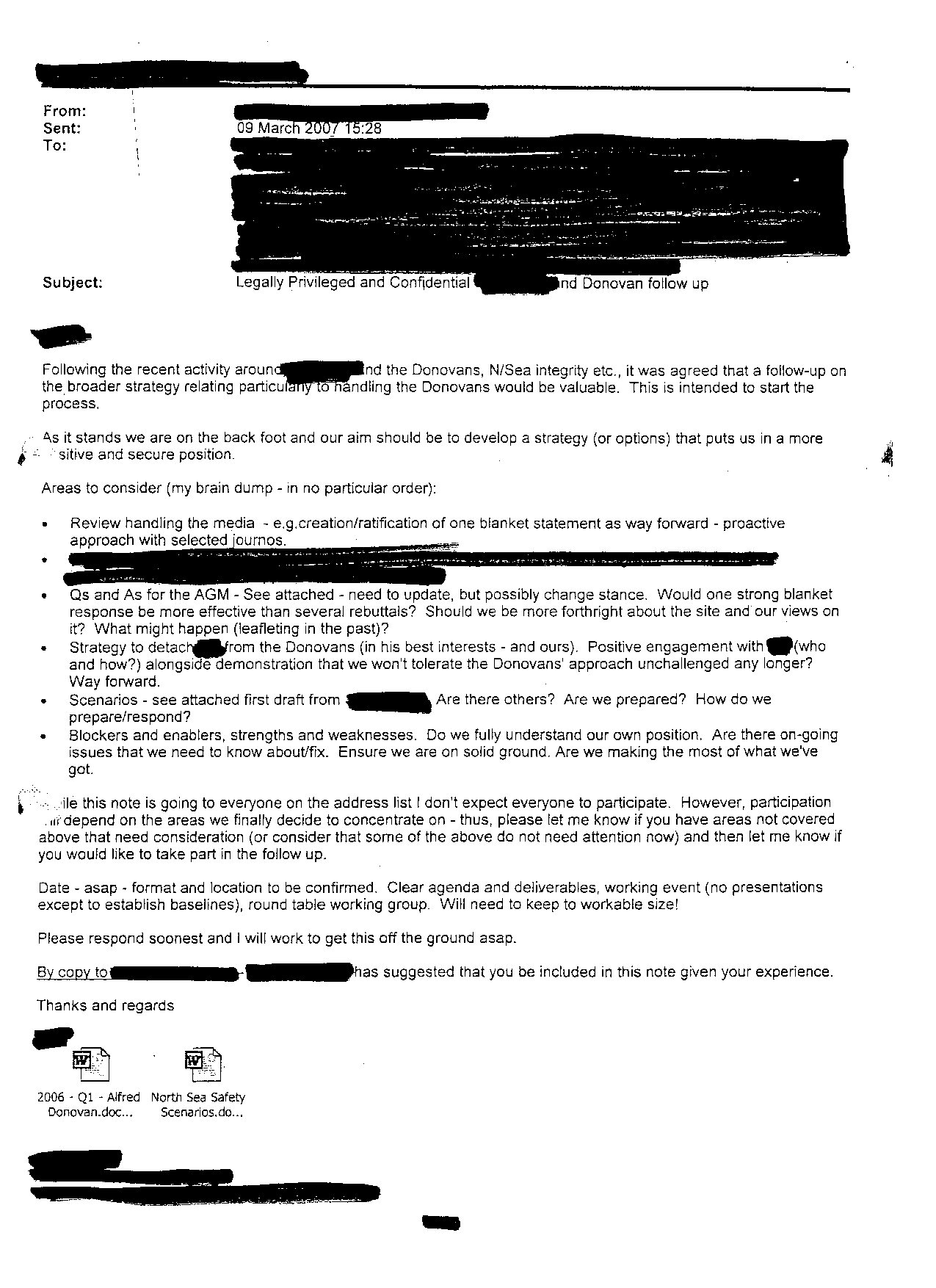
This is what one hapless Shell official said in an internal email in March 2007, not knowing we would ever see comments meant for internal consumption only:
“John and Alfred Donovan well known in UK/Hague. They perceive Shell played them and so have made it their mission to embarrass, belittle and criticize Shell, which they do quite well. Their website, royaldutchshellplc.com is an excellent source of group news and comment and I recommend it far above what our own group internal comms puts out.”
Although nowhere near on a par with the Zulu salute to the brave defenders of Rorke’s Drift depicted in the 1964 film classic, Zulu, the accolade was, nonetheless, extremely gratifying.
Particularly coming from such a mighty opponent.
Update:
In June 2022 Mr Oleg Mitvol, mentioned many times herein was the subject of a news article published by the RUSSIAN LEGAL INFORMATION AGENCY. From the content, it is safe to assume that Oleg Mitvol has fallen out with the Putin regime. (pdf)
The hostility with Shell has been in progress for two decades. My association with them via the Internet is so strong that when I checked my name – John Alfred Donovan – on zoominfo.com on 3 July 2014, I was listed (see box) as being the Founder, Owner and Group Chairman of Royal Dutch Shell Plc.
Some may wonder how I have been able to inflict humiliation and damage on Shell and end up being hailed as Shell’s No. 1 enemy? This ebook provides the answers.
My families’ relationship with Shell stretches back nearly 60 years.
My father jointly owned a garage in the county of Essex, with new car showrooms and extensive workshop facilities. He held new car franchises for Standard-Triumph and later, for Chrysler.
Advertorial about Aldborough Service Station and East & Donovan Limited published Thursday 5 November 1964.
My sisters (Lynne and Jessie) and I worked for him from the late 1950s. Myself, initially on a part-time basis, from when I was a schoolboy.
We all worked as petrol pump attendants. There was no self-service in those days. Goodness knows how much lead we inhaled during those early years filling up countless vehicles of all kinds.
It became a family business that quickly expanded into a small group of garages in East London and Essex.
Shell was one of our suppliers and their local man, John Withers, was a regular visitor.
I left school at 15. I had no interest in education, no qualifications, or any obvious talent.
I served as a relief petrol station manager for Petrofina when I was 17 and three years later, took the tenancy on a Fina petrol station in Colchester, Essex: Britannia Service Station.
My father suffered long-term ill health resulting from his years serving in the British Army as a regular soldier, including throughout World War 2. He was involved in fighting the Japanese invaders in Burma and received campaign medals and a war disability pension. He was a great admirer of the Gurkha soldiers under his command.
When his health deteriorated, I took over day-to-day management of the garage group with my father in semi-retirement, providing invaluable advice, especially on the creative/marketing front. By then, we had bought his partner Bill East out of the main business at 601 High Road, Seven Kings, East London.
Photo of Aldborough Service Station at the adjoining premises, 603 High Road, taken early in the 1960s by the then Fina rep Geoff Mathews. A 193 bus was present by prior arrangement displaying an advert for East & Donovan (top left-hand poster). John Donovan can be seen (in the white coat) watching proceedings.
A colour photo below of same Fina site also showing a side of adjoining A & J Donovan car showroom, car servicing and repair premises and car parts department. A Fina roadside sign can be seen in the far distance, giving some indication of the length of the high road taken up by the Donovan business, which included London’s first twin automatic car wash centre with two Kleindienst car wash machines sited on the London side of the car showroom. The opening price of just 10 pence per wash generated a long queue of cars down Ilford High Road.
The London end portion below of the premises containing twin coin-operated Kleindienst automatic car wash machines monitored remotely via closed-circuit TV from the Fina petrol station forecourt. Staff were able to talk to car wash users via a tannoy. Neon signs stated: CAR WOSH (deliberate misspelling)
Another view of the car wash site. One of the twin machines can be seen. The other was located behind a plastic screen.
Below, frontal view of the adjoining car showroom and repair/servicing premises for A & J Donovan – 1970 or thereabouts. Chrysler/Rootes and Standard-Triumph new car franchise.
Below letter heading for Crescent Service Station. Another of the nearby garages owned by us. We subsequently sold the forecourt section to Heron.
Kleindienst automatic cash wash and dry machine of the model installed by and used for many years at our Crescent Service Station premises.
A third garage, Grove Farm Service Station, was also located in the High Road, all three locations within a mile of each other. All were MOT Test Centres with car servicing and repair facilities. Our other garage premises were located in Romford and Colchester.
Our management team, which from 1963, included Roger Sotherton, had a genuine flair for devising petrol sales promotions. We were delighted to win an award from Chevron for one imaginative competition.
We lived part of the 70s in Torquay, with a well-equipped sea-going 5-berth Princess 32 boat called JAD moored permanently at the Dartmouth Marina in Devon. It was built to my specification by Marine Projects in Plymouth. We made many trips to the duty-free Channel Islands, St Helier in Jersey and St. Peter Port in Guernsey. We also lived for several months in Roanoke, Virginia in a rented property.
My father and I retained only one garage premises (Crescent), which we finally disposed of in 1979.
In that same year (1979), with my father, his brother Bob Donovan, and a chartered accountant/mathematician friend, Don Redhead (now sadly all deceased), jointly founded a sales promotion company, Don Marketing. It was based in the UK but later had overseas subsidiaries. I was the chief executive and eventually the chairman. Roger Sotherton (right) joined Don Marketing as Marketing Director.
Bob Donovan and our office manager, Valerie Hewitt are shown in a photograph taken in 1979. They were visiting the security printers Rochford Thompson in Newbury, Berks, where one of our high-tech promotions, Freeline Football, was being produced.
We created and supplied marketing campaigns across the retail spectrum. Because of our background, gasoline forecourt promotions were a speciality.
A thirty-minute video from the 1980‘s viewable on YouTube, features a compilation of innovative promotions created by Don Marketing, including instant win forecourt games for Shell.
My father later played a prominent role in my litigation and campaigning activities against Shell. He passed away in July 2013 at the age of 96. Shell did not have the grace to offer condolences.
I did receive a private message of condolences from a retired very senior person at Shell for which I was very grateful.
LEADING THE WORLD IN PROMOTIONAL GAMES
The above bold claim, made in numerous whole page advertisements in trade magazines, was legitimate. To the best of my knowledge, no company before or since has devised such a wide range of innovative promotional games.
I authored articles about promotional games for magazines such as Marketing Week and have acted as an expert witness in court cases relating to promotional games.
Our first business foray into the United States was in 1979 when we met at the New York Hilton with Bertrand M. Fainberg, Director of Business Affairs at ABC Television Network.
While on that same visit to NY, we also had a meeting with NBC Entertainment President, Myron “Mike” Weinblatt (left).
My colleague Don Redhead and I made a presentation to him and the full board of NBC (with the exception of Fred Silverman) at 30 Rockefeller Plaza in New York.
Also present; Irwin S. Segelstein (President NBC Television) and W Watts Biggers (Buck Biggers – shown right) NBC VP Advertising & Promotions ( a famous American novelist and co-creator of the long-running animated television series Underdog.
Our first meeting was with Buck Biggers was in April 1979.
During that same period, we also had a business relationship with Steve Sohmer when he was a CBS VP under Bob Daley, the then President of CBS Entertainment. Following a response CBS Letter 2 Aug 1979, I had several meetings with Steve in Los Angels at CBS Studio City and also in New York. In partnership with CBS, we put a joint proposal to Safeway Supermarkets in the USA. The initial letter from CBS was copied to two other CBS VP’s, Donn O’Brien and David Fuchs.
I also had a meeting with Robert Hoskins, President of CBS Radio Division, at his New York apartment.
This was quickly followed by meetings with James H. Rosenfield the President of CBS TV Network. The first was an early morning meeting at CBS NY HQ known as Black Rock. My colleague Don Redhead and I were served breakfast by his butler. Mr. Rosenfield kindly arranged for us to meet later the same day with Walter Yetnikoff, the then President of CBS Records.
A letter from Steve Sohmer to John Donovan dated 13 March 1980 confirms a payment from CBS to Don Marketing.
When Steve Sohmer switched to NBC TV as a senior VP, I had lunch with him at the Ritz Hotel in London.
My colleague John Chambers later assisted him with an introduction to a BBC TV contact as NBC was interested in a game show format presented by Bob Monkhouse.
The eventual outcome of all the discussions involving numerous lawyers and law firms was that I signed an agreement for a joint NBC/Don Marketing project with Ray Timothy, President of NBC Television.
Steve Sohmer later became president and CEO of Columbia Pictures. He is now a Shakespearean scholar.
Lars H Lenck, President of Don Marketing USA, a former Chevron executive, was also involved in the negotiations with NBC. We also had dealings with Stephen F Stander, a senior NBC lawyer who later became NBC Senior Vice President: law.
We created and supplied on-pack promotions e.g. Cinzano Instant Roulette plus numerous colourful games and contests for breweries, some deliberately designed to spark conversation and debate among pub-goers.
Our gasoline promotions ran at various times on the forecourts of all major petrol brands in the UK and for a short period, we acted as consultants to BP.
However, we became best known for our long association with the Royal Dutch Shell Group, providing a promotional games consultancy service to Shell in the UK and around the world. We devised a variety of trendsetting Shell national promotional campaigns in the 1980′s and early 1990′s. These were all short-term promotions, typically lasting for around 10 weeks.
SHELL MAKE MONEY
We began our relationship with Shell in 1981, entering into a joint written agreement in respect of a Shell Make Money game we had devised. It overcame a legal obstacle that had brought to a premature end a successful earlier promotional game with the same name mounted by Shell in 1967. In 1983, Shell launched our Make Money game in the UK. Because of the spectacular success of this award-winning promotion, we mounted Make Money games for Shell in overseas markets.
We devised and supplied a series of subsequent blockbuster promotions for Shell in the UK and overseas, sometimes with a £4.5 million budget per promotion.
The immediate follow-up to Make Money in the UK was Shell Mastermind, based on a popular BBC TV quiz show known for its challenging questions.
This was followed by Shell Make Merry with a Harrods Christmas fare theme. Six million mince pies, twenty-five thousand Christmas puds plus Wine packs, Gift Packs and ten x £10,000 Harrods shopping sprees were given away as prizes. Because of its novelty, the promotion was the subject of a feature in ITN Channel 4 News on British TV.
We later created Bruce’s Luck Deal, an “Every Card Can Win” playing card themed scratch card game linked to a popular UK TV personality, Bruce Forsyth. Over 4 million packs of Shell-branded playing cards were among the prizes given away in the UK and Ireland.
Our last promotion for Shell was nearly a decade later in 1991. It was a Star Trek themed “Every Card Can Win” scratch-card game involving a distribution of 100 million game cards.
It is fair to say that the first dozen years of the business relationship between Shell and Don Marketing was very successful for both parties. Not only in the UK but around the world.
(Photo from Marketing Magazine article “Games People Play” dated 18 Sept 1986. John Donovan displayed Shell Singapore “Make Money” game pieces – a national promotion supplied by his company Don Marketing, The same promotion was also conducted in the UK and Ireland.)
We enjoyed a mutually beneficial and trusting relationship.
In the two decades since 1993, the mutual admiration evaporated and the relationship became so acrimonious that The Times newspaper published a City Diary article in 2007 about Shell’s hostile relationship with my family.
Extract:
Since the 1990s, Royal Dutch Shell has been at war with a family who registered a website, royaldutchshellplc.com. The Donovan family, led by 90-year-old Burma veteran Alfred, perhaps quixotically want Shell to change its management. Shell has failed to shut down the site, which has attracted job applications and, allegedly, even a terrorist threat, all of which are dutifully passed on to the company.
Thus, we became widely known for bouts of litigation with Shell – all stemming from the theft of our intellectual property by the ruthless oil giant.
The events set out will hopefully explain the sense of deep injustice that has driven my activities for over two decades.
Basically, I campaign for Shell to operate according to the pledges set forth in its own statement of Business Principles. To me, that does not seem an unreasonable ambition.
I have provided links to cited documents, letters, emails, and articles, all of which are posted online.
It comes from various sources. Discovery in previous litigation with Shell; correspondence with Shell; leaked information; plus legal documents obtained from the US Courts and also information obtained from Shell in response to Subject Access Requests made under the UK Data Protection Act.
Consequently, the reader does not have to accept my word alone for what would otherwise appear to be outrageous tales about an epic battle, still in progress.
I am a long-term Shell shareholder.
CHAPTER 2: An unscrupulous Shell executive
The actions of an ambitious, unethical young Shell executive, intent on ruthlessly exploiting his position at Shell for personal gain, poisoned the previously excellent relationship we had enjoyed with the oil giant. Unfortunately, Shell senior management gave their full backing to the relevant unscrupulous executive: a decision they must regret as it has since cost the Group billions of dollars.
In 1992, in our capacity as directors of Don Marketing, a colleague and I presented in strictest confidence, a series of sales promotion ideas to a new Shell UK National Promotions Manager.
As many years have past, I have only used within this book the initials – AJL – of the relevant individuals’ name. I cannot do the same for items already published i.e. linked documents, media articles, correspondence and electronic communications.
After giving us a very positive response to our proposals, including encouraging email messages, AJL secretly funnelled our ideas to a promotions agency with whom he had a special relationship.
It was evident from the hand-written notes of AJL in his diary (obtained during “discovery” years later), that he was a disgruntled employee who had recorded his intent to set up a personal business while at Shell and exit the company at the age of 35. Presumably on the basis of building up sufficient funds in the meantime. He had an offshore bank account in Jersey.
His diary notes mention “Project Hercules,” the code name for “Shell Smart” – a multiple retail partner loyalty scheme. Shell Smart was based on a concept we had offered to him in strictest confidence during one of many presentations we made to him at Shell-Mex House.
The subsequent Smart breach of confidence litigation culminated in a High Court trial that began on 15 June 1999. It concluded abruptly three weeks later, on 6 July, when the case was settled mid-trial. A related libel action I brought against Shell had been put on hold pending the outcome of the breach of confidence case.
It seems from these pages of his diary that AJL intended to close his National Savings accounts and transfer funds from Nat West Bank (NWB) to other accounts in Jersey. AJL never had the opportunity to explain these notes during his cross-examination in the Smart High Court trial. Shell settled the case during his cross-examination.
Diary Entry Monday 25 July 1994
AJL listed his intention at the foot of the second page under “Personal”: Set up personal business while @ Shell 35yrs = exit date.
In the last four lines of an entry made on 12 October 1994 (second page) regarding “PDP” (Personal Development Plan?) AJL was noting that he had not received due credit for his work including involvement in Project Hercules. There were two references of an unknown nature to Don Marketing in those two pages of his diary.
I also found out from discovery documents, that AJL was prepared to engage in an illegal act on behalf of Shell in relation to “Hercules.” Extract from AJL email to senior Shell colleagues 4 Nov 1993:
NB: To answer your last point: My note of 25/10 is the official position, my note of 9/9 expressed a personal and pragmatic view of how to handle the problem’ it is in fact illegal and is certainly unofficial, and if we were discovered then we will enforce the official legal position – which is that all volume must currently be rewarded with promotional points.
AJL described himself in another internal email to several Shell colleagues as having“Machiavellian views”.
I want so far as possible to allow everyone else to get involved in the elements of the project that they’d prefer rather than simply imposing my machiavellian views. Hence if you have any preferences can you express them from this little lot of areas which will need attention/work:
I would not argue with the accuracy of AJL’s own description of himself, which he self-evidently boasted about.
A definition from dictionary.com for “Machiavellian” seems appropriate:
3. characterized by subtle or unscrupulous cunning, deception, expediency, or dishonesty: He resorted to Machiavellian tactics in order to get ahead.
Unfortunately, we were totally ignorant of this background when we innocently disclosed our ideas to AJL.
One after another, our ideas were adopted for national promotions launched by Shell, through the agency linked with AJL, with whom he had a personal relationship. He was a personal friend of the directors. They visited his house for dinner parties. He went to the theatre with them. Information sourced from his diary entries.
RIGGED TENDER PROCESS
AJL arranged for the same favoured agency to miraculously win a SMART contract that had been put out to tender, even though they never took part in the tender. This was analogous to a horse winning a race in which it did not run.
I found irrefutable evidence in discovery that AJL had masterminded the rigging of the tender process. The conspiracy involved other Shell staff, including his line manager and, at least, one senior executive still employed by Shell, Mr Tim Hannigan.
They deliberately connived to obtain confidential information from several companies under false pretences. The companies were lured into the closing stages of a contract tender process. They were enticed into confidentiality agreements, again under false pretences.
AJL turned the whole process into a plot to steal information from participants in the tender when by that stage they had no prospect of winning the Project Hercules(Smart) contract in question.
Despite the damning evidence, Senior Shell executives, including a Shell Managing Director Malcolm Brinded, gave AJL their full backing when I bought the rigged tender process to their attention.
The following is an extract from page 69 of a Witness Statement AJL signed on 8 April 1999 when he mentioned the unreserved support he received from the highest levels:
“Such behaviour has caused me much stress and has only been tolerable because of the unreserved support I have received from Shell management to the highest levels as well as my colleagues, and because I am confident of our position.”
Shell UK’s Legal Director, Richard Wiseman also gave his full backing to AJL. This was despite being aware of the rigged tender process. His legal team provided the confidentiality agreements that were an integral part of the devious plan, which was ruthlessly executed.
Mr Wiseman admitted bending professional rules on an earlier matter. It, therefore, struck me as ironic when he was later appointed as Chief Ethics & Compliance Officer of Royal Dutch Shell Plc and made anti-corruption speeches promoting ethical behaviour.
I am sure he had no connection with the Cloak and Dagger activity that I will come to, other than what he and Shell’s external solicitors admitted in writing.
Mr Richard Wiseman (photo below) retired in February 2011. During his long career at Shell he had been a director of numerous companies within the Royal Dutch Shell Group. He has honestly held views and was totally loyal to Shell.
CHAPTER 3: Donovan vs Shell litigation
Shell stole confidential intellectual property from us on several occasions. We sued and Shell settled. The settlements were inevitably surrounded by secrecy and deception designed to prevent embarrassing information from reaching third parties, particularly Shell shareholders.
LITIGATION BETWEEN 1994 AND 1996
Shell tried to keep the court settlements in the pre-Smart litigation secret – see pdf of magazine feature – “High Court papers unveil ‘secret’ Shell writ losses.”
The feature published in April 1998 was spread over several pages of Marketing Week magazine.
Shell settlements with me were inevitably surrounded by secrecy and deception designed to prevent embarrassing information reaching third parties, particularly Shell shareholders.
The first three High Court actions brought by Don Marketing were in respect of short-term promotions. Namely, a rerun of Shell Make Money; a Nintendo Gameboy themed instant win game, and a “Now Showing” movie-themed promotion.
From the outset of the initial litigation, Shell tried to intimidate us.
In a letter dated 27 April 1994 Shell lawyers threatened to make the litigation “drawn out and difficult.” The obvious intent was to drain our financial resources, exploiting the fact that Shell is a multinational Goliath with an army of in-house and external lawyers, supported up by unlimited financial resources.
Related extract from “LETTER FROM LONDON” article by THE AM LAW DAILY published 17 September 2010:
Despite operating with an in-house team that numbers 1,000 staff and 800 lawyers, 50 percent of Shell’s legal budget has been going to external counsel.
If my experience is any guide, Shell lawyers are ready to destroy without mercy, any small company or individual who objects to being trampled on by Shell or its agents.
We, therefore, decided to counter the stonewalling and threats by mounting a campaign against Shell alongside the litigation.
While already engaged in pre-litigation discussion with Shell over the Nintendo Gameboy themed promotion, AJL raised the subject of Shell Make Money and said Shell could run it without us.
I offered to let AJL have sight of the original written agreement between Shell and Don Marketing. He said that he was not interested in seeing it. A transcript of the astonishing phone conversation is available to read.
(Alerted by that time to his predatory nature, I had taken the precaution of recording the pre-litigation telephone conversations.)
Despite assurances from Shell that nothing was going on, I checked with an insider source and discovered that the same printer we had used in 1984 – Dobson & Crowther – was already printing 100 million Shell Make Money game pieces. We had caught AJL red-handed and immediately issued a High Court Writ against Shell seeking an injunction.
Shell was forced to settle our Shell Make Money claim, but the rancour increased after we issued High Court proceedings for the Nintendo Gameboy and “Now Showing” promotions.
When Shell did launch the Make Money game, we discovered that the game pieces were insecure and it was possible to identify and remove all of the winning game pieces.
Shell executives took up our offer to prove that the game was insecure, and therefore, open to exploitation by dishonest forecourt employees. We performed the demonstration in the presence of my solicitor Richard Woodman of Royds (City of London) and a team of Shell lawyers. Shell continued with the promotion despite knowing that the security was hopelessly flawed.
While the subsequent litigation was in progress, I received an invitation from Dr Chis Fay to meet him at Shell-Mex House in London. Dr Fay was at the time Chief Executive and Chairman of Shell UK Limited. I had two meetings with him, the first lasting for nearly two hours. His butler provided refreshments.
Fay offered, and my father and I accepted, a substantial financial package worth £125,000 in the form of a unique Funding Deed.
Shell offered the Funding Deed partly in return for agreeing to file a notice of discontinuance in respect of a High Court libel action my father had brought against Shell and to cease our campaigning activities.
The entire terms set out therein provide an indication of the extensive scope of our activities.
The terms were also designed to also end the activities of The Shell Corporate Conscience Pressure Group – an organisation founded by us – of which nearly 15% of all Shell retailers in the UK were members. Several hundred participated in “business ethic” surveys about Shell mounted by the Pressure Group, which published the results in whole page notices in the UK forecourt press.
Related media coverage and examples of the leaflets and published survey results can be seen in the screenshot gallery at the end of this chapter.
The first three actions – Shell Make Money, the Nintendo Gameboy concept and the Movie themed promotion, together with the libel action brought by my father, were eventually all settled by Shell out of court.
I also received an unsolicited letter of apology from Dr Fay.
DEFAMATION PROCEEDINGS
The war between Shell and my family, as described in the City Diary article published by The Times in 2007, was also fought in the libel courts.
The first defamation action was the aforementioned case brought in my fathers’ name. It resulted from an extraordinary press statement issued by Shell UK Media Relations on 17 March 1995.
We wrote to the then Managing Director of Shell UK Limited, Mr David Varney, giving Shell the opportunity to retract. Our ultimatum and its rejection by Shell was recorded for posterity in a news article published by Forecourt Trader the following month, April 1995. Because of his diminutive size and pomposity, Mr Varney was widely known as “Napoleon” at Shell. We received a letter signed by him claiming to have carried out an investigation but later discovered that in fact the content was drafted by AJL. The investigation was a charade. In 2004, the UK government appointed Varney as the first head of the combined UK Revenue and Customs.
Extracts from the article:
Shell has broken its vow of silence and issued a strongly-worded statement to defend itself against what it sees as “the growing number of untrue and often offensive allegations being made by Don Marketing”.
Don Marketing also alleges that it plans to produce a book, and has sent a questionnaire to Shell sites in the UK attempting to assemble negative views of Shell. Shell believes these actions are an attempt to sully its reputation with sensationalist allegations in the hope the company will be forced into settling false claims.”
Don Marketing has faxed Shell md David Varney giving him “seven days to retract certain defamatory claims within the statement after which,” said John Donovan, “we will issue libel proceedings”. Shell’s response is steadfast: “What we said is true and accurate.”
A number of news articles were published in relation to the libel proceedings against Shell.
Marketing Week 31 March 1994: Shell faces libel threat from Don
Marketing Magazine 20 April 1995: Don Marketing founder Alfred Donovan has issued a libel writ against Shell UK.
Marketing Week 21 April 1995: Shell faces libel action as Don’s founder issues writ
Promotions & Incentives May 1995: Donovan issues Shell libel writ
Forecourt News April 1995: Don Marketing has issued a writ for libel against Shell
Marketing 25 May 1995: Shell has confirmed that its senior management will hold talks with Don Marketing
Extract
Shell has confirmed that its senior management will hold talks with Don Marketing to resolve legal actions between the two. Don has issued a libel writ, a high-court action and a small-claims case against Shell in a two-year struggle over two disputed promotions.
Shell settled the libel action in the overall financial transaction worth £125,000 I have already mentioned.
In April 1998, we issued further libel proceedings against Shell, this time in my name. The lawsuit was in respect of a Shell press release relating to the subsequent Shell SMART loyalty card litigation.
The story was covered in a Marketing Magazine article published 30 April 1998 under the headline:
Donovan brings new Shell writ
John Donovan, the sales promotion agency managing director who is suing Shell for copyright infringement over its Smart Card loyalty scheme, has served another writ on the oil company, this time for libel.
Donovan, whose agency, Don Marketing, has already brought three copyright actions against Shell, is suing over a press statement the oil firm released in response to his latest copyright writ.
Shell responded to the writ, served two weeks ago, by saying it was satisfied that “the claim … is entirely without substance”.
Donovan says that this implies he is bringing a claim which is “wholly bogus and false”. The libel writ claims damages on the basis that Donovan’s reputation has been gravely damaged and that he has “suffered acute anxiety and distress”.
A spokeswoman for Shell said: “All we have done is defend our position when publicly attacked by Don Marketing.”
Marketing Week published an article the same day, 30 April 1998, mentioning the second writ in relation to the Smart scheme, which was issued on Friday 24 April 1998:
Headline: Shell reveals plans for challenging Smart writ
Extracts
Don Marketing has issued the writ over the disputed idea dating back to 1989, together with a further writ, issued last Friday, claiming that its managing director John Donovan has been defamed in a Shell press statement (MW April 16 and 23).
Don Marketing’s second writ alleges that last week a Shell press statement defamed Donovan. It seeks damages and an injunction to prevent Shell from making further claims about him.
A LETTER FROM ME PUBLISHED BY MARKETING WEEK MAGAZINE ON 21 MAY 1998 REFERRED TO THE LIBEL ACTION
Headline to Letter
Shell: Don is more than ‘disgruntled’
Extracts from the content
The multimillion pound claim in respect of the Smart consortium concept operated by Shell in the UK and in several other countries is not our first High Court action against Shell UK. It is the fourth. All involve breach of confidence and/or breach of contract. All involve the same Shell UK national promotions manager. It has been going on for five drawn out years.
I also want to set the record straight regarding a statement issued by Shell UK on or around April 21 1998 in which it gave the impression that I am a vexatious litigant, who issues High Court actions in respect of bogus claims. In fact, Shell has already settled the first three actions in our favour.
I even received an unsolicited letter of apology from Dr Fay, the chairman of Shell UK, admitting that its dealings with us did not meet “the high standards we set ourselves and which our long relationship had led you to expect of us”. I have now issued libel proceedings against Shell UK for defamation in regard to its press statement.
As Shell is well aware, we were not the only sales promotion agency which complained to Shell UK about the business practices of the relevant manager. Even its retained promotions agency eventually refused to disclose confidential information in his presence. We are, however, the only agency which has been brave enough (or foolish enough) to take on one of the world’s leading multi-national Goliaths.
Extracts end
My attention was first drawn to the libellous Shell press statement by Rachel Oldroyd, a reporter from the Financial Mail On Sunday who published an article on 19 April 1998.
Her interest was probably triggered by an article published a few days earlier – on the front page and page 5 of Marketing Week Magazine, 16 April 1998: ”Shell faces High Court battle over Smart Card.”
A Daily Telegraph article published on 11 June 1998, also referred to the libel action: “Donovan’s beef with Shell on-line”
Extract
Donovan is alleging a breach of confidence and breach of contract and has also filed a separate writ for libel.
Shell applied to the High Court to have the libel action struck off on the grounds that the comments in the statement of 21 April 1998 were not defamatory.
The application was heard at the Royal Courts of Justice by Mr Justice Eady, the well-known libel/privacy Judge. He rejected Shell’s application and made Shell pay substantial legal costs.
The case was one of those later settled by Shell, with Shell paying all of my legal costs for the Smart litigation and the related libel action. I also received a secret payment.
In 2011, I published a related article: “Fond memories of Mr Justice Eady, the privacy law judge”
Extracts
On 18th April 1998 I was surprised to learn from Rachel Oldroyd, a reporter from the Financial Mail On Sunday, that Shell had issued a press statement that clearly inferred that previous claims I had brought against the oil giant were bogus, thus repeating a libel of March 1995, which Shell had already settled at some considerable cost to Shell shareholders.
The following day, the Mail On Sunday published a report written by Rachel actually quoting from the Shell press statement. Shell issued a further libelous press statement on 25th April 1998 and then on 27th April 1998, capped it all by circulating a letter to its service station network containing a further libel. A trade magazine subsequently published an article relying on the information in Shell’s press statements. Also in April 1998, Shell had circulated a libelous statement about us to Shell staff.
What Shell had not anticipated is that we would get our hands on the offending materials. Friendly publications and Shell petrol station managers had been happy to supply us with copies, so that we had an astonishing array of hard evidence against Shell.
The Smart libel action and the related unsuccessful striking off application by Shell was also covered in a variety of other publications.
e.g. an article published 30 July 1998 by Marketing Week Magazine
Extracts
Don claims first round in Shell libel action
Don Marketing, the sales promotion agency, is claiming a victory against Shell UK in the first round of a libel case against the oil giant.
Shell UK was ordered to pay costs for a preliminary hearing at the High Court which took place earlier this week. The libel case will be heard before a jury and Don Marketing will have the power to subpoena top Shell UK management, including chairman Chris Fay, to give evidence.
Also, an article published by Loyalty Magazine under the headline: “McShell” case continues (screenshot on far left)
Extract
His company, sales promotion agency Don Marketing is claiming a first round victory against Shell UK in a libel case already being dubbed “McShell,” because of its David and Goliath-style similarities to the “Mclibel” case.
And an article published by Incentive Today Magazine, September 1998 edition, under the headline: “Shell smacked over libel action”
Extract
The legal wrangle between John Donovan and Shell UK continues with Donovan claiming victory in the first round.
In response to the writ Shell issued the press statement to Incentive Today which was printed in the May edition. Donovan immediately issued a writ for libel on the grounds that the statement implies that previous claims that he has made against Shell were without merit and that the Smart claim is bogus.
Shell attempted to have the writ struck off in a High Court hearing in July but failed and was ordered to pay costs.
POSTERS ON DISPLAY AT SHELL HQ
On 23 September 1998, Shell made an unprecedented move to counter our lawful campaigning activities.
Shell put posters on public display at the Shell Centre in London, specifically targeting my father and me. We were the sole topic. I have never heard of a multinational corporation doing anything like this before or since.
Printed below is the content of the related leaflets distributed for or by Shell.
YOU MAY BE HANDED A LEAFLET OUTSIDE SHELL CENTRE BY MR ALFRED DONOVAN, FORMALLY OF A COMPANY CALLED DON MARKETING UK LIMITED.
YOU SHOULD BE AWARE THAT JOHN DONOVAN, A DIRECTOR OF DON MARKETING UK LIMITED, MR ALFRED DONOVAN’S SON, HAS ISSUED A WRIT AGAINST SHELL UK CLAIMING THAT HIS COMPANY INVENTED THE SMART LOYALTY CARD PROGRAMME.
MR DONOVAN’S ALLEGATIONS HAVE BEEN VERY CAREFULLY INVESTIGATED BY SHELL UK AND DISCUSSED IN DETAIL WITH MR DONOVAN AND HIS SOLICITORS. THE CLAIM IS BEING VIGOROUSLY DEFENDED.
AS SOME OF YOU MAY KNOW, MR DONOVAN HAS MADE SOME OFFENSIVE STATEMENTS ABOUT SHELL UK COLLEAGUES. WE REJECT SUCH ALLEGATIONS ABSOLUTELY AND ARE WHOLLY CONFIDENT THAT OUR COLLEAGUES HAVE ACTED IN THIS MATTER AT ALL TIMES IN GOOD FAITH AND IN LINE WITH OUR LONG STANDING BUSINESS PRINCIPLES.
23RD SEPTEMBER 1998 PXX COMMUNICATIONS
Our response in the form of a leaflet circulated outside the Shell Centre the following day can be read here.
ANOTHER DEFAMATORY SHELL PRESS RELEASE
A further press release issued by Shell in November 1998 contained defamatory allegations about me.
The same allegations were also repeated in a Shell internal magazine article under the headline: “DEFENDING THE COMPANY’S GOOD NAME AND REPUTATION.” The article was authored by Shell Legal Director Richard Wiseman. I was accused of being dishonourable and of smearing a Shell employee.
It was only as a result of a Subject Access Request under the Data Protection Act that I found out many years after the trial about these additional publications of allegations by Shell. These materially important items of evidence had not been disclosed in the discovery process.
SHELL DEFAMATION PROCEEDINGS INVOLVING OUR WEBSITE
In June 2004, we published information supplied to us by Dr John Huong, a Shell Malaysia Production Geologist who had worked for the company for decades. He was probably the first Shell employee to blow the whistle internally on the Shell reserves fraud, described on BBC TV as the biggest fraud in history.
I put Dr Huong into contact with the New York lawyers acting for the lead plaintiffs in a related Shell shareholder class action in which our website played an important facilitating role.
Shell’s response to the information published on our website in his name was draconian.
Eight Royal Dutch Shell Group companies collectively obtained an Interim Injunction and Restraining Order against Dr Huong in the Malaysian High Court alleging the postings on our website amounted to defamation. Additional proceedings against him were issued by the same Shell plaintiff companies in 2006 in respect of further publications on our website.
The additional proceedings included a “Notice to Show Cause” relating to a “contempt of court” action potentially punishable by imprisonment.
Dr Huong claimed that Shell engaged in dirty tricks, threats, and surveillance operations against him and his family. Suffice it to say that he felt sufficiently concerned for his own safety that he resorted to using bodyguards.
The entire litigation, in progress for several years, was eventually settled by Shell out of court.
More information, including court documents, is available.
Overall, Shell had about as much success in the defamation courts as it did in respect of the IP theft litigation and more recent domain name proceedings: none at all.
TEAM A
Dr Huong was not the only former employee of Shell Malaysia that we were in contact with. We also published articles about a group of 399 former Shell Malaysia employees known as “Team A” (see centre screenshot below). They successfully sued Shell for alleged misuse of their pension funds, but the decision was reversed on appeal after Shell exploited a time-limit loophole.
In 1997, I confronted Shell about their launch in the UK of the SHELL SMART multi-brand loyalty card. This was long before the advent of the similar NECTOR scheme in the UK. Nearly twenty years later variations of the concept are still being run by Shell in numerous countries.
I devised the original concept and had disclosed the idea to Shell (via AJL) in strictest confidence.
Since it was a long-term promotion, which could be introduced into many countries, the Shell SMART case was by far the most important High Court action in terms of potential damages.
I also placed prominent announcements in various marketing and gasoline trade magazines directed at potential partners in the Shell SMART scheme, threatening to bring legal proceedings against them.
The announcements themselves became the subject of media coverage.
Article published by Marketing Week 26 May 1998 (Scroll down the linked pages to see examples of published warning notices):
EXTRACT
Don Marketing posts warning about Shell
Don Marketing, the sales promotion agency alleging Shell breached copyright on the idea it used to create the Shell Smart card scheme, has placed an advertisement in this week’s Marketing Week warning businesses they may face legal action if they join the scheme.
Under the headline “Shell Smart Legal Notice”, the ad sets out the details of the court case and warns potential partners that participation in the scheme “may involve an infringement of rights, rendering it liable to legal action”.
Don Marketing Managing Director John Donovan has been forced by Shell’s legal department to revise a letter he planned to send to Shell’s 1,700 service stations (MWMay 21).
The revised “letter before action” will be sent to all Gulf stations which have not been rebranded as Shell and are not yet contracted into the Smart scheme with Shell.
Donovan says: “There is a problem with interfering with existing contracts, but we are setting our approach out in the letter.”
The letter will also be sent to Shell service stations to warn managers they will be liable to legal proceedings when the Smart card scheme ends, and also to dealers to warn they will be liable if they switch to another franchise brand.
Shell UK is adamant it will win the case when it reaches the High Court. Mike Harle, retail development manager for UK and Ireland, says: “We think the case is clear that the Shell Smart card scheme out there is not John Donovan’s, but ours. We believe we can prove this in court.”
Shell UK will keep its station owners informed of the legal proceedings.
Shell Legal Director Richard Wiseman “personally” kept senior Shell directors informed of progress in the SMART case.
This included the then Royal Dutch Shell Group Chairman, Mr Cor Herkstroter and two titled Shell Transport directors. Namely, Sir William Purves and Sir Peter Holmes (now deceased) – a former Group Chairman of the Royal Dutch Shell Group. The significance of the two latter names will become apparent.
Shell’s machinations during the run-up to the SMART trial (the breach of confidence case), destroyed any prospect of a fair trial.
SHELL TORPEDOED MY LEGAL AID
Shell completely undermined my financial situation by sending a letter (from Mr Wiseman) to the legal aid board making an allegation that happened to be completely untrue.
My legal aid was revoked and the SMART trial date arrived in June 1999, before the judicial review on the relevant issue could be heard. It meant that if I lost the case, I would be responsible for all legal costs and would have to declare bankruptcy, with a vengeful Shell as my major creditor. This was obviously a less than appetizing prospect.
The same thing happened to my father’s legal aid to fund his defence against the Counter-Claim brought against him by Shell. His legal aid was granted, then revoked. Again, the trial arrived before the judicial review of his application. My father complained bitterly about this injustice for the rest of his life.
As he correctly pointed out, terrorists have been granted legal aid (see screenshot gallery for recent example,) but his legal aid was revoked despite serving his country loyally as a regular soldier for 12 years, including throughout WW2.
SHELL CORRUPTED THE DISCOVERY PROCESS
Shell buried evidence in a mountain of mainly irrelevant documentation. Furthermore, due to incompetence or design, Shell delayed until days before the trial, the supply of vitally important handwritten discovery material – the diaries of AJL. Other relevant items only came to light years later, when I made an application to Shell under the UK Data Protection Act. For example, the aforementioned article by Richard Wiseman published in a Shell internal magazine.
The Judge never had sight or knowledge of this materially important activity by Shell.
Shell’s lawyer Colin Joseph, the then senior partner of a London law firm DJ Freeman, asked me to substantiate my claim, made in my letter published by Marketing Week magazine, that my family had been bombarded by threats. I supplied a 7-page letter listing the threats up to that point.
However, worse was to come when Shell resorted to corporate espionage.
ASSURANCE OF OUR PHYSICAL SAFETY BY SHELL
Because of sinister threats and associated events, including a series of highly suspicious burglaries in the run-up to the Smart High Court trial, which commenced in June 1999, Mr. Wiseman felt it appropriate to provide the following assurance on behalf of Shell in a faxed letter dated 9 July 1996 (link to the whole letter):
Extract
Neither you, your family, nor any potential witness has any cause for physical fear as a result of your prosecuting this case with all the vigour we have come to expect.
The mere fact that a Shell director had felt that he should make such an assurance was itself somewhat disconcerting.
Apart from Police investigations, at one point, because of apparent anxiety in some quarters at Shell about the cloak and dagger activity, Shell held an internal investigation.
Colin Joseph confirmed in a letter dated 26 October 1998, that an internal investigation had taken place at Shell. The results were not shared with us.
The faint-hearted might decide to back off in the face of such sinister developments, irrespective of the merits of a claim or grievance. The threats and sinister events had a reverse effect on my family and me.
Since there were two distinct bouts of espionage activity, I have divided the relevant information into two parts: (1) “Shell corporate espionage in the run-up to the Smart trial” and (2) “Shell corporate espionage in more recent years” – covered in a later chapter.
My account of what occurred during the litigation years is based on my own memory of events, together with contemporaneous correspondence, documents, published news articles, and an extensive draft article prepared at the time by a journalist representing the Guardian newspaper, Mr Simon Rines.
The main Smart litigation was so long drawn out and intensely reported that it was said to have scuppered a merger deal between Shell and Texaco.
Extracts from a related magazine article dated July/August 1999 (the linked file also contains a salient letter circulated by Shell to Shell retailers):
One ex-Shell employee said, “This has been an on-going saga for so long now, one could reasonably assume that the action had become a fly in the ointment for any potential deal. From the language of the statements it does seem that Shell has wanted to draw a line under this action and secure the future of Smart. This could now pave the way for a merger, and Texaco would be the likely candidate.” The recent fluctuations in the oil price and the need to rationalise and cut costs across major markets has led oil giants into increasingly ambitious partnerships.
Shell’s proposed merger with Texaco was halted last year. Uncertainty over the long-term legal ownership of the Smart concept would certainly be a barrier to such a deal.
“I will supply for publication further informed comment and revelations in the run up to Shell’s AGM on 28 June. It will include examples of the toxic combination of arrogance, greed, dishonesty, and blatant disregard for all ethical norms by Shell Management, that has culminated in the current shame heaped upon the once proud Shell name.”
“…1 have integrated my personal insights as seen from the perspective of a former Shell employee – a Shell geologist for almost 30 years – who was unfairly axed by Shell management. I was punished because I insisted on working within the ethical boundaries of Shell’s “Statement of General Business Principles” (SGBP) which is supposed to protect shareholder, national and other stakeholder interests.”
“Correspondence between Sir Mark Moody-Stuart and Mr. Richard Wiseman below shows the actual mentality of Shell Management in high places. This behavior was inevitably imitated by executives in operating companies who followed and adopted the example of a ruthless and deceitful corporate culture practiced by those at the very top of the Royal Dutch Shell Group.”
“No amount of spin and hype can hide the fact that Shell’s claimed core principle of truth and honesty in all of its dealings is unadulterated propaganda. Like Enron and WorldCom executives, Shell senior management obviously feels that it is okay to hide the truth from its shareholders and the public.”
“Below is a letter I last wrote on 3rd June 2004 to Shell Malaysian Management, hoping that if both sides entered into a constructive dialogue on a “without prejudice” basis, the matter could be resolved amicably despite the threats I had received on 17th May 2004 from their legal Manager Mr. Thavakumar Kandiahpillai. It is significant that legitimate questions (“Confidentiality versus Shareholder’s interests”-25th May 2004) I posed to him about Shell’s ethical practices have remained unanswered.”
It seems that Mr. Jeroen van der Veer and Mr. Malcolm Brinded could not command any effective solutions to Shell management in the Operating companies in resolving my case. I am just wondering how Jeroen and Malcolm can have the time to consider the well-being of an individual axed-employee when they have to think around the clock for ways and means in undoing and/or hiding their own personal and professional wrong-doing?
If only they could institute discipline and fair-minded management at the workplace, then Shell’s reputation will be given a breathing place to recover from being torn to pieces by the immoral self-serving attitude of Shell top management who appear to place their fat cat remuneration/pension packages above all other considerations, moral and legal.
Mail on Sunday: Chairman Jeroen van der Veer in frame over Shell scandal – could lead to 20 years in jail: Patrick Tooher, 6 June 2004
SOME ADVICE FROM A SHELL INSIDER OF ALMOST 30 YEARS …
Investors – “You cannot be sure of Shell” growing your funds. Potential employees – do not trust your career and aspirations to Shell until you understand the true inside story. If Shell is unwilling to undergo radical change at every level in the organization for the better, Shell’s negative and evil ingrained cultures will ultimately destroy the little which remains of its former reputation.
Just consider the recent appalling headlines as follows.
The Independent: “Lies, cover-ups, fat cats and an oil giant in crisis”
The Guardian: “Trail of emails reveals depths of deceit at the heart of Shell”
The Scotsman: Shell admits reserve ‘lies’
Daily Telegraph: “Memos expose Shell’s years of lying”
London Evening Standard: “Shell bosses lied to the City”
Minneapolis Star Tribune: “Dutch/Shell Group exec was ‘sick and tired’ of lying”
When I started with Shell all those years ago I was proud to be an employee of what I considered to be nothing less than the best company in the world; an internationally respected brand and an equally highly respected management. It is a matter of the deepest regret to me that the company has sunk so low with its management acquiring global notoriety for participating in a disgraceful scandal which ranks alongside the likes of Enron and WorldCom.
It is ironic: If only Shell management had abided by its own ethical code – the SGBP, the humiliating reserves scandal, the results of which will inevitably drag on for many years with the investigations and ruinous class action law suits, could never have occurred. As God is my witness, that is the truth.
I am finding it hard to come to terms with the con-artist mentality of a management which thought it could say one thing in speeches and advertising – pledging “Profits and Principles” – honesty, openness, integrity etc and actually get away and rewarded with doing the exact opposite.
My recipe for recovery: Every single member of Shell senior management who is implicated in or tainted to the least extent by the reserves debacle should do the honorable thing and resign immediately. That includes Mr van der Veer and Mr Malcolm Brinded.
Royal Dutch Petroleum and Shell Transport and Trading should be merged into one unified company – Shell with a single management structure.
Only then would I be prepared to invest in Shell or to recommend anyone else to so.
This article is published under the universally recognised basic human rights of freedom of expression and freedom of speech.
Dr. John Huong Yiu Tuong 10 June 2004
CONTENT ENDS
(Ironically, just over a year later, Shell followed Dr Huong’s advice and merged the Anglo-Dutch arms to form Royal Dutch Shell Plc)
CHAPTER 4: Shell hypocrisy
In October 1996, I received an unsolicited letter of apology from Shell Chairman Dr. Chris Fay for the way we were treated by Shell. His letter arrived after Shell had already settled out of court with us for four High Court actions and one County Court case. As can be seen, the tone of the letter, not meant for public consumption, was totally at odds with press releases issued by Shell before and after his letter. Examples are displayed. It is therefore difficult to avoid the conclusion that the apology letter was disingenuous.
A few months later Mr Wiseman was engaged in mysterious correspondence with the editor of Time Magazine about me.
The letter from the editor was sent in response to a SAR application we made to Shell.
We were not given sight of the letter from Mr Wiseman that triggered the hostile reply asking for an apology.
I have no idea what Mr Wiseman was worked up about.
Perhaps he was becoming paranoid about me by that stage.
Again, ironic, bearing in mind that I believe he was behind the letter of apology I received from his boss, Dr Fay.
I can provide a second breathtaking example of Shell hypocrisy.
A Shell executive brought up the subject of our Shell Make Money game and asserted that if Shell “run Make Money again, we would probably do it off our own backs.”
I immediately pointed out: “I have got a letter from Shell saying we have equal rights to Make Money and I will produce that letter anytime you want to see it.” The Shell executive replied: “I don’t care about that, what I’m saying is that if we want to run Make Money again, then we know how to do it, we can go out and do it.”
The text in italics comes from a transcript of the conversation.
We then discovered that Shell was secretly printing a new Make Money game in North Wales.
We made strong representations to Shell.
Shell lawyers rejected our Make Money claim out of hand.
We issued a High Court Writ in 1994. Shell was forced to settle.
Imagine our surprise when the following reference was made to our Make Money claim in a statement by solicitors acting for Shell which was supplied to CEDR mediators in August 1996. The mediation was in relation to the Nintendo and “Now Showing” High Court actions we brought against Shell, both also settled out of court according to Shell Legal Director, Richard Wiseman on moral grounds.
The Shell Make Money extract:
“Shell recognised that Don had perfect rights to claim sums due in respect of Make Money, and the agreed sum was paid within a matter of days of proceedings being issued. Shell also recognises and acknowledges the long and successful trading history between the two companies. Don have been involved in a number of successful promotions run by Shell, concluding with a promotion known as Star Trek in 1992. Don’s considerable assistance in previous years Is formally acknowledged by Shell.”
So when it suited Shell it rubbished our Make Money claim, but later acknowledged in writing that we actually had perfect rights. This was when Shell was trying to curry favour with the mediators by pretending that Shell had treated us properly!
That notion was completely undermined by the letter of apology we received from the Chairman of Shell UK Limited in October 1996.
In its DEFENCE AND COUNTERCLAIM filed for the High Court action in June 1999 Shell reversed its position again on Shell Make Money.
Shell also denied that we Don Marketing had originated the Shell Star Trek game.
Fortunately, a magazine had published a multipage article documenting the circumstances of how I had the idea and that I had arranged a licencing deal in principle with Paramount Pictures before even approaching Shell. More about that later.
Suffice it to say that based on my experience Shell does not seem to have any regard for the truth.
That takes me to the third and perhaps most significant act of sustained hypocrisy on the part of Shell.
I refer to…
SHELL’S SHAM BUSINESS PRINCIPLES.
Since 1976 Shell has proclaimed that it operates within a set of business principles pledging honesty, integrity, openness and respect for people.
An extract from the March 1997 edition
Shell companies have as their core values honesty, integrity and respect for people. Shell companies also firmly believe in the fundamental importance of the promotion of trust, openness, teamwork and professionalism, and in pride in what they do.
Unfortunately, like a bet placed with a bookmaker, the claimed principles are binding in honour only. There is no legal redress for any breach of the solemn pledges.
Just as well for Shell bearing in mind its toxic track record, including a securities fraud that came to light in 2004 and brought about the forced merger of the Anglo-Dutch arms of the oil giant.
We decided to put Shell under pressure not just in the high court on legal grounds but also in the court of public opinion on moral grounds, bearing in mind the bombardment of threats and the sinister covert activity, all of which was entirely incompatible with Shell’s claimed Business Principles.
We established during correspondence with Shell’s top lawyer Richard Wiseman that the Business Principles have no legal value. Read his faxed letter dated 5 June 1997.
Letter to Shell General Counsel and Company Secretary, Mr Richard Wiseman, dated 2 June 1997
Initial response letter from Mr Wiseman dated 3 June 1997
Considered response letter from Mr Wiseman dated 5 June 1997
In correspondence on the subject with the No 10 Downing Street and the Office of Fair Trading, we correctly described them as a conman’s charter.
The correspondence took place before it became evident that the then PM Tony Blair had a special relationship with Shell.
All these years later there is still no statutory backing for codes of conduct such as Shell’s Business Principles. They are still worthless. They may have caught the judges attention but we established the legal reality.
Extract from my letter to the PM dated 5 May 1998:
These solemn pledges are being showered on the UK public like confetti, and apparently have about as much value, as they apparently have no legal standing whatsoever.
Shell’s deeds are unfortunately far removed from its words.
Ask the Ogoni people in Nigeria where Shell has plundered and polluted for decades.
How can a multinational giant promise so much yet act so badly?
CHAPTER 5: Shell corporate espionage in the run-up to the Smart trial
Titled Shell directors, the late Sir Peter Holmes, and Sir William Purves were also directors, major shareholders and the spymasters of Hakluyt & Company, a UK corporate espionage firm founded by former senior MI6 officers. Shell used Hakluyt to engage in cloak-and-dagger operations against its perceived enemies, including Greenpeace, as exposed in a Sunday Times front-page lead article “MI6 ‘firm’ spied on green groups.” It led to a follow-on inside-page headline: “How agent Camus sunk Greenpeace oil protests”.
When Shell first instigated a cloak and dagger operation against us, we had no knowledge of the oil giants long-time involvement in the dark arts.
I first mentioned the subject of investigative activity in a letter dated 15 June 1998 that I sent to Dr Chris Fay, the then Chairman & Chief Executive of Shell UK Limited. It was also copied to Shell lawyers.
From paragraph 4 of page 3:
“Shell did retain an investigative specialist in connection with the previous litigation. They made investigations about me going back over a decade.”
Since the previous litigation commenced in 1994, it means that the investigative activity instigated by Shell kicked off over two decades ago.
It became more visible in 1998 in the run-up to the then pending Shell Smart High Court trial. Our case against Shell, including witnesses and evidence, was the subject of undercover activity. Witnesses were interviewed by an undercover agent posing as a journalist. The same person also gained access to our evidence under false pretences.
Evidence was scrutinized and tampered with during a series of what the police unofficially concluded were targeted burglaries.
Such clandestine activity was totally at odds with the pledges of honesty, integrity and openness in all of Shell’s dealings set out in Shell’s much trumpeted General Business Principles.
I reminded Shell directors many times about the failure to uphold the claimed principles. I did so for example in a letter I circulated to all directors of Shell Transport and Trading Company Plc at their home addresses, e.g. this letter to Sir Peter Holmes MC dated 23 April 1998.
It was sent just days after serving a breach of confidence writ on Shell in respect of the Shell Smart Loyalty card scheme.
The letter contained a reference to an article by Rachel Oldroyd published on 19 April 1998 in The Financial Mail on Sunday newspaper: “Shell card in legal row.”
I also supplied the multipage feature that had just been published in Marketing Week magazine – “High Court Papers unveil ‘secret’ Shell writ losses”.
Sir Peter (now deceased) was a former Chairman of the Royal Dutch Shell Group and had remained as a non-executive director. I had no idea at the time that he, and a fellow titled director of Shell Transport and Trading Company plc (Sir William Purves), were also the spymasters, directors and major shareholders in Hakluyt, a London-based corporate espionage firm set up partly by Shell and BP and staffed mainly by former MI6 officers.
Related information is confirmed on pages 111, 142 and 157 of a book about corporate espionage authored by Eveline Lubbers and published in 2012:
“Secret Manoeuvres in the Dark”
In 1995, Shell International was one of Hakluyt’s first clients (page 143 of the Lubbers book).
According to information on pages 9, 144 and 145, the information gathered by the cloak and dagger activity was used to develop corporate counterstrategy, including bringing a counterclaim lawsuit.
As is stated on page 9: “– a corporation does not spy on its critics just to know what is going on: it does so to be prepared and to defend itself.”
This is exactly what happened in our case. After gathering evidence Shell brought counterclaims in June 1998 against Don Marketing UK Limited, my father, and against me.
I will return to the subject of Hakluyt later.
It is relevant to point out that we were not the first critics of Shell to be the subjects of cloak and dagger activity. According to the same book in 1987, Shell Oil Co implemented a secret 265-page devious plan devised by a Washington-based firm, Pagan International called “The Neptune Strategy.”
It was designed to undermine support for critics of Shell’s policy of propping up the despised racist apartheid regime in South Africa. On page 67, Lubbers reveals that Shell had secret meetings with church delegates.
The revelations on page 68 are even more damning, with The Church of England accusing Shell of dishonesty and outright deception.
The last paragraph of Page 74 sets out how Royal Dutch Shell tried to publicly separate itself from the activities of Shell Oil Company in regards to the Neptune Strategy, but evidence showed that this was just a deception. We have evidence of similar deception by Shell Oil Company and Royal Dutch Shell Plc in relation to an email I sent to Bill O’Reilly of Fox News about Shell sanctions-busting in relation to Iran.
SHELL “CLOAK-AND-DAGGER ESCAPADES”
On 12 September 2001, under the headline: “No Secret’s Safe From These Sharp Eyes”, The New York Times published an article focused on corporate “cloak-and-dagger escapades.” Mr Stephen J. Wade, an executive of Shell International Exploration and Production, a Royal Dutch/Shell Group business, was revealed as being a “competitive intelligence analyst” – a corporate spy. The report said that Mr Wade “uses every trick in the book” and “may even dish out erroneous information…” Mr Wade was quoted as commenting: “It isn’t James Bond.” The article went on to say: “Still, like any good spy, Mr Wade declined to give detailed examples of information gleaned this way”. It also pointed out that corporate spying “sometimes skirts ethical bounds”.
In a letter dated 21 May 1998, DJ Freeman, the solicitors representing Shell in the SMART litigation, challenged me to substantiate my claim that Shell UK and its lawyers “bombarded my company and my family with threats over the years (verbally and in writing)”. I replied on 25 May 1998 supplying irrefutable evidence. DJ Freeman dropped the subject like a hot potato.
Sinister Events – Mr Charles Hoots
On Friday 15th May 1998, a gentleman called Mr Charles Hoots contacted my solicitor, Mr Richard Woodman of the City of London law firm Royds. He purported to be a journalist representing “The European” newspaper. Mr Hoots phoned me shortly thereafter from Paris using the same cover story. He had visited our website and wanted to write an article for The European about the litigation with Shell. He asked to meet me on Monday 18th May. I offered to travel to London but he insisted on coming to Bury St Edmunds so that he could interview me at my office or my home. I had lunch with him at an expensive restaurant. The wine flowed freely. Hoot’s paid the bill. He seemed to have a generous expenses allowance.
I became suspicious and telephoned Lynn Moorlen, the editor of The European. She was shocked at hearing the claim made by Mr Hoots that he was representing her newspaper.
This is an extract from her response letter: “Further to our conversation today, I would like to confirm that we have not commissioned Charles Hoots to write for The European on any subject for almost two years. However, having taken legal advice from our lawyers we will be taking this matter up with him. I hope this explains our position and clarifies any uncertainty that may have arisen.”
She did not explain what had happened to end the relationship two years earlier, but it was plain that she wanted nothing more to do with Mr Hoots.
A UK national newspaper, The Guardian, subsequently investigated Mr Hoots. A journalist at the paper, Mr Paul Brown told me that Charles Hoots had not written any articles for some time and that in their opinion he was probably a “spook” (his term) working under the cover of being a journalist. There is evidence to suggest this analysis was correct.
Sinister Events – Mr. “Christopher Phillips”
An agent using the name “Christopher Phillips” made an undercover visit to our business centre offices in Bury St Edmunds (St Andrews Castle). He was spotted by an office administrator, Marie Neal, inspecting the pigeon holes used for storing arriving mail. This act, combined with the scope and unusual nature of his questions about us raised her suspicions about the true purpose of his visit. In response to a challenge about his snooping, he presented what turned out to be fake credentials for a sham firm called “Cofton Consultants”.
Sinister Events – “Daniel Wilson” incident on 9 June 1998
On Tuesday 9th, June 1998, my solicitor, Mr Richard Woodman, received a telephone call from a Mr. “Daniel Wilson,” who claimed to be representing The Daily Express newspaper. Mr Wilson said that he had visited our website. He had originally intended to write a story about the way that the Internet was used in the “McLibeI” case. He now intended to focus on our story. The article would be published the following day, Wednesday 10th June. He repeatedly pressed Mr Woodman to answer some questions about the litigation. Mr Woodman refused to do so. Mr Wilson left a telephone number for me to call. When I did so, it became apparent that the number did not exist. I telephoned The Daily Express and spoke to several people. None had ever heard of Daniel Wilson. No article was published about websites in the paper on the date quoted. “Mr Wilson” never called again.
Anonymous Call received 14 June 1998
I received a telephone call from a different gentleman who refused to disclose his name. When I stated that I was not prepared to hold a conversation on that basis, he indicated that if I gave him a few minutes, it would become obvious that he had an intimate knowledge of the litigation and associated events. I would learn something to my advantage. Intrigued by his introduction, I listened to what he had to say.
An account of the call was contained in a letter my father sent to Royal Dutch Shell Group Chairman Mark Moody-Stuart in November 1998. (centre screenshot).
Extract
In June, threats were made against my family and potential key witnesses, during an anonymous call from a London payphone. Shell UK Legal Director, Mr Richard Wiseman, denied that anyone at Shell had any connection with the incident. However, It was evident from his subsequent actions that he had doubts about the veracity of his denial. Details about the call, including the location of the payphone, were uncovered as a result of Investigations by the Police, a BT Investigations Unit, and a national newspaper, The Guardian, which obtained and examined closed circuit TV videos from a local bank. Unfortunately they were unable to identify the caller. The anonymous caller had inside knowledge of Shell’s secret plans to go on the offensive against us. He not only disclosed that Shell was about to bring a Counterclaim, he even mentioned the grounds on which it was subsequently brought. Beyond any doubt, the caller was someone closely involved with Shell. Mr Wiseman evidently concluded that this was the case, as he launched an internal investigation at Shell-Mex House and personally Interviewed AJL, the key Shell manager in all of the four High Court Actions my son has brought against Shell (three of which Shell has already settled). The accuracy of the Information the caller disclosed was clearly designed to prove his credibility and the potency of his threats.
Extracts end
(I have substituted initials for the name of the relevant Shell manager questioned by Richard Wiseman)
I confronted Shell about the sinister activity.
On 15 June 1998, I faxed a letter to Dr Chris Fay (right), the then Chairman of Chief Executive of Shell UK Limited (centre screenshot). I sent copies to Mark Moody-Stuart, Richard Wiseman and Colin Joseph of DJ Freeman. I set out in the letter the disturbing events that had taken place, involving Charles Hoots, Christopher Phillips, Daniel Wilson and the anonymous call.
I received a response from Colin Joseph with the following opening sentence: “I have been asked to respond to your letter of 15th June addressed to Dr Fay.”
The letter mentioned Mr Hoots and the anonymous call. There was no mention of Daniel Wilson or Christopher Phillips and no admission that Shell had any connection with ANY of the sinister events that led me to call in the police.
On 18 June 1998, my solicitor, Richard Woodman, faxed a letter to DJ Freeman, which put Shell in a corner.
It said:
We enclose for your information a letter which we have sent to a Company called Cofton Consultants, the contents of which are self-explanatory.
We should be most grateful if you could confirm that Shell has and never has had any connection with this Company whether in relation to John Donovan, Don Marketing UK Limited, the current or past litigation, or in any other respect.
The following day DJ Freeman faxed a response to me admitting for the first time that both DJ Freeman and Shell were aware of Christopher Phillips and claimed he was making “routine credit enquiries” in connection with the litigation. There was no indication of who issued the brief, DJ Freeman or Shell. In the same letter, Shell’s solicitors said that neither they nor Shell had any knowledge of the other incidents. They made particular reference to the anonymous call.
The following are extracts from a related faxed response by Royds Treadwell (see pages 3 and 4 of the correspondence with DJ Freeman):
If “routine credit enquiries” were indeed the sole ambit of the brief given by your firm to Cofton Consultants then perhaps you would supply us with a copy of your letter of instruction so that everyone can be satisfied about what you say. Neither do we accept that such enquiries are “normal” in litigation.
As you can imagine we have taken detailed instructions from our Client about the extremely disturbing anonymous telephone call he received ten days ago. We are entirely satisfied that this call could only have been made by someone connected with your Clients or fully briefed by them. The caller accurately informed John Donovan that your Clients were using private enquiry agents, accurately informed John Donovan that your Clients had retained the services of Shandwick Public Relations and Tequila (both of whom have recorded a number of visits to our Client’s website); accurately recounted the events which had taken place at Shell’s AGM; and (probably) accurately recounted Dr Fay’s anger on that occasion.
The caller also stated that your Clients were “fed up with” the campaign which supports the litigation (particularly the “colourful website”) and threatened that if this continues not only would the litigation prove financially ruinous to Mr Donovan, he and his family would be “endangered”.
The then Legal Director of Shell UK Mr Richard Wiseman, also confirmed in writing, in a letter dated 24 June 1998, that “Christopher Phillips” was working for Shell. I asked him if “Christopher Phillips” had engaged in surveillance or phone tapping activities against us. Wiseman ducked the question by stating:
So far as the visit of Mr Phillips is concerned, and his instructions, we will, as D J Freeman have said, co-operate with the police to the utmost extent.
Despite the seriousness of the situation, we were never given sight of the brief issued in respect of the visit by “Christopher Phillips,” who obtained information under false pretences, using fake credentials.
Colin Joseph made it plain in a letter dated 3 July 1998, that Phillips was not the only person involved in making enquiries on Shell’s behalf.
If, nevertheless, the police wish to obtain any further information from my clients or from anyone involved in enquiries on their behalf, including Mr Phillips, then, as has been said on several previous occasions, the fullest of co-operation will be given.
The revelation that Phillips was apparently just one of an undisclosed number of agents making enquiries was intimidating and no doubt deliberately meant to be so.
Shell lawyers were unwilling to disclose how many agents were involved, or what they were doing on Shell’s behalf.
The excuse given of making “routine credit enquiries” did not stand up. Routine credit enquiries can be made instantaneously using modern technology. The questions Phillips asked staff about us had nothing to do with credit enquiries. Their agent was clearly engaged in gathering information about my family and me, asking for example about the purpose was of our visits to the USA.
No trace was ever found of any business of any kind by the name of “Cofton Consultants.”
SINISTER BURGLARIES
The initial underhand activity soon turned into something even more sinister.
My main witness, Mr Roger Sotherton (right), returned home one evening to discover that his house had been burgled and that someone had examined his files on the case.
When I reported this astonishing development to my solicitor Richard Woodman, he shocked me by revealing that his home in South London had also been burgled in similar circumstances.
A short time later, on 13 October 1998, my house was also broken into. Nothing was taken. Documents were tampered with.
The burglaries were referred to in the aforementioned letter my father sent to Mark Moody-Stuart in November 1998.
EXTRACTS
Now we have the latest bombshell – the burglaries carried out against people associated with our SMART claim, including key witnesses. Brief cases have been forced open, papers examined, including privileged documents between DM and its lawyers. The latter included a brief issued to Dr Mary Vitoria QC – a document Shell’s lawyers recently failed to obtain after making an application to the Courts (which was dismissed with costs).
Personal and company bank statements for Don Marketing and its current and former Directors have also been examined. Such information goes beyond the bounds of “routine credit enquiries. One burglary was carried out at a house that Mr Hoots was keen to visit. The Police have been notified of the burglaries and of the circumstances linking all of them.
EXTRACTS END
My father received a response letter dated 26 October 1998 from DJ Freeman on behalf of Moody-Stuart. It was dated 26 October 1998, but this must have been an error as the first line stated: “We have received your letter dated November 1998 addressed to Mr Moody-Stuart.” Presumably, the date should have been 26 November 1998. It confirmed that Shell had carried out an internal investigation into the threatening call and also indicated that Shell only became aware of the burglary at the home of Roger Sotherton after being contacted by a Guardian newspaper journalist.
Some of these events were set out at the time in a letter dated 23 November 1998 my father sent to Colin Joseph.
It included reference to threats made “against my son, his family and against his witnesses.”
Although I lived in Suffolk and Roger Sotherton lived in Norfolk, the police sent the same forensic’s team to both locations.
I received a letter dated 16 October 1998 from a Sector Commander of Suffolk Police, S J Gates, supplying information, including a Crime Reference code.
All of the burglaries across Southern England took place within a matter of weeks leading up to the 1999 trial in which counter-claims were brought against us, later abandoned by Shell.
The police investigated the series of events including the anonymous telephone call. They interviewed staff at Shell-Mex House, including AJL. The police discussed setting a trap at the home of Mr Paul King a retired Shell National Promotions Manager.
They thought Mr King might also be targeted.
The Police eventually advised me off the record that despite concluding there had been a criminal conspiracy against us, there was insufficient evidence to prove it.
Shell and DJ Freeman did, however, after being cornered, admit in writing the activities of Christopher Phillips.
As is evident from the letter I received from Richard Wiseman dated 1 July 1998, Mark Moody-Stuart and Dr Chris Fay were both in the loop regarding the discussions about the undercover activity.
It would not be surprising if the incidents frightened my key witnesses.
The burglary activity did have an impact on the trial.
Roger Sotherton, whose evidence was crucial to my case, was not his normal self when giving evidence.
His memory was called into question because he could not recall something that had happened a few days earlier during the trial. When pressed at one point in his cross-examination, he testified under oath that Shell papers in his possession were tampered with during the burglary at his house. He also referred to the burglaries at the homes of other people involved in the litigation. He was clearly shaken rigid by the series of sinister events.
RELATED TESTIMONY ABOUT THE BURGLARIES GIVEN BY ROGER SOTHERTON UNDER OATH AT THE SMART TRIAL IN JUNE 1999
See highlighted in yellow extracts from the official transcript of Roger Sotherton being cross-examined by Geoffrey Hobbs QC acting for Shell (and in italics below):
Q: Have you kept files in your house relating to these matters that we are discussing here?
A: I had done.
Q: Until when?
A: last October-ish.
Q: Did you not think that they ought to be kept beyond October?
A: No, I did not, and the reason I disposed of the files was I had a burglary, and it was rather a strange circumstance really, because very little was taken but small items of jewellery left laying around, and at a later point I discovered that these files had actually been tampered with, although at the point that the police were called, the scenes of crimes officers went over the house, I had not noticed that any of it had been disturbed. At that point I wondered, as other people that appeared to be involved as witnesses in this case or whatever, who also had burglaries, that I no longer wanted any of the paperwork with anything to do with these matters, and passed them back to John Donovan.
Q: So you passed your files back to him?
A: Yes. He has had them since about last October.
EXTRACTS END
A very nervous Mr King, who had expressed reservations about the ethics of AJL and Shell, declined to give evidence on behalf of Shell or me. He expressed concern about retaining his Shell pension. A handwritten letter he sent me a few years earlier after his retirement from Shell when he indicated that Shell was no longer the company he had joined, was, however, entered into evidence.
By the time of the trial, the evidence of all of my potential key witnesses was undermined, neutralized or not given at all, due to the intimidating nature of the sinister events.
The self-explanatory letters below provide an accurate contemporary account in chronological order of the events I have described if anyone wants to read the detail. Otherwise, skip to “HAKLUYT & COMPANY.”
John Donovan letter to The Editor of The European newspaper: 9 June 1998
Letter from Lynn Moorlen, Editorial Manager of The European: 11 June 1998
John Donovan letter to Dr Chris Fay, Chairman & CEO, Shell UK Limited: 15 June 1998
Reply letter from DJ Freeman on behalf of Dr Fay: 16 June 1998
Further letter from John Donovan of Don Marketing to The European newspaper: 16 June 1998
Royds letter to DJ Freeman (please read the copy letters to Cofton Consultants which were enclosed): 18 June 1998
Royds letter to John Donovan of Don Marketing: 18 June 1998
John Donovan letter to Colin Joseph of DJ Freeman: 18 June 1998
Correspondence between DJ Freeman (acting for Shell) and Royds Solicitors (acting for John Donovan: 19/23 June 1998
Letter from John Donovan of Don Marketing to Shell Chairman Mark Moody-Stuart: 23 June 1998
Letter from John Donovan of Don Marketing to Shell UK Legal Director Richard Wiseman: 23 June 1998
(Includes my question asking if Phillips had engaged in surveillance or phone tapping activities against me.)
DJ Freeman letter to Royds Treadwell: 24 June 1998
Letter from Shell UK Legal Director Richard Wiseman to John Donovan: 24 June 1998
(Mr Wiseman confirms Phillips was instructed by Shell/DJ Freeman but ignored my question about whether the instructions included authorization of surveillance or phone tapping activities against me.)
Royds letter to DJ Freeman: 25 June 1998
(Extract: “Mr Phillips enquiries at the business centre involved a straightforward deception of the receptionist.”)
Letter from Richard Wiseman to John Donovan:1 July 1998
Extract: “So far as, I have been able to discover, nobody in any Shell company has any knowledge of Mr Hoots.”
Letter from DJ Freeman to John Donovan: 3 July 1998
Extract: “If, nevertheless, the police wish to obtain any further information from my clients or from anyone involved in enquiries on their behalf, including Mr Phillips, then, as has been said on several previous occasions, the fullest of co-operation will be given.”
Letter from Shell UK Legal Director Richard Wiseman to John Donovan, Don Marketing: 9 July 1998
Extracts:
“Both Mr Joseph and I have denied any Shell involvement in any of the intimidation you allege. The activities of Mr Phillips have, of course, been admitted.“: “Neither you, your family, nor any potential witness, has any cause for physical fear as a result of your prosecuting this case with all the vigour we have come to expect.“
DJ Freeman letter to John Donovan, Don Marketing 9 July 1998
DJ Freeman letter to John Donovan, Don Marketing 7 August 1998
DJ Freeman letter to John Donovan, Don Marketing: 11 August 1998
(Confirms internal investigation by Shell)
Letter to John Donovan from Suffolk Police about the burglary: dated 16 October 1998
Letter to Alfred Donovan from DJ Freeman: 26 October 1998
(Further confirmation of an internal investigation by Shell)
Links for the entire correspondence.
I strongly suspect, but cannot prove, that additional activity was arranged at a much higher level.
HAKLUYT & COMPANY
Hakluyt is a corporate intelligence company based in London founded by former senior officers of the British Secret Service, in close association with titled Shell directors.
As mentioned earlier, I had no idea when the cloak and dagger activity was in progress that Shell directors were at that time, also the spymasters, directors and major shareholders in Hakluyt.
Sir Peter Holmes was President of the Hakluyt Foundation, which supposedly had an oversight function on the spying operations while Sir William Purves was Chairman of Hakluyt & Company Ltd.
In view of their personal involvement with Hakluyt, these two Knights of the realm were no doubt amused by our vocal public complaints about the spying relating to our litigation against Shell.
A Hakluyt director is on record as stating that it is their normal modus operandi to bring in operatives from overseas to engage in spying/intelligence gathering activities. The undercover agents then conveniently leave the legal jurisdiction in which such activities have taken place.
Hakluyt sometimes uses serving secret service agents who carry out assignments on a freelance basis.
Hakluyt also uses investigative journalists for intelligence gathering activities – a perfect cover. See this article from July 2008 about Hakluyt recruiting journalists as spies.
The following are extracts from an article about Hakluyt published by the FT on 23 March 2000 under the headline: “Masters of the great game turn to business”
“The company has over 100 “associates” on its books – some based in London, others at stations worldwide, formed by personal contacts, whose judgement the directors trust absolutely. They might be investigative journalists…”
“When Hakluyt receives an assignment, it calls up to five associates back to London to be briefed and then “deploys” them.”
According to the aforementioned Lubbers book (page 142): “Each associate is given different questions and works independently”.
Extracts from an article about Hakluyt published by The Scotsman on 20 January 2003 under the headline: “Intelligence firm with an air of mystery” are also illuminating:
Extracts
At its centre lies a British-based private intelligence firm, with close links to MI6 – and distaste for any sort of publicity.
Last year MPs called on Jack Straw, the Foreign Secretary, to investigate the company following newspaper revelations that Hakluyt spied on green pressure groups in order to pass information about them to oil production companies Shell and BP.
It emerged that Hakluyt had employed a German spy, who posed as a left-wing sympathiser and film-maker, in order to betray plans by Greenpeace against oil companies.
The affair left MPs questioning whether secret intelligence services used the firm as a front to spy on green groups.
Hakluyt has denied claims by some in the intelligence community that it was started by MI6 officers to carry out “deniable” operations.
Extracts end
Remember, I knew nothing about Hakluyt during the period when the litigation was in progress – the period when the sinister events took place.
It is relevant to note that two years later, The Sunday Times ran a front-page lead story about Shell/Hakluyt espionage operations conducted on an international basis against Shell’s perceived enemies, including Greenpeace, The Body Shop and Nigerian activists. See “SHELL CONNECTION WITH HAKLUYT & COMPANY LIMITED.” Also, a link to a PDF version of Sunday Times front page article on 17 June 2001 exposing these activities.
Sir Peter Holmes and Sir William Purves were both listed as being in attendance at the Shell AGM in 1995. They heard a public exchange between my father and Sir John Jennings during the Q&A session.
Despite all that happened, Shell did not disclose to the Police, or to me, its close association with Hakluyt. An organisation skilled in the intelligence gathering tactics that had been directed against us, which were, as indicated, used against other parties also perceived to be enemies of Shell.
On page 146 of the Eveline Lubbers book, several examples are provided of Hakluyt making denials that proved to be completely false. Hakluyt only made admittances when confronted with irrefutable evidence of their involvement. In all other circumstances, it seems they are happy to lie. Lubbers also confirmed that Shell is still a client of Hakluyt.
The bizarre circumstances of our dealings with the then Hakluyt Managing Director (a former senior MI6 officer,) and the letter we received from him, carefully crafted by a titled lawyer, Sir Anthony Hammond KCB QC – only added to the intrigue. More on this later.
IAN FORBES MCCREDIE CMG OBE
A former senior British Secret Intelligence Service (SIS) officer, Ian Forbes McCredie was, until December 2010, Vice President of Corporate Security for Royal Dutch Shell aka Shell Corporate Affairs Security (CAS).
Mr McCredie is closely associated with Hakluyt. When I sent an email to him at Shell, I received a response from his Hakluyt email address.
His spook duties at Shell were listed in his CV published online (as of October 2015). See box below.
A retired senior FBI official, Richard T. Garcia, was Global Security Manager for Shell Americas.
A very senior person within Shell Global Security, another former spook, contacted me with insider information and confirmed that he was involved in monitoring my website activities. I have all of the correspondence with this individual.
Mr Hoots came to the UK specifically to gather information about my case against Shell and incurred substantial costs. He never approached Shell to find out their side of the story, only my solicitor, my witnesses and me.
He never published an article. He used false pretences when speaking to all of us and gained access to an array of documents. I later found out that his modus operandi was entirely in keeping with the common method of operation by undercover agents engaged in corporate espionage.
Other parties have been the victims of alleged spying activity by Shell.
The following is an extract from a statement published on the Internet by John Alfred Dyer:
In 1993, following five years of research, my findings resulted in the commissioning of a television program for ‘Carlton Television’. Shell quickly responded. Investigators kept me under surveillance. My telephone was tapped. My mail was intercepted, and destroyed and/or kept. At the same time, Shell filed a seemingly endless line of complaints about my own alleged conduct, to the Independent Television Commission (UK regulatory authority), Carlton, and others.
Mr Laurie Flynn, a former producer of the UK TV investigative documentary World in Action, confirmed to me the accuracy of these allegations. Pressure was successfully applied by Shell to prevent the documentary feature being aired.
In the summer of 2008, Shell was accused of being responsible for surveillance operations directed at members of the local population in Ireland protesting against the Shell led Corrib Gas Project. The story was covered in The Irish Times and elsewhere.
As was confirmed in a Guardian newspaper article published on 5 November 2015, Shell’s close association with Hakluyt & Company continues.
Extracts from Ian McCredie linkedin.com page:
AN INVESTIGATION IN 1997 BY SIMON RINES FOR THE GUARDIAN NEWSPAPER
I am able to provide an overview from an independent journalist on how matters looked in April 1997. It is in the form of a 14-page draft Guardian/Observer Newspaper article authored by Simon Rines, as faxed to John Donovan on 11 April 1997.
Mr Rines wrote for many marketing magazines as well as for The Telegraph, The Observer, and The Sunday Business.
No article was published at the time. Simon Rines was, however, the joint author with Sylvia Pfeifer of an article published by The Sunday Business newspaper on 6 June 1999: “Donovan takes Smart case against Shell to court.”
Neither Mr Rines nor The Guardian Media Group have been notified about the publication of his draft article for The Guardian, which means that it is not published with their advance knowledge or with their prior consent.
The draft was circulated to me and the aforementioned Mr Paul Brown, a correspondent for The Guardian who now teaches journalism.
As can be seen in his draft article, Mr Rines did investigative the anonymous call and with the aid of British Telecoms special investigations unit found the phone box in London from where the call was made.
Events turned even more sinister soon after the date of the draft article, with the series of burglaries.
In a subsequent faxed communication, on 14 May 1997, Mr Rines expressed concern about possible additional espionage activity being directed at us. He suggested that certain security measures should be implemented.
Neither he nor I had a clue at that time about the clandestine activities of Hakluyt & Company. We had never heard of the spy-firm.
Shell kept silent about Hakluyt, even during a meeting with Mr Rines on 10 September 1998 at Shell-Mex House attended by Mr Wiseman, Mr Joseph of DJ Freeman and a representative from Shell’s media department. Some judgment can be made on how sensitive the subject was by the fact that both sides tape-recorded the entire interview.
Shell did not reveal the Hakluyt connection. A letter my father sent to Colin Joseph on 23 November 1998 makes reference to the meeting and what was discussed.
The bold highlighting is by me.
THE DRAFT ARTICLE BY SIMON RINES
Since August 1 Mark Moody-Stuart has been getting used to his new position as head of Royal Dutch Shell, Europe’s largest company and, although trading conditions are somewhat bumpy, the company itself is enjoying a stable period. A huge effort to re-establish its ethical credentials following the public relations fiascos over Brent Spar and its involvement in Nigeria has largely paid off. There would seem little need to spare a few drops of oil for troubled waters. But if the whole question of ethical conduct blows up in his face, Moody-Stuart cannot claim he wasn’t warned.
The source of ignition is not an environmental pressure Group or questionable involvement with a political regime, but Suffolk businessman John Donovan and his 81 year old father, Alfred. The case involves a litany of deceptive behaviour, downright lies, broken promises and incompetence on behalf of Shell. It has already paid out over a £X million pounds in damages and £X in costs to Donovan.
It has resulted in one in ten Shell UK forecourt traders joining an anti-Shell pressure group, disruption at two of Shell UK’s AGM’s and Moody-Stuart has had to stand by and watch as Donovan has placed highly embarrassing advertisements in the trade press and set-up an equally damning website.
In the latest round of battle, the stakes are higher than ever prompting Shell’s solicitors to send a clandestine investigator to Donovan’s business premises. Most alarming, however, is an anonymous phone call Donovan received warning him to lay off Shell or the consequences to him and his family would be dangerous.
The story begins in 1983 when John Donovan, managing director of Don Marketing, persuaded Shell that he had devised a legal version of the forecourt promotion Make Money that Shell had originally run in the 60’s but withdrawn on police advice that it contravened the lotteries act. Shell agreed with Donovan and ran Make Money, the basis of which was to collect two halves of a specified denomination note to claim a reward of that value. In marketing terms, it was a sensation. Forecourt sales rose by 30%, people were placing ads in newspapers to get the missing halves and Don Marketing won an Institute of Sales Promotion award for the campaign.
There then followed a long and successful relationship between the two companies until 1992 when Shell appointed AJL as national promotions manager.
Initially Donovan saw no problem in working with AJL and briefed him on a raft of new marketing ideas over an eight-month period. The briefings were ‘in confidence’, a clause which effectively ensured that Donovan retained the legal rights to the ideas.
“I first became aware that things were amiss one morning in June 1993 when I opened my newspaper to see an advertisement for Shell’s Nintendo promotion” says Donovan.
“I had briefed AJL on the idea in 1992 and had done quite a lot of work on developing it. AJL had told me in February that Shell had, at the time, no plans to run it but he would keep me informed. I later discovered this to be deceptive because developments on Nintendo had already taken place.”
Donovan immediately went out and collected some of the ‘instant win-scratch off game pieces’ and discovered that although the design differed from his proposals, the concept was almost identical. Donovan also noticed that many of the latex scratch off coverings were too thin, making it possible to read through the material. When later challenged on this point, AJL said that he didn’t care because the top prize was worth only about £70.
In other words, staff at filling stations were able (using friends or family) to claim many of the prizes and Shell’s national promotions manager was unconcerned.
Donovan phoned AJL pointing out that Nintendo was his idea and pressed for a settlement without resorting to the costly and, for Shell, embarrassing recourse to legal action. A discussion also took place on the subject of re-running Make Money in which Donovan pointed out that the two companies had equal rights. In response to this point AJL said: “I don’t care about that. If we want to run Make Money again, then we know how to do it”.
In July 1993, Donovan wrote to the managing director of Shell UK, David Varney (now chief executive of Transco) to complain about AJL’s behaviour and to seek an internal investigation into the matter. Varney’s reply stated that he had personally undertaken an investigation and that AJL had no involvement in the Nintendo promotion, implying that he could not have stolen the idea. The whole letter was a pack of lies. It later emerged that marketing and communications manager David Watson had undertaken the investigation, that AJL had a major role in Nintendo, and that the letter far from being written by Varney, was actually drafted by Watson and AJL – Varney had merely signed it.
The matter dragged on until February 1994 when in, a further telephone conversation with AJL, Donovan became suspicious of evasive answers on the subject of re-running Make Money. When challenged directly on the matter AJL again responded evasively: “If we want to do something in a year’s time then we’d have to get it resolved at that stage”. Using contacts in the industry Donovan discovered that Make Money was in production and challenged Shell’s legal department who denied the allegation. Don Marketing saw no option but to issue a High Court writ.
Within 12 days Shell was ready to settle but offered a ten minute ultimatum to Donovan – either accept a £60K settlement or the company would scrap Make Money and run another promotion that was also at an advanced stage of preparation, in which case Don Marketing would get nothing. Donovan agreed, but later discovered that the alternative promotion was ‘Now Showing’, based on another of his ideas. Had he known this he would not have settled for what he considered an inappropriate sum. When Shell did run Make Money in April 1994 it was, again, a flawed promotion because it was possible to see through the envelopes leading to the same potential abuses as with Nintendo.
Donovan used this information to his benefit. In exchange for his silence on the matter, Shell agreed to mediation on the Nintendo dispute. Donovan suggested that, a high ranking member of Royal Dutch, John Smeddle, whom he trusted, be arbitrator.
But when mediation began Shell UK had broken the agreement because there was no one present who had the authority to compromise the action. Everyone’s time, including Smeddle’s, for whom Donovan still has high regard, was wasted.
“After that failed mediation Shell’s solicitors sent me two letters suggesting a settlement offer, which would suit both sides was imminent.” says Donovan. “This was followed by a letter nearly three weeks later stating that no offer was to be made. I feel we were hoodwinked to keep quiet during the Make Money promotion.”
In the meantime Shell had launched Now Showing. Donovan issued High Court writs covering both Nintendo and Now Showing and a lengthy legal dispute entailed. In this time he became a Shell shareholder and, with his father, set up the Shell Corporate Conscience Pressure Group which, at one point, had over 10% of forecourt owners as well as Shell shareholders as members.
Apart from Donovan’s dispute with Shell the group also aimed to highlight concerns being expressed by franchisee’s in their dealings with the company. The group conducted surveys of the franchisees in which 89% of those responding said that they would not recommend any petrol retailer to switch to Shell and 91% said that Shell’s management should resign. The results were published in a full-page advertisement in trade publication Forecourt News in May 1995.
“I felt that Shell was using its strongest weapon, the ability to make litigation expensive and lengthy, to the full.” Says Donovan.
“I didn’t want a long drawn out case and thought that if I use my creative skills to put pressure on them then the matter would be concluded more quickly.”
Shell eventually settled out of court in October 1996 paying Don Marketing £200,000 in respect of Nintendo and Now Showing and £74,500 to cover legal fees. The Shell Corporate Conscience Pressure Group ceased operations. Donovan also received an unsolicited letter of apology from chairman and chief executive of Shell UK, Dr Christopher Fay stating that “some of our dealings with you appear not to have met the high standards we set ourselves.”
In the meantime Shell had launched a new card based loyalty programme, Shell Smart in October 1994. In March 1997, however, a new, multi-partner version of the scheme was launched in Scotland. “1 immediately recognised it as almost identical to the plans I had first put to Shell in 1989.” Says Donovan.
Donovan wrote to Dr Fay who refused to enter into correspondence and put the matter in the hands of Shell’s solicitors.
Donovan put proposals for binding arbitration to Moody-Stuart (then, as now, Chairman and MD of Shell Transport) which were rejected. He then spent a year gathering evidence and corresponding with Shell.
He finally issued a writ in April this year alleging breach of contract and misuse of confidential information over the Smart scheme.
If Donovan succeed’s he stands to make millions because, unlike the previous claims, for short-term ‘tactical’ promotions, Smart has an unlimited life span and is now running in nine countries. If Smart is introduced to the US market where, in a similar case against General Motors, the litigant was recently awarded $24 million in damages, any settlement in Donovan’s favour could be astronomical.
Shell’s response to the writ was to issue a press statement claiming that Donovan “has made various claims that he or his company own rights in respect of several Shell forecourt promotions” and that “Shell UK is satisfied that it (the Smart claim) is entirely without substance.”
Donovan issued a writ for libel on the grounds that the statement implies that his previous claims were without merit and that the Smart claim is bogus. Shell sought to have the libel writ struck off, but in a preliminary hearing in July, this was rejected and Shell was ordered to pay costs.
To keep the pressure on Shell, Donovan set up a website in April that pulls no punches. He has also published leaflets and his father had a slanging match with Moody-Stuart at Shell’s recent 100th anniversary AGM.
More recently Donovan placed an advertisement in Forecourt Trader warning Shell retailers that they too could face prosecution if they run Smart. Further advertisements have been placed in the marketing trade press warning existing and potential partners of Smart that they could face legal action.
The past few months have also seen a series of strange approaches to the Donovan camp. In May, a Paris based journalist, Charles Hoots, contacted Donovan claiming to be from The European and wanted to discuss the case. He then travelled to Suffolk from Paris, and questioned Donovan and a colleague over several hours including a lunch costing £90 that he insisted on paying for. In all he had spent several hundred pounds and had put a lot of effort into the story but, although he had freelanced for The European two years ago, he had no current commission nor has he ever contacted the paper on the matter.
Similarly a ‘Daniel Wilson’ phoned Donovan’s solicitor claiming to be from The Express’ and wanted to discuss the website. He left a number that proved to be a dead line. No one at the Daily Express has any knowledge of him and he has never called back.
Then on Sunday June 14 Donovan received an anonymous call at home. According to Donovan the caller had an in-depth knowledge of the case including such details as Dr Fay’s anger following the incident at the recent AGM.
Most of the discussion concerned information that is, theoretically, in the public domain although it would have required considerable research for anyone involved to discover. The caller then said that Shell had instructed an investigative resource and that the company was about to go on the offensive. He then mentioned that Donovan should not count on former Shell employees to give evidence and that Shell’s patience with Donovan had run out. He told Donovan that for the sake of him and his family, he would be well advised to withdraw the claims otherwise Donovan would be putting himself and his family in a dangerous situation – he then hung up.
The Guardian has since traced the call to a public telephone box on London’s Whitechapel Road just outside the City.
The following day Donovan reported the matter to the police and faxed Shell full details of the call and the activities of Hoots, Wilson and ‘Christopher Phillips’.
Donovan had learned that morning of a visit by Phillips on May 21 to a business centre used occasionally by Don Marketing as a messaging address and meeting facility. Office administrator, Marie Neal, had first noticed Phillips scrutinising the pigeon holes used for mail when she entered the otherwise empty reception area.
When approached, he explained that he was looking for office accommodation for a friend who worked in marketing and was interested to know if there were similar companies in the building. When Don Marketing (being a non-residential client) was not mentioned, he broached the subject of such users. Neal told him of Don Marketing but despite his questioning on its activities, she couldn’t give more details – partly through lack of knowledge and partly through suspicion. ‘Phillips’ gave her a card listing him as a director of Cofton Consultants based in Brompton Road, Knightsbridge. Cofton Consultants is not listed in Companies House, the address is for a secretarial service which Phillips uses as an accommodation address – staff there have no details of a forwarding address or number.
Neal had not immediately informed Donovan because she didn’t consider Phillips’ visit significant.
Shell’s solicitors, DJ Freeman responded to Donovan’s fax with a promise to cooperate fully with any police investigation but categorically denied any knowledge of Hoots, or the anonymous caller, although Shell is understood to have launched an internal inquiry into the call. Despite the fact that Donovan’s fax had reported the visit of Phillips and the caller’s reference to an investigative resource, DJ Freeman made no mention of Phillips’ activities.
It was only when challenged directly about Phillips later in the week that DJ Freeman admitted his involvement, explaining it ‘was, quite reasonable to establish whether my clients would be covered to receive all their costs from you if they are successful in this action’.
Quite how a credit check on Donovan could be made by asking questions unrelated to his financial situation is unclear. The reason given for Phillips’ visit is also undermined by the fact that it is John Donovan, not Don Marketing, who served the writ – Don Marketing’s credit rating is, therefore, irrelevant.
Significantly, another aspect of the anonymous call turned out to be accurate in that Shell has subsequently gone on the offensive by issuing a counter claim against Donovan claiming £100,000 for his failure to comply with the terms of the Nintendo/Now Showing settlement.
Again the legal process is grinding on with any outcome on the libel and Smart claims unlikely before next year. Donovan believes the whole unpleasant situation could have been avoided:
“I don’t seek to hold Shell to ransom for an enormous amount of money and I certainly don’t relish a long legal battle. I have an 81 year old father with a War Disability Pension and a mother, who is also unwell, to look after. I’ve made numerous offers of binding arbitration to Shell but they have refused.
But I won’t just drop the case,its not about money – it’s because I don’ t think that big powerful corporations should be allowed to treat people the way I have been treated.”
Anyone who has met Donovan can see that he is neither paranoid nor obsessive. He is, however, determined and meticulous to the degree of keeping every piece of correspondence (including the envelopes they were posted in) relating to Shell since before the legal wrangles began.
Every letter that he or his solicitor has sent in recent years has been copied to senior members of Shell’s management including Moody-Stuart.
Despite the enormous number of public accusations that he has made, and the damage that they have caused Shell, the company has so far refrained from issuing a single libel action.
Shell’s statement of General Business Principles contains a section on ‘Business Integrity’ which states: ‘Shell companies insist on honesty, integrity and fairness in all aspects of their business’. Considering full details of the case are known to Shell’s senior management, and with AJL still employed by the company, Donovan, for one, finds his experiences hard to square with those lofty ideals.
ENDS
CHAPTER 6: Shell Smart Trial at The Royal Courts of Justice
We suspended our website don-marketing.com before the Smart trial commenced in June 1999.
Screenshot from the Wayback Machine web archive for shell-shareholders.org website: 12 March 2000
The trial actually commenced on 15th June 1999 in Court 58 on the 7th Floor of the modern air-conditioned Thomas More Building at the Royal Courts of Justice in London.
HIGH COURT TRIAL JUNE/JULY 1999 Case No: DD04199 Court 58 John Alfred Donovan v. Shell UK Ltd
At the start of the trial the Judge, Mr Justice Laddie QC commented that it was one of the most unpleasant cases that had ever come before him, with both sides making extremely serious allegations against each other.
Personal Intervention of Judy Moody-Stuart
Days before the Smart trial commenced, a magazine published an article containing a reference to an extraordinary personal intervention by Judy Moody-Stuart, the Quaker wife of the Shell Chairman, Mark Moody-Stuart. (Now Sir Mark & Lady Judy Moody-Stuart).
Extract
The latest part of the claim has seen Donovan set up a website attacking Shell, he has also picketed the Shell Centre at Waterloo and disrupted the oil giant’s 100th Anniversary AGM. The latest bizarre development in the case is an intervention in the form of a letter from the wife of Mark Moody-Stuart, the head of Shell International. In her letter to Donovan, Judy Moody-Stuart pleads with Donovan to stop attacking her husband saying ‘I’ve had enough of reading your miserable destructive comments about a great group of people, Shell people, and their organisation’. She then urges Donovan to spend his time working for the charity Centrepoint before wishing him ‘good luck in coming to terms with the world.’
Her well-meaning intervention, which had a significance that will become apparent, was brought to the attention of the trial judge, Mr Justice Laddie who was appointed to hear my case against Shell and Shell’s Counterclaim against Don Marketing, my father, and me.
PRESS COVERAGE
A number of news articles were published to coincide with the start of the trial. Examples are provided.
An article by Simon Rines and Sylvia Pfeifer published by The Sunday Business newspaper on 6 June 1999: “Donovan takes Smart case against Shell to court”
An article by David Harrison published by The Sunday Telegraph on 6 June 1999: “Promotions expert claims Shell stole his Smart card idea”
A Marketing Magazine article by Neill Denny published 10 June 1999 under the headline: “Shell faces court battle on its Smart scheme”
An article published by The Times on 16 June 1999: “Ideas man sues Shell”
East Anglian Daily Times article on 16 June 1999: “Oil giant stole my promotion idea, alleges businessman”
Front-page lead article published by the Bury Free Press on 18 June 1999: “INTO BATTLE WITH SHELL”
At the start of the trial on 15 June 1999, the Judge, Mr Justice Laddie, commented that it was one of the most unpleasant cases that had ever come before him, with both sides making extremely serious allegations against each other. He forecast that whatever he decided, his verdict would be appealed and would ultimately end up in the European Courts.
He made it plain he would ideally like the parties to try to discuss settling the case without the trial continuing to a judicial decision. He hoped discussions would take place.
My impression was that the Judge was uncomfortable about the glaringly obvious lack of a level playing field between the parties in litigation, bearing in mind that he was also supposed to decide the counterclaims brought by Shell.
Don Marketing had stopped functioning as a normal business and had no assets. However, the legal process required that someone should represent the company in Court. An unpaid young man
Nick Gill, the IT friend I mentioned earlier, who had no legal qualifications whatsoever, was press-ganged into the role. My then 82-year-old father, with no legal representation at all and in poor health, was supposed to defend himself.
No wonder the Judge was pushing for a way out of having to hear and deliver a verdict on a trial taking place in such unequal, farcical circumstances.
As already explained, both my father’s legal aid and mine had been withdrawn on erroneous grounds. We applied for judicial review of the revocations but the trial took place before the judicial reviews could be arranged.
Basically, I had been placed in the position of either abandoning the litigation or giving my legal team a charge over my home. I chose the latter. In other words, I bet my house on the outcome unaware, as will be revealed later, that the judge appointed to hear the case had undeclared connections with Shell.
I could not afford to hire a Queen’s Counsel nor even a lead barrister specialising in Intellectual Property law. Instead, I retained a criminal law barrister, Mr Geoffrey Cox, to lead my legal team. I gave the barristers a charge over my house. (Source: Royds Treadwell letter 7 May 1999).
Update added 10 February 2021 – Mr Cox is now Sir Geoffrey Cox QC MP. Link to information downloaded from his chambers website 10 Feb 2021. Note under the heading “Civil and Commercial” reference to “a well-known inventor of forecourt games in his action against a major multi-national oil company for breach of confidence.” (Me).
The calibre of Geoffrey Hobbs QC, the IP specialist who headed Shell’s legal team, can be judged from the following extract of a LegalWeek.com article by Dominic Carman published 6 October 2005 under the headline “Hot Property”:
A silk since 1991, of leading commercial set One Essex Court, Geoffrey Hobbs QC has enthusiastic support from several firms. His encyclopaedic knowledge of trademark law is widely acknowledged. One partner comments: “[He is] possibly the cleverest man in England – or at least at the IP Bar.”
I was informed that Mr Hobbs was paid £60,000 PLUS £3,000 per day. (Source: Royds Treadwell letter 7 May 1999).
Richard Wiseman, the then Legal Director of Shell UK, attended court on a daily basis.
A parade of people gave evidence under oath in the witness box, including a Mr John Armstrong-Holmes who confirmed in his witness statement the horrendous similar experience he had in dealings with AJL. I tracked him down from discovery documents disclosed by Shell.
AMBUSH & ENTRAPMENT
When my time came to give evidence the lawyers acting for Shell sprung an ambush in court, using outright deception in an attempt to entrap me at the climax of my cross-examination.
Partly in stage whispers just loud enough for the Judge and me to hear (but not picked up in their entirety by the court transcriber) Shell’s solicitors discussed with the lead Shell barrister, Geoffrey Hobbs QC, the pending arrival at The Royal Courts of Justice of a motorbike messenger supposedly on the way from Sainsbury’s, the supermarket group. The messenger was said to be bringing evidence, which by implication, would prove that I had forged correspondence with Sainsbury’s. The motorbike would not arrive until 2 pm at the earliest.
The Judge was fascinated and gave encouragement to what was going on. I assume the judge was unaware of the deception. See pages 89 to 96 inclusive from the official transcript of the Donovan v Shell trial.
This is what Mr Justice Laddie said to Geoffrey Hobbs QC, the lead barrister acting for Shell:
Yes. Would you like me to rise for five minutes? I have very acute hearing. I am deliberately not listening, but I am also immensely inquisitive and I am finding it hard. Would you prefer me to rise?
Mr Hobbs may also have been unaware that he was being used in a deception perpetrated by the instructing solicitors, DJ Freeman.
In fact, there was no motorbike, no messenger and no evidence. It was all an outright fabrication and deception. A theatrical performance designed to frighten, deceive and entrap.
In a subsequent related exchange between the judge and Geoffrey Cox on 22 June, Cox pointed out that Shell had previously admitted having the documents in question. See pages 49 to 52 inclusive of the official transcript.
Despite this admittance, a Shell lawyer at the trial apparently came up with the theory that the relevant correspondence did not exist at the time of my dealings with AJL and that I had created/forged them at a later date.
Cox complained bitterly about what he correctly described as an ambush. The Judge described the trial as being dreadful and the accusations about the documents as being “a load of old tosh”.
The trial was suspended after my barrister strongly objected to what was going on.
A team of lawyers acting for the court, travelled overnight to my home in Bury St Edmunds, arriving early in the morning and carried out an extensive search lasting all day.
This was of course extremely upsetting to my family, particularly my mother who had been diagnosed with Alzheimer’s. All of my files stretching back decades were taken away.
Not all were returned. The original handwritten letter to me from Mr Paul King (a predecessor of AJL as Shell National Promotions Manager) in which he expressed reservations about Shell, was never returned.
The Sainsbury’s correspondence in question was subjected to forensic examination by Dr Audrey Giles, an expert in the scientific examination of documents and handwriting. See report dated 28 June 1999 by Dr Audrey Giles.
Dr Giles could not make any firm determination because the documents were not first-generation copies and Sainsbury’s had destroyed the originals.
No evidence of any wrongdoing was found because none existed.
In his cross-examination on 1 July, AJL said in relation to the correspondence that seeing the letters in the months before the trial “seems to jog memories. Nothing more than that. It seems to come back to me that it may have been mentioned in passing.“ See pages 173 to 176 inclusive from the official trial transcript.
He then described this as “only a dim recollection“, before reverting to his early denials. His dim recollection is to my mind further confirmation that the correspondence existed at that time, as also confirmed by other witness testimony given under oath.
A comment made by the judge to Geoffrey Hobbs QC related to the same correspondence whose authenticity was disputed – see extract in italics below from page 68 of the official trial transcript for June 22, 1999.
MR JUSTICE LADDIE: This is all a little bit abbreviated in this case, not least because you had omitted the authenticity of a document which you now say is a forgery. That is water under the bridge, but that is why we are where we are, Mr Hobbs.
(Is omitted a transcript misspelling? Should it have said, “admitted”?
It is also relevant to note that Shell did not subpoena the Sainsbury’s executive who engaged with me in the correspondence. He was contacted. I can only speculate that he was unwilling to testify that the correspondence never took place. To do so would have been untenable bearing in mind that the correspondence included an original letter that he sent to me. I still have it.
What it boils down to is that there was no evidence to support the forgery allegations. There was, however, original evidence and witness testimony confirming that we did approach Sainsbury’s on behalf of Shell.
I would have thought that attempted entrapment supported by no credible evidence and involving entirely fake information being given to the witness under cross-examination (me) and given to the judge, would not be allowed even in a criminal trial.
I was disgusted with the deceptive tactics used by Shell and apparently condoned by the judge who, as far as I know, took no action against those responsible.
The judge himself admitted in open court that he had lost control of the trial. The following is an extract from a transcribed comment he made to Shell’s barrister Mr Geoffrey Hoobs QC on Tuesday 29 June 1999:
MR HOBBS: Your Lordship said was there any other matter. I do not know whether your Lordship wishes to know about the open correspondence that has passed between the parties.
MR JUSTICE LADDIE: Mr Hobbs, it may come as a surprise to you but I am not running this case. That is very apparent. If you wish to make any submissions to me or bring anything to my attention that is a matter for your choice. I have decided there is no point in me making further enquiries of my own volition.
MR HOBBS: There has been open correspondence and since the response that we received from Me Donovan Senior was to invite the attention of the court to his response to my letter and since I have had an open response from my learned friend’s solicitor, I think the right thing would be to put that material into a clip and let your Lordship see it in your Lordship’s private room.
MR JUSTICE LADDIE: Thank you very much.
As can be verified from the same 8-page official transcript extract, that important admission was made by the judge after it was established that there was no evidence whatsoever to substantiate the “grave” allegation that had been made about me by Shell’s lawyers.
It was not the only completely false claim made by Shell.
I was shocked to read on page 2 of the Defence & Counterclaim that Shell denied that we had originated “Star Trek: The Game,” claiming instead that we had merely assisted Shell to develop a pre-existing concept.
I can only assume that Shell’s lawyers had not read a front-page lead story in “Promotions & Incentives” magazine published in July/August 1991: “Will Shell’s intergalactic experiment pay off?”
The headline of the main article was “Hang on! I’ve got a new idea…” It went on to state, “Star Trek was Donovan’s idea.”
The extensive detailed coverage, which stretched over several pages, included comment from a Shell executive.
It provided a detailed contemporaneous account from1991 of how I set up a licensing deal in principle with Paramount Films (via their Senior VP Jonathan Zilli) before I had even disclosed the idea to Shell.
When I did do so, Shell immediately abandoned the promotion it had intended to run and switched to our unique Star Trek-themed game. The game concept was totally unknown to Shell until I disclosed it to them.
How could the truth get so twisted?
Article published by The Sunday Telegraph on 6 June 1999.
Promotions expert claims Shell stole his Smart card idea
by DAVID HARRISON
Pump action: John Donovan has fought Shell for six years
A BUSINESSMAN who claims Shell stole his ideas for its internationally successful Smart card promotion scheme, is this week launching a multi-million pound lawsuit against the oil company.
If John Donovan wins he stands to collect millions. If he fails, he will lose everything – including his home.
The case – alleging breach of contract and misuse of confidential information – opens in the High Court on Thursday and is expected to last three weeks with costs running up to £1 million.
Mr Donovan, 52, says that Shell took his ideas – which he gave to it in confidence – and developed them without consulting or paying him.
“I want what I am entitled to and I want the world to see that Shell is not the company it claims to be in its glossy propaganda brochures,” he said.
Shell denies the allegations and is counter·claiming £100,000 for breach of a confidentiality agreement.
Richard Wiseman, its legal director, said Mr Donovan was “misguided” and had been wrongly encouraged by Shell’s previous payments.
Mr Donovan has received £60,000 and another substantial undisclosed sum in settlements from Shell after claiming the theft of other ideas.
Mr Wiseman said Mr Donovan’s expertise was no longer appropriate for the type of promotions Shell was doing.
The court case is the culmination of a six·year campaign by Mr Donovan and his father, Alfred, 82, which has seen them picket Shell’s London headquarters and buy two Shell shares each to give them access to annual general meetings.
At risk in the latest action is their detached home near Bury St Edmunds, Suffolk.
The Donovans began devising promotion schemes in the late Sixties when Mr Donovan senior owned a chain of petrol stations in East London and Essex.
In 1981 they struck their first deal with Shell for a “Make Money” promotion scheme – in which petrol purchasers had to find two matching halves of a “bank-note”. Shell gave them £500 to help to develop the idea.
The scheme was a success and others followed: a £4.5 million Mastermind promotion; a scratch card game offering £2·5 million of food prizes from Harrods; a card game endorsed by Bruce Forsyth; and a £4’5 million Star Trek promotion.
“We were putting up ideas in confidence,” Mr Donovan said. “We both respected that. We worked exclusively with Shell on a handshake basis.” Mr Donovan’s company, Don Marketing, was paid about £50,000 for each idea plus a percentage of printing costs and other fees.
But the relationship changed in 1992 when Shell appointed a new national promotions manager, he said.
In April 1994, Mr Donovan issued a writ against Shell over the use of a “Make Money” scheme. He threatened to sue each of Shell’s 2,000 forecourt businesses.
He accepted a £60,000 settlement and continued to fight Shell over a Nintendo promotion and a film promotion called “Now Showing”.
The Donovans formed a pressure group, The Shell Corporate Conscience Pressure Group. In October 1996 Shell paid another, larger, sum to settle the outstanding claims.
In March 1997, when Shell launched the Smart loyalty card, an ambitious promotion involving companies such as Woolworth and British Airways, Mr Donovan claimed that it was almost identical to a scheme he had first proposed in 1989. He claims that the oil company took an option on it in 1990.
He also alleges that Shell used an undercover investigator, Christopher Phillips, to look into his financial affairs. Shell’s lawyers admit that they hired Mr Phillips, but only to carry out “routine credit inquiries”.
Mystery over parts of the trial held “in camera”
HIGH COURT TRIAL JUNE/JULY 1999 Case No: DD04199 Court 58 John Alfred Donovan v. Shell UK Ltd
Extracts from the official trial transcript obtained from Smith Bernal Reporting Ltd, 180 Fleet Street London.
Several times during the proceedings, the Judge ordered that the trial should go into “camera”. Whenever this happened, the public, witnesses and journalists were all ordered to leave the court.
There is mention in the transcript that the proceedings held “in camera” would be the subject of a separate transcript which was not supplied with the official transcript.
No explanation of why the proceedings were held “in camera” from time-to-time was ever given to me by the judge, the court officials, or the lawyers acting for me or Shell.
This is the information from a Google search asking the question “What is meant by in camera proceedings?”
Simply put, ‘in-camera‘ proceeding is a proceeding carried out in private, in the absence of the public and the press. … In-camera proceedings are done rarely, in exceptional cases when the court deems fit.
It was not a rare event in my case.
The first example was on day 3, June 17, 1999. I have included the relevant pages 83 and 84 from the official transcript (plus the two earlier pages 81 and 82 to provide context). Basically, Shell was bringing our campaigning tactics to the attention of the Judge, perhaps alleging that the tactics amounted to attempted blackmail. That question was never put to me by Shell’s lawyers or by the judge, so I can only surmise that if attempted blackmail was the allegation, it was decided during the proceedings “in camera” that there were no grounds to raise the issue with me when I was giving evidence under oath in the witness box. The first item shown is the official transcript index for the indicated date, Day 3 June 17, 1999, followed by copies of the actual transcript pages.
The second occasion was on 18 June 1999 when the Judge offered Mr Geoffrey Hobbs QC to conduct the court proceedings “in camera”, apparently to discuss a request by Mr Hobbs’ that Roger Sotherton should not be allowed to be present in court when John Donovan was giving evidence. Mr Cox said such a move might give the appearance of certain inequality, given that AJL had been present throughout the trial. The judge accepted that the comment made by Mr Cox was valid and the proceedings continued without being put “in camera”.
The third occasion was on page 41 of the transcript for June 22, 1999 – see screenshot immediately below. Comments made by the judge to Mr Hobbs in relation to the allegations of forgery.
The final occasion was recorded on the official trial transcript for July 2, 1999 (page 89) when the judge asked AJL to leave the courtroom while unspecified matters presumably involving AJL were discussed “in camera”.
HIGH COURT TRIAL JUNE/JULY 1999 Case No: DD04199 Court 58 John Alfred Donovan v. Shell UK Ltd
Transcript from Smith Bernal Reporting Ltd, 180 Fleet Street London
Some of these PDF files are up to 50 pages so takes some time to load
Day 1: Tuesday June 15, 1999 Word Index 15 pages
Day 2: Wednesday June 16, 1999
Day 2: Wednesday June 16, 1999 Word Index 16 Pages
Day 3: Thursday June 17, 1999 47 Pages
Day 3: Thursday June 17, 1999 Word Index
Day 4: Friday June 18, 1999 One further page
Day 4, Friday June 18, 1999 Word Index
Day 5: Monday June 21, 1999 Transcript incl Word Index
Day 5: Monday June 21, 1999 Last page of Word Index
Day 6: Tuesday, June 22, 1999 Includes Word Index
Day 7: Tuesday, June 29, 1999 Word Index
Day 8: Wednesday, June 30, 1999
Day 8: Wednesday, June 30, 1999 Word Index
Day 9: Thursday, July 1, 1999 Word Index
Day 10: Friday, July 2, 1999 Word Index
CHAPTER 7: A High Court Judge who resigned in controversial circumstances
Regretfully, it became evident that the controversial Judge, the late Mr Justice Laddie (above) appointed to hear the case was not impartial. He strongly objected to our “high-profile campaign” against Shell and failed to disclose his connections with Shell.
Before the trial began Mr Justice Laddie notified my solicitors that he was a participant in the Shell SMART multi retail partner loyalty card scheme. The promotional concept that happened to be the subject of the litigation. I advised that this was not a problem. It was the only Shell connection that he declared.
Condemned our campaigning activities
On the first morning of the trial, out of the blue, Mr Justice Laddie made comments signalling that our campaigning activity against Shell was already at the forefront of his mind. He brought up the subject by saying to my barrister Geoffrey Cox: “I know at one stage your client was a moving force behind the body which was protesting at Shell’s allegedly improper business practices.”
This was a reference to the Shell Corporate Conscience Pressure Group set up by my father and me which hundreds of Shell UK retailers and suppliers joined.
The “ethical statement that had been made on behalf of Shell” referred to in the same exchange was presumably a reference to Shell’s Statement of General Business Principles.
The following is an extract from page 17 of Shell’s Counterclaim:
“Can the Directors of Shell UK be trusted to uphold the code-of-ethics published by the Royal Dutch Shell Group? Based on our experience the answer is no. Shell’s Statement of General Business Principles appears to be nothing more than a PR inspired, confidence trick. Mere sleight-of-hand. A sham.”
The judge did not suggest that our campaigning activities were illegal but as will become clear, he did frown on them, to put it mildly.
Given his strong feelings on the subject, he should have stepped down and not allowed his negative first impression to fester.
The relevant early exchanges in open court can be read immediately below.
His comments were Innocuous at first sight, but when considered in conjunction with his later recital at the end of the trial of a letter I had sent to Marketing Week magazine, it was plain that he was appalled from the outset by my campaigning activities against Shell.
The letter in question was published by Marketing Week magazine on 25 February 1999.
The judge condemned my letter and made clear his strong objections to my “high profile campaign,” listing my activities in this regard, including operating websites.
Strangely, he said not a single word about Shell’s use of undercover activity mentioned in the same letter.
Shell’s covert activities were ignored, my perfectly lawful campaigning castigating Shell for not abiding by its own claimed business principles was viewed by him as beyond the pale. See the section entitled SHELL BUSINESS PRINCIPLES at the foot of this webpage.
The incendiary remarks were made by Mr Justice Laddie at the conclusion of the trial in the so-called “Judges Comments” – comments made by him when he was supposedly going to “rubber stamp” a settlement agreed between the parties. His rant about my campaigning potentially put the settlement at risk and showed just how worked up he was on a subject that had grabbed his attention from the outset.
His related comments on day one were an early warning signal. He had apparently formed a smouldering bias against me on those grounds from the kick-off.
I was told that it was not necessary to attend court in relation to the settlement since it was just a formality. Hence, I was not there to hear what the judge said and only obtained a transcript of his comments years later after Shell director Richard Wiseman brought them to my attention.
I did know from my solicitor Richard Woodman that there was some heated discussion between the Judge and Geoffrey Cox on that last day in court, but until Mr Wiseman mentioned that he had a copy of a transcript of the “Judges Comments”, I was not aware of their existence.
Since the case had been resolved in a “compromise settlement” the Judge was not required to deliver a verdict but insisted on making comments about me, even though I was not there.
If I had been present and had listened to his allegations and ranting I would probably have said something that would have ended up with me being held in contempt of court.
If he had delivered a verdict in Shell’s favour, I would have been legally entitled to ask for leave to appeal. There is apparently no right to do so in respect of “Judges Comments”. That is plainly wrong.
By the time of making his Judges Comments, Mr Justice Laddie had apparently decided that the accusations were not all tosh as he had once described them. The Judge said he was considering calling in the Director of Public Prosecutions because he thought that the allegations about me made in court by Shell’s QC (later withdrawn by Shell) had more than passing strength to them.
He also said that AJL “worked hard for his employer and put its commercial interests before the interests of outside firms.”
This seems to be a reference to AJL’s Machiavellian “Keep Rejects Holding” plan found in discovery documents. An outright conspiracy, led by AJL, to scam a group of outside firms into investing more time and disclosing more proprietary information to Shell, in the false expectation, deliberately dangled by AJL, that they were still in the running for a Shell Smart contact. The scheme was totally unethical, possibly illegal and completely at odds with Shell’s claimed business principles.
Why would the Judge praise AJL for such dishonest conduct in its dealings with outside firms?
As can be seen from the transcript, there was a heated exchange between the Judge and my lead barrister, Geoffrey Cox, who happened to be a criminal law specialist. It is clear from the explosive exchange recorded in the court transcript that the Judge was blatantly biased against me.
According to Geoffrey Cox, the row over the Judges Comments continued in the Judge’s chambers. This is when the Judge found out that he had been badly misled.
SETTLEMENT TERMS WITHHELD FROM THE JUDGE
Shell had withheld the true terms of settlement from Mr Justice Laddie. This is confirmed in an email sent to me by Richard Wiseman on 17 June 2008 – part of a related string of emails providing details of the overall background circumstances. I did not know that the settlement terms disclosed to the Judge were incomplete and therefore deceptive. Hence the instructions to deceive the judge MUST have come on the instruction of Shell.
When discussing the settlement terms with the Judge, Geoffrey Hobbs QC is on record in the transcript as saying: “…your Lordship has seen the paperwork.” It turns out that this was untrue. Part of the paperwork was secretly withheld.
At the time of making his injudicious comments, the Judge was totally unaware that Shell had paid my legal fees and that I had received a secret payment. He probably thought I had surrendered when in fact it was the other way round. I would not agree to settle without a substantial payment.
He did see the DEED OF COMPROMISE and its annexe’s 1, 2 and 3, two of which were Orders and the third item a press release. Both Orders indicated that there was no order “as to costs.” The document kept secret from the Judge contained the following clause: “The parties undertake to keep this Deed and the contents (including the fact of a payment being made) confidential to the parties and their professional advisors save that disclosure may take place under compulsion of law.”
Shell paid my legal costs and I received a settlement payment. A totally different outcome than was indicated to the Judge, who had already admitted, as recorded in the previous chapter, that he had lost control of the trial.
DISCOVERY WITHHELD FROM THE JUDGE
The Judge was also unaware when making his biased comments of a material omission by Shell, which seriously undermined the trial. Richard Wiseman, the Legal Director of Shell responsible for the litigation and who attended court almost every day of the trial and was responsible for the Counterclaim Shell brought against us, had not disclosed crucial evidence relating to the Counterclaim.
The “PARTICULARS” section of the Counterclaim listed information published by us as part of our campaigning activities. Shell provided examples to the Judge.
However, Shell withheld from the Judge important items of evidence proving that Shell had published material attacking us.
Firstly a so-called “factsheet” was published and circulated to Shell staff in November 1998 by “Shell U.K. Limited Public Affairs UKCM and Legal UKLG” under the headline: “DON MARKETING: THE FACTS.” The text alleged that I had acted dishonourably. As can be seen via the link, a substantial part of the factsheet supplied to me by Shell years later in response to a Subject Access Request (SAR) under the UK Data Protection Act, was redacted by Shell. It may well have contained further defamatory comments falsely presented as fact.
Secondly, a magazine article penned by Richard Wiseman (in his capacity as Legal Director of Shell) was, unbeknown to us, published in a Shell magazine in November 1998.
These vital items of evidence were not disclosed to me by Shell in the Counterclaim proceedings. This was a breach of discovery rules. Neither appears in the list of evidence.
This non-disclosure was important in the context of the comments made by Mr Justice Laddie, which made it clear he had taken exception to the aforementioned letter I sent to Marketing Week magazine that the editor decided to publish on 25 February 1999.
My letter was brief, taking up less than 20% of a magazine page, and was not defamatory. If it had been, Marketing Week would never have published it. In comparison, the whole page article by Richard Wiseman in a Shell magazine was devoted exclusively to me and the content was undoubtedly defamatory, accusing me of being dishonourable and of smearing AJL. It was published months before my letter to the Editor of Marketing Week.
Under the circumstances, it is easy to understand why Shell did not disclose the existence of the article authored by their Legal Director as they were legally obliged to do.
The non-disclosure by Shell of the most important element in the settlement terms (who paid who) and the withholding by Shell of absolutely crucial evidence, misled the Judge by creating a completely erroneous picture of the true circumstances.
It is worth bearing in mind the following observation attributed to Sir John Donaldson:
“Litigation is not a war or even a game. It is designed to do real justice between opposing parties and, if the court does not have all the relevant information [emphasis added], it cannot achieve this object” (Davies v Eli Lilly & Co [1987] 1 All ER 801). See “All cards on the table” – the litigant’s duty of disclosure and inspection.”
For reasons that I will explain, I agreed to an unsatisfactory outcome, including a so-called joint press statement announcing a stalemate outcome, the content of which was deliberately contrived by Shell to deceive the media.
Inserted comments of Alfred Donovan on the Judges Comments
Geoffrey Cox, the lead counsel for John Donovan, identified the two documents handed to the Judge for his consent – the first being a deed of compromise and the second a draft order which also contained a “DRAFT PRESS RELEASE”. The content and tone of the documents including the draft press release gave the overall impression of a “stalemate” result in which my son had dropped his Smart claim and related libel action against Shell without receiving ANY benefit from Shell. The true situation was rather different. There was an even more important document withheld from the Judge. Since neither my son nor I gave any instructions that any terms should be withheld from him. I can only speculate that the instructions come from Shell. It would entirely be in keeping with its corporate culture of cover-up and deception as witnessed in the reserves scandal involving the same management.
The Judge made the point that my son could not drop the action “without leave of the court”. Mr Justice Laddie was therefore entitled to believe that in requesting his consent. the parties involved had put before him the true terms of settlement. As indicated below this was not the case.
The Judge failed to say that the trial was far from near a conclusion. AJL was still being cross-examined. The vast majority of Shell’s witnesses had yet to give evidence and therefore had not been cross-examined. No evidence had been heard or documents considered in respect of Shell’s Counterclaim against my son and separately against me. The trail was only halfway through.
In the light of the expert advice from criminal law specialist, Mr Cox, the Judge downgraded his finding that “the allegations made by Mr Hobbs in this regard have more than passing strength” to “my suspicions”.
The “deed” mentioned by Geoffrey Hobbs QC was a legal document which recorded secret terms of settlement which were WITHHELD from Mr Justice Laddie including provision for Shell to pay my sons legal fees (total legal fees apparently amounted to well over £1 million pounds. In addition, further secret arrangements covered a substantial payment mode to my son to drop the SMART claim. Consequently the Judge was unaware of the true basis of settlement before making his comments and no doubt thought that my son had accepted the compromise settlement on the basis implied by the draft press release. Shell circulated a press release within days of these heated exchanges taking place in which Shell withdrew the false allegations against my son by Mr Hobbs which had first prompted the Judge to make his comments.
The one thing the “Judges Comments” did not do is allow the parties to “put their dispute behind them”. Two years after the “Judges Comments” were made. Shell Legal Director Richard Wiseman used them maliciously to denigrate my son to o third party company. In do doing he invalidated the settlement and undermined the press release circulated by Shell at the time of settlement withdrawing all allegations made against my son.
In fact the “soothing words” cited by the Judge had been paid for by Shell.
What about the “long term and painful scars” inflicted on my son by the “Judges Comments” later spitefully used by Shell senior management as indicated above.
The Judge did not hear all of the evidence in the trial nor were our previous successful High Court Claims against Shell dealt with in his court.
Simply because AJL was the key Shell manager responsible as the evidence in the previous cases proved – why did the Judge think Shell had settled for hundreds of thousands of pounds if AJL was innocent of wrong-doing?
The Judge neglected to mention that my son had been under fire in an even more dramatic cross-examination also spread over three days which had culminated in an entrapment plot fronted by Geoffrey Hobbs QC – a court room ambush which involved an outright deception, apparently carried out with the consent of the Judge. Under the circumstances the Judges comments were blatantly biased.
It was not just a case of a once off dinner with directors of Option One. Apart from the dinners at Mr AJL’s home and ot restaurants there were trips to the theatre. There was also the issue of AJL’s offshore bank account, details of which were found in AJL’s diaries. Option One was the agency to whom AJL seemed to funnel all contracts, miraculously even the multi-million pounds Shell SMART contract for which Option One did not even tender. Documents provided incontrovertible proof that AJL deliberately cheated and deceived companies which participated in the relevant tendering process. This was the “sensational” evidence referenced to in my son’s letter published in Marketing Week magazine – see below.
It is evident from his own words above that the Judge read the Marketing Week article published in February 1999.
One paragraph in the Marketing Week article was devoted to the THREE PREVIOUS HIGH COURT ACTIONS my son and I SUCCESSFULLY brought against Shell which Shell settled out of court in each case. All three claims involved AJL. We even received an unsolicited letter of apology from Shell Chairman Dr Chris Fay. Shell lawyers also made on the record admissions of wrongdoing. There are transcripts of recorded telephone conversations proving how AJL purposely deceived us. Why was none of this information about his prior convictions brought up in court? How on earth could the Judge give this serial poacher of ideas absolution in respect of claims which the Judge did not hear and which had already been settled at a cost of several hundred thousand pounds to Shell?
Another paragraph in the Marketing Week article read by Mr Justice Laddie stated that Shell Legal Director Richard Wiseman had admitted in writing the activities of undercover investigators who had engaged in outright deception on behalf of Shell. When the cloak and dagger activities were investigated by the Police. Shell failed to disclose that it had an associated company with common directors/ shareholders which engaged in espionage activities, including using undercover agents. Shell later admitted that its agents had engaged in sabotage, infiltration. deception, intelligence gathering etc on Shell’s behalf. If the Police had known about Shell’s close association with a shadowy private spy firm linked to MI6 their line of enquiry might have token a different path. For some reason the Judge asked not a single question about t he undercover activity he had read about in the Marketing Week article and which was also detailed at length in numerous other evidence put before him.
Mr Cox made it clear that his questions to AJL were with “proper foundation”. He also courageously – with as much respect as he could muster – openly chastised the Judge for his comments.
Mr Cox made the point that my son’s cross-examination also took two and a half days and was just as intense – so why had the Judge praised AJL in this regard but not my son?
What about the court room ambush by Geoffrey Hobbs involving a motorbike messenger supposedly on his way to the court with implied incriminating documents? In fact it all a total fabrication. There was no motorbike, no messenger and no documents in transit. Yet the Judge allowed this outright deception and attempt at entrapment to be carried out in his court room. Why? My son’s ordeal was in fact much more severe than the cross-examination of Shell executive AJL yet AJL was praised by the Judge for his performance under fire. In addition to the ambush charade the trial was suspended while my sons’ house was searched directly as a result of the false allegations. It is notable that not one word of acknowledgement of my son’s ordeal was made by the Judge until Mr Cox made the above comments which the Judge could not argue with because they were true.
The following is an extract from an email my son received on 18 June 1999 from his solicitor after his cross examination had finished: “I tried to ring but the answerphone was on so I left a message. I hope you arrived back home safely and are having a well-eamed rest. You performed magnificently in the witness box. You have done credit to yourself and have earned the admiration and respect of all concerned.” He obviously was not speaking for Mr Justice Laddie. If the Judge was so obviously biased when commenting on matters of indisputable fact – the amount of time spent under arduous cross-examination by each of the two main protagonists, how could any reliance be placed on his impartiality in relation to issues which were less certain? The Judge failed to mention that AJL was still being cross-examined when Shell decided it was an opportune moment to settle? This was before Mr Cox had got onto further questions about AJL’s close association with directors of Option One.
The Judge had been given misleading information because Shell was intent on keeping the true terms of settlement from the media and Shell shareholders. This is popularly known as a cover-up. The Judges consent was rendered invalid because the compromise settlement Mr Justice Laddie sanctioned by a judicial order was not the settlement which actually took place. This is confirmed by the transcript of the “Judges Comments”
The payment my son received was considerably less than he had anticipated and overall he was out of pocket. Thus the settlement did not constitute a win but neither was it a stalemate. The unsatisfactory terms were negotiated while he was under immense pressure as a result of the false accusations in court, the undercover activity during the run up to the trial, the sustained campaign of threats including threats of violence against his family and witnesses and the series of suspicious series of burglaries at the homes of his solicitor in Croydon, a key witness in Norfolk and at his own residence.
No mention was made by the Judge of the three previous settlements made by Shell in our favour. We received hundreds of thousands of pounds from Shell in settlement of the claims. AJL was the key Shell executive involved in all three of t he previous claims. The Judge also failed to mention the unsolicited letter of apology we received from Shell Chairman Dr Chris Fay. Admissions of wrongdoing was made on the record by Shell and in writing by its lawyers. It was therefore inexplicable and nonsensical for the Judge to clear AJL of ANY wrong doing. A senior independent lawyer who had interviewed AJL at length when acting as a mediator in respect of two earlier claims stated in the presence of witnesses that it was the view of him and his co-mediator, another independent lawyer. that Mr (AJL) had “pissed on Don Marketing from a very great height”.
It was only because of the blatantly biased nature of the “Judges Comments” – one-sided in favour of Shell/AJL, that Geoffrey Cox was provoked into revealing the true settlement terms in the Judges chambers immediately after the heated exchanges in open court.
Mr Justice Laddie Judge failed to deal impartially with matters of incontrovertible fact – the respective amount of recorded time spent under cross-examination by Shell’s key witness compared with my son. He also displayed bias in his comments. Consequently, I can surely be forgiven for doubting his impartially when dealing with matters of subjective opinion? Let me make it plain: I have never read such patently one-sided comments as those made by Mr Justice Laddie. Why did he make any comments at all and why were they so completely one-sided? It is bizarre and inexplicable why the Judge went so far out of his way to please Shell/ AJL.
To be fair. Mr Justice Laddie like the rest of the global population probably had an entirely different view of Shell’s standing and reputation at the time of the trial than is the case now. Most of us thought we could truly be sure of Shell. The same Shell senior management figures who gave their full support to AJL in the SMART trial were responsible for the reserves scandal which has destroyed Shell’s reputation and brought about he end of a once great British company, The “Shell” Transport and Trading Company plc. Incriminating emails proved how Shell directors had lied and deceived investors. Shell has paid $150 million in fines to the regulatory authorities for misleading the markets and relevant directors are still under criminal investigation as well as being defendants in multi-billion dollar US class action lawsuits. The scandal was described in t he BBC Money Programme as the biggest investor fraud in history.
As can be seen below, by co-incidence or otherwise, Mr Justice Laddie became the first high court judge to resign in decades. This occurred soon after we wrote to every MP drawing their attention to our case and his conduct. Shortly thereafter in another astonishing twist, he joined a consultancy founded by a lifetime friend, which had Shell as a client.
Updated in June 2024 with the above comments by Alfred Donovan in italics and the related comment in this paragraph: Here we are decades later, with Shell still paying the price for taking on the wrong people – literally billions of pounds damage to Shell – due to the continued existence of our Shell focussed websites attracting important whistleblower information. This includes evidence and press coverage of the Brent Bravo disaster, the reserves scandal the Sakhalin II debacle and the ongoing Prelude LNG ill-fated white elephant project.
PRESS COVERAGE OF THE OUTCOME
There were a number of articles published about the outcome, all based on the false information in the press release designed to portray Shell in a favourable light. As per previous settlements with Shell, nothing was what it seemed.
East Anglian Daily Times article 7 July 1999: “Stalemate for marketing firm’s ‘stolen’ idea claim”
Marketing Week article 8 July 1999: “Don ends legal proceedings against Shell UK”
Bury Free Press article 9 July 1999: “Shell claim is settled”
Marketing Magazine article 28 July 1999: “Shell has settled out of court with John Donovan”
Debrief newsletter published July 1999: “SHELL IN HIGH COURT SUIT OVER SMARTCARD SCHEME”
Forecourt Trader article August 1999: “Shell action abandoned”
Incentive Today July/August 1999: “Don and Shell end Smart row” (the article suggests the settlement may have cleared the way for a Shell-Texaco merger).
Like the judge, the news media were also deceived about the outcome.
UNDISCLOSED SHELL CONNECTIONS
The Moody-Stuart family?
Mark Moody-Stuart was at the relevant time Group Chairman of the Royal Dutch Shell Group. He and his wife Judy had become personally involved in the litigation.
The name of Mark Moody-Stuart appears many times in the transcript of the trial.
My father had received a heartfelt handwritten letter from the wife of Sir Mark a few months before the trial, followed up by a kind handwritten note just before the trial commenced. The note was in response to my father’s equally heartfelt reply to her original letter.
During the opening days of the trial, Shell’s solicitors put a settlement offer to my father. They said it was their intention to bring the offer to the attention of the court. On 28 June 1999, my father responded asking that his response, which included a copy of his reply letter to Judy Moody-Stuart, also be provided to the court.
Despite the prominence of the Moody-Stuart name in the trial, the judge did not disclose that he personally knew Tom Moody-Stuart, the barrister son of Mark and Judy. They both belonged to the same law chambers.
I was informed that Mark Moody-Stuart had personally approved the settlement. The full set of settlement documents may have also been withheld from him and his senior management colleagues, just as they were from the Judge. My solicitors represented me in the negotiations. I only know what I insisted upon as a last-ditch negotiating position, what I was told in response, what was set out in writing, and what I received into my bank account.
I agreed to the compromise settlement purely because of the immense pressure put on me as a result of Shell’s machinations, with the dire possibility of Shell ending up as my main creditor. It was the second or third “peace treaty” settlement offer made by Shell during the trial. It came when the cross-examination of AJL was in progress and about to reach a climax.
In November 2002, we wrote to the Judge via his Clerk, Mr Peter Smith, concerning a possible conflict of interest in respect of his connection with Tom Moody-Stuart, but as can be seen in the email correspondence, the judge refused to enter into correspondence or comment on the matter.
Related extracts from a faxed letter I sent to Sir Mark Moody-Stuart on 7 June 2004
5. Your wife, Lady Judy Moody-Stuart, subsequently personally intervened in the SMART dispute without your knowledge or consent by writing directly to me. I engaged in correspondence with her which was supplied to the Trial Judge, Mr Justice Laddie, via Shell’s solicitors, DJ Freeman.
6. In November 2002 you requested on behalf of your barrister son, Mr Tom Moody-Stuart, a copy of a manuscript I had written which included references to you, your wife, and your son (and his connection via the Law Chambers at 8 New Square with the trial Judge, Mr Justice Laddie). I have no reason to believe that your son is anything other than a man of the very highest integrity. I have only asked legitimate questions about any professional connection between him and the Judge at that time. If they did know each other, the Judge should have recused himself from hearing the trial.
His long time friend, Mr Tony Willoughby
After his sudden resignation as a judge, Sir Hugh Laddie QC joined an IP firm founded by his friend of 35 years, Tony Willoughby. Willoughby & Partners AKA Rouse & Co. Shell was a long-term client.
This is a link to a press statement dated 22 June 2005 downloaded from the Rouse website on 5 March 2006 announcing that Sir Hugh Laddie had left the Hign Court to join Willoughby & Partners/Rouse Legal.
This is a link to a “client and cases” webpage downloaded from the Rouse website on 26 July 2005 listing Shell as a client.
The Judge ended up working for a firm that had Shell as a client.
When I sent an email on 24 November 2008 to Richard Wiseman, in his then capacity as the Chief Ethics and Compliance Officer of Royal Dutch Shell plc, Shell was still listed on the Rouse International website as a client with Sir Hugh Laddie and Tony Willougby, both listed as consultants.
The following is an extract from the same email string.
It was sent to Mr Wiseman by John Donovan.
You have, of course, also had a commercial relationship with Laddie. Professor Sir Hugh Laddie QC as he is now known, works as a consultant to an IP law firm founded by a long-term friend, Tony Willoughby of Willoughby & Partners… who had Shell as a client at the time of the trial (and still boasts of having Shell as a client).
Mr Wiseman was Chairman of a law conference in which Professor Sir Hugh Laddie QC was one of his invited speakers.
Extracts from LegalWeek.com:
Laddie move prompts ban review: “Justice Laddie’s decision to become a consultant causes controversy”
Friends of Mr Justice Laddie, the convivial senior judge of the Patents Court, had been sensing for some time that he was not his usual self.
“…he was to join international IP consultancy Rouse & Co and its associated UK firm Willoughby & Partners as a consultant.
“Laddie’s friendship with Willoughby stretches back to 1973…”
“Laddie’s move has also been linked to sustained controversy…”
“At any other time, one suspects that Mr Justice Laddie’s decision to quit the High Court and join his old chums at Willoughby & Partners ”
Extracts from an article published by Lawyer.com
Mr Justice Laddie has always aroused passions. One particularly bitter IP solicitor recently penned an open letter to Laddie’s successor, Mr Justice Kitchin, which is a thinly veiled attack on the former judge.
Laddie’s final defining controversy came in June. He became the first judge to resign from the bench in 35 years. To make matters worse, he announced that he was joining IP consultancy Rouse & Co, to be based with the firm’s UK legal arm Willoughby & Partners.
Unsurprisingly, Laddie has little truck with this line of argument. “We decided that we were against slavery quite some time ago,” he says. “The theory that judges have to work on as judges is ridiculous. If you don’t enjoy a job, or you don’t think you’re doing it very well, you just leave.
But why did he resign? The common theory is that he was bored. This is mainly because one national newspaper chose to wrongly quote him as being bored in a headline.
It is the Laddie that became unpopular with many IP lawyers who felt harshly judged in his court. However, on paper the rant seems worse than it is. Laddie is very measured, gentle even. And his rants are driven by a passionate belief that a legal system should treat clients fairly.
His name was just about to be put forward to a number of international law firms when he spoke to Willoughbys founding partner Tony Willoughby, a friend of 35 years’ standing.
f there’s any honour – and there is an honour in being made a judge – it’s the honour of being made a judge. No other mark is necessary. If they wanted to take the title away, it wouldn’t worry me at all,” says Laddie, outspoken to the end.
And so he begins his new life. No longer Mr Justice Laddie. Just Hugh Laddie, consultant, Rouse & Co.
ARTICLE EXTRACTS END
How likely is it that Laddie did not discuss the Shell case with his good friend Tony Willoughby, who had Shell as a client?
ENDS
In May and June 2004 we undertook several initiatives.
On 20 May 2004, we wrote a letter to Lord Falconer, the Lord Chancellor outlining events and requesting an investigation. We were informed in a reply that his department could not comment on individual judicial cases and suggested we should seek legal advice. We published the correspondence and a related sworn affidavit on the Internet.
On 26/27 June we sent emails to every UK MP on the subject of “HAKLUYT – THE COMMERCIAL ARM OF MI6.”
We provided a link to our letter to Lord Falconer complaining about the conduct of Mr Justice Laddie.
The judge was not interested in the Shell sponsored cloak and dagger activity. Some Members of Parliament were.
We received many responses including one from the Intelligence & Security Committee on behalf of Rt. Hon Ann Taylor MP advising: “the contents of your email have been noted and will be drawn to the attention of the other Committee members.”
We were also in correspondence with the then PM Tony Blair MP via 10 Downing Street.
On 2 June 2004, we faxed a letter to Christopher James, a former SAS/MI6 officer and co-founder of the corporate espionage company Hakluyt & Company asking if Hakluyt had been involved in Shell’s spying activities against us.
Bizarrely, we received a response from a lawyer at The Church of England, Mr Mike Webster, who discovered our letter on a fax machine in their legal department.
This is the astonishing email correspondence on 6 July 2004, which contains a reference to a related telephone conversation between Mr Webster and me. He thought our letter had been faxed to the Church of England in error.
It turned out that the then *head lawyer at The Church of England, *Sir Anthony Hammond KCB QC was a director, shareholder and legal counsel at Hakluyt. He had been asked to draft a reply to our letter. The matter was obviously deemed of sufficient importance to require his lawyer skills. Why would that be the case if Hakluyt had no involvement?
We naturally brought this astonishing development to the attention of the head of the Church of England, Her Majesty Queen Elizabeth II. See our letter dated 7 June 2004.
We supplied copies of related correspondence including the letter to the then Lord Chancellor complaining about Mr Justice Laddie. Buckingham Palace replied on behalf of Her Majesty stating that we were “quite correct to write to the Archbishop of Canterbury and to Lord Falconer.”
We received an acknowledgement letter on behalf of the Archbishop of Canterbury on 22 June 2004.
*Sir Anthony Hammond was Standing Counsel to the General Synod of the Church of England. By coincidence or otherwise, after his association with Hakluyt was prominently exposed, Sir Anthony ceased being the legal counsel of Hakluyt & Company.
On 13 January 2005, we circulated a further email to MP’s, once again raising the subject of Mr Justice Laddie and his conduct.
Our emails to MP’s, correspondence with the Intelligence & Security Committee, Church of England, Buckingham Palace, Canterbury Palace, and 10 Downing Street, were all published on the Internet.
Thus, Mr Justice Laddie was well aware of our views and was placed in a very difficult position, with his credibility and reputation being publicly called into question and at the highest levels of the state. The various correspondence on the subject ended on 21 April 2005.
By coincidence or otherwise, just eight weeks later, Mr Justice Laddie resigned as a Judge in mysterious controversial circumstances (June 2005).
(Within weeks of his resignation, Shell used his Judges Comments in WIPO proceedings Shell brought against my father. The reference was made in an attempt to denigrate us – a further violation of the so-called peace treaty if it had still been in force. Shell lost the WIPO case.)
Doubts were raised about the reason the judge gave for his resignation (boredom), which caused a sensation in legal circles. See the obituary published 3 December 2008 by the Telegraph.
John Walsh, a writer for The Independent newspaper asked, “What is one to make of the behaviour of Sir Hugh Laddie, better known as Mr Justice Laddie…”
Mr Justice Laddie was the first High Court Judge to resign for 35 years. He certainly seemed to have something on his mind.
Tragically he passed away in 2008 as a result of cancer. It was clear from tributes made at the time that he was a much liked and widely respected Judge.
As for Tony Blair, his apparent intervention came to nought. Unbeknown to me, at the time we were in contact with his office, Blair was lobbying Libyan dictator Gaddafi on behalf of Shell.
The oil giant even drafted a letter for Blair to send to Gaddafi.
Extract from the relevant Daily Mail article:
Lobbying: Shell is said to have dictated what Tony Blair said to Colonel Gaddafi in order to seal a £325million deal with Libya.
Extract from a related article in The Times by David Robertson published 27 April 2010:
While it is common for government ministers to champion British interests abroad, Shell’s draft reveals an unusual assurance in its ability to dictate Mr Blair’s conversation with the Libyan leader. It also raises questions about the motives behind Britain’s improved relations with Libya and the subsequent release of Abdul Baset Ali Al-Megrahi, the Lockerbie bomber. Lockerbie victims have claimed that the Government paved the way for al-Megrahi’s release as part of a deal with Libya to give British companies access to Libya’s lucrative oil and gas industry.
Tony Blair, titled Shell directors, High Court Judges and the like are all fully paid-up members of the UK establishment. An elite club of which we have never been members.
My guess, from his condemnation of our unconventional campaigning tactics, is that Mr Justice Laddie regarded us as upstart outsiders who did not play by the unwritten rules of the old boy network.
If that was his view, it was correct.
My solicitor, Richard Woodman, did warn me at an early stage in the litigation that a Judge might frown on our campaigning as showing a lack of decorum. His warning proved well-founded.
I was not, however, prepared to sit back and leave it all to the lawyers bearing in mind the mounting horrendous costs involved.
That would have suited Shell, who would have dragged out proceedings even longer than they did.
I provided encouragement for the litigation to proceed without the delay which would have otherwise put Shell at a further advantage.
An article published by The Observer on 18 August 2018, provides an example of a Judge stepping aside to avoid any perceived conflict of interest, as Professor Laddie should have done.
Summary
I incurred the wrath of the judge for doing what I was legally entitled to do.
The degree of his displeasure did not become clear until the end of the trial when he erupted.
I have no doubt that he was a decent man of high integrity with immense knowledge and expertise, fully deserving of the tributes by family, friends and colleagues.
Having acknowledged all of that, if I had known that the trial would be held by a judge with a bias against entirely legal campaigning activity and disturbing undisclosed Shell connections, I would not have bet my house on a fair trial.
There is not just the consideration of outright bias, but unconscious bias.
Extract covering some of the same events from a related article… Donovan Libel Actions Against Shell
SMOKE & MIRRORS SETTLEMENT IN JULY 1999
The John Donovan libel action against Shell was withdrawn as part of a settlement of the SMART litigation contained in a deed of compromise dated 5 July 1999. Annexes 1, 2 and 3 includes a so-called joint press statement that was actually issued by Shell. The Deed of Compromise dealt with the abandonment of all claims. There was no mention of any payment being made by Shell.
Substantial settlement payments were however set out and sent to the solicitors acting for me as provided in a separate DEED of the same date, 5 July 1999.
The DEED contained this provision.
“The parties undertake to keep this Deed and the contents (including the fact of a payment being made) confidential to the parties and their professional advisors save that disclosure may take place under compulsion of law.”
Shell withheld the DEED in its entirety from the Judge Mr Justice Laddie. He had been deliberately completely misled about the outcome of the trial.
Therefore, when he made his Judges Comments in open court the following day, he was unaware that Shell had settled the case, paying ALL legal costs nor did he know that I would receive payment.
Fortunately, during the exchanges between the judge and my lawyer Geoffrey Cox captured in the Judges Comments, the precise documents handed over to the judge were mentioned.
AS a result, a false impression was conveyed by Shell when it withheld the key settlement document from the Judge.
It appeared that I had surrendered.
I have a communication from a senior Shell lawyer confirming that the relevant settlement document was withheld from the Judge.
This false impression was reinforced by a press statement released by Shell deliberately misleading the news media, the public and Shell shareholders. I agreed to the content of the press statement under duress from the bombardment of threats and sinister events.
The closing days of the trial were marked by an outright deception allowed by the Judge and ended in his heated exchange with my lead counsel Mr Geoffrey Cox. The Judge admitted that he had lost control of the trial.
Geoffrey Cox QC MP later became the UK Attorney General famous for his Brexit related declaration in the House of Commons that “This is a dead parliament.”
By coincidence or otherwise, soon after we wrote to every UK MP in January 2005 raising questions about the independence and impartiality of the Judge, he resigned (in June 2005) in controversial circumstances.
Extract from a Telegraph article headlined:
‘Bored High Court judge resigns:
Mr Justice Laddie, 59, is thought to be the first judge to resign voluntarily from the High Court for 35 years and is the first to join a solicitors’ firm.
The solicitors firm was founded by a lifetime friend. Shell was a client.
He was a distinguished speaker in an informa law “In-house Counsel 2006” conference chaired by Shell’s legal director, Richard Wiseman, who had attended court on a daily basis.