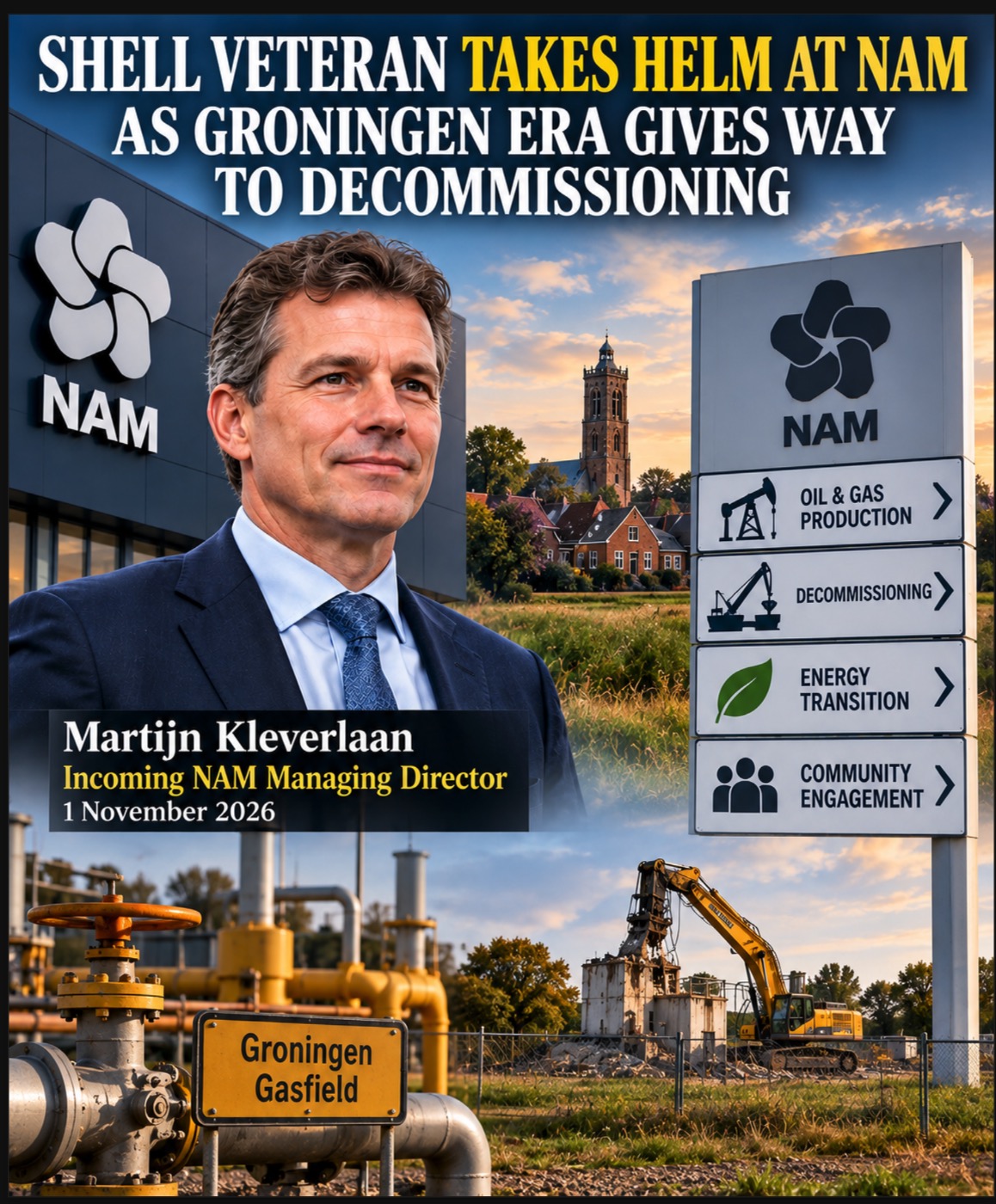
Martijn Kleverlaan will become Managing Director of Nederlandse Aardolie Maatschappij on 1 November 2026, taking charge of a much smaller organisation shaped by the end of Groningen gas production, offshore divestments and an expanding decommissioning programme.
Nederlandse Aardolie Maatschappij, the long-standing Dutch oil and gas producer associated with Shell, is changing leadership at a particularly symbolic moment in its history.
Martijn Kleverlaan, 53, will take over as Managing Director of NAM on 1 November 2026, succeeding Martijn van Haaster, who is returning to Shell after three years in charge. NAM announced the appointment on 30 September, with offshore industry publication Ocean Energy Resources reporting it on 1 October. nam.nl
This is more than a routine executive appointment.
Kleverlaan inherits a company that has been fundamentally reshaped by the end of production from the Groningen gas field, the sale of its offshore portfolio, the restart of oil production at Schoonebeek and an increasingly important obligation to dismantle and clean up infrastructure left behind by decades of oil and gas production. nam.nl
A company entering a different phase
Under Van Haaster, NAM produced the final gas from Groningen, closing one of the most consequential chapters in Dutch energy history.
The end of production did not mean the end of NAM’s responsibilities there. It marked the beginning of a large-scale programme to dismantle above-ground facilities, close wells and remove or deal with associated underground infrastructure. nam.nl
NAM says the organisation has now been restructured around two principal activities:
continued oil and gas production in the Netherlands, and
accelerated decommissioning of infrastructure that is no longer required. nam.nl
The physical shrinking of NAM is visible in another major change. The company announced earlier this year that, after 37 years at its present Assen headquarters, it will move its main office to Sappemeer. NAM said the Assen complex had become too large following reorganisations associated with the Groningen closure and the 2025 sale of its offshore activities. Around 300 employees involved mainly in production are expected to work from Sappemeer from January 2027. nam.nl
Kleverlaan is no newcomer
Kleverlaan brings 25 years of Shell experience and has spent more than a decade working at NAM.
Until recently he was Asset Manager responsible for operations in northern Netherlands. NAM says his career has covered technical, operational and leadership positions across Shell. nam.nl
His earlier roles are particularly relevant to the direction in which NAM now finds itself moving.
A 2020 Shell technical publication identified Kleverlaan as NAM’s energy transition manager, responsible for shaping new business directions for Shell’s upstream activities in the Netherlands. It also recorded that he joined Shell in 1999 as a drilling engineer and holds an MSc in physics from Delft University of Technology and an MBA from Edinburgh Business School. Shell
That background gives his appointment an interesting dual character.
He is an experienced upstream executive taking charge of an oil-and-gas producer, but he has also previously been responsible for considering what comes after conventional upstream production.
Schoonebeek is producing again
NAM is not simply winding itself down.
Only weeks before announcing Kleverlaan’s appointment, the company confirmed that oil production at Schoonebeek had restarted after more than four years.
NAM said the facilities had been progressively brought back into operation and that the first newly produced oil had already been transported to a refinery. nam.nl
That restart illustrates the unusual position Kleverlaan inherits.
NAM is simultaneously dismantling large parts of its historical infrastructure while continuing to extract hydrocarbons from selected Dutch fields.
Its future is therefore neither conventional growth nor straightforward closure.
The Groningen legacy remains
The end of Groningen gas production does not erase the enormous social and political legacy associated with the field.
NAM itself acknowledged in March that although seismic activity has declined significantly, the effects of earthquakes on Groningen residents remain considerable. The company has been dismantling the field since 2019 and says it does not see itself as the appropriate operator if the Dutch state decides that part of Groningen’s production infrastructure should be retained purely as a strategic emergency gas reserve. nam.nl
That is an important distinction.
The company that for decades stood at the centre of Groningen gas production is increasingly presenting itself as an operator responsible for managing the aftermath as much as extracting new resources.
Offshore portfolio gone, Ternaard abandoned
Van Haaster’s tenure also saw NAM dispose of its offshore activities to Tenaz Energy.
At the same time, NAM and the Dutch government reached an outcome under which the company abandoned plans to drill the proposed Ternaard well beneath the Wadden Sea. nam.nl
Those developments have left a considerably leaner organisation than the NAM of previous decades.
Van Haaster described the resulting company as smaller but robust, with continuing roles in Dutch energy supply and the energy transition. nam.nl
Kleverlaan now has to turn that description into an operating model.
From expansion to stewardship
NAM’s public statement says that under Kleverlaan it will continue to concentrate on safe and responsible oil and gas production, accelerated removal of redundant installations and pipelines, and improving relations with local communities and other stakeholders. nam.nl
That last element should not be dismissed as routine corporate language.
For NAM, particularly after Groningen, relations with communities are not a peripheral public-relations issue. They are inseparable from the company’s social licence to operate and from the long-term consequences of decisions made during decades of Dutch gas production.
Kleverlaan therefore assumes responsibility for something rather different from the company earlier generations of NAM directors inherited.
The old model was based on discovering, developing and producing hydrocarbons.
The emerging model is more complicated: produce what remains commercially and politically acceptable, dismantle what is no longer required, manage the liabilities of the past and demonstrate that the organisation still has a credible role in the Netherlands’ changing energy system.
That may prove a considerably more difficult management task than simply expanding production.
A symbolic handover
The timing of the appointment is therefore significant.
The Groningen production era is over.
NAM’s offshore portfolio has been sold.
Its headquarters are moving.
Large-scale decommissioning is under way.
Yet Schoonebeek has restarted, underground gas-storage assets remain important, and NAM continues to argue that domestic oil and gas have a role in Dutch energy security. nam.nl
Martijn Kleverlaan takes charge on 1 November 2026.
His challenge will not be to recreate the NAM of the Groningen era.
It will be to determine what remains of NAM after that era has ended—and how a company built around Dutch hydrocarbon production manages the enormous physical, financial and reputational legacy that production has left behind.
Sources: NAM, 30 September 2026; Ocean Energy Resources, 1 October 2026; Shell TechXplorer Digest; NAM announcements concerning Schoonebeek, Groningen and the headquarters relocation. nam.nl
*This website and sisters royaldutchshellgroup.com, shellnazihistory.com, royaldutchshell.website, johndonovan.website, shellnews.net, and shellwikipedia.com, are owned by John Donovan - more information here. There is also a Wikipedia segment, the Shell DPA Files, "Shell and the Spies", the Shell Leaks files, the Independent Shell Archive, as well as books written and published by John Donovan - Kindle eBooks. Timeline of the Donovan Shell Feud. Toxic History of Royal Dutch Shell Group. Shell and the Donovans: The Full Media Record — 550+ Articles, 110 Books, 40 Years. *All conjured up by internet wizz, Nick Gill.