Within 24 hours, Shell found itself on opposite sides of the risk ledger: Kazakhstan resumed enforcement of a huge disputed environmental penalty while the Shell-led LNG Canada venture committed billions to doubling its export capacity.
Shell has just provided an unusually vivid illustration of the risks and rewards inherent in operating one of the world’s largest energy portfolios.
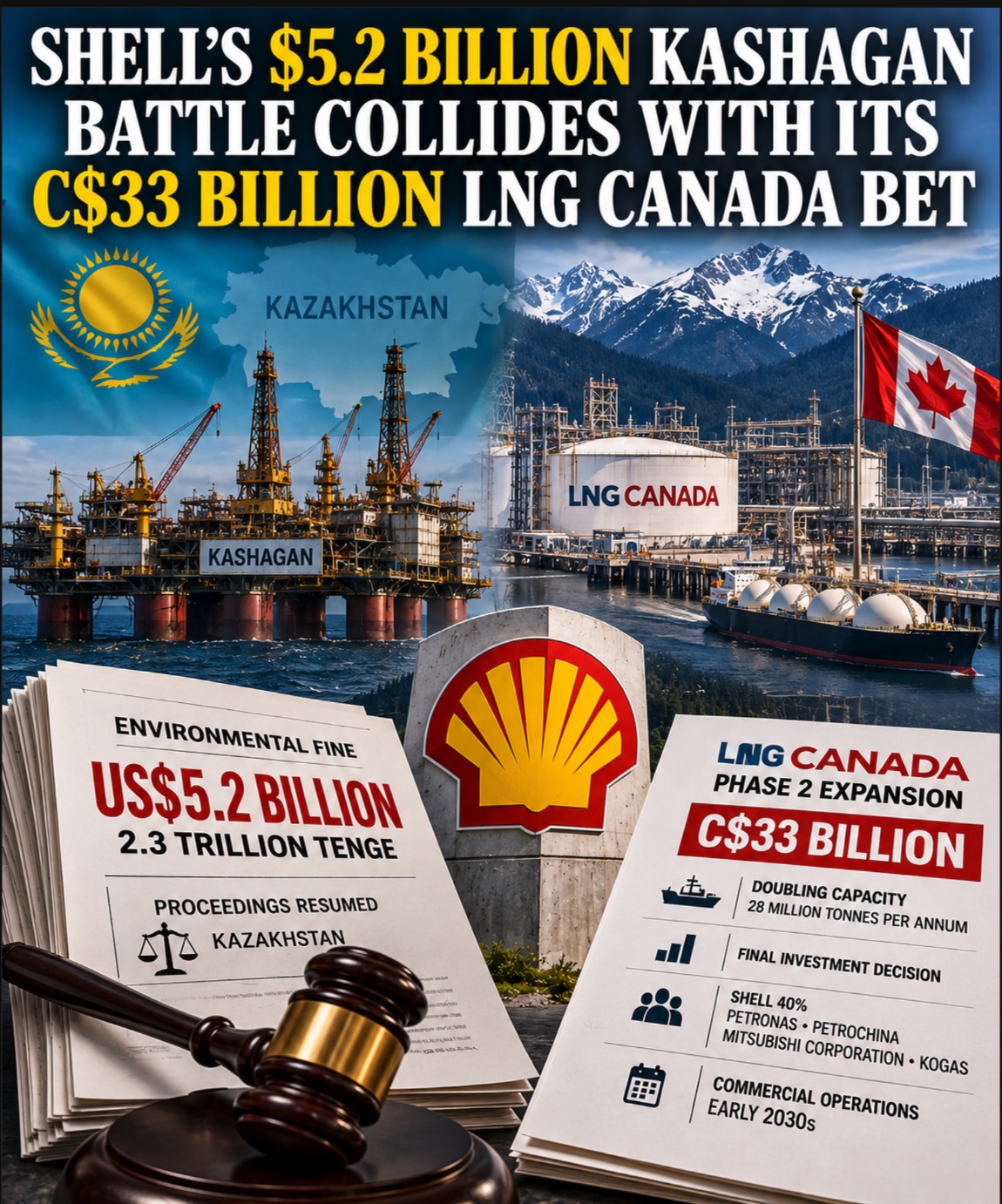
On one side of the globe, Kazakhstan has restarted proceedings aimed at collecting a 2.3 trillion tenge—approximately US$5.2 billion—fine from the international consortium operating the giant Kashagan oil field.
On the other, Shell and its partners have taken the final investment decision on a C$33 billion expansion of LNG Canada, doubling the British Columbia project’s production capacity.
The contrast was highlighted by a Yahoo Finance/Simply Wall St analysis published on 30 September.
But behind the investor shorthand of a “$5.2 billion fine and LNG bet” lie two very different and considerably more complicated stories. Yahoo Finance
Kazakhstan resumes pursuit of Kashagan penalty
The more immediate problem is Kashagan.
Reuters reported on 30 September that Kazakhstan had restarted enforcement proceedings seeking 2.3 trillion tenge from North Caspian Operating Company, the consortium responsible for the enormous offshore field in the Caspian Sea. London South East
Shell is one of the participants, alongside companies including ExxonMobil, TotalEnergies and CNPC.
The dispute concerns alleged violations involving the storage of sulphur generated during processing of Kashagan’s highly sulphurous oil.
The consortium rejects the allegations and the penalty and is contesting them through available legal channels. There has therefore been no acceptance by Shell or NCOC that the alleged environmental violations occurred. London South East
The enforcement process reportedly resumed on 29 September, after having been temporarily suspended while NCOC challenged enforcement action in an administrative court. The Times Of Central Asia
This is not simply a new fine suddenly imposed upon Shell this week. It is the latest phase of a complicated legal battle that has already passed through multiple rounds of proceedings.
Shell itself has disclosed the dispute
There is useful confirmation in Shell’s own financial documentation.
In a November 2025 debt-programme supplement, Shell disclosed several disputes involving Kazakhstan and described litigation concerning a sulphur-permitting inspection.
Shell recorded that Kazakhstan’s Supreme Court had returned the earlier case to an appellate court in June 2025. The appellate court subsequently cancelled the sulphur fine on procedural grounds.
Shell then disclosed that the environmental regulator imposed another penalty of approximately US$4.37 billion in August 2025, of which Shell said its share was approximately US$735 million.
Shell described the regulator’s actions as unlawful and said the relevant Shell non-operated venture was pursuing administrative and judicial challenges. Shell
The figure now being pursued by Kazakhstan is approximately US$5.2 billion at consortium level.
That distinction is important. The headline figure should not be represented as a US$5.2 billion fine payable solely by Shell.
A giant and difficult oil field
Kashagan is not an ordinary upstream asset.
Reuters describes it as one of the world’s largest oil discoveries of recent decades, with an estimated 13 billion barrels of recoverable reserves. London South East
Its enormous potential has also been accompanied by technical complexity, huge expenditure and recurring disputes.
The current enforcement battle therefore raises questions extending beyond the nominal size of the penalty: the commercial relationship between Kazakhstan and the international consortium, the conditions under which Kashagan operates, and the possibility of further legal and regulatory confrontation.
And while that dispute was returning to the headlines, Shell was committing itself to another enormous project thousands of miles away.
Shell doubles down on LNG
On 29 September Shell announced that the partners in LNG Canada Phase 2 had taken their final investment decision.
The expansion will double the Kitimat facility’s production capacity from 14 million tonnes per annum to 28 million tonnes by adding another two LNG processing trains together with additional storage and loading infrastructure. Shell
Shell owns 40% of LNG Canada and says Phase 2 will provide it with nearly 6 million tonnes per annum of additional LNG.
The other participants are PETRONAS, PetroChina, Mitsubishi Corporation and KOGAS. Shell
The Canadian government puts the investment associated with the expansion at approximately C$33 billion. Canada
Reuters reports that commercial operations are targeted for the early 2030s. London South East
Not exactly an energy-transition retreat
Shell’s announcement is particularly revealing about where the company sees its long-term business.
Shell says LNG Canada is a core part of its Integrated Gas portfolio and explicitly links the investment to its ambition to remain a leading integrated gas and LNG business through the 2040s. Shell
The company forecasts global LNG demand increasing from 422 million tonnes per annum in 2025 to nearly 700 million tonnes by 2050.
That is Shell’s forecast, not an established future outcome. Nevertheless, it helps explain why the company is prepared to support another enormous capital investment in LNG infrastructure. Shell
Shell’s strategy is therefore becoming increasingly clear.
Whatever language accompanies its energy-transition ambitions, large-scale natural gas and LNG remain central to its plans for decades to come.
Two stories, one Shell strategy
Yahoo Finance approaches the developments principally from the perspective of Shell investors: how much financial damage could the Kazakhstan dispute cause, and how much future value might LNG Canada generate? Yahoo Finance
There is another way of viewing the juxtaposition.
Kashagan represents the risks inherited from enormously complex, politically sensitive international hydrocarbon developments: environmental regulation, host-government relations, litigation and potentially very large financial claims.
LNG Canada represents Shell’s willingness to continue making very large long-term commitments to hydrocarbons when management believes the economics justify them.
One is a reminder of what can go wrong.
The other demonstrates that Shell has by no means lost its appetite for another generation of megaprojects.
Important qualifications
The US$5.2 billion Kashagan penalty is being pursued against NCOC, not Shell alone. Shell is one participant in the consortium.
NCOC disputes both the penalty and the underlying allegations and continues to challenge them.
Likewise, the C$33 billion LNG Canada figure relates to the overall Phase 2 project, not a C$33 billion expenditure by Shell alone. Shell owns 40% of the venture. London South East
Those distinctions become blurred rather easily in headlines describing Shell as simultaneously facing a “$5.2 billion fine” and making a “$33 billion bet.”
The underlying numbers remain enormous even after the corporate structures are properly understood.
From the Caspian to British Columbia
Within roughly a day, two announcements illustrated opposite faces of Shell’s global hydrocarbon strategy.
In Kazakhstan, authorities resumed attempts to enforce a multibillion-dollar environmental penalty against a consortium containing Shell.
In Canada, a Shell-led consortium committed to another multibillion-dollar LNG expansion intended to operate well into the coming decades.
For Shell shareholders, the comparison is striking.
The same global scale that allows Shell to participate in projects as enormous as LNG Canada also exposes it to the regulatory, political, environmental and legal consequences of projects such as Kashagan.
C$33 billion of new LNG investment on one side of the ledger. A disputed US$5.2 billion Kashagan penalty on the other.
For one of the world’s largest energy companies, both are manifestations of the same strategy: enormous projects, enormous capital—and correspondingly enormous risk.
Sources: Yahoo Finance/Simply Wall St; Shell plc, LNG Canada Phase 2 announcement, 29 September 2026; Reuters, 29–30 September 2026; LNG Canada; Government of Canada; Shell financial disclosures. Yahoo Finance
*This website and sisters royaldutchshellgroup.com, shellnazihistory.com, royaldutchshell.website, johndonovan.website, shellnews.net, and shellwikipedia.com, are owned by John Donovan - more information here. There is also a Wikipedia segment, the Shell DPA Files, "Shell and the Spies", the Shell Leaks files, as well as books written and published by John Donovan - Kindle eBooks. Timeline of the Donovan Shell Feud. Toxic History of Royal Dutch Shell Group. Shell and the Donovans: The Full Media Record — 550+ Articles, 110 Books, 40 Years. *All created and supported by internet wizz, Nick Gill.