A final investigation by the US Chemical Safety and Hazard Investigation Board has delivered a serious verdict on the June 2025 explosion at Shell Polymers Monaca in Pennsylvania: the incident was not caused by some unforeseeable industrial anomaly, but by a combination of an unintended valve operation, weak safeguards, insufficiently experienced personnel and a control-system interface that made a critical error too easy to make. Chemical Safety Board
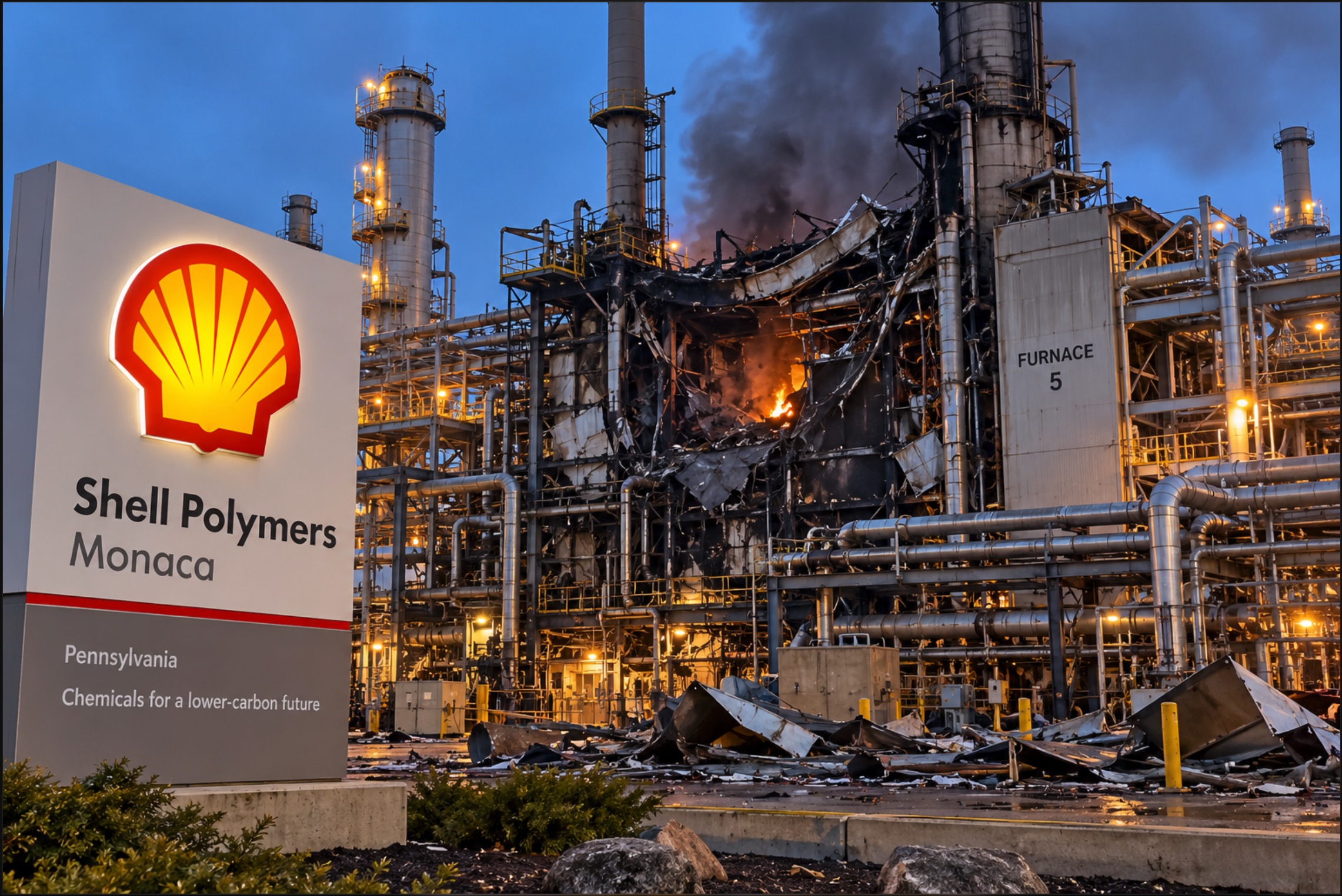
The explosion occurred on 4 June 2025 in Furnace 5 of the ethane cracking unit. According to the CSB, two motor-operated valves that had been isolating the furnace were inadvertently opened at the same time. That created an unintended flow path allowing flammable cracked gas from operating furnaces to backflow through the downstream quench system into the firebox of Furnace 5. Roughly six minutes later, the accumulated gas encountered lit pilot flames and ignited. Chemical Safety Board
The result was a major explosion and fire.
Fifteen employees were evacuated.
The furnace suffered severe damage.
Around 5,100 pounds of ethylene and combustion products were released.
And Shell estimated the property damage at approximately:
$95 million
Fortunately, no one was killed or seriously injured. Chemical Safety Board
The problem was not simply “operator error”
One of the most important aspects of the CSB report is what it does not do.
It does not stop at blaming the person who opened the valves.
The process-control engineer assigned to the task had never performed it before and had limited process knowledge. The CSB found that the plant’s system design and safeguards created conditions in which a human mistake could have catastrophic consequences. Chemical Safety Board
That distinction matters in process safety.
A sophisticated chemical plant should not rely on the assumption that every operator or engineer will always select the correct control, especially during unusual operating configurations.
The purpose of engineered safeguards is precisely to prevent one incorrect action from escalating into an explosion.
At Monaca, according to the CSB, that protection was inadequate.
Shell relied on 11 administrative controls
Perhaps the most striking finding is that Shell relied on:
11 administrative controls
to prevent cracked-gas backflow and a potentially catastrophic explosion.
Those safeguards depended on workers and managers remembering and correctly following procedures.
The CSB says Shell’s own process hazard analyses had already identified backflow as capable of causing a fatal incident.
Yet the facility did not have an engineered safeguard configured to prevent that backflow while Furnace 5 was in the relevant double-isolation condition. Chemical Safety Board
That is a much more serious finding than saying somebody clicked the wrong valve.
The hazard was known.
The possible consequences were known.
The protection depended heavily on human behaviour.
And the engineered system did not prevent the dangerous configuration.
The licensor had already provided a possible engineered safeguard
The CSB found that the furnace technology licensor had provided engineered controls capable of preventing backflow.
But according to the investigation, Shell had not configured those controls for use during removal of the double isolation. Chemical Safety Board
That finding goes directly to the hierarchy of controls widely used in industrial safety.
Administrative controls — procedures, instructions, training and supervision — are generally weaker than engineered safeguards because they depend upon people consistently doing the right thing.
Where a foreseeable error can release flammable material into an ignition source, the stronger design philosophy is to prevent the hazardous state physically or automatically wherever practicable.
That is essentially what the CSB is now telling Shell to do.
The human-machine interface also came under criticism
The report also focused on the plant’s human-machine interface, or HMI — the screens through which operators and control engineers interact with valves, alarms and process equipment.
The CSB found deficiencies that made the relevant furnace valves difficult to distinguish clearly. Safety and Health Magazine
The Board’s wider lesson is straightforward: control-room systems should make critical actions obvious, should provide clear feedback about what has been selected and, where appropriate, should allow an action to be cancelled before it is executed. Safety and Health Magazine
In a refinery or petrochemical plant, interface design is not merely a matter of convenience.
It is part of the safety system.
A confusing screen can become a process hazard.
Safety-critical alarms should not simply be suppressed
The CSB also highlighted alarm management.
Its final lessons warn chemical facilities against suppressing safety-critical alarms without analysing the risks created in each operating state — including startup, normal operation and shutdown. Safety and Health Magazine
That is significant because serious process-safety incidents frequently occur not during steady-state production but during transitions: startup, shutdown, maintenance or abnormal configurations.
Furnace 5 was in just such a non-routine condition.
The system needed to be safe not only when everything was operating normally, but while equipment was being returned from isolation.
The CSB has issued two formal recommendations to Shell
The Board has issued two recommendations specifically to Shell Polymers Monaca, and both remain open. Chemical Safety Board
The first requires Shell to review its process hazard analysis for the ethane cracking unit and identify hazards that are controlled solely through administrative measures. Where such a scenario could lead to death, serious injury or major property damage, the CSB says Shell should implement an inherently safer design or engineered control. Chemical Safety Board
The second recommendation is more specific.
The CSB wants Shell to install and maintain an engineered safeguard capable of preventing cracked-gas backflow into a furnace:
during all modes of furnace operation.
The recommendation expressly refers to recognised functional-safety standards for safety instrumented systems. Chemical Safety Board
As of the CSB’s current recommendation-status page, both recommendations remain listed as:
Open — Awaiting Response or Evaluation/Approval of Response. Chemical Safety Board
That does not necessarily mean Shell has done nothing. It means the recommendations have not yet been formally closed by the CSB.
Furnace 5 was out of service for roughly seven months
The consequences were not merely financial.
The CSB says Furnace 5 required extensive repair and returned to service approximately seven months after the explosion. Chemical Safety Board
That matters because the furnace is part of the ethane cracker at the centre of the Monaca complex.
Shell describes the Pennsylvania plant as a major integrated petrochemical facility designed to produce approximately:
1.6 million tonnes of polyethylene annually.
The facility processes ethane from the Marcellus and Utica shale regions and converts it into ethylene and ultimately polyethylene used in packaging, household goods and industrial products. Shell
A severe furnace failure therefore affects one of Shell’s largest recent chemicals investments in North America.
Monaca had already experienced start-up difficulties
There is also useful corporate context.
Shell commenced operations at Monaca in November 2022. Shell
But Shell’s own 2024 Annual Report acknowledged that the plant:
“was not fully functional during 2023 due to operational and start-up challenges.”
Shell said the facility subsequently ramped up operations from the first quarter of 2024. Shell
The June 2025 explosion therefore came after a plant start-up period that Shell itself had already characterised as operationally challenging.
That does not establish a causal connection between the earlier start-up problems and the Furnace 5 explosion.
The CSB report should be relied upon for causation.
But the earlier difficulties are relevant background when assessing the operational history of the site.
The plant is strategically important to Shell
Shell’s 2025 Annual Report listed Monaca as having approximately:
1.5 million tonnes per year of ethylene capacity
and
1.6 million tonnes per year of polyethylene capacity. Shell
That scale makes the CSB’s conclusions commercially significant as well as technically important.
This is not a small speciality-chemicals unit.
It is one of Shell’s major chemical plants.
And the Board has concluded that a known potentially fatal process hazard was being managed primarily through procedures rather than a sufficiently robust engineered safeguard.
“It could have been even worse”
CSB chairman Steve Owens summed up the central concern.
The incident demonstrated, he said, the importance of assigning experienced people to critical tasks and designing process-control systems that communicate essential information clearly.
His most important observation was also the simplest:
the outcome could have been much worse. Safety and Health Magazine
That is worth remembering when looking at the $95 million damage figure.
Industrial safety performance should not be measured merely by whether people happened to survive.
The correct question is whether the system was designed so that foreseeable human error could not easily develop into a major explosion.
The CSB’s answer at Shell Polymers Monaca is plainly:
not adequately.
Documentary position
Established: On 4 June 2025, Shell Polymers Monaca suffered an explosion and fire in Furnace 5 after two motor-operated isolation valves were inadvertently opened simultaneously, allowing cracked gas to backflow into the furnace and ignite. Chemical Safety Board
Established: Fifteen employees were evacuated, approximately 5,100 pounds of ethylene and combustion products were released, and Shell estimated approximately $95 million in property damage. No one was killed or seriously injured. Chemical Safety Board
Established: The CSB found that the assigned process-control engineer had never previously performed the task and had limited process knowledge. Chemical Safety Board
Established: Shell relied on 11 administrative controls to prevent cracked-gas backflow despite process hazard analyses identifying the scenario as potentially fatal. Chemical Safety Board
Established: The furnace licensor had provided engineered controls capable of preventing backflow, but the CSB found those controls had not been configured for the relevant double-isolation transition. Chemical Safety Board
Established: The CSB identified deficiencies in the human-machine interface and issued two recommendations requiring stronger engineered safeguards. Both are currently listed as open. Chemical Safety Board
Corporate context: Shell’s own earlier reporting acknowledged operational and start-up challenges at Monaca during 2023. No claim is made that those earlier problems caused the 2025 explosion. Shell
Commentary
There is an uncomfortable lesson in the Monaca report.
Modern petrochemical plants are full of sophisticated automation.
Yet sophisticated equipment does not necessarily produce sophisticated protection.
If a known fatal hazard can still be created because one relatively inexperienced person selects two valves through an unclear interface, while the principal barriers consist of eleven administrative procedures, the system has allowed far too much safety responsibility to migrate back onto the human being sitting in front of the screen.
That is precisely why engineered safeguards exist.
The importance of this report is therefore much broader than Shell Polymers Monaca.
It is about a recurring industrial-safety problem: organisations can accumulate procedures until the paperwork creates the appearance of control, while the underlying equipment remains capable of entering a catastrophic state.
Eleven administrative controls sound impressive.
One properly designed engineered interlock may be safer.
At Monaca, the CSB has now effectively told Shell to address that imbalance.
And Shell should perhaps be thankful that the lesson cost approximately $95 million rather than lives.
Sources
The principal source is the US Chemical Safety and Hazard Investigation Board final investigation record, including the final report and formal recommendations.
CSB — Shell Polymers Furnace Explosion and Fire investigation
The CSB’s 16 September 2026 final-report announcement summarises the causal findings, $95 million property loss, 5,100-pound release, personnel issues, administrative-control weaknesses and HMI deficiencies.
CSB — Final investigation report on Shell Polymers Monaca explosion
The report prompting this article is Kevin Druley’s 6 October 2026 Safety+Health account of the final CSB findings and their broader process-control lessons.
Safety+Health — Final report on polymer plant explosion focuses on process control systems
Shell’s own project description records Monaca’s role and designed polyethylene capacity.
Shell — Shell Polymers Monaca project description
Shell’s annual reporting provides the wider operational background, including the earlier start-up challenges and the facility’s production capacity. Shell
Site-wide disclaimer applies.
*This website and sisters royaldutchshellgroup.com, shellnazihistory.com, royaldutchshell.website, johndonovan.website, shellnews.net, and shellwikipedia.com, are owned by John Donovan - more information here. There is also a Wikipedia segment, the Shell DPA Files, "Shell and the Spies", the Shell Leaks files, as well as books written and published by John Donovan - Kindle eBooks. Timeline of the Donovan Shell Feud. Toxic History of Royal Dutch Shell Group. Shell and the Donovans: The Full Media Record — 550+ Articles, 110 Books, 40 Years. *All created and supported by internet wizz, Nick Gill.