Court rejects attempt to revive consumer-deception case over fossil-fuel advertising — but the ruling is not a judicial declaration that oil-company environmental claims are truthful
New York City has suffered another major defeat in its attempt to hold Shell, ExxonMobil and BP liable for allegedly misleading consumers about the environmental consequences of fossil fuels and the companies’ efforts to portray themselves as part of the solution to climate change.
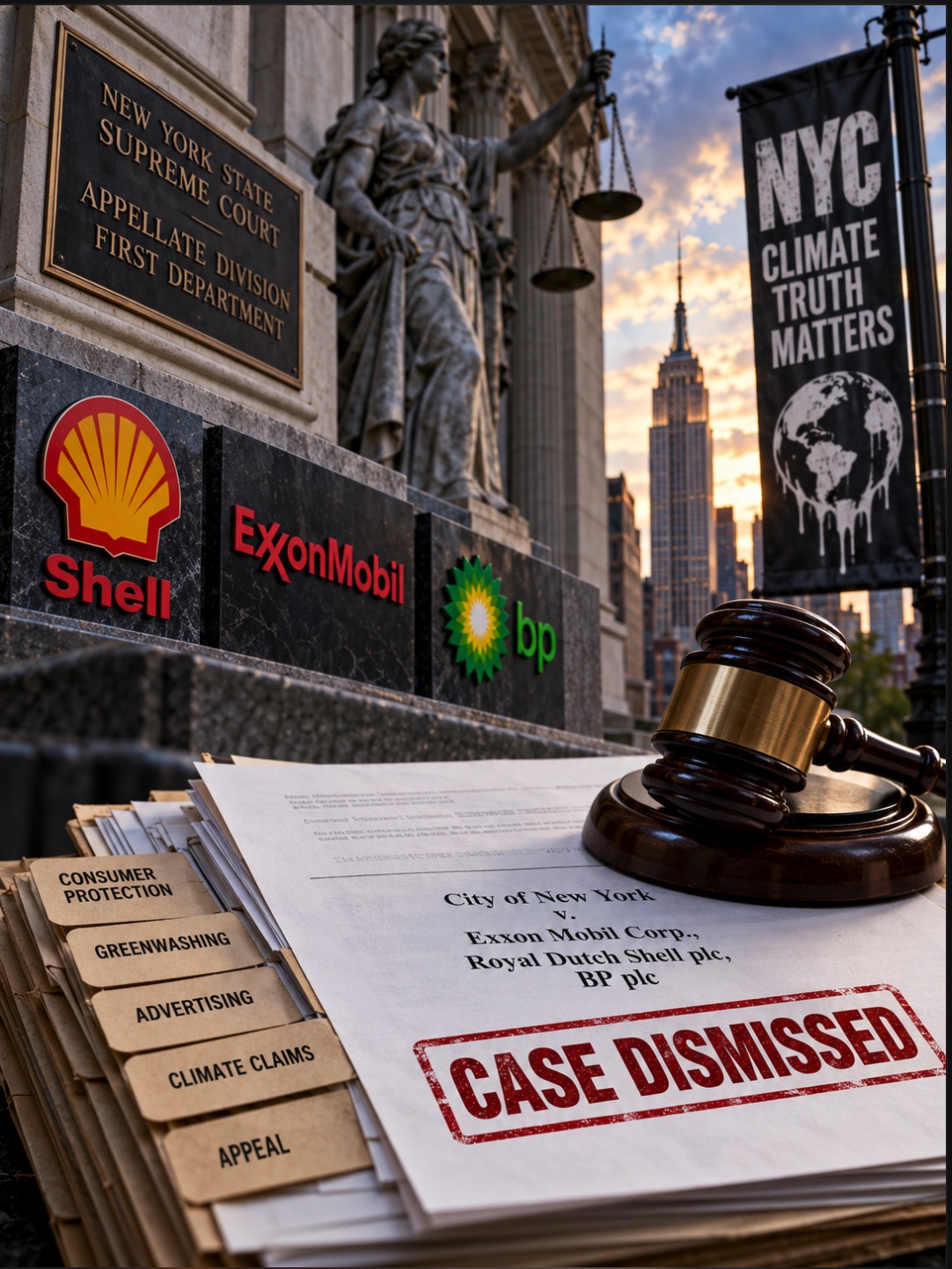
On 8 October 2026, a New York appellate court upheld the dismissal of the City’s lawsuit, rejecting its attempt to revive claims brought under the New York City Consumer Protection Law.
The decision represents a significant legal victory for the three oil majors.
But its meaning requires some care.
The courts have not ruled that every environmental claim made by Shell, Exxon or BP was true. Nor have they ruled that fossil-fuel consumption does not contribute to climate change.
Instead, the case failed because New York City’s allegations did not satisfy the particular legal requirements governing deceptive consumer practices.
That distinction is important.
The case began on Earth Day 2021
New York City commenced the action on 22 April 2021 — Earth Day.
Its defendants were Exxon Mobil Corporation and ExxonMobil Oil Corporation; Royal Dutch Shell plc and Shell Oil Company; BP plc and BP America Inc.; and the American Petroleum Institute.
The City accused them of engaging in what it called systematic deception and “greenwashing.”
According to the City’s complaint, the oil companies promoted allegedly environmentally preferable fuel products while simultaneously presenting themselves as corporate leaders in tackling climate change.
The City maintained that consumers concerned about global warming were being encouraged to regard the companies and their products as greener than they really were.
The lawsuit sought civil penalties and orders preventing the alleged practices from continuing. New York City Government
Shell’s V-Power advertising was specifically targeted
For Shell, this was not merely a general attack on corporate climate rhetoric.
The complaint identified specific advertising connected with Shell fuel products.
Among them were Shell’s Nitrogen Enriched Cleaning System and V-Power Nitro+ Premium petrol.
According to the City’s allegations, Shell advertised these products as producing “fewer emissions.”
The City did not claim that such statements were necessarily technically false in isolation.
Its broader argument was that promoting reduced emissions associated with particular fuel characteristics, without simultaneously disclosing the overall contribution of fossil-fuel use to climate change, could mislead environmentally conscious consumers.
The trial court would eventually reject that theory. CounselStack
New York City also attacked Shell’s corporate image
The second strand was more ambitious.
The City accused Shell, ExxonMobil and BP of using corporate advertising to cultivate the impression that renewable and low-carbon energy represented a substantial and rapidly growing part of their businesses.
The complaint alleged that this wider corporate messaging was designed to make consumers more comfortable purchasing the companies’ fossil-fuel products.
In other words, New York attempted to connect what might ordinarily be regarded as broad corporate reputation advertising with the eventual sale of petrol to consumers.
That connection became one of the lawsuit’s fundamental legal weaknesses.
January 2025: the entire complaint was dismissed
On 14 January 2025, Justice Anar Rathod Patel of the New York Supreme Court dismissed the City’s complaint in its entirety.
The judgment identified two principal deficiencies.
First, the court found it unsustainable for the City simultaneously to contend that New York consumers were sufficiently climate-conscious to be influenced by environmental advertising while also arguing that those consumers would not know that fossil-fuel use contributes to climate change.
The court considered the fossil-fuel/climate relationship to be publicly known information in the context of the City’s own allegations. FindLaw
Second, the broader corporate “greenwashing” statements were not sufficiently connected with the sale or offering for sale of consumer goods in New York City, as required by the relevant Consumer Protection Law.
The judge warned that the City’s interpretation would effectively turn almost any broad corporate statement about a company’s business or environmental ambitions into consumer advertising covered by the statute.
The law did not stretch that far. FindLaw
The Shell petrol claims failed the “reasonable consumer” test
The court also considered the advertisements for particular fuel products.
That included Shell’s V-Power Nitro+ claims.
Its conclusion was that a reasonable consumer would not interpret promotional language concerning reduced emissions or fuel performance as meaning that using petrol did not contribute to climate change.
That difference is central to understanding the result.
New York City effectively wanted the court to treat a claim about the comparative characteristics of a petrol product as potentially misleading because it omitted the much larger environmental consequences associated with burning fossil fuels.
The judge declined to do so.
The ruling did not determine that climate-related advertising can never be deceptive.
It found that the particular statements pleaded by New York City did not meet the legal test required in this case. FindLaw
Older allegations were also out of time
The City encountered another obstacle.
The court held that alleged statements made before 22 April 2018 fell outside the applicable limitation period.
That removed part of the historic advertising record from the litigation independently of the substantive arguments over whether consumers had been misled. FindLaw
The dismissal therefore rested on several distinct legal grounds rather than a sweeping declaration that the oil companies’ environmental marketing had been vindicated.
New York appealed
The City was not prepared to accept that outcome.
It filed its appeal in February 2025.
The case became City of New York v. Exxon Mobil Corp., Appellate Division, First Department, Case No. 2025-01687.
New York argued that the trial judge had applied an unduly restrictive interpretation of its Consumer Protection Law and had improperly resolved factual issues that should have been permitted to proceed further.
The defendants took the opposite position.
They argued that the City could not simultaneously portray consumers as highly informed and concerned about climate change while asserting that those same consumers would understand petrol advertising to mean that fossil fuels had no climate consequences.
The defendants’ appellate brief was filed in March 2026. Climate Policy Radar
Oral argument followed in April
The First Department heard oral argument on 15 April 2026.
Court records confirm that the City and the oil companies were each allocated 15 minutes for argument. New York Courts
The case was being closely watched because it tested a particular version of climate litigation increasingly seen in the United States.
Rather than suing oil companies simply for producing fossil fuels, governments and campaigners have increasingly framed some cases around consumer deception:
What did oil companies tell consumers?
What did they leave out?
And did corporate environmental advertising influence purchasing decisions?
The New York case was therefore potentially significant beyond the individual advertisements identified in the complaint.
8 October 2026: the companies win again
The appellate court has now sided with the defendants.
Bloomberg Law reports that the three-judge panel rejected New York City’s attempt to revive the case and upheld the oil companies’ victory.
Of particular significance, the panel agreed that the challenged representations concerning products and carbon emissions were not misleading in the manner required to sustain the City’s statutory claims.
The result leaves the January 2025 dismissal standing.
For ExxonMobil, Shell and BP, it is an unequivocal litigation victory.
For New York City, it is the end of another round in a climate-accountability campaign that has repeatedly encountered difficult questions about what courts, rather than legislatures and regulators, can properly decide. value-trades.com
What Shell has — and has not — won
Shell can legitimately say that it defeated the lawsuit.
That is a matter of court record.
What Shell cannot reasonably claim from this judgment is that a New York appellate court has certified its historical environmental marketing as accurate.
The difference is substantial.
A court dismissing a deceptive-practices claim may do so because:
the statute does not cover the conduct;
a reasonable consumer would not understand the advertisement in the alleged way;
the alleged representation was not sufficiently connected to a consumer sale;
the claim was filed too late;
or the pleadings otherwise fail to state a legally recognised cause of action.
Those are legal conclusions.
They are not the same thing as an independent scientific audit of Shell’s advertising.
Shell’s peculiar position in the case
There is also an historical curiosity.
The defendant named in the proceedings remains Royal Dutch Shell plc.
That was Shell’s corporate name when the action began in April 2021.
The company subsequently changed its name to Shell plc in January 2022.
So the case now provides yet another piece of the surviving documentary trail from the period when the company formally carried the Royal Dutch Shell name.
The independent website on which this article appears, of course, continues to carry that name rather more enthusiastically.
This should not be confused with New York City’s earlier climate lawsuit
There is an additional complication worth explaining.
This 2021 greenwashing case is not New York City’s earlier lawsuit seeking billions of dollars from major oil companies for the costs of climate-change damage.
That earlier action, filed in 2018 against BP, Chevron, ConocoPhillips, ExxonMobil and Royal Dutch Shell, pursued a different legal theory.
The City sought to make the companies pay towards infrastructure needed to protect New York from sea-level rise and other climate effects.
That litigation was also dismissed, and the dismissal was upheld on appeal.
The 2021 case examined here instead focused on consumer advertising and allegedly misleading environmental representations.
Different lawsuit.
Different legal theory.
Same underlying argument that major fossil-fuel producers should bear greater accountability for the consequences of the products they sell. New York City Government
A wider American climate-litigation battle
The New York decision arrives during a much larger legal struggle over whether state and municipal governments can use traditional state-law causes of action to pursue fossil-fuel companies for climate-related conduct.
Numerous cases remain in courts around the United States.
They differ substantially.
Some allege nuisance.
Some seek compensation for physical climate damage.
Others allege fraud or consumer deception.
And one of the major recurring legal questions is whether matters involving global greenhouse-gas emissions can be regulated indirectly through state tort law or whether federal law pre-empts such claims.
By 2026, that broader dispute had reached the US Supreme Court in litigation brought by Colorado local governments against ExxonMobil and Suncor. The Court agreed to consider whether federal law pre-empts state-law climate-damages claims, a question potentially relevant to many cases around the country. Amazon Web Services, Inc.
The New York greenwashing decision does not resolve that national question.
But it demonstrates another difficulty confronting climate litigants: even where claims survive arguments about jurisdiction or federal pre-emption, plaintiffs still have to satisfy the precise elements of the particular state or municipal law they invoke.
New York City failed that test here.
An interesting contrast with European advertising regulation
For Shell, there is another reason the decision deserves attention.
European advertising regulators have sometimes taken a considerably stricter approach to corporate environmental messaging than the New York courts did in this case.
In Britain, Shell has previously fallen foul of the Advertising Standards Authority over advertisements that were judged to give consumers an insufficiently balanced impression of Shell’s overall business.
The conceptual issue is similar.
Can a fossil-fuel company advertise renewable power, electric-vehicle charging, lower-carbon products or particular emissions advantages without giving consumers sufficient context about the scale of its continuing oil and gas operations?
Different legal systems are producing different answers because the statutory tests are different.
That alone makes it dangerous to convert the New York decision into the proposition:
“Shell cleared of greenwashing.”
That would go considerably further than the judgment supports.
A more accurate description is:
Shell defeated New York City’s attempt to establish that the particular advertising and corporate statements identified in this lawsuit violated New York City’s Consumer Protection Law.
Documentary position
Established: New York City sued ExxonMobil, Shell, BP and the American Petroleum Institute in April 2021, alleging deceptive advertising and corporate greenwashing under the City’s Consumer Protection Law. New York City Government
Established: The City’s Shell-specific allegations included advertising associated with Shell V-Power Nitro+ and its Nitrogen Enriched Cleaning System. CounselStack
Established: Justice Anar Rathod Patel dismissed the case against ExxonMobil, Shell and BP in its entirety on 14 January 2025. FindLaw
Established: The trial court found, among other things, that the City had failed adequately to allege actionable deception concerning the fossil-fuel products and had failed to connect the broader corporate environmental statements sufficiently to consumer sales under the statute. FindLaw
Established: Statements predating 22 April 2018 were held time-barred. FindLaw
Established: New York City appealed, with oral argument taking place before the Appellate Division, First Department, on 15 April 2026. New York Courts
Latest development: Bloomberg Law reports that the appellate panel has now rejected the City’s attempt to revive the case, leaving the oil companies victorious. value-trades.com
Not established: The decision does not establish that all environmental representations ever made by Shell, ExxonMobil or BP were accurate.
Not established: It does not constitute a judicial finding that fossil-fuel consumption is unrelated to climate change.
Not established: It does not determine the merits of every other climate or greenwashing lawsuit against fossil-fuel companies.
Commentary
There is a temptation on both sides of climate litigation to make every judgment signify considerably more than it actually does.
Campaigners may portray a surviving lawsuit as proof that corporate wrongdoing has been established.
Companies may portray dismissal as proof that the allegations themselves were false.
Neither proposition necessarily follows.
The New York case illustrates the difference particularly well.
The City’s theory was ambitious.
It wanted to transform a mixture of petrol advertising and broad corporate environmental messaging into violations of a municipal consumer-protection statute.
The courts have now said that the legal machinery chosen by the City does not support that case.
Shell, Exxon and BP are entitled to call that a victory.
But the much larger debate over how oil companies have presented the environmental consequences of their businesses remains very much alive.
And there is an irony here for Shell.
The company has spent years telling consumers, governments and shareholders about its role in the energy transition.
When such claims are challenged, Shell understandably insists that individual statements must be read precisely, in their proper context, and under the particular law that governs them.
The same standard should apply when Shell describes this judgment.
It won the lawsuit.
It did not win a judicial certificate declaring:
“No greenwashing here.”
Those are two very different propositions.
Sources
Bloomberg Law — 8 October 2026
The report prompting this article states that the New York appellate court rejected the City’s attempt to revive its environmental consumer-deception lawsuit against ExxonMobil, Shell and BP.
Bloomberg Law — Exxon Mobil, Shell, BP Win Fight to Quash NYC Environmental Suit
City of New York — 22 April 2021
The City’s original announcement explains the allegations and the consumer-protection theory underlying the lawsuit.
New York City — lawsuit against ExxonMobil, Shell, BP and API
New York Supreme Court — 14 January 2025
The trial judgment in City of New York v. Exxon Mobil Corp., Index No. 451071/2021, sets out the Shell-specific advertising allegations and the reasons for dismissing the complaint.
FindLaw — City of New York v. Exxon Mobil Corp. trial judgment
Appellate proceedings
The City’s appeal was docketed as 2025-01687 in the New York Supreme Court, Appellate Division, First Department. Official court records show oral argument took place on 15 April 2026.
New York Courts — First Department April 2026 calendar
Defendants’ appellate brief
The oil companies’ March 2026 brief sets out their arguments for affirming the dismissal.
Defendants-Respondents’ appellate brief
Site-wide disclaimer applies.
*This website and sisters royaldutchshellgroup.com, shellnazihistory.com, royaldutchshell.website, johndonovan.website, shellnews.net, and shellwikipedia.com, are owned by John Donovan - more information here. There is also a Wikipedia segment, the Shell DPA Files, "Shell and the Spies", the Shell Leaks files, as well as books written and published by John Donovan - Kindle eBooks. Timeline of the Donovan Shell Feud. Toxic History of Royal Dutch Shell Group. Shell and the Donovans: The Full Media Record — 550+ Articles, 110 Books, 40 Years. *All created and supported by internet wizz, Nick Gill.