Why prosecutors are targeting Shell: An unprecedented intervention by public prosecutors
10 October 2026
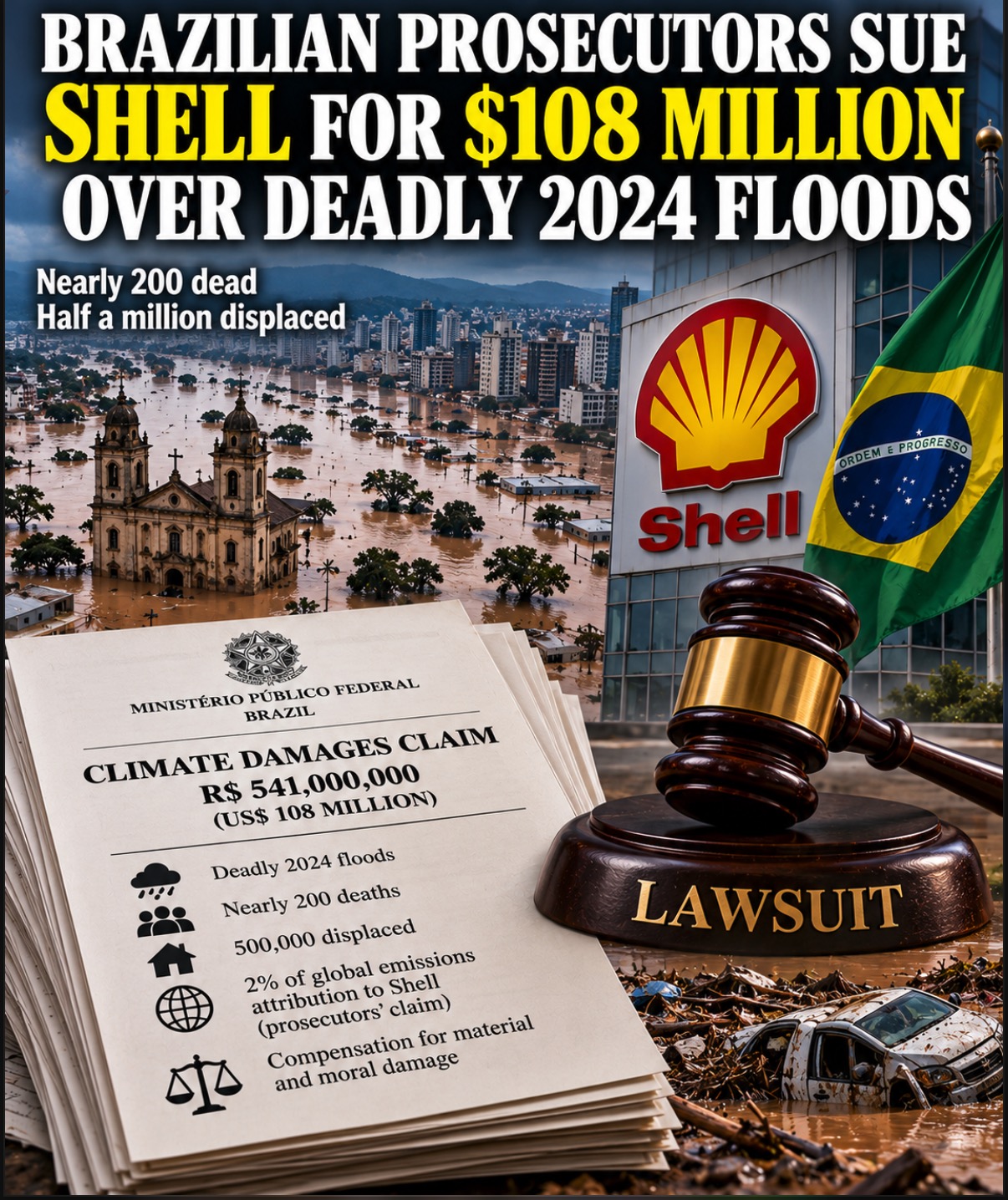
Brazilian federal prosecutors have launched an unprecedented lawsuit against Shell’s Brazilian subsidiary, seeking approximately $108 million in compensation for the catastrophic 2024 floods in Rio Grande do Sul. The case could become an important test of whether an oil multinational can be required to compensate victims of a climate-related disaster according to its alleged contribution to historical global greenhouse gas emissions.
Shell has become the target of a potentially landmark climate lawsuit in Brazil.
On Friday, 9 October 2026, Brazil’s Federal Public Prosecutor’s Office (Ministério Público Federal, or MPF), working alongside the environmental organisation Instituto Preservar, brought civil proceedings against Shell’s Brazilian subsidiary over the devastating floods that struck southern Brazil in April and May 2024.
The prosecutors are seeking more than 541 million Brazilian reais, approximately US$108 million, in compensation.
The legal argument is potentially far more significant than the monetary demand.
The prosecutors contend that Shell should bear a proportionate share of the damage caused by the floods because of the company’s historical and continuing contribution to global greenhouse gas emissions.
According to the case described by Agence France-Presse (AFP), the claim attributes approximately 2% of historical global greenhouse gas emissions to Shell’s contribution to global warming.
That figure is part of the claimants’ case. It has not been established as a finding by the Brazilian court.
Nevertheless, the proceedings represent a striking development in the international effort to hold major fossil-fuel companies financially accountable for climate-related damage.
A catastrophe that devastated southern Brazil
The floods that overwhelmed Rio Grande do Sul in 2024 were among the worst natural disasters in modern Brazilian history.
Extraordinary rainfall inundated communities, destroyed homes, damaged infrastructure and forced hundreds of thousands of people from their homes.
Nearly 200 people died.
Approximately half a million people were displaced.
The destruction extended across residential neighbourhoods, agricultural communities, businesses, transport networks and public facilities.
Porto Alegre, the state capital, became one of the most recognisable images of the disaster as floodwaters submerged streets and buildings.
The scale of the devastation is important to understanding the litigation.
This is not a conventional environmental case involving an oil spill, contaminated site or industrial accident directly attributable to a particular Shell installation.
Instead, prosecutors are attempting to establish responsibility for a disaster associated with the wider consequences of global climate change.
The claim therefore reaches beyond Shell’s immediate operations in Brazil.
It concerns the historical emissions associated with the multinational oil and gas business.
Why prosecutors are targeting Shell
According to the court documents examined by AFP, Brazilian prosecutors argue that Shell’s historical and continuing greenhouse gas emissions, associated with fossil-fuel exploration, production and sales, have contributed to the warming of the planet.
Their case seeks to translate that alleged contribution into a financial responsibility for the consequences of an extreme weather disaster.
The argument is that major fossil-fuel producers should not be insulated from climate-damage claims merely because the resulting harm occurs far from their production facilities.
The proceedings reportedly seek compensation for both collective material damage and collective moral damage.
French-language AFP reporting describes two components of approximately 270 million reais each, together accounting for the reported total of roughly 541 million reais.
The distinction is important.
The prosecutors are not seeking a conventional regulatory fine.
They are pursuing civil compensation for alleged damage resulting from climate change.
The underlying proposition is that the costs of climate-related disasters should not necessarily be borne entirely by governments, taxpayers, insurers and victims.
Instead, the claimants argue that companies whose emissions have contributed to global warming should share those costs.
An unprecedented intervention by public prosecutors
One of the most important features of the case is the identity of the claimant.
Climate litigation against multinational energy companies is no longer unusual.
Environmental organisations, affected communities and individual claimants have brought proceedings in several countries.
But this Brazilian action is different.
It has been initiated by a national public prosecution authority.
Maria Antonia Tigre, director of global climate litigation at Columbia University’s Sabin Center for Climate Change Law, told AFP that this was the first case in which a national prosecutor had sued a major oil company over a climate disaster.
That assessment gives the proceedings international significance.
It suggests that climate-damage litigation may be expanding from private civil claims into cases brought directly by public authorities exercising environmental enforcement and public-interest responsibilities.
If other prosecutors adopt comparable approaches, major fossil-fuel producers could face a wider range of climate-related civil claims.
Whether the Brazilian action succeeds remains uncertain.
But its initiation is itself a development worth recording.
The central legal question: can climate damage be apportioned?
The Brazilian case raises a difficult question.
Climate change results from greenhouse gas emissions accumulated over long periods and originating from numerous countries, industries, businesses and individuals.
How, then, can a court assign legal responsibility for a particular flood to one company?
The Brazilian prosecutors’ proposed answer is proportional responsibility.
Rather than arguing that Shell alone caused the disaster, they seek to attribute a share of responsibility based on the company’s alleged contribution to historical emissions.
The reported figure is 2%.
The legal theory is significant because it attempts to bridge the gap between scientific attribution and legal liability.
Climate science can assess how human-induced warming influences the probability or severity of certain extreme weather events.
Historical emissions research can also estimate contributions associated with major fossil-fuel producers.
But establishing that climate change contributed to an event is not necessarily the same as proving that a particular defendant is legally liable for a specified proportion of the resulting losses.
A court must consider the applicable legal standards, evidence of causation, the defendant’s conduct, the quantification of damages and any available defences.
These are substantial legal obstacles.
The Brazilian claimants will need to persuade the court that their proposed approach satisfies Brazilian law.
The German precedent: a warning, but not a victory for claimants
The Brazilian proceedings arrive against a background of important developments in European climate litigation.
One of the most closely watched cases involved Peruvian farmer Saúl Luciano Lliuya and German energy company RWE.
Lliuya sought to establish that RWE should contribute towards measures addressing flood risks affecting his community in Peru.
In 2025, a German court rejected his individual compensation claim.
However, the judgment was widely regarded as significant because it recognised, in principle, the possibility of civil liability for climate-related damage attributable to major emitters.
The distinction is essential.
The German court did not order RWE to pay compensation.
Nor did it establish that every major emitter is automatically liable for a fixed percentage of climate damage.
Nevertheless, the litigation demonstrated that courts may be prepared to examine proportional climate liability as a legally arguable proposition.
Brazilian prosecutors are now pursuing a related approach, although under a different legal system and in materially different circumstances.
Shell already faces climate-damage litigation in Britain
The Brazilian lawsuit is not the only climate-damage claim confronting Shell.
AFP also draws attention to proceedings in the United Kingdom brought by people affected by Typhoon Odette, known internationally as Typhoon Rai, which devastated parts of the Philippines in December 2021.
Those claimants are pursuing Shell in connection with alleged contributions to climate change and the damage they suffered.
The existence of these proceedings illustrates how climate litigation is developing beyond cases seeking reductions in future emissions.
An increasingly important strand seeks financial redress for damage allegedly associated with emissions produced or enabled by major fossil-fuel companies.
Other claims have been brought against energy and industrial companies in connection with flooding in Pakistan and rising sea levels affecting an Indonesian island community.
The cases involve different defendants, legal systems and factual circumstances.
Their outcomes cannot be assumed to be interchangeable.
But together they demonstrate a developing international strategy: using civil liability to pursue compensation for climate-related losses.
What has Shell said?
At the time of AFP’s initial reporting, Shell’s Brazilian subsidiary had not provided an immediate response to the news agency’s request for comment.
That should not be interpreted as an admission.
The lawsuit contains allegations that Shell is entitled to contest.
The company may dispute the proposed emissions attribution, the alleged causal connection with the floods, the legal basis for proportional liability, the amount of compensation sought or the appropriate defendant.
The publicly reported information does not yet establish the full scope of Shell’s defence.
Nor does the filing of the lawsuit mean that a Brazilian court has accepted the prosecutors’ allegations.
The case is at an early stage.
A reliable assessment of its prospects will require examination of the originating court documents, the applicable legal provisions and Shell’s response.
Why this case matters to Shell shareholders
The immediate financial demand of approximately $108 million is not, by itself, a sum likely to threaten Shell’s financial viability.
The broader implications could be considerably more significant.
If courts begin accepting the principle that major fossil-fuel producers can be required to contribute proportionately to climate-disaster compensation, the resulting financial exposure could extend far beyond any individual case.
Extreme weather events can cause enormous losses.
Potential claims may involve destroyed infrastructure, damaged property, agricultural losses, business interruption, displacement and wider social harm.
For shareholders, the important issue is therefore not simply the amount demanded in Brazil.
It is whether the case advances a legal theory capable of being applied in other jurisdictions.
A single unsuccessful lawsuit may have limited financial consequences.
A successful precedent, however, could encourage further litigation and affect the assessment of long-term legal and financial risks associated with fossil-fuel production.
At present, such consequences remain possibilities rather than established liabilities.
The wider contradiction in Shell’s position
There is also a striking contrast between this development and Shell’s recent financial disclosures.
On 7 October, Shell reported that its indicative refining margin had risen sharply to $42 per barrel.
That disclosure was examined in our recent article:
Three days later, Shell finds itself at the centre of another important climate-related legal development.
The contrast is revealing.
The company’s established oil and gas activities continue to generate substantial commercial opportunities.
At the same time, the long-term environmental consequences associated with fossil-fuel emissions are becoming the subject of increasingly ambitious legal claims.
That tension is likely to remain an important consideration for investors assessing Shell’s future.
A new chapter for the independent Shell archive
The Brazilian proceedings deserve a permanent place in the independent historical record of Shell-related litigation.
The case is distinctive in several respects.
It involves federal prosecutors rather than only private claimants.
It seeks compensation for a specific, catastrophic weather event.
It advances a theory of proportional responsibility based on historical greenhouse gas emissions.
And it targets Shell’s Brazilian subsidiary while drawing on allegations concerning the wider group’s contribution to global warming.
For the purposes of The Shell Leaks Files and the broader Shell litigation archive, the case should be recorded as a newly filed civil climate-damages action.
The reported compensation demand is approximately 541 million reais, equivalent to around $108 million.
The alleged emissions contribution is 2%.
Neither the claimed damages nor the asserted attribution has yet been judicially established.
The exact court, case number and procedural timetable should be added once independently verified.
These distinctions are important because the value of a historical archive depends on separating allegations, documentary evidence and judicial findings.
Conclusion: a potentially historic test of climate responsibility
Brazil’s lawsuit against Shell could become an important test of how the law responds to the financial consequences of climate change.
The prosecutors are advancing a proposition that would have seemed highly ambitious only a few years ago.
They argue that a major fossil-fuel producer should contribute financially to the damage caused by a catastrophic flood because of its historical contribution to global warming.
Shell has not been found liable.
The prosecutors have not yet proved their case.
And substantial questions remain about causation, attribution and the application of Brazilian environmental law.
Nevertheless, the significance of the proceedings should not be underestimated.
For decades, major oil companies have generated revenues from the extraction, production and sale of fossil fuels.
The emerging legal question is whether those companies can also be required to contribute to the costs of climate-related disasters.
Brazilian federal prosecutors have now placed that question directly before a court in proceedings against Shell.
The outcome may matter far beyond Brazil.
Sources
- Agence France-Presse, 10 October 2026 — Brazil prosecutors sue Shell for $108 million over deadly 2024 floods
- UOL / AFP, 9 October 2026 — Brazilian prosecutors seek more than R$541 million from Shell
- Correio do Povo — Federal prosecutors bring Shell flood claim
- Columbia University — Sabin Center for Climate Change Law
- Shell plc — Third Quarter 2026 Update Note
Editorial note: This article reports allegations in newly filed civil proceedings. Shell’s liability has not been established. The precise court docket, pleadings and any subsequent company response remain to be independently verified.
The most important aspect of this story is the involvement of Brazil’s federal prosecutors. That gives the case a significance beyond the $108 million demand and makes it particularly relevant to the Shell litigation archive.
I can also prepare a strong accompanying editorial image showing the 2024 Brazilian floods, Shell and the new climate lawsuit.