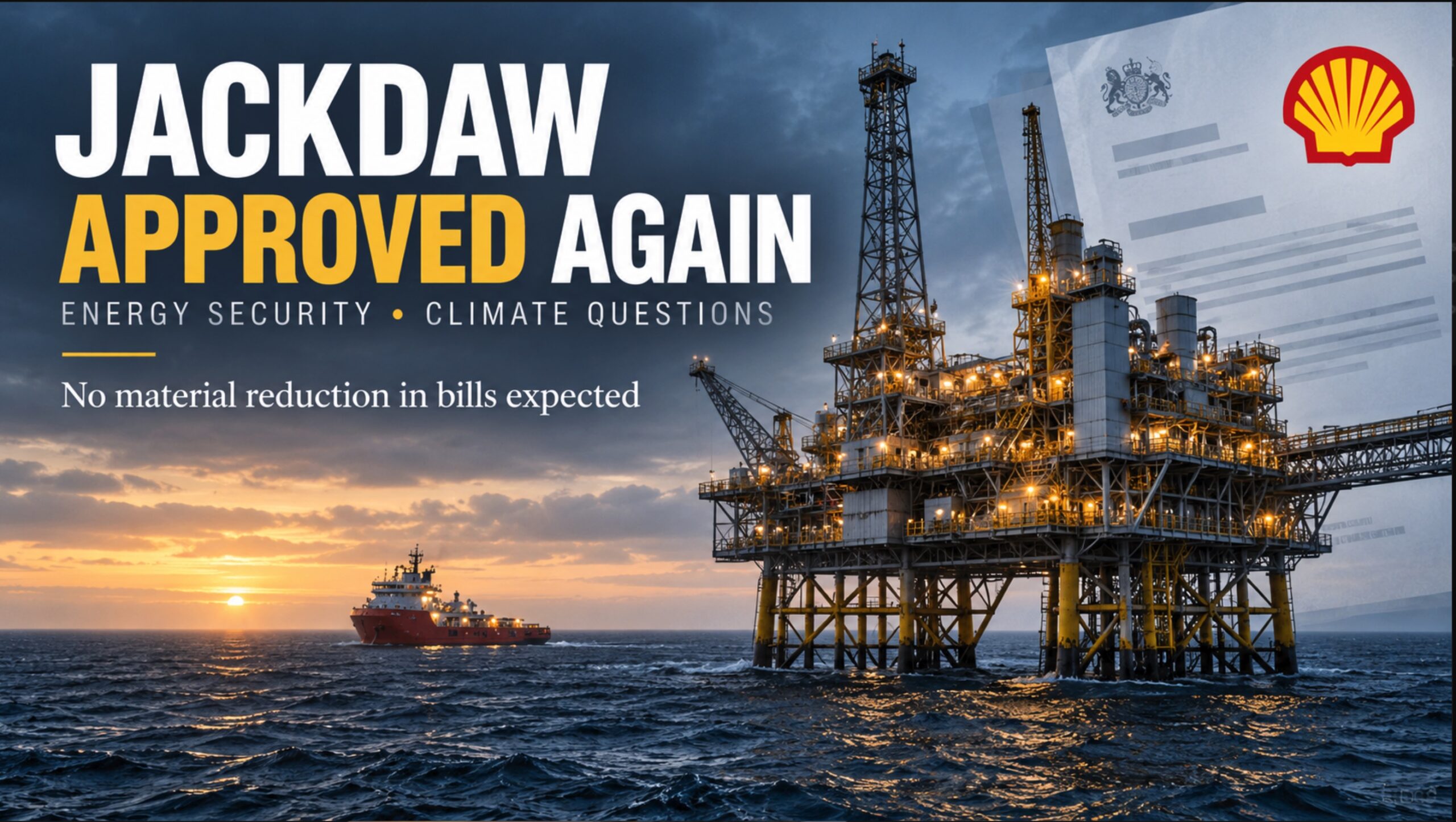
The renewed approval is a commercial breakthrough for Shell-backed Adura. The official decision, however, acknowledges significant greenhouse-gas effects and limits to the project’s benefits for consumers.
By John Donovan — 21 October 2026
The Jackdaw gas project has received renewed approval, allowing a development previously caught by a successful legal challenge to proceed.
For Shell and its joint-venture partner Equinor, the decision removes an important regulatory obstacle. For the government, it supports the argument that domestic gas production has a continuing role during the transition towards lower-carbon energy.
But the detailed documents deserve attention alongside the announcement.
The Secretary of State’s assessment says Jackdaw will not materially affect energy prices or consumer bills. It also recognises significant environmental effects from the project’s greenhouse-gas emissions, while deciding that consent should nevertheless be granted. Official decision, paragraphs 4, 183 and 194
What has actually been approved?
There are two distinct decisions.
The Secretary of State agreed to the grant of consent on 14 October 2026. The North Sea Transition Authority then granted consent on 21 October.
The official notice identifies the developer as Adura Operations Limited and confirms that the project may proceed. Regulation 16 decision notice
This is development consent for an already licensed field. A licence and permission to develop a particular project are separate regulatory steps. Government announcement
Shell’s involvement now runs through Adura
Describing Jackdaw simply as a Shell-operated project would overlook an important corporate change.
Shell and Equinor completed the formation of Adura in December 2025. Each owns 50% of the joint venture, which brought together substantial parts of their UK offshore portfolios. Jackdaw was among the assets included. Shell’s announcement of Adura’s formation
Shell remains commercially involved, but its latest statement identifies Adura as Jackdaw’s operator.
Shell welcomed the approval and argued that predictable regulation and a competitive investment environment are important to long-term energy projects. Its position is that domestic production remains necessary as existing North Sea output declines during the energy transition. Shell’s response
Why the earlier approval could not stand
Jackdaw previously received consent in 2022.
The government’s letter to Adura records that the Court of Session quashed the consent and the Secretary of State’s agreement in January 2025, suspending the effect pending a further decision.
The renewed assessment included additional information on Scope 3 emissions—the emissions arising from the eventual use of the extracted hydrocarbons—and an updated assessment of the project as a whole. Letter to Adura, dated 19 October 2026
The underlying court proceedings concerned environmental assessments that had omitted downstream emissions. The judgment records agreement between the parties that the challenged decisions were unlawful on that basis. Court of Session, 29 January 2025, paragraph 3
The new approval therefore should not be described as overturning the earlier judgment. It follows a renewed regulatory process addressing the omitted assessment.
An approval that acknowledges environmental effects
The distinction is important: permission to proceed does not mean the government found the project environmentally inconsequential.
The decision assigns the greenhouse-gas effects “moderate adverse weight” in its balancing exercise. It also says the Secretary of State would still approve the project if it delivered no reduction in emissions intensity compared with alternative supplies. Decision, paragraphs 182–183
That is a policy and regulatory judgement about competing considerations. It is not a finding that the climate consequences disappear.
Energy security and household bills are different questions
The government’s parliamentary statement forecasts an increase of around 6% in domestic gas production at peak, over a project life of up to 11 years. That percentage concerns domestic production, not total UK gas consumption. Ministerial statement, 21 October 2026
Adura says peak output could provide energy equivalent to heating around 1.4 million homes and that the approval clears the way for supplies within weeks. These are company projections, not confirmation that production has begun or that particular households will receive Jackdaw gas. Adura’s announcement
The government’s detailed assessment describes the security contribution as small but meaningful. However, it concludes that UK participation in global markets means Jackdaw will not materially affect prices or consumer bills. Decision, paragraphs 193–195
Domestic supply and cheaper household energy should therefore not be presented as interchangeable benefits.
Employment claims also require precision
The decision records the developer’s estimates of 27 new full-time-equivalent operational roles and 273 existing Shearwater jobs safeguarded.
Those are different categories. Neither should be substituted for the other when discussing employment benefits. Decision, paragraph 202
Environmental organisations remain opposed. Global Witness argues that approval perpetuates dependence on fossil fuels without protecting households from volatile gas prices, and advocates greater investment in renewable energy instead. That is the campaign organisation’s position, rather than a judicial finding. Global Witness’s response
What happens next?
The developer letter attaches operational conditions addressing offshore carbon-dioxide venting, emissions monitoring and the management of production through Shearwater. It also explains that decisions may be challenged through judicial review, subject to the applicable rules and time limits. Decision letter, pages 2–3
That does not establish that a fresh challenge has been filed.
For Shell shareholders, the approval is a significant development for an asset held through Adura. For the public, the documents provide a basis for testing the claims made about its benefits.
The important questions now concern actual production, compliance with conditions, employment outcomes and environmental performance. Those results should be measured against the forecasts accompanying today’s decision.
Editorial note: This article distinguishes official decisions, corporate forecasts, campaign positions and editorial analysis. Approval does not establish that production has commenced, guarantee projected benefits or determine the outcome of any future legal challenge. The website’s general disclaimer also applies.
*This website and sisters royaldutchshellgroup.com, shellnazihistory.com, royaldutchshell.website, johndonovan.website, shellnews.net, and shellwikipedia.com, are owned by John Donovan - more information here. There is also a Wikipedia segment, the Shell DPA Files, "Shell and the Spies", the Shell Leaks files, the Independent Shell Archive, as well as books written and published by John Donovan - Kindle eBooks. Timeline of the Donovan Shell Feud. Toxic History of Royal Dutch Shell Group. Shell and the Donovans: The Full Media Record — 550+ Articles, 110 Books, 40 Years. *All conjured up by internet wizz, Nick Gill.







