By John Donovan | 22 October 2026
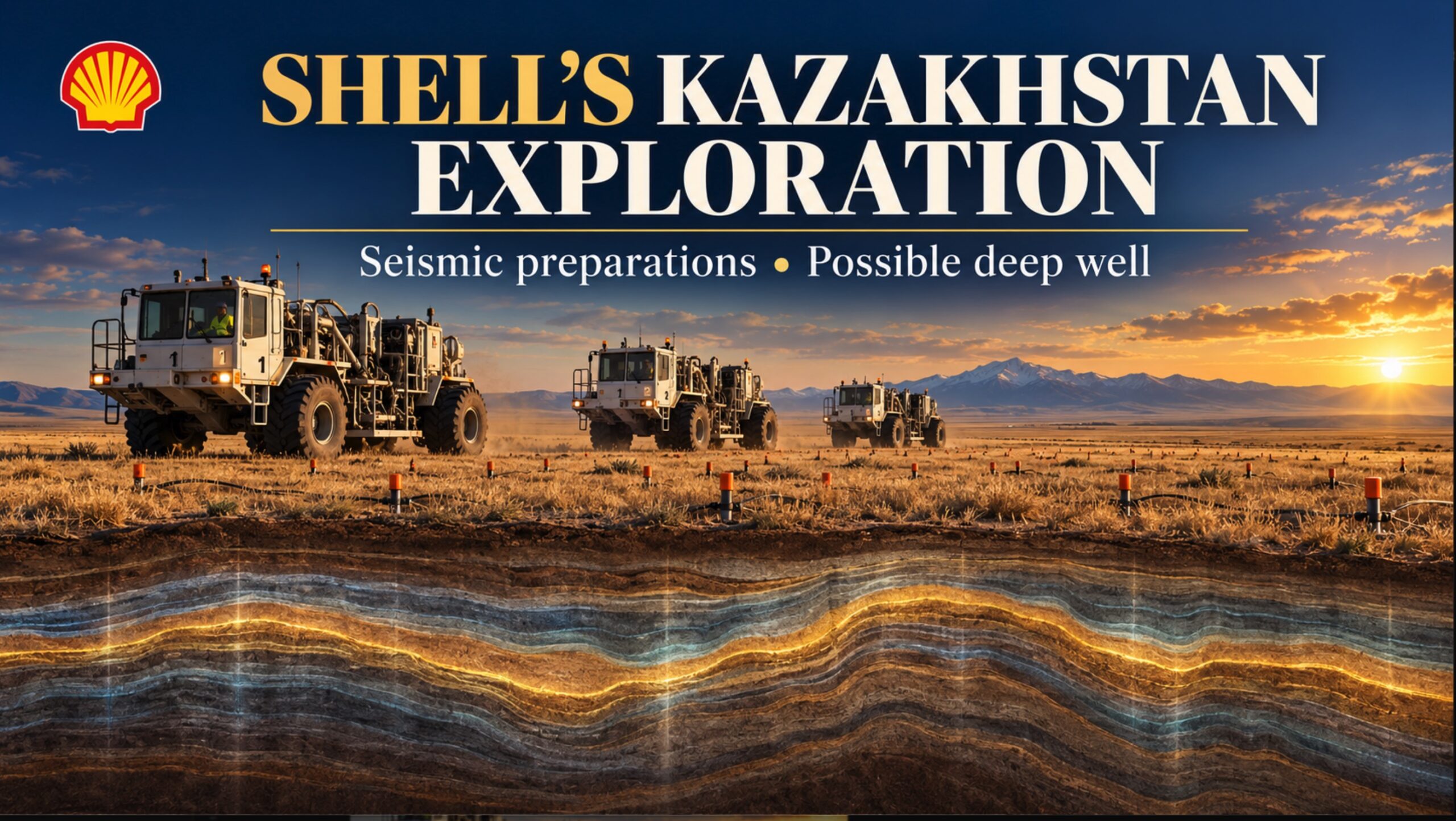
Shell is preparing further exploration work in Kazakhstan, with seismic surveys intended to help assess whether a prospective block warrants deep drilling.
Public company and government information provides a foundation for the development highlighted in Upstream’s report, “Shell eyes major seismic push and deep well in Kazakhstan.” The important distinction is that exploration preparations do not establish a discovery or a commitment to commercial production.
A new seismic procurement notice
Shell Kazakhstan’s corporate portal says the Zhanaturmys licensed block in the Aktobe region has deep subsalt potential. It describes preparations for a combined two-dimensional and three-dimensional seismic acquisition programme to improve understanding of the underground geology and support exploration decisions.
The same portal carries an invitation from Shell EP Offshore Ventures Limited for companies to express interest in a potential forthcoming tender for land 3D seismic acquisition.
The expression-of-interest window opened on 19 October 2026 and closes on 2 November. This is evidence of procurement preparations; it is not an announcement that a seismic contract has been awarded or that fieldwork has begun. Shell Kazakhstan: exploration and procurement notice.
The exploration agreement runs to 2032
Kazakhstan’s Energy Ministry has separately confirmed an exploration contract with Shell Kazakhstan covering Zhanaturmys.
The ministry describes a block covering 1,377 square kilometres in the Aktobe region. Its work programme includes 3D seismic studies and the potential drilling of a deep exploration well.
The contract runs until 2032. Work is subject to regulatory requirements and the necessary permissions. The ministry also says Shell will provide at least 100 million tenge towards the region’s socioeconomic development during the contract period. That commitment should not be confused with the project’s total exploration budget. Kazakhstan Energy Ministry announcement, in Russian.
Reuters reported the contract on 5 March, noting that the ministry’s announcement did not specify the investment amount. The October procurement notice therefore represents a more recent development within an exploration project already publicly disclosed earlier this year. Reuters’ March report.
A possible well remains a possible well
The government’s wording is conditional: the programme includes potential deep drilling.
The sources reviewed do not establish a drilling start date, a contracted rig, a final well depth or a commercial discovery. Those details should remain open until supported by a project announcement or relevant documentation.
For shareholders, the distinction matters. Money spent investigating a prospect buys information and the possibility of a future development. It does not immediately create producing reserves or establish that a project will earn an acceptable return.
Any eventual development would require further evidence about recoverable resources, technical feasibility, costs and the conditions under which production could proceed.
A wider search for deeper resources
Zhanaturmys also sits against a broader national interest in deeper exploration.
In an October interview with S&P Global, KazMunayGas deputy chairman Kurmangazy Iskaziyev described efforts to assemble a multinational consortium involving Shell, Chevron, Sinopec and CNOOC to investigate deep formations in the Caspian region.
He outlined targets between approximately 5.5 and 10 kilometres deep and a proposed regional seismic programme covering 60,000 line-kilometres over three years. These were descriptions of a wider initiative, not verified specifications for Shell’s Zhanaturmys programme. The two should not be combined into one project or budget. S&P Global interview.
What to watch next
The immediate milestones are whether the expression-of-interest exercise leads to a tender, whether a seismic contractor is appointed, and what survey scope and timetable are subsequently disclosed.
Beyond that, the central question is whether the geological evidence supports drilling—and whether drilling, if undertaken, establishes a commercially worthwhile resource.
The available record supports a clear report of continuing exploration preparations. It does not yet support announcing a major new oil or gas find.
Source and scope note: This article draws on publicly accessible company and government information, Reuters’ March reporting and an attributed S&P Global interview. The full Upstream article was not available for review. Exploration potential, procurement preparations, drilling decisions and commercial discoveries are distinct stages; no discovery or production commitment is established by the sources reviewed.
Site-wide Disclaimer Applies.








