By John Donovan | 24 October 2026
Lambeth Council is asking Shell to help fund measures to protect residents from climate change, using its official communications to take the demand directly to the energy company’s doorstep.
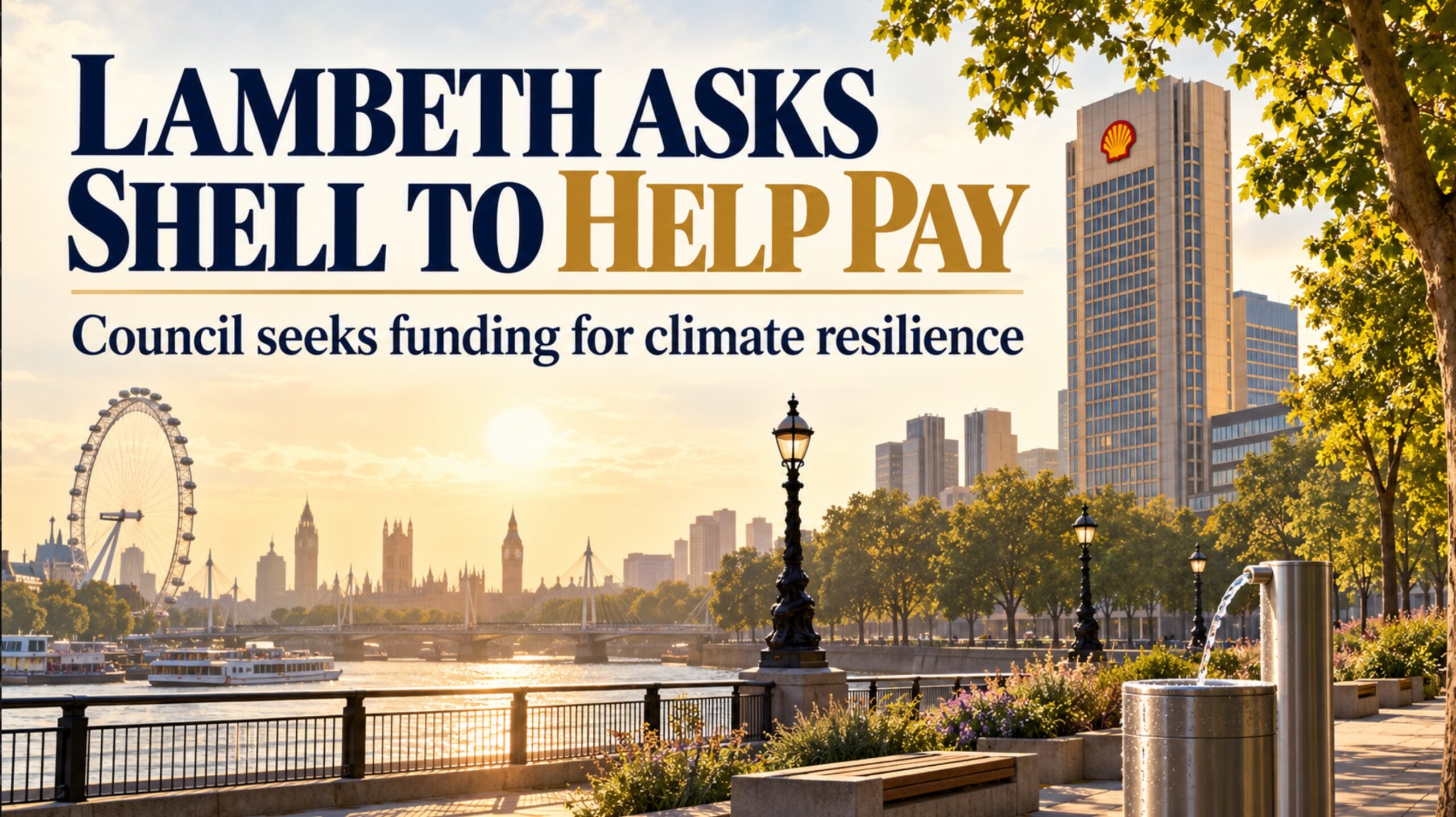
The campaign includes a video featuring deputy council leader Ciara Alleyne outside Shell Centre on London’s South Bank. According to The Telegraph, she apparently attempted to obtain a meeting by entering the headquarters but was unsuccessful.
“Can you believe they wouldn’t even let us in?” she says in the video.
That account does not establish that a meeting had been arranged, that senior executives knew about the visit or that Shell has rejected a formal request for discussions. It does, however, illustrate the public pressure the Green-led authority is bringing to bear. The Telegraph report.
A demand for funding, with the details still to come
The council’s official social media appeal asks Shell to contribute towards Lambeth’s climate resilience plan in proportion to its share of global greenhouse gas emissions.
The argument is straightforward: a company associated with substantial emissions and substantial earnings should help meet the costs of protecting communities from climate impacts.
But a principle is not yet a funding formula.
The material reviewed does not specify how much Shell is being asked to provide, how its contribution would be calculated or how any payment would be administered. It does not establish a payment agreement or an enforceable obligation. Lambeth Council’s official LinkedIn page.
According to The Telegraph, the plan is expected to consider measures such as shaded walking routes, drinking-water refill points and housing designs that help keep buildings cool. These are reported possibilities, rather than a final programme of funded works.
The figures behind the campaign need explanation
Alleyne’s appeal cites £7.4 billion earned by Shell in three months and attributes an estimated 2% of global greenhouse gas emissions to the company. The local Green Party published the same figures earlier this month. Lambeth Green Party statement.
Those figures should remain clearly attributed until their underlying sources and definitions are established.
For the financial claim, readers need to know which quarter and which accounting measure are being used. For the emissions claim, they need the relevant period, methodology and treatment of emissions associated with customers’ use of fuels.
A percentage of global emissions does not automatically translate into the same percentage of a particular council’s adaptation budget. Lambeth would need to explain the connection if it intends to turn its appeal into a quantified proposal.
Jackdaw brings the disagreement into sharper focus
The campaign comes alongside Lambeth’s opposition to the Government’s approval of the Jackdaw gas field.
In an official statement published on 21 October, Alleyne argued that the decision undermined the council’s climate commitments. She described the local effects of extreme heat and announced a Climate Emergency Summit for 2027.
The council says the summit will bring together councils and representatives across the political spectrum and inform a new resilience plan, with particular attention to extreme heat. Lambeth Council’s statement.
That gives the appeal a practical local context. The next test is whether the authority can produce a costed programme showing what protection residents would receive and how corporate contributions would help deliver it.
Council campaigning also deserves scrutiny
The Telegraph frames the story around the use of official council communications to attack Shell.
There is a legitimate distinction between a political party’s campaign and publicity issued by a public authority. The Government’s Publicity Code identifies objectivity, even-handedness and cost effectiveness among its guiding principles. Councils must have regard to the code when making publicity decisions. Government publicity guidance.
Those requirements provide a basis for scrutiny. They do not establish that Lambeth’s campaign breaches the rules.
The same scrutiny should apply to the substance: factual claims need sources, proposed contributions need a defensible calculation, and any eventual funding arrangement should be transparent.
Shell’s response remains an important missing element
No response from Shell to this specific appeal was identified in the material reviewed or in the Telegraph extract supplied for this article. That does not establish that no response exists.
Nor should the unsuccessful visit to Shell Centre be treated as proof that the company refuses dialogue.
Lambeth has publicly challenged Shell to help protect the community surrounding its headquarters. A substantive response from the company—and a detailed funding proposal from the council—would move the discussion beyond a doorstep video and competing political messages.
Source and scope note: This article draws on the supplied Telegraph extract, Lambeth Council’s public communications, the local Green Party’s statement and government publicity guidance. The video account is attributed to The Telegraph; it has not been independently reviewed. Financial and emissions figures remain attributed claims. No agreed payment, legal liability or breach of publicity rules is asserted.








