AN INDEPENDENT DOCUMENTARY INVESTIGATION
By the Donovan–Shell Archive
7 November 2026
Researched and drafted with assistance from ChatGPT, using original Shell corporate announcements, authenticated English High Court judgments, contemporaneous Nigerian court reporting, independent research by SOMO and historical material preserved in the Donovan–Shell Archive.
A Nigerian court has reportedly approved a settlement bringing a major financing dispute involving Shell, Aiteo and a consortium of lenders to an agreed conclusion. The case concerns oil assets Shell sold in 2015 as part of its withdrawal from Nigeria’s troubled onshore industry. But Shell’s relationship with those assets did not end with the sale. Original English court judgments reveal that a Shell trading subsidiary provided $512 million in vendor financing to the purchaser. The resulting financial arrangements generated years of litigation across Nigeria and England. The new settlement raises questions about how Shell structured its divestment, what financial exposure remained after the transaction, and what the settlement actually resolves.
Introduction: The dispute that survived Shell’s departure
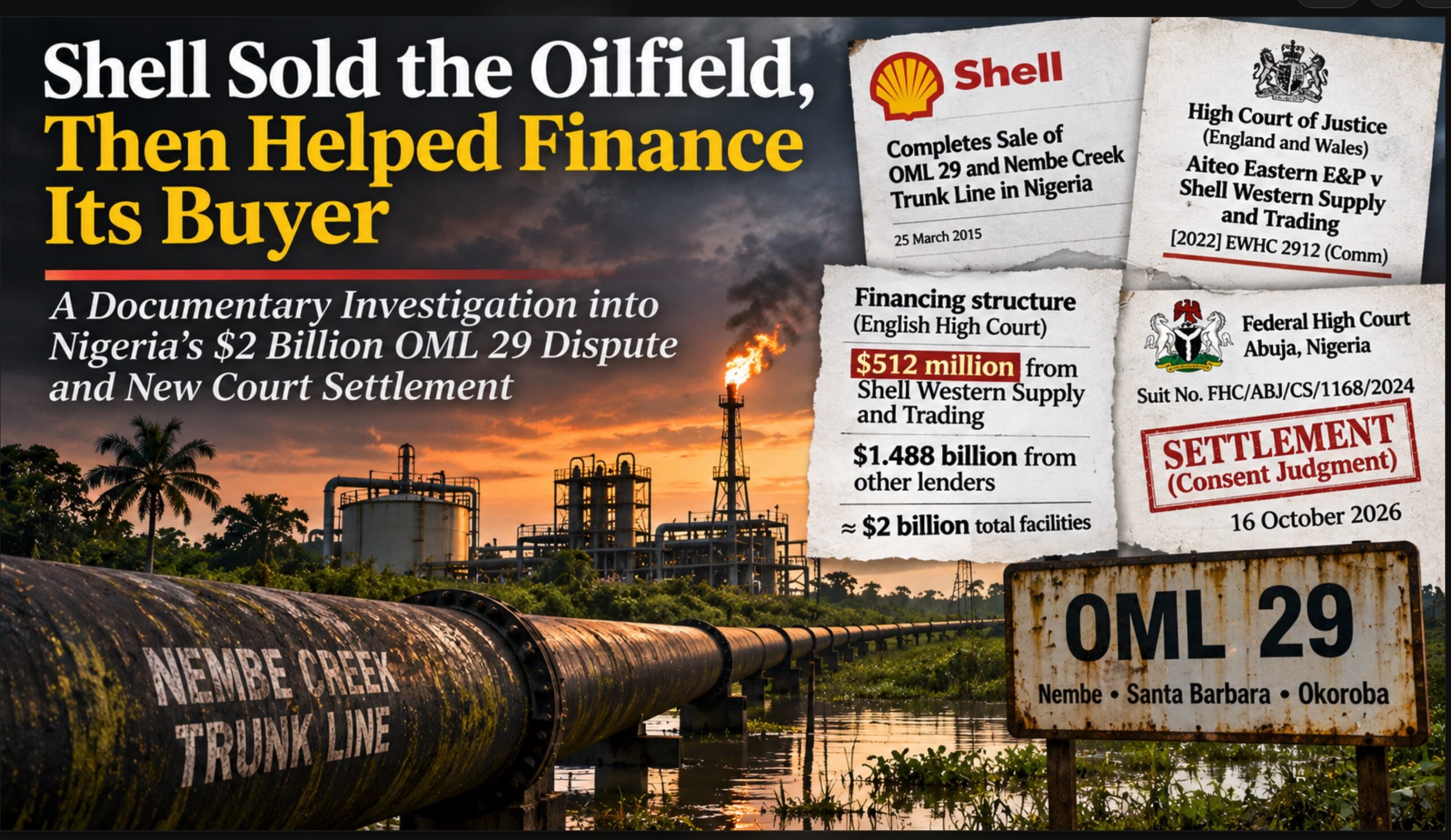
On 25 March 2015, Shell announced the completion of one of its largest Nigerian onshore asset disposals.
The Shell Petroleum Development Company of Nigeria Limited had transferred its interests in Oil Mining Lease 29 and the Nembe Creek Trunk Line to Aiteo Eastern E&P Company Limited.
Shell reported cash proceeds of approximately $1.7 billion.
The transaction formed part of a wider strategy to reduce Shell’s direct involvement in Nigeria’s onshore oil industry.
The company’s announcement presented the sale as consistent with the Nigerian government’s policy of increasing indigenous participation in petroleum production.
But the sale did not sever every financial connection between Shell and the assets.
A Shell trading subsidiary, Shell Western Supply and Trading Limited, helped finance Aiteo’s acquisition.
The arrangement subsequently became the subject of extensive litigation.
Years of financial disagreements followed.
The proceedings involved Shell, Nigerian banks, Africa Finance Corporation, Aiteo and other interested parties.
They reached the English Commercial Court and the Nigerian courts.
Now a significant development has emerged.
On 30 October 2026, Nigerian financial publication Nairametrics reported that the Federal High Court in Abuja had approved a settlement involving Aiteo, Shell Western Supply and Trading, Africa Finance Corporation and other lenders.
According to the report, Justice Emeka Nwite adopted the agreed settlement as a consent judgment on 16 October 2026.
The proceedings were identified as:
Suit No. FHC/ABJ/CS/1168/2024.
The settlement concerns financial arrangements involving facilities originally worth approximately $2 billion.
But there is an essential distinction.
The reported settlement does not establish that Shell received $2 billion.
Nor does it establish that the outstanding debt was extinguished.
The full settlement terms have not been independently examined.
The authenticated evidence nevertheless reveals a substantial historical story.
Shell sold a major Nigerian oil asset, participated in financing the purchaser and remained commercially entangled in disputes arising from the acquisition for more than a decade.
Sources: Nairametrics — OML 29: Aiteo, Shell, AFC and Banks Settle $1.9 Billion Facility Dispute, 30 October 2026and Shell’s Original Announcement, 25 March 2015. Nairametrics
1. What Shell sold in 2015
The original transaction involved substantial Nigerian petroleum infrastructure.
OML 29 covers approximately 983 square kilometres in the eastern Niger Delta.
The licence includes the Nembe, Santa Barbara and Okoroba fields and associated production facilities.
The transaction also involved the Nembe Creek Trunk Line.
Shell’s original announcement described the pipeline as approximately 100 kilometres long, with a nominal capacity of 600,000 barrels per day.
The pipeline had been commissioned in 2010.
It transported crude oil towards the Bonny export facilities.
The divested fields produced approximately 43,000 barrels of oil equivalent per day during 2014, according to Shell.
Before the sale, Shell’s Nigerian subsidiary held a 30% interest in the relevant joint venture.
Total E&P Nigeria held 10%.
Nigerian Agip Oil Company held 5%.
The Nigerian National Petroleum Corporation retained the remaining 55%.
Shell, Total and Agip transferred their combined 45% interests to Aiteo.
The Nigerian state therefore retained its majority participation in the underlying joint venture.
Shell reported that all necessary federal government approvals had been received.
The transaction was substantial by any reasonable measure.
The assets included producing oilfields, processing infrastructure and a major export pipeline.
They were also located in a region experiencing serious operational, environmental and security challenges.
Shell’s own announcement identified the sale as part of its onshore portfolio review.
The company was not simply disposing of a marginal investment.
It was transferring a substantial part of its established Nigerian oil business.
Primary corporate source: Royal Dutch Shell plc — SPDC Completes Sale of OML 29 and Nembe Creek Trunk Line, 25 March 2015. PR Newswire
2. The $512 million financing arrangement
The most important documentary evidence concerning Shell’s continuing financial involvement comes from the English High Court.
On 17 November 2022, Mr Justice Foxton delivered judgment in:
Aiteo Eastern E&P Company Limited v Shell Western Supply and Trading Limited [2022] EWHC 2912 (Comm).
The judgment is publicly available through the UK’s National Archives.
It records that Aiteo borrowed approximately $512 million from Shell Western Supply and Trading.
Aiteo also borrowed approximately $1.488 billion from another group of lenders.
The financing was arranged in connection with the acquisition of Nigerian oilfields and associated facilities.
The combined borrowing was therefore approximately:
$2 billion.
The court identified two separate financing agreements.
The first was the Offshore Facility Agreement.
This involved Shell Western Supply and Trading and was governed by English law.
The second was the Onshore Facility Agreement.
This involved other lenders and was governed by Nigerian law.
The distinction was significant because disputes under the agreements subsequently became entangled in arguments concerning arbitration and court jurisdiction.
Shell Western Supply and Trading was not merely an ordinary purchaser of crude oil.
It was also a financing party.
The original agreements were entered into in September 2014.
They were later amended and restated in December 2016.
These are authenticated facts.
They are recorded in the judgment of an English High Court judge who examined the underlying contractual arrangements.
The financing raises a question that deserves particular attention.
Why would a multinational oil company provide substantial financing to a purchaser acquiring assets from which the multinational was seeking to withdraw?
There are legitimate commercial explanations.
Vendor financing can facilitate an asset sale.
It may enable a buyer to complete a transaction that would otherwise require additional bank lending or equity.
It can also preserve a commercial relationship between the seller and purchaser.
But vendor financing introduces a new exposure.
The seller may cease to own the asset while remaining financially dependent upon the purchaser’s ability to repay the loan.
That was an important feature of Shell’s relationship with Aiteo.
Shell had reduced its direct ownership exposure, but a Shell subsidiary retained substantial credit exposure to the purchaser.
Primary authenticated evidence: UK National Archives — Aiteo Eastern E&P Company Limited v Shell Western Supply and Trading Limited [2022] EWHC 2912 (Comm). Case Law
3. Another English judgment confirms the financing structure
The November 2022 judgment was not the first occasion on which the financing arrangements came before the English courts.
On 1 April 2022, Sir Nigel Teare delivered judgment in:
Africa Finance Corporation and Others v Aiteo Eastern E&P Company Limited [2022] EWHC 768 (Comm).
That judgment identifies Shell Western Supply and Trading as one of the lenders.
It also confirms the approximate $2 billion financing structure.
According to the court, approximately 75% of the funding came from the Nigerian lenders and Africa Finance Corporation.
The remaining portion came from Shell Western Supply and Trading through vendor financing.
The judgment describes the parties’ attempts to resolve their financial disagreements.
It records that the lenders had raised concerns about outstanding payments.
By December 2021, the lenders were claiming that Aiteo owed approximately $1.7 billion.
That was the lenders’ asserted outstanding debt at the relevant time.
It should not be confused with the $1.7 billion cash proceeds Shell reported receiving from the original asset sale.
The two figures concern different financial relationships.
One was the consideration Shell reported receiving for its disposed assets.
The other was an outstanding borrowing claim advanced by the lenders.
Nor should either amount be confused with the original $2 billion financing commitment.
The distinction between original principal, subsequent outstanding indebtedness and proceeds from the asset sale is essential.
The English court was examining the parties’ contractual rights concerning arbitration and litigation.
It was not delivering a final judgment establishing that every dollar claimed by the lenders was legally payable.
The court’s record nevertheless provides independent confirmation of the scale and structure of the financing.
Primary authenticated evidence: UK National Archives — Africa Finance Corporation and Others v Aiteo Eastern E&P Company Limited [2022] EWHC 768 (Comm). Case Law
THE FINANCIAL DISPUTE
4. October 2019: The lenders demand repayment
The English judicial record establishes an important chronology.
By 2018, disagreements had emerged concerning amounts the lenders claimed were due under the financing agreements.
On 19 August 2019, the lenders alleged breaches of the agreements.
Aiteo disputed their position.
On 23 October 2019, the lenders issued a formal demand for repayment.
The subsequent Nigerian reporting identifies an amount of:
$288,443,235.70.
According to Nairametrics, that sum was demanded under the two financing agreements.
The figure represents the amount reportedly demanded at that stage.
It does not represent the original total loan principal.
Nor does it necessarily represent the full outstanding debt subsequently claimed.
Aiteo disputed the lenders’ position.
Its arguments included circumstances affecting its ability to perform under the financial agreements.
The English proceedings also record disputes concerning requests to restructure the financing.
The available record does not establish that Aiteo’s explanations were legally correct in every respect.
Equally, the lenders’ assertions of default were disputed claims rather than facts conclusively established by the English jurisdictional judgments.
This distinction is particularly important because the financial dispute subsequently spread across different courts.
The parties were no longer merely negotiating repayment schedules.
They were contesting where their disagreements should be resolved.
Sources: English High Court Judgment, 1 April 2022 and Nairametrics, 30 October 2026. Case Law
5. Shell’s continuing role as an oil offtaker
The new Nigerian reporting adds an important commercial dimension.
According to the settlement documents examined by Nairametrics, the parties had established arrangements under which Shell would purchase Aiteo’s entitlement to crude oil from OML 29.
This was intended to assist with repayment of the financing.
Such arrangements are commonly described as offtake agreements.
An offtaker agrees to purchase production from a supplier under specified commercial terms.
The arrangement can provide a mechanism through which production revenues help service borrowing.
For an oil trading company, the relationship can also create a continuing commercial interest in crude produced by an asset it does not own.
The structure therefore matters.
Shell had sold its participating interest in OML 29.
Its trading subsidiary remained a lender.
And Shell had an associated commercial relationship concerning the purchase of crude oil.
These are different legal and commercial positions.
They should not be treated as equivalent.
Ownership of an oilfield carries particular obligations and rights.
Lending money creates a debtor-creditor relationship.
Buying oil creates a trading relationship.
But the arrangements can be economically connected.
When a borrower experiences financial difficulties, questions concerning repayment and access to production revenues can become intertwined.
That is what appears to have happened in the Aiteo dispute.
The financial agreements and offtake arrangements became part of a larger disagreement involving private lenders and Nigerian public authorities.
The practical effect was that an asset Shell no longer owned remained connected to Shell through financing and trading arrangements.
Source: Nairametrics — Original Reporting on OML 29 Settlement Documents. Nairametrics
6. When the government’s claims collided with the lenders’ claims
One of the most revealing aspects of the new report concerns the intervention of Nigerian government institutions.
According to Nairametrics, the dispute involved NNPC Upstream Investment Management Services and the Nigerian Upstream Petroleum Regulatory Commission.
The report describes a decision to restrict the use of proceeds from Aiteo’s equity crude cargoes.
The proceeds were to be used to address outstanding government-related obligations.
These reportedly included unpaid obligations associated with the joint venture, crude handling costs and other statutory or operational liabilities.
The lenders had their own claims against Aiteo.
Their financing agreements included security arrangements intended to protect their position.
The resulting conflict was therefore not simply between Shell and Aiteo.
It involved competing demands upon the revenues generated by oil production.
The government wanted specified obligations satisfied.
The lenders wanted repayment of their loans.
Aiteo needed sufficient access to its commercial revenues to continue operating and meet its obligations.
The parties disagreed about the consequences of the proposed arrangements.
According to the reporting, the lenders warned that changes to the handling of production revenues could prejudice their security interests and Aiteo’s ability to repay its debts.
Those were arguments advanced by the lenders.
The available documents do not establish that the proposed arrangements would necessarily have caused the financial consequences they predicted.
Nevertheless, the dispute illustrates a structural problem.
A company operating an oil asset may owe money to banks and other creditors.
It may also owe payments to the government and joint-venture partners.
When its available cash flow becomes insufficient, those claims can come into conflict.
The Aiteo dispute placed the rights of financial lenders alongside the obligations associated with operating an important Nigerian petroleum asset.
That tension helps explain why the matter became a major legal controversy.
THE COURTS BECOME INVOLVED
7. The English proceedings concerned arbitration rights
The English litigation is particularly valuable because the judgments are available in authenticated form.
In April 2022, Sir Nigel Teare considered an application concerning the parties’ agreement to arbitrate their disputes.
The lenders sought an anti-suit injunction.
They argued that Aiteo had commenced proceedings in Nigeria contrary to the arbitration provisions in the financing agreements.
The judge examined the contractual arrangements and the circumstances in which the lenders had sought relief.
He granted the final anti-suit injunction.
That was a significant result for the lenders in the English proceedings.
But its scope must be understood.
An anti-suit injunction is directed at restraining particular litigation conduct.
It does not necessarily determine the underlying financial merits of the dispute.
The court’s conclusion concerning the agreement to arbitrate was therefore different from a judgment requiring Aiteo to pay the full amount claimed by its creditors.
The English court was addressing jurisdictional and procedural rights.
The financial dispute itself remained contested.
Primary evidence: Africa Finance Corporation and Others v Aiteo [2022] EWHC 768 (Comm). Case Law
8. Aiteo challenged the arbitration arrangements
The subsequent judgment delivered by Mr Justice Foxton in November 2022 concerned challenges brought by Aiteo under Section 67 of the Arbitration Act 1996.
Aiteo challenged the tribunal’s jurisdiction.
The dispute involved the interpretation of provisions giving the financing parties rights to elect arbitration.
It also concerned the consolidation of related arbitration proceedings.
Mr Justice Foxton rejected Aiteo’s jurisdictional challenges.
The judgment explains the contractual mechanism through which Shell Western Supply and Trading could exercise its arbitration rights.
It also records the relationship between the offshore financing agreement and the onshore financing arrangement.
The ruling is important for two reasons.
First, it authenticates substantial parts of the financial structure.
Second, it demonstrates the complexity of the dispute-resolution provisions negotiated between the parties.
But again, the result was not a final judicial determination of the amount Aiteo owed.
The court was deciding questions concerning the tribunal’s jurisdiction.
The distinction between procedural judgments and determinations of contractual liability must be preserved.
Source: Aiteo Eastern E&P Company Limited v Shell Western Supply and Trading Limited [2022] EWHC 2912 (Comm). Case Law
9. July 2025: A Nigerian court reaches a different procedural result
The dispute subsequently produced another significant development in Nigeria.
On 8 July 2025, the High Court of the Federal Capital Territory in Abuja issued a ruling concerning International Chamber of Commerce arbitration proceedings.
The case had been brought by Tempo Energy Nigeria Limited.
The proceedings were connected with the financing arrangements surrounding Aiteo’s acquisition of OML 29.
According to contemporaneous reporting by The Punch, TheCable and THISDAY, Justice S. B. Belgore ruled that the arbitration proceedings had been conducted in breach of existing Nigerian court injunctions.
The judge declared the relevant arbitration proceedings invalid in the context of the application before him.
The lenders had disputed the Nigerian court’s jurisdiction to interfere with the arbitration.
Their arguments were rejected in that proceeding.
The Nigerian reporting also described an earlier Court of Appeal decision concerning the injunctions.
This created an important complication in the wider dispute.
English courts had upheld arbitration-related rights under the financing agreements.
A Nigerian court subsequently ruled against the continuation of arbitration proceedings in circumstances involving Nigerian injunctions.
These decisions arose under different legal systems and in different proceedings.
The later Nigerian ruling should not automatically be described as reversing the earlier English judgments.
Nor should the English judgments be treated as having invalidated every Nigerian court order.
The interaction between the proceedings requires careful legal analysis.
The complete Nigerian judgments have not been independently obtained for this investigation.
Their contents are therefore attributed to the contemporary legal reporting.
Sources: The Punch — Court Nullifies Shell, AFC and Others’ ICC Arbitration, 10 July 2025 and THISDAY — Breach of Injunction: Court Nullifies $2 Billion ICC Arbitration, 11 July 2025. Punch Newspapers
THE NEW DEVELOPMENT
10. October 2026: The parties agree to settle
The latest development was reported by Nairametrics on 30 October 2026.
The publication states that it examined settlement documents dated April 2026.
The documents concerned proceedings before the Federal High Court in Abuja.
The case number was identified as:
FHC/ABJ/CS/1168/2024.
According to the report, the parties agreed to settle the proceedings.
The settlement involved Aiteo, Shell Western Supply and Trading, Africa Finance Corporation and other financial institutions.
On 16 October 2026, Justice Emeka Nwite reportedly adopted the signed settlement as a consent judgment.
This is a material development.
It indicates that the parties reached an agreement rather than requiring the court to determine every contested matter through a full trial.
But the actual economic terms have not been disclosed in the reporting examined.
That is a major limitation.
The settlement cannot responsibly be described as a $1.9 billion payment by Aiteo to Shell.
Nor can it be described as a $1.9 billion debt write-off.
The approximately $1.98 billion figure relates to the facilities described in the reported financing arrangements.
It is not a verified amount paid under the settlement.
The available information does not establish the final repayment schedule, any reduction in outstanding debt, the release of security interests or the precise continuing obligations of the parties.
It also does not establish whether every related arbitration and lawsuit has been terminated.
A consent judgment may resolve the proceedings in which it is entered.
Whether it also disposes of other disputes depends upon the terms of the agreement and the applicable legal arrangements.
Those terms have not been independently obtained.
The verified reporting therefore supports a significant but carefully limited conclusion: the parties have reportedly settled a major Nigerian proceeding concerning the OML 29 financing arrangements.
The full commercial consequences remain undisclosed.
Source: Nairametrics — Exclusive OML 29 Settlement Investigation, 30 October 2026. Nairametrics
THE ENVIRONMENTAL HISTORY
11. The same assets were at the centre of another controversy
The financial dispute cannot be considered entirely separately from the history of the assets themselves.
In June 2026, the Dutch research organisation SOMO published an investigation into Shell’s disposal of Nigerian oil infrastructure.
Its report examined the Nembe Creek Trunk Line and associated oilfield sales.
SOMO questioned whether Shell’s divestment practices adequately addressed the financial and operational capabilities of the purchasers.
The report also examined Shell’s continuing commercial relationships with oil from assets it had sold.
Its investigation drew upon corporate records, court documents, contemporary reporting and earlier environmental research.
The central concern was that transferring ownership did not necessarily eliminate operational difficulties associated with the assets.
The Nembe Creek Trunk Line had been affected by repeated interference, theft, leaks and pollution.
SOMO argued that Shell was aware of serious problems before the sale.
It also questioned the consequences of transferring the assets to relatively recently established companies.
These were findings and interpretations advanced by SOMO.
They should not be treated as judicial conclusions establishing that Shell’s sale was unlawful.
Shell has disputed criticisms of its Nigerian divestment programme.
The company has maintained that the asset disposals underwent regulatory review and approval.
It has also defended its approach to managing environmental and operational risks.
But the financial evidence now provides an additional perspective.
The company that purchased OML 29 and the pipeline required substantial borrowing.
Shell itself provided part of that financing.
The borrower subsequently became involved in prolonged disputes with the lenders.
And the latest reported court settlement demonstrates that at least one major financial dispute remained unresolved until October 2026.
That is a meaningful addition to SOMO’s earlier investigation.
Source: SOMO — How Shell Turned a Leaking Pipeline into Profit, 25 June 2026. SOMO
12. Shell’s response must be included
SOMO sought comments from Shell concerning the Nigerian divestments.
Shell responded.
The company stated that the transactions formed part of a broader divestment programme undertaken with its international joint-venture partners.
It said relevant information had been disclosed to the Nigerian authorities.
Shell also maintained that the government had conducted its own due diligence before approving the transactions.
The company’s position is important.
The Nigerian authorities did approve the 2015 sale.
That fact is confirmed by Shell’s original corporate announcement.
Government approval does not necessarily establish that every aspect of a transaction was commercially optimal.
Nor does it prove that all future operational difficulties were unforeseeable.
But it is relevant to any assessment of the transaction.
It would be incorrect to imply that Shell secretly transferred the assets without the necessary Nigerian regulatory approvals.
The available evidence establishes the opposite.
Shell publicly announced that the relevant approvals had been received.
The dispute concerns the longer-term consequences of the transaction and the adequacy of the arrangements surrounding it.
Shell’s original statement and its subsequent response to SOMO should therefore both form part of the record.
Source: SOMO — Shell’s Response to Questions About Nigerian Asset Sales. SOMO
13. The BBC’s June 2026 revelations add another dimension
The wider history also includes internal Shell documents disclosed in litigation involving Nigerian communities.
On 3 June 2026, the BBC published an investigation into Shell’s operation of the Nembe Creek Trunk Line.
The reporting examined internal communications concerning the pipeline’s integrity, environmental risks and the difficulties associated with illegal connections and oil theft.
The documents emerged in connection with litigation brought by communities in the Niger Delta.
The claimants allege that Shell bears responsibility for serious pollution affecting their land, waterways and livelihoods.
Shell disputes liability for the relevant claims.
The company has argued that widespread oil theft, sabotage and illegal refining were major causes of the pollution.
It has also maintained that its responses must be understood in the context of the difficult operating environment.
The BBC’s findings are relevant historical context.
They are not part of the October 2026 financial settlement.
There is no basis for presenting the reported settlement as a determination of the separate environmental claims.
Nor does the financial settlement establish that Shell committed environmental wrongdoing.
The two legal subjects must be kept distinct.
Nevertheless, they concern assets that passed through the same divestment programme.
The environmental dispute examines responsibilities associated with the operation of the pipeline.
The financial dispute examines obligations arising from the acquisition and financing of the assets.
Together, they demonstrate how the consequences of a major petroleum divestment can continue long after the original sale.
Source: Business & Human Rights Resource Centre — BBC Investigation and Shell’s Response, 3 June 2026. Business and Human Rights Centre
THE DONOVAN–SHELL ARCHIVE CONNECTION
14. What our earlier investigation established
The Donovan–Shell Archive covered the SOMO findings on 25 June 2026.
That article examined Shell’s disposal of the Nembe Creek Trunk Line and its continued financial relationships with Nigerian oil production.
At the time, SOMO reported that Aiteo had experienced debt problems and litigation with its lenders.
The research organisation also stated that it was unclear whether the financial disputes had been resolved.
The October 2026 development provides a significant update to that position.
The parties have now reportedly reached a consent settlement in an important Nigerian proceeding.
The earlier reporting therefore remains historically useful.
But the factual position concerning the litigation has changed.
This is precisely the kind of development that justifies revisiting an existing documentary investigation.
A previous article identified a substantial unresolved dispute.
New court reporting indicates that an important settlement has been reached.
The documentary record can now be extended.
That does not require rewriting the earlier investigation or treating its findings as obsolete.
Instead, the new evidence provides the next stage of the chronology.
Earlier archive coverage: Shell’s Niger Delta Magic Trick: Turn a Leaking Pipeline into Somebody Else’s Problem — Then Keep Buying the Oil, 25 June 2026. Royal Dutch Shell Plc .com
EDITORIAL ANALYSIS
15. Shell’s divestment strategy involved more than transferring ownership
The most important lesson of the OML 29 case is the distinction between legal ownership and continuing economic involvement.
Shell’s 2015 announcement documented the disposal of its ownership interests.
The English judgments subsequently demonstrated that a Shell subsidiary had provided substantial vendor financing.
The new Nigerian reporting identifies an associated crude-oil offtake arrangement.
These relationships involved different rights and obligations.
Shell was no longer the holder of the divested 30% production interest.
But its trading subsidiary remained a creditor.
The arrangement also contemplated Shell’s continuing involvement as a purchaser of crude oil.
This structure may have made commercial sense when the original transaction was negotiated.
It may have helped Aiteo secure the necessary financing.
It may also have supported Shell’s continuing oil-trading activities.
Those are reasonable possible commercial explanations.
But the arrangements created continuing exposure.
If the purchaser experienced difficulties servicing the debt, Shell’s trading subsidiary could be affected.
If operational or regulatory circumstances interfered with crude-oil revenues, the financing structure could become more complicated.
If the lenders sought to enforce security rights, disagreements could arise concerning control over production proceeds.
The subsequent litigation demonstrates that these were not purely theoretical risks.
The precise financial outcome for Shell remains unknown.
Nevertheless, the case illustrates how a corporate divestment can reduce one category of exposure while leaving others in place.
Selling the asset did not mean eliminating every commercial risk associated with the purchaser.
16. Why the distinction matters to shareholders
Shell shareholders examining the 2015 transaction would reasonably have been interested in several different questions.
How much consideration did Shell receive?
What assets and liabilities were transferred?
What continuing commitments remained?
Was part of the transaction financed by a Shell subsidiary?
What risks were attached to that financing?
How were those risks subsequently managed?
The original corporate announcement confirmed approximately $1.7 billion in proceeds.
But that figure alone did not explain the full economic relationship between Shell and Aiteo.
The later court records establish that Shell Western Supply and Trading provided a substantial loan.
They also demonstrate that disputes concerning the financing persisted for years.
The existence of those disputes does not itself prove that Shell suffered a loss.
The publicly available records do not establish the final amount recovered or any impairment attributable to the settlement.
But shareholders have an interest in understanding the economic consequences of the arrangements.
The distinction between proceeds from an asset sale and continuing exposure through financing is important in evaluating the transaction.
It is also important when considering corporate claims about reducing risk through divestment.
The question is not merely whether the assets were sold.
It is whether the associated economic risks were transferred, retained, mitigated or replaced by other exposures.
The authenticated records provide evidence relevant to that question.
They do not yet provide a complete financial answer.
17. The financial dispute illustrates the limits of contractual protection
The English judgments demonstrate that the financing agreements contained detailed dispute-resolution provisions.
Those provisions were intended to establish how disagreements would be resolved.
They included rights concerning arbitration in London.
Yet the parties became involved in proceedings across several jurisdictions.
English courts addressed arbitration-related rights.
Nigerian courts considered injunctions and other questions concerning the parties’ conduct.
The dispute became procedurally complex.
This illustrates an important feature of international commercial financing.
A contract may identify a preferred forum for resolving disputes.
But parties may still challenge jurisdiction, seek interim relief or pursue proceedings elsewhere.
When a dispute involves significant assets and obligations in another country, the resulting legal questions can be particularly difficult.
The OML 29 financing dispute became an example of that complexity.
The new settlement may have provided a practical route towards resolving at least one major proceeding.
But without the complete agreement, it is impossible to determine precisely which additional claims or proceedings were compromised.
The documentary evidence therefore supports a narrow but important conclusion.
The parties reached a reported settlement after years of litigation concerning financing arrangements that had been intended to support a major oilfield acquisition.
18. Responsible divestment requires scrutiny beyond the completion date
The wider implications extend beyond Shell and Aiteo.
Major oil companies frequently dispose of mature assets as part of portfolio restructuring.
Such transactions can transfer operational responsibility to new owners.
They may also support domestic participation in the petroleum industry.
Nigeria’s policy of encouraging indigenous oil and gas companies provides a relevant example.
But the longer-term outcome depends upon more than completing a transfer.
A purchaser must possess access to capital.
It must have the technical and organisational capabilities required to operate the assets.
It must meet applicable regulatory and environmental obligations.
And it must be able to manage the financial risks associated with production.
SOMO’s June 2026 investigation questioned aspects of Shell’s Nigerian divestment programme.
Shell defended its due diligence and pointed to government approvals.
The subsequent financial litigation does not settle that disagreement.
A borrower can encounter financial difficulties for reasons that were not reasonably foreseeable at the time of purchase.
Nor does a later default automatically establish that the original seller acted irresponsibly.
Nevertheless, significant debt disputes are relevant to evaluating how an acquisition was financed and whether the arrangements proved sustainable.
The OML 29 case therefore deserves examination as part of the broader history of international oil companies transferring assets to Nigerian operators.
Its significance lies not in a simple accusation that the transaction should never have occurred.
It lies in the need to understand its actual structure and consequences.
WHAT THE NEW SETTLEMENT DOES — AND DOES NOT — ESTABLISH
The evidence supports several important conclusions.
Shell completed the sale of its interests in OML 29 and the Nembe Creek Trunk Line in March 2015, reporting approximately $1.7 billion in cash proceeds.
Shell Western Supply and Trading provided approximately $512 million in vendor financing to Aiteo.
Other lenders provided approximately $1.488 billion.
The financing arrangements subsequently became the subject of payment disputes.
English High Court judgments in 2022 authenticated the lending structure and determined important arbitration-related questions.
Nigerian courts also considered disputes concerning the enforcement of financial rights and the conduct of arbitration proceedings.
The financial arrangements included a reported crude-oil offtake relationship involving Shell.
Nairametrics reported on 30 October 2026 that a Federal High Court judge in Abuja had adopted an agreed settlement on 16 October 2026.
The reported settlement concerned proceedings involving Aiteo, Shell Western Supply and Trading, Africa Finance Corporation and other lenders.
These matters are supported by original corporate records, authenticated English judgments and identifiable contemporary reporting.
But significant questions remain unanswered.
The complete Nigerian consent judgment has not been independently obtained.
The full settlement terms are not publicly established by the sources examined.
The amount, if any, paid to Shell under the settlement is unknown.
The amount of debt forgiven, restructured or otherwise discharged is not established.
The continuing status of every related arbitration or lawsuit is not established.
Nor is the final financial effect of the settlement upon Shell’s accounts known.
The report does not establish that Shell has recovered the entire amount originally advanced.
It also does not establish that Shell has suffered a loss equal to that amount.
Finally, the financial settlement does not determine the separate environmental allegations associated with the Nembe Creek Trunk Line.
Those questions remain legally and factually distinct.
CONCLUSION: THE SALE THAT DID NOT END SHELL’S INVOLVEMENT
The history of OML 29 demonstrates why major corporate transactions should be examined beyond their original announcements.
In March 2015, Shell completed a substantial Nigerian asset sale.
It received approximately $1.7 billion in proceeds.
The company presented the transaction as part of its strategic withdrawal from certain onshore operations and as consistent with Nigeria’s policy of increasing local participation.
But Shell did not simply transfer the assets and eliminate every commercial relationship associated with them.
Its trading subsidiary had provided substantial financing to the purchaser.
That financing helped support the transaction.
It also created a continuing relationship between Shell and Aiteo.
As financial disagreements emerged, the parties became involved in litigation.
The dispute spread across courts in England and Nigeria.
The English judgments established important contractual and procedural facts.
Nigerian proceedings raised further questions concerning enforcement and the treatment of production revenues.
The dispute remained unresolved for years.
Now, according to the Nigerian reporting published on 30 October 2026, the parties have reached a settlement adopted by the Federal High Court.
That is a significant development.
But the financial terms remain undisclosed.
The public record therefore establishes the existence and scale of the original lending arrangements.
It establishes the subsequent litigation.
And it supports the reported settlement of an important proceeding.
It does not yet establish the ultimate financial outcome.
For Shell shareholders, that distinction matters.
An asset sale can generate substantial proceeds while leaving the seller exposed through financing or other commercial arrangements.
For communities affected by petroleum operations, a transfer of ownership does not necessarily eliminate the environmental problems associated with the assets.
For Nigeria, the case illustrates the challenges that can accompany the financing of major petroleum acquisitions.
And for the Donovan–Shell Archive, the new settlement provides another important document in the longer history of Shell’s Nigerian operations.
Shell sold OML 29 in 2015. More than eleven years later, the financial consequences of that transaction were still being addressed in court.
The reported consent judgment may represent an important conclusion to one part of the dispute.
Whether it brings the entire financial controversy to an end remains to be established.
The original sale announcement was only the beginning of the documentary story.
The court records reveal much of what followed.
The final financial settlement deserves the same scrutiny.
PRINCIPAL DOCUMENTARY SOURCES
1. Nairametrics — 30 October 2026
The new investigation reporting the settlement involving Aiteo, Shell Western Supply and Trading, Africa Finance Corporation and other lenders. Identifies the Nigerian proceedings and the reported consent judgment dated 16 October 2026.
Read the Original Nairametrics Investigation
2. Royal Dutch Shell plc — 25 March 2015
Shell’s original announcement confirming completion of the OML 29 and Nembe Creek Trunk Line divestment, approximately $1.7 billion in proceeds and Nigerian government approval.
Read Shell’s Original Corporate Announcement
3. UK High Court — 1 April 2022
Africa Finance Corporation and Others v Aiteo Eastern E&P Company Limited [2022] EWHC 768 (Comm).
Authenticated English Commercial Court judgment describing the approximately $2 billion financing arrangements, Shell’s role as a vendor-finance lender and the dispute concerning arbitration rights.
Read the Complete Judgment — UK National Archives
4. UK High Court — 17 November 2022
Aiteo Eastern E&P Company Limited v Shell Western Supply and Trading Limited [2022] EWHC 2912 (Comm).
Authenticated judgment identifying the $512 million Shell financing arrangement, approximately $1.488 billion in other lending and the contractual arbitration provisions.
Read the Complete Judgment — UK National Archives
5. The Punch — 10 July 2025
Contemporaneous Nigerian reporting on the Federal Capital Territory High Court’s ruling concerning the International Chamber of Commerce arbitration.
Read the Nigerian Court Report
6. THISDAY — 11 July 2025
Additional reporting on the Nigerian court proceedings and the dispute concerning injunctions and arbitration.
7. SOMO — 25 June 2026
The Dutch research organisation’s investigation into Shell’s Nigerian divestments, the Nembe Creek Trunk Line, purchaser financing and continuing commercial relationships. Includes Shell’s response.
How Shell Turned a Leaking Pipeline into Profit
8. Business & Human Rights Resource Centre — 3 June 2026
Preserved reporting of the BBC’s investigation into internal Shell documents concerning the Nembe Creek Trunk Line, together with Shell’s response.
Read the BBC Investigation Summary and Shell Response
9. Donovan–Shell Archive — 25 June 2026
Earlier examination of the SOMO investigation and Shell’s continuing relationships with divested Nigerian oil assets.
DOCUMENTARY DISCLAIMER
This investigation examines Shell’s historical divestment of interests in OML 29 and the Nembe Creek Trunk Line, the associated financing arrangements and subsequent litigation.
The account is based upon Shell’s original corporate announcement, authenticated English High Court judgments, identifiable Nigerian court reporting, published independent research and historical material preserved by the Donovan–Shell Archive.
The 2015 divestment and its announced consideration are established by Shell’s original corporate disclosure.
Shell Western Supply and Trading’s participation in the acquisition financing is established by authenticated English High Court judgments.
The approximately $512 million Shell financing arrangement is distinguished from the approximately $1.488 billion provided by other lenders.
The combined original borrowing is distinguished from later claims concerning outstanding debt.
The financial figures are not presented as interchangeable.
The reported October 2026 consent judgment is attributed to Nairametrics, which states that it examined the relevant settlement documents.
The complete Nigerian consent judgment and associated settlement agreement have not been independently obtained.
Consequently, this investigation does not claim to establish the complete settlement terms.
It does not claim that Shell received $1.9 billion or any other specified settlement payment.
It does not claim that the outstanding debt was extinguished, forgiven or repaid in full.
The precise financial consequences for Shell remain unverified.
The Nigerian proceedings are distinguished from the earlier English court cases.
The English judgments concerning arbitration rights and jurisdiction are not represented as judgments finally determining all disputed financial liabilities.
The July 2025 Nigerian ruling concerning arbitration is attributed to contemporary reporting.
Its full legal consequences, including any interaction with the English judgments, are not independently determined here.
The October 2026 settlement is not assumed to terminate every related proceeding in England, Nigeria or elsewhere.
The investigation does not allege that Shell unlawfully financed the acquisition.
Nor does it allege that vendor financing is inherently improper.
The commercial implications of the financing structure are identified as editorial analysis.
SOMO’s findings concerning the Nembe Creek Trunk Line are attributed to that organisation.
Shell’s responses concerning regulatory approval, due diligence and the circumstances of its Nigerian operations are acknowledged.
The allegations made in separate environmental litigation are not treated as judicially established facts.
The reported financial settlement does not determine responsibility for environmental pollution.
No allegation of bribery, fraud or other criminal wrongdoing is made against Shell, Aiteo, the participating lenders or their executives in connection with the settlement.
Shell plc, Shell Western Supply and Trading Limited, Aiteo, Africa Finance Corporation, the participating financial institutions and other interested parties are invited to submit factual corrections, additional documents or responses for consideration and publication.
The website’s general disclaimer also applies.
*This website and sisters royaldutchshellgroup.com, shellnazihistory.com, royaldutchshell.website, johndonovan.website, shellnews.net, and shellwikipedia.com, are owned by John Donovan - more information here. There is also a Wikipedia segment, the Shell DPA Files, "Shell and the Spies", the Shell Leaks files, the Independent Shell Archive, as well as books written and published by John Donovan - Kindle eBooks. Timeline of the Donovan Shell Feud. Toxic History of Royal Dutch Shell Group. Shell and the Donovans: The Full Media Record — 550+ Articles, 110 Books, 40 Years. *All conjured up by internet wizz, Nick Gill.