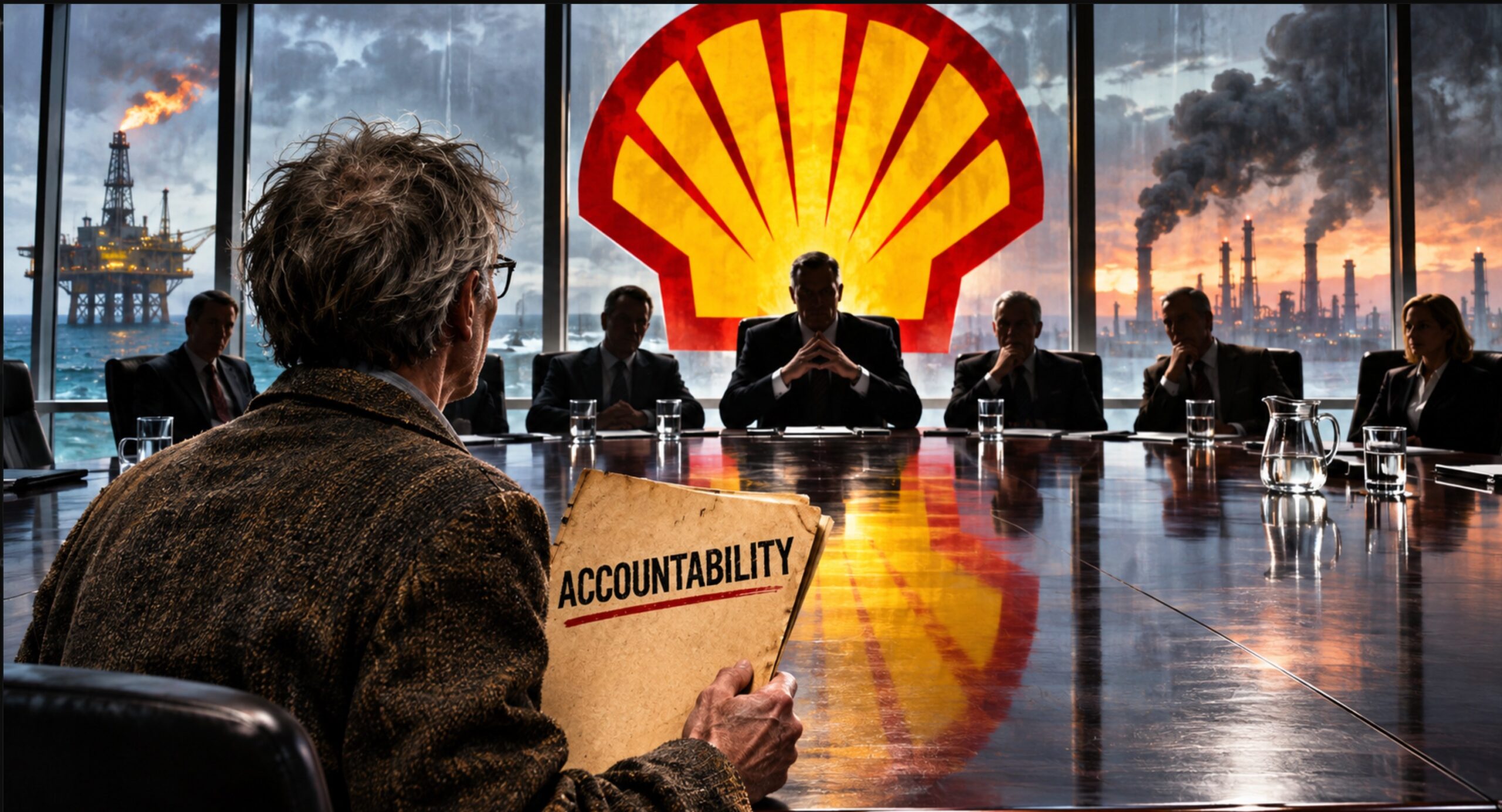
Illustration: A shareholder confronts the boardroom over corporate accountability, climate risk and the right to challenge management. Conceptual artwork; not an actual Shell board meeting
AN INDEPENDENT DOCUMENTARY INVESTIGATION
By the Donovan–Shell Archive | 6 November 2026
A new legal analysis from international law firm Fieldfisher identifies Shell as a leading example of the difficulties facing activist shareholders. But behind the legal arguments lies a much larger question: who really holds the directors of a multinational oil giant accountable?
There is something wonderfully revealing about the corporate world’s vocabulary.
When executives challenge established practices, it is called leadership.
When consultants recommend changes, it is called transformation.
When shareholders challenge the directors who are supposed to represent their interests, however, it can become a corporate crisis.
Welcome to the curious world of shareholder activism, where the owners of a company can sometimes appear to be treated as an occupational hazard.
On 5 November 2026, international law firm Fieldfisher published an analysis entitled Shareholder activism and boardroom pressure: managing an escalating corporate challenge.
The article offers practical guidance to corporate boards confronted by increasingly assertive shareholders.
It also specifically examines the unsuccessful legal action brought by environmental organisation ClientEarth against Shell plc’s directors.
That makes it particularly relevant to anyone interested in Shell’s corporate governance, environmental commitments, shareholder relations and history of disputes with critics.
And it raises a rather uncomfortable question.
At what point does defending the interests of a company become defending its directors against legitimate scrutiny?
The shareholder: owner, investor or potential troublemaker?
Fieldfisher begins by acknowledging that shareholder activism is now an established feature of British corporate life.
Shareholders may challenge executive remuneration, question strategic decisions, oppose acquisitions, demand changes to boards or campaign publicly for reform.
Importantly, a relatively small shareholding can sometimes provide access to significant legal mechanisms.
Under section 303 of the Companies Act 2006, members representing at least 5% of relevant voting rights may require directors to call a general meeting.
Section 338 provides qualifying shareholders in public companies with a mechanism to require circulation of AGM resolutions, subject to statutory thresholds.
These are not revolutionary privileges.
They are established rights under company law.
Nevertheless, from a boardroom perspective, exercising them can be the beginning of an unwelcome confrontation.
Fieldfisher recommends that companies assess an activist’s objectives, track record, influence and potential support among other shareholders.
All perfectly sensible.
But the advice becomes particularly interesting when it turns to coordinating legal teams, corporate communications, investor relations and management responses.
A shareholder may believe that a company has made a poor decision.
The company may respond by assembling a coordinated professional apparatus to defend its position.
One side may have a modest shareholding and a folder of documents.
The other may have an entire corporate infrastructure.
Such is the modern interpretation of a level playing field.
ClientEarth versus Shell: 27 shares against an oil giant
The clearest illustration in Fieldfisher’s analysis concerns the litigation brought by ClientEarth against Shell’s directors in 2023.
ClientEarth held just 27 shares in Shell.
It sought permission to bring a derivative claim on behalf of the company, alleging that directors had breached their duties in their management of climate-related risks.
The organisation argued, in substance, that Shell’s climate strategy exposed the company to significant risks and that its directors had failed to discharge their legal responsibilities.
The High Court refused permission for the claim to proceed.
In ClientEarth v Shell plc [2023] EWHC 1897 (Ch), Mr Justice Trower addressed the considerable legal hurdles involved in asking a court to intervene in directors’ commercial decision-making.
Permission to appeal was subsequently refused.
This was a significant defeat for ClientEarth.
It was not, however, a judicial declaration that Shell’s climate strategy was environmentally adequate or commercially infallible.
The distinction matters.
A court deciding whether a shareholder can pursue a derivative action is not conducting a general referendum on the wisdom of the company’s energy strategy.
Directors have considerable discretion to balance competing commercial considerations.
That discretion is essential to the functioning of companies.
But discretion should not be confused with immunity from criticism.
Fieldfisher correctly identifies the litigation as an illustration of the substantial obstacles facing shareholders who seek to challenge directors through derivative proceedings.
There is another lesson.
Twenty-seven shares were sufficient to give ClientEarth standing to seek the court’s permission. They were not sufficient to overcome the legal threshold for proceeding.
The law provided a doorway.
It did not guarantee entry.
Shell’s climate strategy: a continuing shareholder argument
The ClientEarth litigation did not occur in a vacuum.
For years, Shell has faced criticism over the compatibility of its fossil-fuel operations with international climate objectives.
In March 2024, Shell revised its energy-transition strategy.
The company changed its 2030 target for reducing the net carbon intensity of the energy products it sells from a 20% reduction to a range of 15–20%, compared with 2016.
It also retired its previous 2035 net carbon intensity target.
Shell explained these changes in terms of commercial realities, anticipated customer demand and its strategic priorities.
The company continues to maintain a net-zero emissions ambition for 2050 and has highlighted investments in lower-carbon energy solutions.
Its position deserves to be represented fairly.
But critics are entitled to ask whether the pace of emissions reductions is consistent with the company’s climate commitments.
They are also entitled to question the financial consequences of continuing investment in oil and gas infrastructure during a global energy transition.
These are not merely ideological disputes.
They concern capital allocation, regulatory exposure, long-term asset values and shareholder risk.
In other words, precisely the subjects that corporate directors are supposed to consider.
Source: Shell Energy Transition Strategy 2024
The LNG dispute: shareholder pressure that Shell could not ignore
A more recent example demonstrates why shareholder activism cannot simply be dismissed as theatrical protest.
At Shell’s annual general meeting on 20 May 2025, a shareholder resolution concerning the company’s liquefied natural gas business attracted approximately 20.6% support among votes cast, according to Shell’s subsequent governance disclosure.
The resolution was defeated.
But more than one-fifth of votes cast represented substantial dissent.
Shell subsequently acknowledged shareholder concerns about its LNG disclosures, potential financial risks and the compatibility of expanding its LNG portfolio with its net-zero ambition.
The company reported further engagement with major institutional shareholders and committed to providing additional information about its LNG strategy.
That is an important example of shareholder pressure producing a corporate response even without a resolution being passed.
It also illustrates a distinction frequently overlooked in discussions of activism.
A shareholder campaign can fail to secure a majority while still raising questions that management must take seriously.
The board may retain its authority.
The questions do not necessarily disappear.
Source: Shell’s October 2025 AGM voting update
At Shell’s May 2026 AGM, a further climate-related shareholder resolution received approximately 13% support, according to shareholder advocacy organisation Follow This.
Again, the proposal failed.
Again, the existence of a significant dissenting minority remained a matter of public record.
Source: Follow This shareholder resolution results
The institutional investors: where the real power resides
For Shell’s smaller shareholders, one of the most important realities is the concentration of voting influence among institutional investors.
Major global asset managers such as BlackRock and Vanguard are important participants in the investment ecosystem surrounding large publicly traded companies, including Shell.
Their holdings and voting authority may be distributed across numerous funds and client mandates; they should not be treated as single individuals exercising unrestricted control over every share.
Nevertheless, the stewardship and voting decisions of major asset managers can have considerable influence.
This creates a fundamental question.
When a shareholder resolution raises concerns about climate risk, executive accountability or corporate governance, how do institutional investors decide whether to support it?
Do they accept management’s assurances?
Do they independently examine the evidence?
Do they consider long-term environmental and financial risks?
And how transparently do they explain their decisions to the underlying investors whose money they manage?
These questions deserve attention regardless of whether the shareholder proposal comes from an environmental organisation, a pension fund or an individual investor.
Large institutions are not obliged to agree with activists.
But meaningful stewardship requires more than automatically endorsing management.
A boardroom should not become an echo chamber simply because its largest shareholders prefer a quiet life.
Fieldfisher’s advice: sensible governance or sophisticated defensive machinery?
Fieldfisher identifies six priorities for boards responding to shareholder activism.
These include monitoring emerging pressure, understanding the activist, testing the company’s position, coordinating legal and communications strategy, preserving evidence and preparing for escalation.
Much of this is sound corporate governance.
Indeed, one of the article’s most important recommendations is that companies should examine criticism objectively rather than assume every activist is hostile.
That deserves emphasis.
Fieldfisher does not advocate suppressing lawful shareholder rights or concealing evidence.
Its analysis expressly recognises that constructive shareholder challenge can expose genuine governance problems.
Nevertheless, the framework illustrates how comprehensively modern corporations can organise themselves when challenged.
Legal advisers assess potential claims.
Investor-relations specialists evaluate shareholder influence.
Communications professionals prepare messaging.
Senior executives coordinate their positions.
And corporate records may become central to future disputes.
This is not necessarily improper.
But it creates an obvious risk.
A company that becomes excessively preoccupied with managing criticism may devote less attention to addressing the underlying problem.
There is a difference between answering a difficult question and devising a strategy to make the question go away.
The former is accountability.
The latter may become reputation management at the expense of accountability.
The documents that companies should preserve
One of Fieldfisher’s most significant recommendations concerns the evidential record.
The firm emphasises the importance of preserving relevant documents when litigation or a dispute becomes foreseeable.
Board minutes, emails, informal communications and contemporaneous explanations of decisions can all become important evidence.
This is particularly relevant to the work of the Donovan–Shell Archive.
For decades, the archive has collected correspondence, litigation records, internal communications and historical material concerning Shell and its predecessor companies.
Such records can help researchers distinguish between what a company said publicly, what its personnel discussed internally and what the available evidence actually establishes.
Of course, internal correspondence must be interpreted carefully.
An isolated email does not necessarily represent an approved corporate position.
An allegation in a document is not proof that the allegation is true.
A fragment of correspondence may be misleading without its surrounding context.
But properly authenticated and contextualised records can provide a valuable independent historical resource.
That is why preservation matters.
Corporate reputations can be repaired through advertising.
Historical records are rather less cooperative.
A history of challenges to Shell
Shell’s experience with public criticism extends far beyond contemporary climate activism.
The company has faced major controversies involving its environmental record, operations in Nigeria, the Sakhalin-2 project in Russia, corporate governance and its 2004 oil reserves scandal.
These episodes differed enormously in their circumstances, evidence and legal outcomes.
They should not be treated as interchangeable examples of wrongdoing.
Nevertheless, together they demonstrate why independent scrutiny of multinational corporations remains important.
The 2004 reserves scandal, for example, involved the overstatement of proved hydrocarbon reserves and resulted in regulatory penalties and significant changes in senior leadership.
The Sakhalin-2 project generated environmental controversy and a major restructuring of ownership following Russian government pressure.
Shell’s activities in the Niger Delta have been the subject of extensive litigation and longstanding disputes over pollution and responsibility.
Each episode illustrates a different aspect of corporate accountability.
And each raises questions about the relationship between management decisions, public representations and the documentary record.
For shareholders, the relevant issue is not whether Shell should be permanently condemned for its history.
It is whether the lessons of that history have been adequately incorporated into contemporary governance.
A company cannot change its past.
It can decide how honestly it confronts it.
When the critic becomes the problem
There is a broader phenomenon worth examining.
Corporate institutions sometimes find it easier to characterise criticism as a threat than to confront the substance of the criticism.
That observation is not an allegation that Fieldfisher or Shell has engaged in unlawful suppression of shareholder activism.
It is a warning about the potential consequences of defensive corporate culture.
When a shareholder asks an uncomfortable question, the first response should be to determine whether the question is justified.
Not whether the shareholder is influential.
Not whether the criticism might attract journalists.
Not whether the individual has previously challenged management.
And certainly not whether the question can be neutralised through a sufficiently expensive public-relations exercise.
The merits should come first.
A well-governed company should be capable of distinguishing malicious allegations from legitimate criticism without treating all dissent as an attack.
That is particularly important in a corporation as economically and environmentally consequential as Shell.
A question for Shell’s board
Shell’s directors have legal duties to the company.
They must exercise independent judgment, promote the company’s success in accordance with applicable law and consider relevant long-term consequences.
They are not required to agree with every shareholder demand.
Nor should courts become substitute corporate management teams.
But the existence of managerial discretion does not eliminate the need for scrutiny.
If anything, considerable discretion makes effective accountability more important.
Fieldfisher’s article provides a useful description of how companies can prepare for shareholder activism.
Our question is slightly different.
How can shareholders ensure that the machinery designed to protect the company does not become a mechanism for protecting management from justified criticism?
There is no simple answer.
It requires effective corporate governance, transparent disclosure, meaningful shareholder engagement, independent journalism and access to reliable historical records.
It also requires institutional investors to exercise their stewardship responsibilities thoughtfully.
And it requires boards to recognise that disagreement is not necessarily disloyalty.
Sometimes the most valuable shareholder is the one asking the question everyone else would prefer to avoid.
Conclusion: accountability is not a corporate emergency
The corporate world spends enormous sums promoting the virtues of transparency, integrity and stakeholder engagement.
Yet when shareholders attempt to put those principles into practice, the resulting challenge can be categorised as a potential crisis requiring coordinated management.
There is an irony here that should not be lost.
Shareholder activism is not inherently evidence of defective governance.
It may be evidence that governance is functioning as intended.
The real test is how directors respond.
Shell has every right to defend its commercial strategy and contest allegations it considers unfounded.
Its shareholders have an equally legitimate right to question that strategy, examine its consequences and seek accountability through lawful means.
The company belongs to its shareholders, not personally to its directors.
And its environmental consequences extend well beyond the shareholder register.
Perhaps the most useful lesson from Fieldfisher’s article is therefore one that goes beyond its intended corporate audience.
The strongest defence against legitimate shareholder criticism is not a sophisticated crisis-management plan. It is a well-supported answer.
If the answer is convincing, shareholders can judge it for themselves.
If it is not, no amount of polished corporate messaging should make the questions disappear.
Principal sources
- Fieldfisher — Shareholder activism and boardroom pressure: managing an escalating corporate challenge, 5 November 2026
- High Court — ClientEarth v Shell plc [2023] EWHC 1897 (Ch)
- Shell — Energy Transition Strategy 2024
- Shell — Annual General Meetings and voting disclosures
- Follow This — Shareholder climate resolution results
Editorial methodology
This article draws on Fieldfisher’s published legal analysis, court judgments, Shell’s corporate disclosures and shareholder advocacy records. It distinguishes established legal outcomes from editorial interpretations. The article was prepared with AI-assisted research and drafting under the editorial framework of the Donovan–Shell Archive.
DISCLAIMER
This article is independent opinion, commentary and documentary analysis. It is not legal, financial or investment advice.
The discussion of shareholder activism, litigation and corporate governance should not be interpreted as an allegation of unlawful conduct by Fieldfisher, its authors, Shell plc or any named institutional investor unless expressly supported by an identified legal finding or reliable documentary evidence.
Shell and other parties mentioned may hold different views of the matters discussed. The archive welcomes substantiated factual corrections and relevant responses for consideration and publication.
*This website and sisters royaldutchshellgroup.com, shellnazihistory.com, royaldutchshell.website, johndonovan.website, shellnews.net, and shellwikipedia.com, are owned by John Donovan - more information here. There is also a Wikipedia segment, the Shell DPA Files, "Shell and the Spies", the Shell Leaks files, the Independent Shell Archive, as well as books written and published by John Donovan - Kindle eBooks. Timeline of the Donovan Shell Feud. Toxic History of Royal Dutch Shell Group. Shell and the Donovans: The Full Media Record — 550+ Articles, 110 Books, 40 Years. *All conjured up by internet wizz, Nick Gill.