 AN INDEPENDENT DOCUMENTARY INVESTIGATION
By the Donovan–Shell Archive
6 November 2026
Researched and drafted with assistance from ChatGPT, using original Blackstone and Mitsubishi Corporation announcements, Shell plc’s SEC filings, Canadian government project disclosures, LNG Canada corporate records and contemporaneous Reuters reporting.
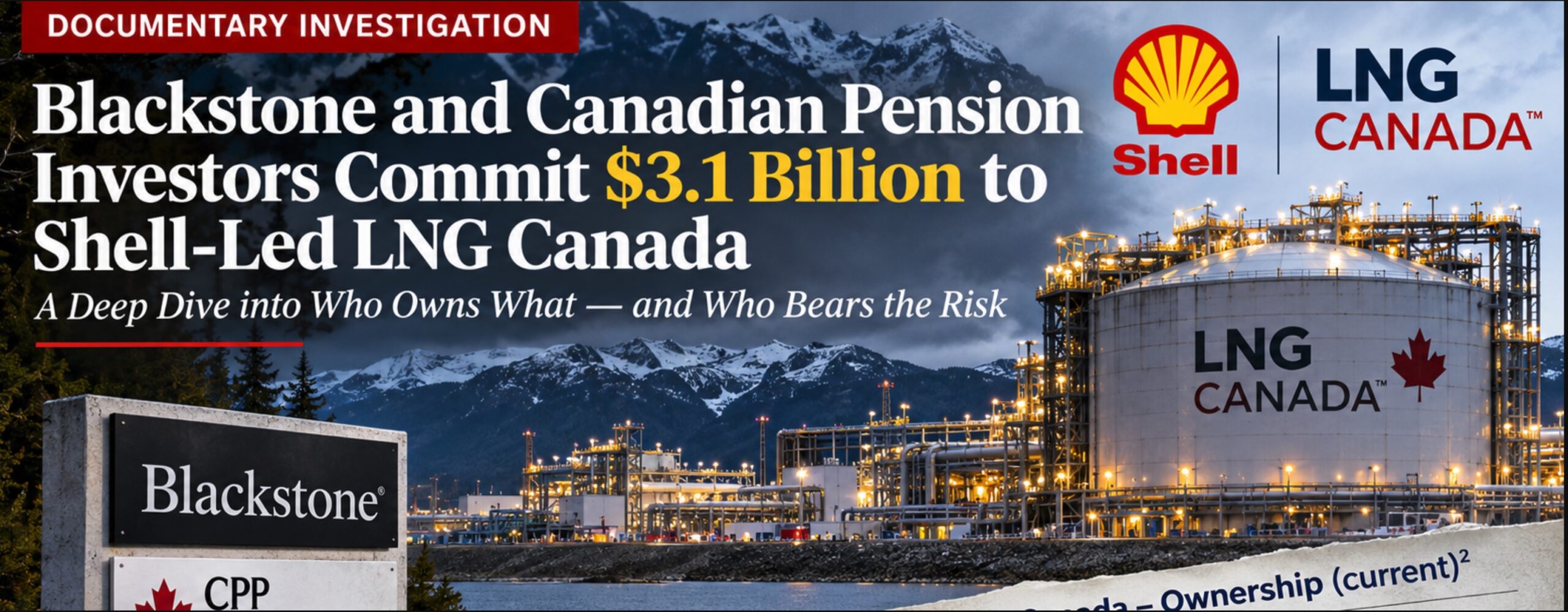
A new $3.1 billion investment agreement has brought Blackstone and some of Canada’s largest pension and institutional investors into the financial structure supporting Shell’s LNG Canada project. But the transaction is more complicated than the headline figure suggests. Mitsubishi Corporation is selling a minority interest in a holding company associated with its 15% participation in the LNG export terminal. Shell is not selling its own 40% interest. Mitsubishi will retain control of its holding company and its entitlement to LNG production. The arrangement comes just weeks after the partners approved a multibillion-dollar expansion that will double the Canadian facility’s annual capacity to 28 million tonnes. An examination of the original corporate announcements reveals how financial investors are gaining exposure to major gas infrastructure while existing industrial shareholders retain their commercial positions.
Introduction: The $3.1 billion announcement
On 2 November 2026, Blackstone announced an agreement involving one of the most important investments in Shell’s international gas portfolio.
Funds managed by Blackstone Credit & Insurance, together with four major Canadian institutional investors, had agreed to invest $3.1 billion in a Mitsubishi Corporation subsidiary.
The subsidiary holds Mitsubishi’s interest in the LNG Canada liquefaction business.
The investors will acquire a 49.9% non-controlling interest in that holding company.
Mitsubishi will retain the remaining controlling interest.
The project at the centre of the transaction is LNG Canada, the liquefied natural gas export terminal at Kitimat, British Columbia.
Shell is the project’s largest shareholder, with a 40% interest.
LNG Canada began exporting LNG in 2025.
On 29 September 2026, Shell and its partners announced a final investment decision to expand the facility.
The expansion will double its production capacity from 14 million tonnes annually to 28 million tonnes.
The new financial agreement therefore arrives at a critical moment.
A project that has only recently entered commercial operation is preparing for another enormous construction programme.
Its shareholders face substantial additional capital requirements.
And financial institutions are being offered opportunities to participate in the project’s long-term economics.
But there is an important distinction.
Blackstone’s investment is not a purchase of shares from Shell. Nor is it a direct acquisition of 49.9% of LNG Canada.
The actual transaction is more specialised.
Understanding that structure is essential to assessing what has happened.
Primary sources: Blackstone — Original Investment Announcement, 2 November 2026 and Mitsubishi Corporation — Original Corporate Disclosure, 2 November 2026. Mitsubishi Corporation
1. Shell remains LNG Canada’s largest shareholder
Before examining the Blackstone transaction, the existing ownership structure needs to be established.
According to Shell’s official announcement of 29 September 2026, LNG Canada’s shareholders are:
| Shareholder | Project interest |
|---|---|
| Shell | 40% |
| PETRONAS | 25% |
| PetroChina | 15% |
| Mitsubishi Corporation | 15% |
| Korea Gas Corporation (KOGAS) | 5% |
Shell therefore remains the largest participant.
Its 40% interest was not included in the transaction announced on 2 November.
Mitsubishi’s 15% interest is the relevant investment.
But Mitsubishi is not disposing of that entire interest.
Instead, it is introducing financial investors into the holding company through which it participates in the liquefaction business.
The distinction may appear technical.
It has important consequences for ownership, control, commercial rights and future LNG deliveries.
Source: Shell — Final Investment Decision to Double LNG Canada Capacity, 29 September 2026. Shell
2. What Mitsubishi is actually selling
Mitsubishi’s original corporate announcement provides the clearest explanation.
The company identifies a subsidiary that holds its 15% interest in LNG Canada’s liquefaction infrastructure.
It describes the entity as its infrastructure holding company.
Mitsubishi has agreed to sell a 49.9% interest in that company to funds managed by Blackstone Credit & Insurance.
Mitsubishi will retain control.
The transaction is therefore a minority investment at the holding-company level.
It is not a direct transfer of 49.9% of LNG Canada itself.
The distinction is particularly important because percentages can become misleading when corporate ownership contains several layers.
Mitsubishi’s holding company possesses a 15% interest in the LNG Canada liquefaction business.
The Blackstone-led investors are acquiring 49.9% of that holding company.
Multiplying the two percentages produces an approximate indirect economic exposure equivalent to 7.485% of the underlying liquefaction business, before considering the detailed rights, obligations and financial structure.
But that calculation does not establish that the investors have acquired a directly registered 7.485% ownership interest in the LNG Canada project company.
Nor does it establish that they possess corresponding voting rights at the project level.
Those matters depend upon the governing corporate documents.
The publicly available announcements do not disclose every contractual provision governing the new investors.
The authenticated conclusion is narrower.
The Blackstone-led group will become a minority financial investor in Mitsubishi’s holding company, while Mitsubishi retains the controlling position.
That distinction is central to the entire transaction.
Source: Mitsubishi Corporation — New Financial Partner for LNG Canada Holding Company. Mitsubishi Corporation
3. Why $3.1 billion does not simply mean a $3.1 billion share purchase
There is a second important distinction.
Blackstone’s announcement describes a $3.1 billion investment.
Mitsubishi’s announcement describes the sale of 49.9% of its holding company for approximately $1.6 billion.
Both statements are official.
But they are not identical descriptions of the financial arrangement.
Mitsubishi states that the transaction consideration is approximately $1.6 billion, equivalent to roughly ¥250 billion.
Blackstone announces a broader $3.1 billion investment commitment.
Contemporaneous Reuters reporting explains that the difference is associated with financing for the Phase 2 expansion.
The reported structure therefore combines the acquisition of an existing ownership interest with additional financing support for future development.
The precise contractual allocation, timing and conditions attached to all investment commitments have not been independently established from the complete transaction agreements.
That limitation matters.
It would be incorrect to assume that Mitsubishi has simply received $3.1 billion in cash from selling its holding-company shares.
It would also be incorrect to treat the entire amount as an immediate payment into LNG Canada’s construction budget.
The two original company announcements describe different aspects of the agreement.
The transaction is commercially significant precisely because it appears to address both ownership and financing.
Mitsubishi can introduce external investment capital while maintaining control of its Canadian LNG position.
The financial investors can obtain exposure to an established LNG facility and its planned expansion.
And the additional financial resources can support the substantial capital requirements associated with Phase 2.
Contemporaneous Reuters reporting confirms the distinction between the approximately $1.6 billion share-sale consideration and the wider $3.1 billion investment arrangement.
Source: Reuters — Blackstone and Canadian Pension Funds to Invest $3.1 Billion in LNG Canada, 3 November 2026. MarketScreener
4. The transaction is not evidence that LNG Canada is worth $41 billion
The different financial figures create a potential valuation trap.
A commentator might take Blackstone’s $3.1 billion announcement, divide it by the 49.9% holding-company interest and then apply the resulting valuation to the entire LNG Canada project.
That would produce a striking number.
But it would also risk producing a misleading one.
The $3.1 billion represents the announced broader investment arrangement.
Mitsubishi identifies approximately $1.6 billion as the consideration associated with the holding-company share sale.
Even using the $1.6 billion figure to calculate an implied equity valuation requires caution.
A simple calculation would place the holding company’s implied equity value at approximately $3.2 billion.
But the financial arrangements may include future investment obligations, financing structures and rights that are not fully disclosed.
Furthermore, the holding company concerns Mitsubishi’s participation in the liquefaction infrastructure business.
That does not necessarily make its implied value directly comparable with the enterprise value of every asset and obligation associated with LNG Canada.
The publicly disclosed transaction also does not establish the valuation of Shell’s separate upstream gas resources, LNG marketing relationships or other Canadian businesses.
Nor does it provide an independent valuation of Shell plc.
The responsible conclusion is that the transaction provides evidence of substantial institutional investor interest in LNG Canada’s future earnings. It does not establish a definitive market valuation for the entire project.
This is an important distinction for Shell shareholders.
Private investment transactions can provide useful evidence about commercial expectations.
But their headline prices must be interpreted according to the actual assets and rights being transferred.
THE NEW INVESTORS
5. Blackstone is bringing Canadian pension and institutional capital into the project
The investor group announced on 2 November includes funds managed by Blackstone Credit & Insurance.
It also includes four major Canadian institutional investors.
They are Canada Pension Plan Investment Board, usually known as CPP Investments; Ontario Municipal Employees Retirement System, or OMERS; Investment Management Corporation of Ontario, known as IMCO; and Public Sector Pension Investment Board, or PSP Investments.
These institutions manage substantial long-term investment portfolios.
They invest in infrastructure, private credit, equities and other assets on behalf of their respective contributors, beneficiaries or institutional clients.
Their investment mandates are not identical.
CPP Investments manages the investment assets of the Canada Pension Plan.
OMERS manages retirement assets for participating employers and employees in Ontario.
PSP Investments manages assets for several federal public-sector pension plans.
IMCO manages institutional investment portfolios, including assets for pension and other public-sector clients.
It would therefore be imprecise to describe all four organisations simply as identical pension funds.
Nevertheless, the involvement of these institutions introduces an important public-interest dimension.
The financial performance of the investment matters not only to Blackstone and Mitsubishi.
It also matters to institutions responsible for managing substantial pools of Canadian retirement and public-sector capital.
Blackstone’s announcement identifies the participants but does not disclose precisely how much each investor is committing.
The available information therefore does not establish the individual financial exposure of CPP Investments, OMERS, IMCO or PSP Investments.
Nor does it establish their respective investment returns, fees or contractual protections.
Those details remain outside the publicly disclosed transaction summary.
Primary source: Blackstone — $3.1 Billion LNG Canada Investment Agreement. Blackstone
6. Why large institutional investors are interested
The commercial attraction is understandable.
LNG Canada is already operating.
Its first phase has established export infrastructure on Canada’s Pacific coast.
Its shareholders have now approved a second phase.
The project is supported by western Canada’s substantial natural-gas resources.
Its location provides relatively direct access to Asian markets.
Mitsubishi’s existing holding company has an entitlement to 2.1 million tonnes of LNG annually.
Following the expansion, that entitlement is expected to increase to 4.2 million tonnes.
Those volumes provide a substantial commercial foundation for the investment.
They do not guarantee future profits.
LNG market prices, operational performance, construction costs, financing expenses and other factors will affect investment returns.
But the project has characteristics that are often attractive to long-term infrastructure investors.
It possesses established industrial facilities.
Its expansion has received a final investment decision.
Its shareholders include major international energy companies.
And the project is expected to operate for decades.
Blackstone’s announcement describes LNG Canada as a strategically important asset with attractive long-term fundamentals.
That is the investor’s commercial assessment.
It is not an independently established guarantee of profitability.
The financial investors are accepting exposure to future economic performance in exchange for their capital.
Whether the projected returns materialise will depend upon future events.
7. Mitsubishi keeps its LNG — and its customers
One of the most revealing details appears in Mitsubishi’s announcement.
The company states that the transaction will not affect its LNG offtake volumes or customer relationships.
This is especially important because LNG Canada operates under an equity-lifting structure.
Each joint-venture participant is responsible for supplying its proportionate share of natural gas to the facility.
Each participant then takes its proportionate share of the resulting LNG production.
Mitsubishi currently receives approximately 2.1 million tonnes annually.
Following Phase 2, its entitlement is expected to increase to approximately 4.2 million tonnes.
Mitsubishi says its LNG is marketed to Asian customers, primarily in Japan, through its Singapore-based subsidiary Diamond Global Energy.
The Blackstone transaction does not alter those announced volumes or customer relationships.
In other words, Mitsubishi is introducing financial investors without abandoning its commercial role as an LNG supplier.
The holding company becomes partly owned by financial institutions.
Mitsubishi retains control and continues its LNG business.
That distinction helps explain why the transaction may be attractive to a major industrial shareholder.
Mitsubishi can improve the capital efficiency of its investment without relinquishing the operating and marketing relationships associated with its LNG supply.
The contractual arrangements governing the financial investors’ economic returns have not been fully disclosed.
But the broad commercial structure is clear.
Source: Mitsubishi Corporation — LNG Canada Transaction and Continuing LNG Offtake Arrangements. Mitsubishi Corporation
THE SHELL CONNECTION
8. Shell has committed itself to a much larger Canadian gas business
The transaction comes at an especially important time for Shell.
On 29 September 2026, Shell announced the final investment decision for LNG Canada Phase 2.
The expansion will add two liquefaction trains to the existing two-train facility.
Annual production capacity is expected to increase from 14 million tonnes to 28 million tonnes.
The project will also require additional storage and loading infrastructure.
The existing Coastal GasLink pipeline will be expanded through the construction of five new compressor stations.
Commercial operations from Phase 2 are expected to begin in the early 2030s.
Shell expects the expansion to provide it with nearly six million additional tonnes of LNG annually.
That represents a major increase in Shell’s international gas supply.
The project also fits within a wider Canadian investment strategy.
In September 2026, Shell completed its acquisition of ARC Resources.
That transaction substantially increased its upstream natural-gas production in western Canada.
Shell therefore possesses significant interests at several stages of the Canadian gas value chain.
It owns upstream gas resources.
It participates in LNG processing infrastructure.
It supplies gas to the export facility.
And it markets LNG through its international trading operations.
This vertical integration is commercially important.
It gives Shell a direct relationship between Canadian production and global LNG demand.
The Mitsubishi transaction does not alter that strategy.
But it demonstrates that another participant is using external institutional capital to support its participation in the same expansion.
Source: Shell — LNG Canada Phase 2 Final Investment Decision. Shell
9. Shell’s own accounts already recognised a major improvement in LNG Canada-related value
There is another important financial development.
On 29 October 2026, Shell published its third-quarter financial results.
Its unaudited financial report included a substantial impairment reversal.
Shell recognised a $1.787 billion pre-tax impairment reversal relating to a North American asset within its Integrated Gas business.
The company stated that the reversal was triggered by changed commercial terms and the final investment decision for LNG Canada Phase 2.
This was a major accounting reassessment.
An impairment reversal reflects an increase in an asset’s recognised recoverable value, subject to accounting requirements.
It is not equivalent to receiving the same amount in cash.
The Donovan–Shell Archive examined that disclosure in its investigation published on 29 October.
The new Blackstone transaction now provides additional evidence about investor interest in the wider project.
But the two developments must not be conflated.
Shell’s impairment reversal was reported before the Blackstone agreement was announced.
The available documents do not establish that Blackstone’s transaction caused Shell’s impairment reversal.
Nor do they establish that the price paid for Mitsubishi’s holding-company interest was used to determine Shell’s accounting valuation.
The events concern different legal entities and financial arrangements.
Nevertheless, they occurred within the same period of substantial new investment commitments to LNG Canada.
Shell’s accounts recorded improved expectations associated with the expansion.
Mitsubishi subsequently announced an arrangement bringing external financial investors into its holding company.
Taken together, these developments demonstrate substantial capital-market and corporate interest in the project’s future.
They do not guarantee its eventual profitability.
Primary source: Shell plc — Third-Quarter 2026 Unaudited Financial Report, SEC Filing, page 32.
Earlier archive investigation: Shell’s $10.8 Billion Profit Bonanza: A $2.1 Billion Biogas Write-Down as LNG Canada Gains $1.8 Billion in Value, 29 October 2026. SEC
CANADA’S NATIONAL ENERGY STRATEGY
10. A project promoted as a national priority
The Canadian government has given LNG Canada Phase 2 considerable political and economic importance.
The project was referred to Canada’s Major Projects Office in September 2025.
The office was established to support the advancement of major infrastructure and economic developments considered nationally significant.
Canada’s official project record identifies LNG Canada Phase 2 as an important opportunity to expand the country’s export capacity.
The government has referred to the prospect of approximately C$33 billion in private-sector investment.
It has also emphasised the potential for employment, economic activity and greater diversification of Canadian export markets.
The distinction between government policy and completed commercial outcomes is important.
The expansion has received a final investment decision.
But the additional liquefaction facilities have not yet begun operation.
The anticipated investment, employment and economic benefits remain dependent upon construction and subsequent performance.
The government’s commitment to facilitating the project does not constitute a guarantee of its commercial returns.
Nor should the projected private-sector investment be confused with the $3.1 billion Blackstone-led financing announcement.
The figures refer to different matters.
The Canadian estimate concerns the much larger expansion programme.
The Blackstone transaction concerns investment in Mitsubishi’s holding-company structure.
There is no basis for adding the two figures together as though they necessarily represent independent, non-overlapping expenditure.
Official source: Government of Canada — LNG Canada Phase 2, Major Projects Office. Canada
11. Government support is not the same as government ownership
Canada’s involvement also requires careful interpretation.
The federal and British Columbian governments have worked with LNG Canada to address commercial, regulatory and infrastructure issues associated with the expansion.
In May 2026, the governments announced enhanced investment co-operation intended to assist progress towards a final investment decision.
The arrangements involved co-operation concerning infrastructure, regulatory processes, employment and relationships with First Nations.
The Canadian government has also identified fiscal measures intended to improve the competitiveness of qualifying LNG investments.
These measures form part of the wider investment environment.
They are not identical to the investment announced by Blackstone.
Nor do they establish that Canada’s government is directly acquiring the ownership interest being sold by Mitsubishi.
CPP Investments and other institutional investors operate under their own investment governance arrangements.
The presence of Canadian pension and institutional capital in the Blackstone group should therefore not be confused with a direct Canadian government purchase of Mitsubishi’s LNG Canada stake.
That distinction matters when assessing the role of public institutions.
Government policy can encourage investment.
Institutional funds can independently decide to invest.
Private companies can pursue commercial returns.
Those are related but legally distinct activities.
Source: Natural Resources Canada — Enhanced Investment Co-operation for LNG Canada Phase 2, 14 May 2026. Canada
ANOTHER OWNERSHIP STRUCTURE: INDIGENOUS PARTICIPATION
12. A proposed C$1 billion investment in LNG storage infrastructure
The Blackstone transaction is not the only significant financing arrangement associated with LNG Canada’s expansion.
On 14 July 2026, LNG Canada announced an equity-option agreement involving MNT Investments LP.
MNT represents economic-development organisations associated with five neighbouring First Nations.
The agreement provides an opportunity to invest up to C$1 billion in infrastructure associated with the expansion.
The proposed investment concerns a new LNG storage tank.
Under the announced structure, a special-purpose entity would acquire the tank and lease it back for use by LNG Canada.
The participating First Nations would obtain a majority ownership interest in that entity.
LNG Canada would continue operating and maintaining the tank.
This is a substantially different investment structure from Blackstone’s arrangement with Mitsubishi.
The Blackstone transaction involves a minority interest in an existing shareholder’s holding company.
The Indigenous equity option concerns potential ownership of a specific infrastructure asset.
The two should not be confused.
Both demonstrate that major infrastructure projects can be financed through multiple ownership arrangements.
The July agreement is an option, however, and should not automatically be described as a completed C$1 billion investment.
Following the September final investment decision, LNG Canada stated that the decision enabled implementation of the option.
The publicly examined announcements do not establish that every subsequent condition has been satisfied or that the full amount has already been invested.
The distinction between an announced opportunity and completed investment must be preserved.
Primary source: LNG Canada — Indigenous Equity Option Agreement, 14 July 2026.
Subsequent project announcement: LNG Canada — Phase 2 Final Investment Decision, 28 September 2026. LNG
13. The environmental questions remain
LNG Canada is promoted by its developers and the Canadian government as an important source of relatively low-emissions LNG.
The proposed expansion is expected to use some existing infrastructure.
The project’s location provides direct access to Pacific shipping routes.
Supporters argue that Canadian LNG can contribute to energy security and potentially replace more emissions-intensive fuels in some importing markets.
But those arguments require qualification.
LNG production involves emissions associated with upstream gas extraction, transportation, processing, liquefaction and shipping.
The combustion of the gas by its eventual customers also produces greenhouse gases.
Claims concerning lower emissions intensity do not mean the project is emissions-free.
Nor do they establish that every exported LNG cargo necessarily displaces coal or another more emissions-intensive fuel.
Those outcomes depend upon the circumstances in the importing market.
The Canadian government’s comparisons of LNG Canada with other international facilities are based upon projected performance and particular measurement boundaries.
Such comparisons should be distinguished from independently measured lifecycle emissions from the completed expanded facility.
The Blackstone transaction does not resolve these questions.
It changes the financing and ownership arrangements associated with Mitsubishi’s participation.
It does not establish the project’s future emissions performance.
Similarly, the participation of some First Nations through commercial agreements should not be interpreted as evidence that all Indigenous communities support every aspect of LNG development in British Columbia.
Different communities and representatives have expressed different positions concerning major gas infrastructure.
The full range of those positions deserves to be acknowledged.
The investment announcement itself does not constitute an environmental assessment or a determination resolving outstanding environmental concerns.
EDITORIAL ANALYSIS
14. Shell’s position is commercially different from Mitsubishi’s
The most revealing aspect of the transaction may be the contrast between the two companies’ approaches to financing their participation.
Shell is LNG Canada’s largest shareholder.
It has recently expanded its upstream Canadian business.
It expects substantial additional LNG volumes from Phase 2.
And its financial statements have recognised improved value associated with the expansion.
Mitsubishi is approaching the same development from a somewhat different position.
It has a smaller project interest.
It also operates an integrated gas and LNG business.
But it has chosen to introduce external financial investors into its liquefaction holding company.
That arrangement enables Mitsubishi to maintain its commercial LNG business while sharing the financial exposure associated with the underlying investment.
The public announcements do not establish that Mitsubishi was unable to finance its participation independently.
Nor do they establish that it was under financial distress.
Mitsubishi explicitly describes the arrangement as a measure intended to improve capital efficiency.
The transaction should therefore be examined as a financing decision rather than evidence of an emergency.
For Shell, the wider significance is that the LNG Canada expansion is attracting different forms of capital.
Industrial energy companies are committing to construction and long-term operations.
Financial institutions are investing through specialised structures.
And potential Indigenous investors are considering participation in particular infrastructure assets.
The result is an increasingly complex ownership and financing system surrounding the same industrial development.
15. The separation of industrial control and financial ownership
The transaction illustrates a wider development in energy infrastructure investment.
An industrial company does not necessarily need to retain every economic interest in a project to preserve its commercial involvement.
It may introduce financial partners into a holding company.
It may sell interests in particular infrastructure assets while continuing to operate or use those assets.
It may enter long-term agreements that preserve access to production without retaining every associated ownership right.
These arrangements can improve flexibility in capital allocation.
They can also create more complicated relationships among investors, operators, lenders and customers.
Understanding who owns what becomes increasingly important.
In the Mitsubishi transaction, the announced control position remains with Mitsubishi.
Its LNG supply relationships remain unchanged.
The financial investors acquire an interest in the holding company.
The detailed distribution of profits, losses, future investment obligations and governance protections remains subject to contractual arrangements that have not been publicly disclosed.
That is an important limitation.
An institutional investor’s indirect interest in LNG infrastructure should not be equated automatically with the operational responsibilities of the companies that develop and operate the facility.
Nor should financial exposure be confused with a direct entitlement to particular LNG cargoes.
The original corporate announcements preserve those distinctions.
They should also be preserved in independent reporting.
16. Pension capital introduces another set of questions
The involvement of Canadian pension and institutional investors makes the transaction especially noteworthy.
These organisations manage assets over long investment horizons.
They must consider potential returns, risk, diversification and their obligations to beneficiaries or institutional clients.
Infrastructure can be attractive because some assets generate revenues over extended periods.
But LNG infrastructure also carries substantial uncertainties.
Global gas demand may differ from forecasts.
Commodity prices may fluctuate.
Construction costs may increase.
Regulatory requirements may change.
Climate policy may affect long-term demand and operating economics.
These are ordinary investment risks.
Their existence does not establish that the Blackstone-led transaction is financially imprudent.
Nor does the participation of major pension institutions prove that the investment is certain to be profitable.
The relevant question is whether the institutions have adequately evaluated the risks and prospective returns.
Blackstone and its partners describe LNG Canada as an attractive investment.
That is a legitimate commercial assessment.
But the underlying forecasts, discount rates and contractual protections are not available in sufficient detail for an independent financial assessment.
It would therefore be premature to calculate expected pension returns or potential losses.
The investment deserves attention because of the scale of the commitment and the institutions involved.
It does not justify unsupported predictions about the eventual outcome.
17. The project is becoming an increasingly important test of Shell’s gas strategy
Shell has repeatedly identified integrated gas and LNG as central to its future business.
The company expects global LNG demand to grow substantially over coming decades.
Its September announcement stated that LNG Canada Phase 2 supports its ambition to remain a leading integrated gas and LNG business.
The company expects the investment to generate returns above the hurdle rate for its Integrated Gas business.
Those are forward-looking corporate expectations.
They are not guaranteed results.
The new Blackstone transaction demonstrates that financial investors also see potential value in the expansion.
But it does not establish that Shell’s demand forecasts are correct.
Nor does it establish that the economic interests of all shareholders and financial investors are identical.
Shell’s commercial position includes upstream gas production, LNG infrastructure and international trading.
Mitsubishi’s position includes its own integrated supply and marketing arrangements.
Blackstone and its institutional partners are entering through a financial investment.
Their respective returns may depend upon different contractual and commercial arrangements.
This is why the transaction deserves a documentary investigation rather than a simple announcement that $3.1 billion has been invested in a Shell project.
The ownership structure is part of the story.
So is the allocation of commercial risk.
THE QUESTIONS STILL UNANSWERED
18. What has not yet been disclosed?
The publicly available documents establish the broad transaction structure.
They do not provide every financial or contractual detail.
The full investment agreements have not been independently obtained.
The precise financial commitment of each institutional investor has not been disclosed.
The detailed timing and conditions of all capital contributions remain unclear.
The complete distribution of future profits, dividends or other returns among the holding-company investors has not been independently established.
Nor have all governance protections and future funding obligations been disclosed.
The original announcements also do not establish that Shell is a party to the share-sale agreement between Mitsubishi and the Blackstone-managed funds.
No direct sale of Shell’s 40% project interest has been announced.
The transaction’s completion should also be distinguished from its announcement.
As of 6 November 2026, the verified corporate disclosures describe an agreement to invest.
Contemporaneous Reuters reporting indicates that completion is expected during November.
An announcement confirming completed closing has not been identified in the sources examined for this investigation.
The transaction should therefore be described as agreed rather than conclusively completed.
These distinctions are essential if the subsequent financial history is to be reconstructed accurately.
CONCLUSION: A NEW KIND OF INVESTOR IN SHELL’S CANADIAN LNG EXPANSION
LNG Canada is becoming an increasingly important component of Shell’s international gas business.
Its first phase began exports in 2025.
The shareholders approved a major expansion in September 2026.
Shell expects to receive substantial additional LNG volumes.
Its financial statements subsequently recorded a significant improvement in the recognised value of a North American Integrated Gas asset associated with the expansion decision.
Now another development has occurred.
Blackstone and four major Canadian institutional investors have agreed to commit $3.1 billion through an investment involving Mitsubishi’s LNG Canada holding company.
The transaction brings new financial participants into the project’s wider ownership structure.
But Shell is not disposing of its 40% project interest.
Mitsubishi is not abandoning its LNG business.
And the financial investors are not directly acquiring 49.9% of LNG Canada.
They are acquiring a minority interest in a company holding Mitsubishi’s participation in the liquefaction infrastructure.
That company will remain under Mitsubishi’s control.
Mitsubishi’s announced LNG offtake arrangements will continue.
The transaction therefore demonstrates a commercially significant distinction.
The industrial shareholders can retain their operating and marketing relationships while financial investors acquire exposure to the underlying infrastructure and help support future investment requirements.
That arrangement may prove commercially successful.
It may also expose the investors to construction, market, regulatory and other long-term risks.
The financial outcome remains to be demonstrated.
For Shell shareholders, the transaction is another indication of the substantial capital being attracted to Canada’s LNG industry.
For Canadian pension beneficiaries and institutional clients, it represents exposure to a major international energy project.
For governments and local communities, it forms part of a much larger debate about the economic and environmental consequences of expanding natural-gas exports.
All of those interests deserve careful consideration.
The Blackstone agreement does not resolve the debate about LNG’s place in the energy transition.
But it demonstrates something important about the present direction of investment.
Major international financial institutions are committing substantial capital to an expansion of fossil-gas infrastructure that its industrial shareholders expect to operate well into the future.
For Shell, that development reinforces the importance of LNG Canada within its long-term portfolio.
For the Donovan–Shell Archive, it provides another authenticated checkpoint against which future claims about value, returns, financing and environmental performance can be assessed.
DOCUMENTARY FINDINGS
Established by authenticated corporate records
On 2 November 2026, Blackstone announced a $3.1 billion investment agreement involving Mitsubishi Corporation’s LNG Canada holding company.
The investor group includes funds managed by Blackstone Credit & Insurance, CPP Investments, OMERS, IMCO and PSP Investments.
The investors have agreed to acquire a 49.9% non-controlling interest in Mitsubishi’s holding company.
Mitsubishi’s original announcement identifies approximately $1.6 billion as the consideration for the holding-company share sale.
Mitsubishi will retain control of the holding company.
Its announced LNG offtake volumes and customer relationships will not change.
The holding company has a 15% interest in LNG Canada’s liquefaction business.
Shell’s 40% interest in LNG Canada is not being sold under the announced transaction.
LNG Canada Phase 2 received a final investment decision in September 2026.
The expansion is intended to increase annual production capacity from 14 million tonnes to 28 million tonnes.
Shell expects nearly six million additional tonnes of LNG annually from the expansion.
Mitsubishi expects its annual entitlement to increase from approximately 2.1 million tonnes to approximately 4.2 million tonnes.
Shell’s third-quarter 2026 financial statements record a $1.787 billion impairment reversal associated with a North American Integrated Gas asset, triggered by changed commercial terms and the LNG Canada Phase 2 final investment decision.
LNG Canada has also announced a separate Indigenous equity-option arrangement involving infrastructure associated with Phase 2.
Corporate expectations and projections
The expansion is expected to begin commercial operations in the early 2030s.
Shell expects the project to generate returns above its Integrated Gas investment hurdle.
Blackstone and its institutional partners consider the investment commercially attractive.
Mitsubishi expects the financial partnership to improve capital efficiency and support the expansion.
These are corporate expectations, not guaranteed outcomes.
Not established by the documents examined
The Blackstone transaction has not been independently established as completed as of 6 November 2026.
The exact allocation of the $3.1 billion among the individual investors has not been disclosed.
The complete financial and governance arrangements have not been independently examined.
The announced investment does not establish a definitive valuation of the entire LNG Canada project.
It does not establish that Shell is receiving $3.1 billion in cash.
Nor does it establish that Shell has sold any of its 40% ownership interest.
The documents do not establish that all future LNG output has been sold under fixed-price agreements.
They do not establish guaranteed financial returns for the pension and institutional investors.
No allegation of unlawful conduct or improper investment arrangements is made.
PRINCIPAL DOCUMENTARY SOURCES
1. Blackstone — 2 November 2026
The original corporate announcement identifying the $3.1 billion investment, the 49.9% holding-company interest and the participating Canadian institutional investors.
2. Mitsubishi Corporation — 2 November 2026
The original announcement identifying the approximately $1.6 billion share-sale consideration, the 15% holding-company interest in LNG Canada and Mitsubishi’s continuing control and LNG offtake arrangements.
3. Reuters — 3 November 2026
Contemporaneous reporting explaining the difference between the announced investment total and the consideration for Mitsubishi’s share sale.
Blackstone and Canadian Pension Funds to Invest $3.1 Billion in LNG Canada
4. Shell plc — 29 September 2026
Shell’s official announcement confirming the final investment decision, project ownership structure, capacity expansion and expected additional LNG volumes.
Shell Takes Final Investment Decision to Double LNG Canada Capacity
5. Shell plc — SEC Filing, 29 October 2026
The company’s unaudited third-quarter financial statements. Page 32 identifies the impairment reversal associated with changed commercial terms and LNG Canada Phase 2.
Shell plc Third-Quarter 2026 Unaudited Financial Report — SEC
6. Mitsubishi Corporation — 29 September 2026
The company’s announcement concerning the Phase 2 final investment decision and its expected increase in LNG offtake.
Mitsubishi Corporation Reaches Final Investment Decision on LNG Canada Expansion Project
7. Government of Canada — Major Projects Office
Official information concerning LNG Canada Phase 2, including its national-project status and the government’s investment and trade objectives.
Government of Canada — LNG Canada Phase 2
8. Natural Resources Canada — 14 May 2026
The federal announcement concerning enhanced co-operation between Canada, British Columbia and LNG Canada.
Enhanced Investment Co-operation Advances LNG Canada Phase 2
9. LNG Canada — 14 July 2026
The original announcement concerning the proposed Indigenous equity investment in additional LNG storage infrastructure.
Landmark Indigenous Equity Option Agreement
10. LNG Canada — 28 September 2026
The project company’s announcement confirming the Phase 2 final investment decision and its implications for infrastructure and Indigenous participation.
LNG Canada Announces Phase 2 Final Investment Decision
11. Donovan–Shell Archive — 29 September 2026
Earlier analysis of Shell’s final investment decision and the wider significance of LNG Canada’s expansion.
Shell Doubles Down on Canada: LNG Canada Phase 2 Turns Kitimat into a 28-Million-Tonne Export Hub
12. Donovan–Shell Archive — 29 October 2026
Earlier investigation examining Shell’s third-quarter earnings, biogas impairment and LNG Canada-related impairment reversal.
DOCUMENTARY DISCLAIMER
This investigation is based principally on authenticated corporate announcements issued by Blackstone, Mitsubishi Corporation, Shell plc and LNG Canada, together with Shell’s financial disclosures filed with the United States Securities and Exchange Commission, official Canadian government project information and contemporaneous Reuters reporting.
The transaction announced on 2 November 2026 is identified as an agreement rather than a verified completed acquisition.
The $3.1 billion investment commitment announced by Blackstone is distinguished from the approximately $1.6 billion share-sale consideration disclosed by Mitsubishi.
The complete investment agreements have not been independently obtained.
No unsupported allocation of capital among the participating institutional investors is made.
Mitsubishi’s holding-company interest is distinguished from direct ownership of LNG Canada.
The Blackstone-led investors’ indirect economic exposure is not represented as a directly registered project-level ownership interest.
Shell’s continuing 40% ownership interest is distinguished from Mitsubishi’s separate transaction.
The investigation does not suggest that Shell has sold its interest or received the investment proceeds.
Mitsubishi’s continuing LNG offtake arrangements are reported according to its original corporate disclosure.
No assumption is made concerning undisclosed financial rights, governance provisions or future investment obligations.
The transaction is not represented as establishing a definitive enterprise valuation of LNG Canada or an independent valuation of Shell plc.
Shell’s 2026 impairment reversal is distinguished from the subsequent Blackstone transaction.
No claim is made that the latter caused the former.
Projected production volumes, commercial returns, construction schedules and economic benefits are identified as forward-looking expectations.
The announced participation of Canadian pension and institutional investors is not represented as evidence of misconduct, imprudent investment or guaranteed profitability.
The Indigenous equity-option arrangement is distinguished from a completed investment.
The environmental implications of LNG Canada Phase 2 remain subject to relevant regulatory requirements, operating performance and the wider debate concerning natural gas and climate change.
Statements concerning comparative emissions performance are attributed to their sources and are not represented as independently established lifecycle outcomes.
No allegations of unlawful conduct are made against Shell, Mitsubishi, Blackstone, the participating Canadian institutions, LNG Canada or associated project companies.
Editorial analysis is identified separately from authenticated documentary findings.
Relevant corrections, additional original documents and responses from Shell, Mitsubishi, Blackstone, the participating institutional investors, LNG Canada and other interested parties are welcome.
The website’s general disclaimer also applies.
*This website and sisters royaldutchshellgroup.com, shellnazihistory.com, royaldutchshell.website, johndonovan.website, shellnews.net, and shellwikipedia.com, are owned by John Donovan - more information here. There is also a Wikipedia segment, the Shell DPA Files, "Shell and the Spies", the Shell Leaks files, the Independent Shell Archive, as well as books written and published by John Donovan - Kindle eBooks. Timeline of the Donovan Shell Feud. Toxic History of Royal Dutch Shell Group. Shell and the Donovans: The Full Media Record — 550+ Articles, 110 Books, 40 Years. *All conjured up by internet wizz, Nick Gill.