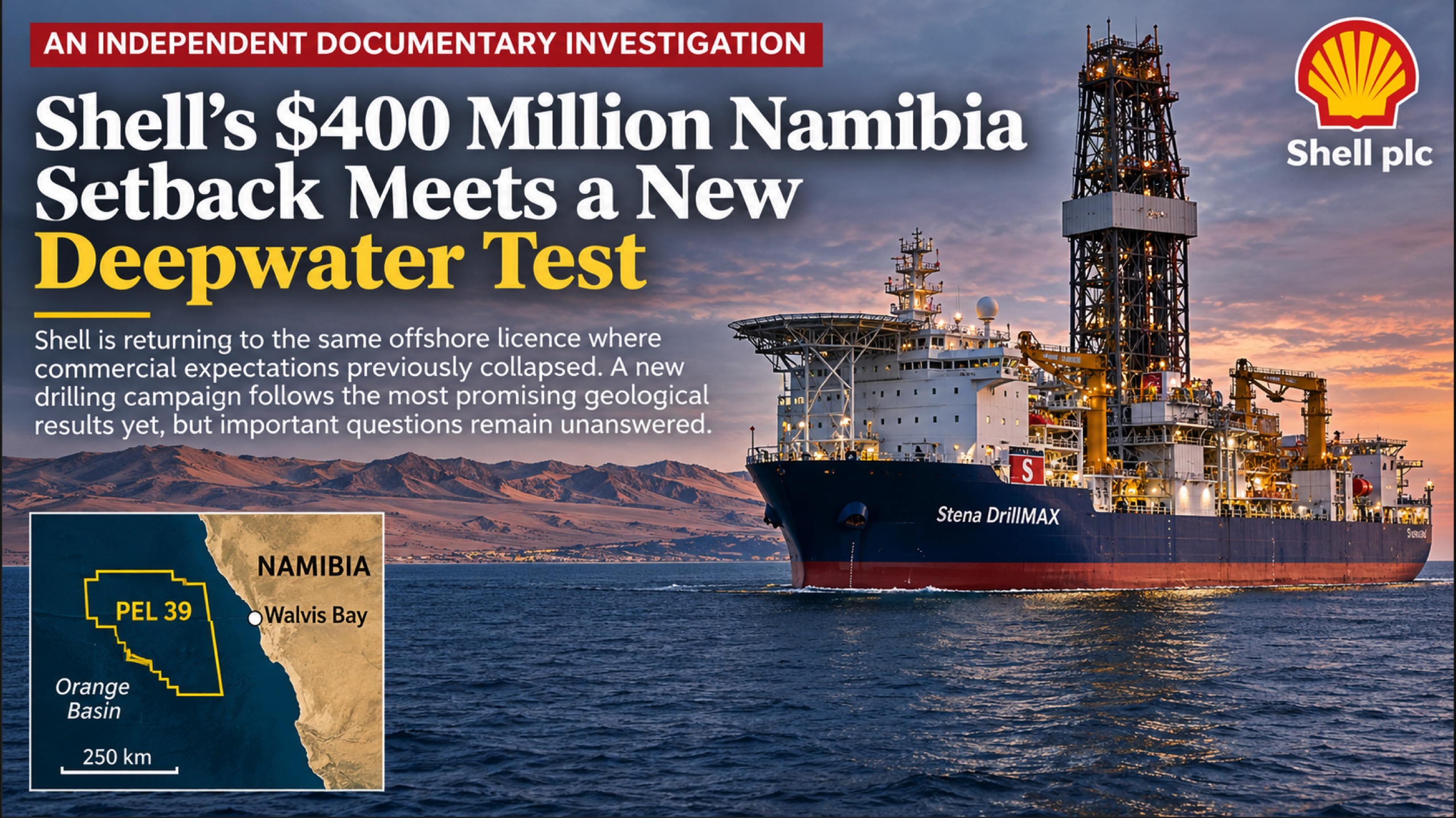
AN INDEPENDENT DOCUMENTARY INVESTIGATION
By the Donovan–Shell Archive
11 November 2026
Researched and drafted with assistance from ChatGPT, using Shell corporate statements, Namibian government and petroleum-company records, published environmental documentation, contemporaneous energy-industry reporting and historical material from the Donovan–Shell Archive.
Shell is returning to the same offshore licence where commercial expectations previously collapsed. A new drilling campaign follows the most promising geological results yet, but important questions about commercial viability, environmental oversight and the benefits to Namibia remain unanswered.
In January 2025, Shell acknowledged a major disappointment in Namibia.
After years of exploration, several hydrocarbon discoveries and considerable international excitement, the company concluded that resources discovered in its offshore Petroleum Exploration Licence 39 could not then be confirmed for commercial development.
Approximately $400 million in exploration expenditure was to be written off.
For a country hoping to establish itself as a significant oil producer, the announcement was an unwelcome reminder that finding hydrocarbons and producing them economically are two very different achievements.
Now Shell is preparing to try again.
On 4 November 2026, Namibian energy publication Mining & Energy reported that Shell was approaching the commencement of another ultra-deepwater drilling campaign using the Stena DrillMAX drillship.
Shell Namibia Country Chair Eduardo Rodriguez Tamayo said that five months of preparation had brought the operation close to drilling readiness.
The development follows the company’s Merlin-1X exploration well, which delivered what Shell described in June as its most promising subsurface results on the licence to date.
The question is whether those results represent a genuine turning point or merely another encouraging discovery that will prove difficult to develop commercially.
Source: Mining & Energy Namibia — Shell prepares to drill new ultra-deepwater well, 4 November 2026.
miningandenergy.com.na+2
The original disappointment: a discovery is not necessarily an oilfield
Shell’s exploration programme in Namibia’s Orange Basin attracted international attention following the Graff discovery in 2022.
Other wells subsequently encountered hydrocarbons, raising hopes that the waters off southern Namibia might contain a commercially attractive new petroleum province.
But the geology presented difficult problems.
The discoveries were located in very deep water, far offshore, and Shell encountered challenges involving reservoir characteristics and the composition of the discovered hydrocarbons.
One particularly important difficulty concerned permeability.
A reservoir may contain substantial quantities of oil while still being difficult to produce economically if the rock does not allow hydrocarbons to flow readily towards production wells.
The presence of associated natural gas can complicate commercial development further, depending on its quantity, composition and the facilities needed to process or transport it.
These are not minor engineering considerations.
They influence the number of wells required, the design of production facilities, development expenditure, operating costs and ultimately whether an investment can generate an acceptable commercial return.
By January 2025, Shell had reached the conclusion that the discovered resources could not then be confirmed for commercial development.
The company planned an exploration write-off of approximately $400 million.
That did not mean that no oil existed. Nor did it mean that every prospect within PEL 39 had been exhausted.
It meant that the particular expenditure and discoveries concerned could no longer be supported on the previously assumed commercial basis.
That distinction is essential to understanding what followed.
Contemporaneous accounts: Reuters reporting reproduced by Mining Weekly, 9 January 2025 and S&P Global Energy’s subsequent examination of Shell’s exploration plans.
Mining Weekly+1
Namibia’s national oil company refused to write off the future
Shell was not the only organisation affected by the disappointing assessment.
The National Petroleum Corporation of Namibia, NAMCOR, is a participant in PEL 39 alongside Shell and QatarEnergy.
On 10 January 2025, NAMCOR issued an official statement concerning the licence.
It acknowledged that the joint venture had already drilled six exploration wells and three appraisal wells.
It also recognised that ultra-deepwater conditions and reservoir complexities remained obstacles.
Nevertheless, NAMCOR maintained that the accumulated geological data indicated continuing hydrocarbon potential and that the partners were evaluating further exploration and appraisal opportunities.
This was an important statement of the Namibian position.
The country’s national petroleum company did not deny the technical difficulties. It argued that the available information still justified further investigation.
That position has now acquired renewed significance.
The 2026 campaign should therefore be viewed not simply as Shell returning to a failed project, but as the continuation of a joint-venture effort to determine whether the licence contains a commercially workable development opportunity.
Primary document: NAMCOR — Position on PEL Block 39, 10 January 2025.
namcor.com.na+1
Merlin-1X: the well that changed the geological outlook
On 9 June 2026, Shell announced encouraging results from Merlin-1X.
The well had begun drilling on 8 April and was the tenth drilled within PEL 39.
According to Shell, it penetrated the Coniacian geological interval and encountered good reservoir quality containing light oil with limited associated gas.
The company described the results as its most promising subsurface findings yet within the licence.
This was a potentially meaningful change from the geological difficulties that had previously undermined commercial expectations.
The composition of the discovered hydrocarbons matters.
Light oil can be commercially attractive, while a lower proportion of associated gas may reduce some of the infrastructure and processing challenges that complicated earlier discoveries.
But the announcement left crucial matters unresolved.
Shell did not disclose a commercially recoverable reserve estimate for Merlin-1X.
It did not announce a final investment decision for an oil development.
Nor did it establish that the new reservoir could support sustained production at a commercially acceptable cost.
The result improved the available geological information.
It did not eliminate the need for further appraisal, engineering studies and economic evaluation.
Shell’s Executive Vice President for Exploration, Strategy and Portfolio, Eugene Okpere, described the results as encouraging while emphasising that the company would continue assessing commercial potential.
That careful language deserves attention.
Shell was not declaring that its Namibian difficulties had been solved.
It was reporting that new evidence justified continuing the investigation.
Primary source: Shell Namibia — Shell advances exploration in Namibia’s Orange Basin with latest well results, 9 June 2026.
Shell Namibia
The new drilling campaign: what is actually confirmed?
The latest development provides evidence that Shell and its partners are moving beyond geological interpretation towards another physical exploration programme.
According to the 4 November report in Mining & Energy, preparations involving the Stena DrillMAX drillship have been completed to the point where drilling is approaching commencement.
The vessel departed Las Palmas in the Canary Islands in October.
Stena Drilling had previously confirmed its voyage to Namibia, with industry reports linking the assignment to Shell’s PEL 39 programme.
Local reporting indicates that the relevant exploration and appraisal window extends from November 2026 into February 2027.
Shell’s country chair has acknowledged the extensive preparations and thanked the Namibian government, joint-venture partners, contractors and employees involved.
There are, however, important limits to what has been publicly established.
The available reports do not identify the precise target of the forthcoming well.
They do not establish whether Shell intends to drill directly into the Merlin discovery, appraise an existing structure or investigate a different prospect.
Nor do the sources reviewed establish that the new well had actually been spudded by 11 November.
It would therefore be premature to describe the drilling campaign as having discovered additional oil.
For now, the confirmed development is operational readiness for another exploration campaign.
Sources: Mining & Energy Namibia, 4 November 2026; Offshore Energy — Stena DrillMAX deployment, 12 October 2026.
miningandenergy.com.na+2
Who owns the licence — and who stands to benefit?
PEL 39 covers approximately 12,000 square kilometres offshore southern Namibia, in waters more than 250 kilometres from the coast.
The ownership structure is straightforward.
Shell operates the licence with a 45% participating interest.
QatarEnergy holds another 45%.
NAMCOR, Namibia’s national petroleum company, holds the remaining 10%.
That gives Namibia a direct participation through its state petroleum company.
However, ownership percentages alone cannot establish the eventual economic benefits to the country.
Those would depend on whether a commercially viable discovery is developed, the applicable fiscal regime, expenditure, production performance, contractual arrangements and the government’s wider revenue entitlements.
No commercial development decision has been announced for PEL 39.
Consequently, projected production revenues should not be treated as secured national income.
The distinction matters because offshore discoveries can generate considerable optimism well before the underlying commercial and engineering questions have been resolved.
Namibia has a legitimate interest in developing its natural resources.
It also has an interest in ensuring that expectations are based on evidence rather than assumptions about future wealth.
Primary source: Shell Namibia — PEL 39 licence and joint-venture information.
shell.com.na
The environmental regulatory record deserves examination
There is another dimension to Shell’s renewed exploration programme.
Deepwater drilling requires environmental assessment, operational safeguards and regulatory oversight.
Namibia’s Ministry of Environment, Forestry and Tourism maintains a public environmental-assessment system containing records of Shell’s applications concerning PEL 39.
One official record relates to a previous application to amend the environmental clearance for exploration and appraisal drilling.
It describes an original authorisation covering up to five wells and a subsequent application to allow up to ten additional exploration or appraisal wells within the established area of interest.
The public project register identifies the amendment application as approved.
Related documentation is preserved by Namibia’s Environmental Information Service, including an environmental assessment amendment report and environmental management material prepared by SLR Environmental Consulting.
These records demonstrate that the regulatory framework and environmental-assessment process have a documentary history extending back several years.
They should not, however, be misrepresented.
The older environmental approval record does not by itself establish the precise conditions applying to the November 2026 drilling campaign.
Nor does a historic environmental clearance demonstrate that every relevant operational requirement has been satisfied for every subsequent well.
Shell’s Namibia country chair has publicly acknowledged government support in meeting regulatory requirements for the latest campaign.
That is evidence of the company’s account of the preparations, not a substitute for examining the actual current approvals.
The appropriate questions are therefore documentary.
What environmental clearances and amendments govern the latest drilling operation?
What conditions apply to well control, waste management, potential discharges and emergency response?
What monitoring and reporting obligations have been imposed?
And how much of the resulting compliance information will be publicly available?
These are legitimate questions concerning accountability for a complex offshore industrial activity.
Their existence does not imply that Shell or its contractors have breached any environmental requirement.
Sources: Namibian environmental assessment register — PEL 39 drilling project; Environmental Information Service — supporting PEL 39 documents; SLR Consulting — Shell PEL 39 seismic environmental-clearance documentation.
eia.meft.gov.na+2
The promise of local employment — and the information still missing
The latest drilling preparations have also been presented as an opportunity for Namibian participation.
Shell’s country chair has acknowledged the involvement of Namibian employees and local suppliers in offshore and shore-based operations.
That is welcome in principle.
Major offshore projects require marine services, logistics, equipment, training, maintenance, accommodation and specialist technical assistance.
Some of that expenditure can support local businesses and develop skills.
But the public reports examined do not establish how many Namibian workers have been employed in the latest campaign, the total value of contracts awarded to Namibian suppliers, or the proportion of expenditure retained within the national economy.
Nor do they provide a quantified account of longer-term employment opportunities arising from PEL 39.
These omissions should not be interpreted as evidence that promised benefits do not exist.
They mean that the benefits cannot yet be measured from the available disclosures.
For a country hoping to develop a new petroleum industry, those distinctions are important.
A drilling campaign can create temporary employment and demand for services without necessarily leading to a producing oilfield.
A producing oilfield, if eventually developed, could generate further benefits, but the scale and distribution of those benefits would depend on arrangements not yet established by the documents examined.
The public-interest issue is not whether Shell should be discouraged from employing Namibians.
It is whether future claims concerning national economic benefits can be independently assessed against disclosed figures.
Source: Mining & Energy Namibia — comments by Shell Namibia Country Chair Eduardo Rodriguez Tamayo.
miningandenergy.com.na
What does the new campaign say about Shell’s wider strategy?
Shell’s continued interest in Namibia is consistent with its wider emphasis on major, potentially competitive oil and gas resources.
The company is prepared to invest in exploration where management believes the available geological evidence justifies additional expenditure.
But the Namibian history demonstrates why that strategy carries uncertainty.
Large companies can possess sophisticated geological expertise, substantial financial resources and extensive offshore engineering experience while still encountering discoveries that fail to meet commercial requirements.
The $400 million write-down was an accounting recognition of that difficulty.
The Merlin-1X results subsequently improved the geological outlook.
The forthcoming drilling campaign represents a further attempt to resolve what remains uncertain.
It is tempting to portray this sequence either as an embarrassing reversal for Shell or as an impressive corporate recovery.
Neither conclusion is yet justified.
The original assessment concerned the commercial viability of resources discovered before Merlin.
The later positive results concern additional geological evidence.
The new drilling programme is intended to generate still more information.
Each development belongs to a different stage of exploration and appraisal.
Further drilling does not automatically reverse a previous impairment.
Nor does a promising reservoir automatically become a commercially recoverable reserve.
The decisive question is whether sufficient evidence ultimately supports a development capable of producing hydrocarbons economically, safely and within the applicable regulatory framework.
That answer has not yet been announced.
DOCUMENTARY FINDINGS
Established by primary corporate and public records
Shell operates Namibia’s PEL 39 with a 45% interest, alongside QatarEnergy with 45% and NAMCOR with 10%.
In January 2025, Shell’s commercial assessment of previously discovered resources resulted in an approximately $400 million exploration write-off.
NAMCOR acknowledged the geological challenges but continued to support evaluation of the licence.
Shell announced encouraging results from Merlin-1X on 9 June 2026, describing it as the most promising subsurface result yet in PEL 39.
Contemporaneous Namibian reporting on 4 November confirmed preparations for a further ultra-deepwater drilling campaign involving Stena DrillMAX.
Public environmental records document earlier assessments and approvals relating to exploration and appraisal activities within the licence.
Established by attributed contemporary reporting, but not independently verified from the underlying operational records
Shell’s Namibia country chair said that five months of preparations had brought the latest campaign close to drilling readiness.
Local workers and suppliers are participating in preparations, although the publicly reported information does not quantify the economic benefits.
Not established by the documents examined
The precise target of the latest well has not been identified.
Commencement of drilling by 11 November 2026 has not been independently confirmed.
No new commercial reserve estimate, final investment decision or production timetable for PEL 39 has been verified.
The specific current environmental-clearance conditions applicable to the latest well have not been independently established from the older public regulatory files.
No evidence examined establishes unlawful conduct, environmental non-compliance or misrepresentation by Shell or its joint-venture partners.
EDITORIAL ANALYSIS: A second chance is not yet a commercial success
Shell’s renewed drilling preparations demonstrate that the company has not abandoned the exploration potential of PEL 39 following its earlier write-down.
That is significant.
An offshore licence that attracted considerable excitement in 2022, suffered a commercial setback in 2025 and produced more encouraging geological evidence in 2026 is entering another consequential stage.
For Shell, the objective is to determine whether additional subsurface evidence can support a commercially attractive opportunity.
For QatarEnergy, the licence represents another element of its international upstream portfolio.
For NAMCOR and Namibia, it represents a possible route towards future petroleum production and associated national economic benefits.
But those interests are not necessarily identical, and none guarantees success.
The test will be whether Shell and its partners can turn encouraging geological results into a credible development proposal supported by demonstrable economics, appropriate environmental safeguards and transparent arrangements for the host country.
The exploration programme is sufficiently important to deserve scrutiny.
It is not sufficiently advanced to justify declaring either victory or failure.
The central finding is therefore straightforward: Shell is preparing to spend more effort evaluating a Namibian licence after recognising a major commercial setback. The new geological evidence explains why it is continuing, but it does not yet establish that an economically viable oilfield has been found.
That is what the next well may help determine.
PRINCIPAL DOCUMENTARY SOURCES
DOCUMENTARY DISCLAIMER
This investigation is based on publicly available corporate announcements, Namibian official records, environmental-assessment documentation and contemporaneous reporting reviewed up to 11 November 2026.
Statements about the forthcoming drilling operation are attributed to identifiable published sources. They do not represent independent confirmation that a new well has commenced drilling or discovered additional commercially recoverable hydrocarbons.
Historical environmental-clearance records are distinguished from the unverified current conditions governing the latest campaign.
Shell plc, Shell Namibia Upstream B.V., QatarEnergy and NAMCOR are separate organisations with their respective roles and responsibilities. References to the joint venture do not imply that every partner exercises the same operational control.
Geological findings, accounting impairments, forecasts and editorial analysis are distinguished from one another.
No allegation is made that Shell, any joint-venture partner, contractor or Namibian authority has acted unlawfully or improperly.
The Donovan–Shell Archive is independent of Shell plc and its subsidiaries. Shell and other interested parties are invited to provide factual corrections, additional documentary material or comments. Substantiated corrections will be considered and reflected fairly.








