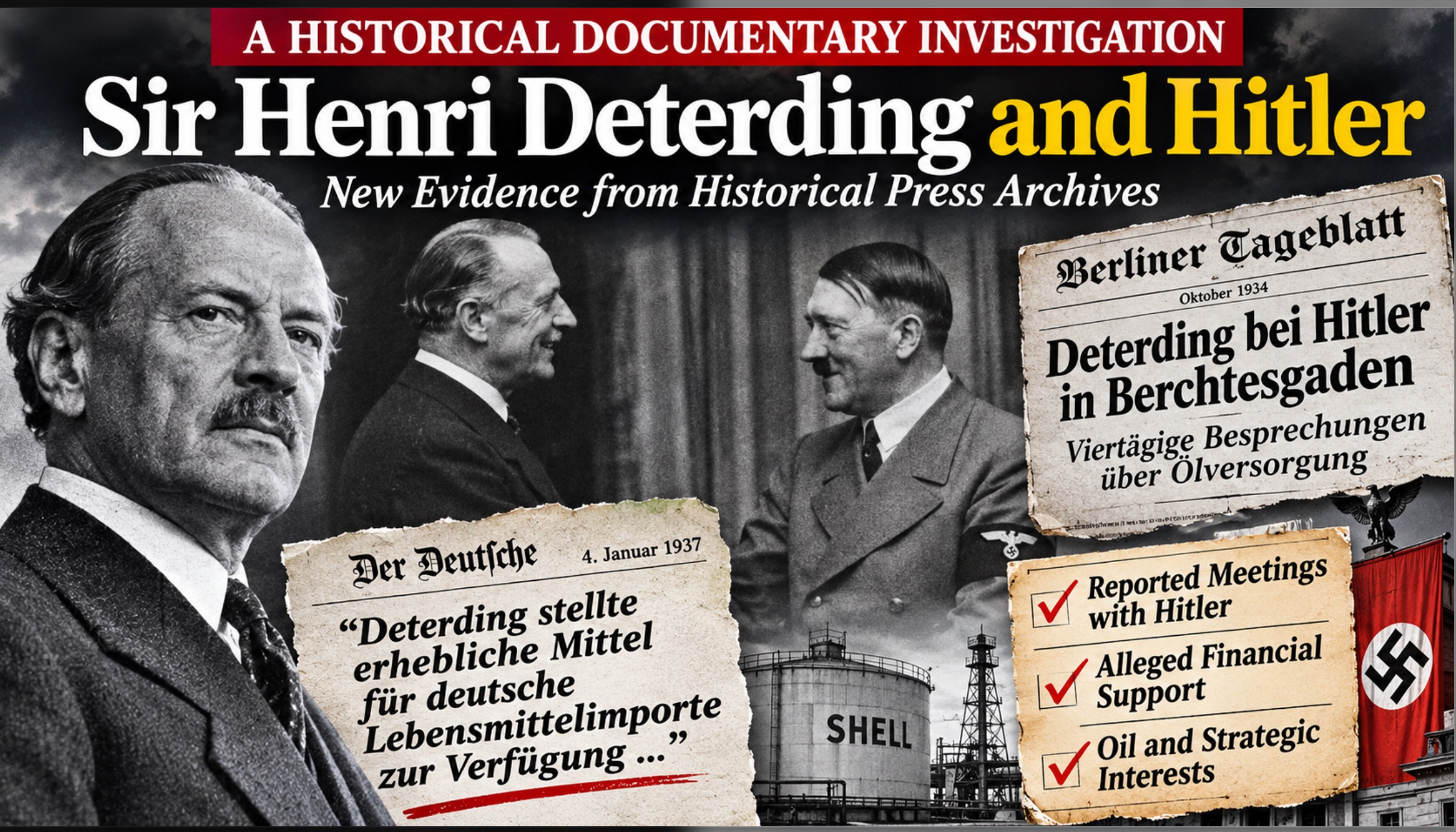
A documented English-language source audit | 15 November 2026
AN INDEPENDENT DOCUMENTARY INVESTIGATION — RESEARCH DOSSIER
By the Donovan–Shell Archive | Researched and drafted with assistance from ChatGPT
EDITORIAL STATUS: Interim source audit, not a complete translation of the ZBW clipping collection. The original ZBW image viewer could not be inspected in this research session. The statements below are based on the independently accessible texts and reproductions specifically identified. Historical allegations are not converted into established facts.
Introduction
Sir Henri Deterding, the former head of Royal Dutch, has a well-documented history of intense anti-communism and increasing sympathy towards Nazi Germany. The critical historical question is not simply whether newspapers linked him to Adolf Hitler, but which alleged meetings, transactions and donations are supported by independent contemporary documentation. Press reports of private negotiations are evidence that claims circulated; they are not themselves proof that a negotiation occurred exactly as described.
The German National Library of Economics (ZBW) retains a dossier of press cuttings relating to Deterding. The Donovan–Shell Archive reproduced many scans in 2018, labelled DOC 1–72 with gaps, and published several preliminary English translations. Not all scans have readable text available in the web-accessible rendition. This audit avoids pretending that a complete translation has been completed.
Main finding: meetings between Deterding and Hitler
March 1933 — an audience request refused
The Shell-commissioned corporate history by historians Joost Jonker and Jan Luiten van Zanden says that Deterding sought an audience with Hitler in March 1933 and was rebuffed. This is a specific claim about March; it does not settle whether Deterding met Hitler subsequently.
Source: A History of Royal Dutch Shell, vol. 1 (2007), pp. 477, 483, as reproduced at https://royaldutchshellgroup.com/wp-content/uploads/2014/03/ShellHistory36P.V1.May2015Comp.pdf
November 1933 — Deterding reportedly claimed a meeting
The same corporate history reports that Deterding said in November 1933 he had recently met Hitler. The historians characterize this as a claim rather than independent confirmation. The statement should therefore be attributed to Deterding until a corroborating meeting diary or official record is located.
Source: A History of Royal Dutch Shell, vol. 1, p. 477; source above
October 1934 — a newspaper alleges a four-day visit
The Daily Gleaner, 29 October 1934, reproduces a London-datelined account saying Deterding had recently visited Hitler at Berchtesgaden for four days to discuss a petroleum-distribution monopoly. It alleges disagreement over first-year oil credit, protected roadside distribution stations and reinvestment of frozen German funds. The report describes negotiations breaking down; it is attributed, not a verified transcript or proof of an agreement. The Donovan–Shell Archive also identifies reporting in the New York Times and Montreal Gazette. These could reflect a syndicated source rather than independent eyewitness corroboration.
Source: The Daily Gleaner report reproduced at https://royaldutchshellplc.com/1934/10/29/sir-henri-deterding-of-royal-dutch-shell-4-day-meeting-with-hitler/
Interpretation
The rejected March 1933 request and alleged October 1934 visit concern different dates, so neither automatically disproves the other. But a published 1934 story cannot, on its own, establish that Deterding met Hitler on the specified occasion or that any monopoly agreement existed. Access to the original diplomatic files, Hitler appointment records and the earliest version of the press dispatch would strengthen the finding.
Source: Comparison of sources above
The most significant newly verified German document
4 January 1937 — Nazi press instruction concerning Deterding
An edited collection of Nazi-era press directives reproduces an instruction dated 4 January 1937, archival identifier ZSg. 101/9/5/Nr. 4. It attributes to Hermann Göring a description of Deterding’s support as a generous foundation. The order states that Deterding had settled in Germany, married a German woman, and made ten million available for importing food because of his admiration for Hitler. It also reports gifts of a large Mecklenburg estate to the Reich Food Estate and a large workers’ settlement in Hamburg. Deterding allegedly did not want public thanks; newspapers were told not to publish further material on him unless the German News Bureau supplied it. These are the claims recorded in the regime’s internal press instruction; the instruction is strong evidence of how Nazi officials represented the assistance, but it is not independent proof of every asserted earlier gift. The currency of the “ten million” is not stated in this particular directive; contemporary reporting described ten million Dutch guilders.
Source: NS-Presseanweisungen der Vorkriegszeit, vol. 5/I (1998), edited by Karen Peter, document 8, printed p. 3. https://api.pageplace.de/preview/DT0400.9783110964158_A31053539/preview-9783110964158_A31053539.pdf
English-language findings from accessible ZBW-related scans
DOC 5 — Frankfurter Zeitung, 27 January 1931
The archive’s existing English rendering describes rumours that Deterding was negotiating a gasoline monopoly in exchange for a $150 million loan. A German report called the claim implausible, while Deterding described his visit as almost entirely private and denied financial negotiations. This clipping is evidence of early rumours and explicit denials, not evidence that such a loan was agreed.
Source: 2018 annotated ZBW scan collection: https://royaldutchshellplc.com/2018/08/01/1930s-german-newspaper-clippings-about-sir-henri-deterding/
DOC 9 — Berliner Tageblatt, 19 September 1934
The archive identifies the headline and subject as Deterding’s claims concerning Soviet-expropriated oilfields. A full English translation of the scanned body is not available in the accessible page text and has not been created here. Its significance lies in the documented continuing prominence of the Soviet oil-property dispute.
Source: Same 2018 annotated ZBW collection
DOC 10 — report of Deterding travelling to Berlin
An existing short translation cites an Agence Économique et Financière report about Deterding travelling to Berlin. A Dutch newspaper reportedly sought confirmation at The Hague and was told that the alleged trip was not known. No meeting with Hitler is established by the available extract. The underlying article date and precise newspaper citation remain to be checked on the scan.
Source: Same 2018 annotated ZBW collection
DOC 15 — Berliner Tageblatt, 30 June 1936
The existing translation reports rumours that Deterding would retire and settle in the Netherlands and that Shell representatives disputed the retirement account. It does not report a Hitler meeting. The wording in the 2018 rendering is imperfect and should be checked against the original before being reissued as a verbatim translation.
Source: Same 2018 annotated ZBW collection
DOC 16 — Deutsche Bergwerks-Zeitung, 16 July 1936
The previously translated article marks the fortieth anniversary of Deterding’s association with Royal Dutch and recounts his commercial strategy, early Asian oil markets, the Asiatic Petroleum Company and competition with Standard Oil. It is biographical and does not independently establish political meetings.
Source: Same 2018 annotated ZBW collection
DOC 72 — French-language retrospective on Deterding
The 2018 archive publishes an English extract characterising Hitler as a defence against Bolshevism from Deterding’s perspective and mentioning visits to Mussolini and Pope Pius XI. This is a retrospective characterisation, not a verified account of meetings with Hitler. The source publication and date should be checked on the original scan.
Source: Same 2018 annotated ZBW collection
Other important sources outside the ZBW dossier
British diplomatic intelligence and the limits of the evidence
The Shell-commissioned corporate history reports that British ambassador Sir Eric Phipps heard in June 1934 that Deterding had promised a year’s supply of products on credit to Germany in an emergency. British Foreign Office specialists doubted the rumour, and the authors found no corroborating records in company archives. They cite Alfred Rosenberg’s diary for a separate May 1934 proposed oil-storage arrangement that ultimately failed. These differentiated claims matter: contemporary diplomatic hearsay, a Nazi official’s diary and proof of a completed contract are different kinds of evidence.
Source: A History of Royal Dutch Shell, vol. 1, pp. 484–485; PDF above
December 1936 — the Dutch food-purchase scheme
Contemporary British and international newspapers reported that Deterding made funds available to buy surplus Dutch agricultural produce for shipment to Germany. A key question is the commercial flow of food and the destination of sale proceeds, not merely whether the scheme was described as charitable. The corporate history states the proceeds went to the Nazi Winterhilfswerk. That constitutes a clearer documented link to Nazi-organised activity than uncorroborated rumours of earlier secret financing.
Source: https://royaldutchshellgroup.com/1936/12/12/news-reports-of-sir-henri-deterding-food-donations-to-nazi-germany/ ; corporate history PDF above
Corporate history offers an important counterpoint
The official company history does not deny Deterding’s pro-Nazi sympathies. It does, however, state that large pre-1933 donations and alleged monopoly-for-cash deals remained unsubstantiated in the archives its authors examined. That position should be represented accurately while comparing it with the independently sourced contemporary press and government directives.
Source: A History of Royal Dutch Shell, vol. 1, pp. 477–485; PDF above
What can safely be deduced
1. Deterding was demonstrably sympathetic to Nazi Germany, particularly from an anti-Bolshevik perspective; the corporate historians also document encounters with senior Nazi officials including Rosenberg and Göring.
2. The 1936 food-purchase arrangement and the January 1937 Nazi press directive provide firmer documentary evidence of material support to Nazi-era German institutions than allegations of earlier clandestine funding.
3. At least one published newspaper account alleges a four-day meeting between Deterding and Hitler in 1934. The evidence examined here is insufficient to confirm that account independently or determine exactly what occurred.
4. A rejected meeting request in March 1933 does not negate a possible meeting later in 1933 or 1934, but reports should not be combined into a categorical claim that multiple meetings have been definitively established.
5. Deterding’s personal financial support must not automatically be described as an authorised corporate donation by Royal Dutch Shell. The persons, legal entities, funds and date of each transaction require individual attribution.
Outstanding work needed for a comprehensive translation edition
The original ZBW folder and its image manifest were not retrievable through the research connection. Therefore the full texts and dates of the remaining labelled entries cannot be established, and this dossier must not be advertised as a translation of all 69 accessible scans. A complete edition would need the original page images supplied in an accessible package or export, then item-by-item transcription, translation, source identification, duplicate checking and copyright clearance where necessary.
Only limited extracts and original commentary are reproduced here. Some historical newspaper articles may remain protected by copyright; hosting the scans publicly does not by itself grant redistribution or full-translation rights. The recommended publication method is to link to originals and provide sourced English summaries unless reproduction rights or public-domain status are confirmed.
Source and corrections policy
Article dates are dates of original source publication wherever established; dates of archive web posts and book editions are separately identified. Contemporary newspaper allegations, official directives, corporate historiography and editorial deductions are labelled separately. Corrections and authenticated alternative records are welcome. The archive is independent of Shell plc and the findings do not constitute a judicial determination of corporate liability.
Principal live sources
ZBW Deterding dossier: https://purl.org/pressemappe20/folder/pe/003922
2018 Donovan–Shell scan index: https://royaldutchshellplc.com/2018/08/01/1930s-german-newspaper-clippings-about-sir-henri-deterding/
1934 Daily Gleaner report: https://royaldutchshellplc.com/1934/10/29/sir-henri-deterding-of-royal-dutch-shell-4-day-meeting-with-hitler/
1937 German press-directives edition: https://api.pageplace.de/preview/DT0400.9783110964158_A31053539/preview-9783110964158_A31053539.pdf
Shell historical volume 1: https://royaldutchshellgroup.com/wp-content/uploads/2014/03/ShellHistory36P.V1.May2015Comp.pdf
International 1936 food-aid news references: https://royaldutchshellgroup.com/1936/12/12/news-reports-of-sir-henri-deterding-food-donations-to-nazi-germany/
*This website and sisters royaldutchshellgroup.com, shellnazihistory.com, royaldutchshell.website, johndonovan.website, shellnews.net, and shellwikipedia.com, are owned by John Donovan - more information here. There is also a Wikipedia segment, the Shell DPA Files, "Shell and the Spies", the Shell Leaks files, the Independent Shell Archive, as well as books written and published by John Donovan - Kindle eBooks. Timeline of the Donovan Shell Feud. Toxic History of Royal Dutch Shell Group. Shell and the Donovans: The Full Media Record — 550+ Articles, 110 Books, 40 Years. *All conjured up by internet wizz, Nick Gill.







