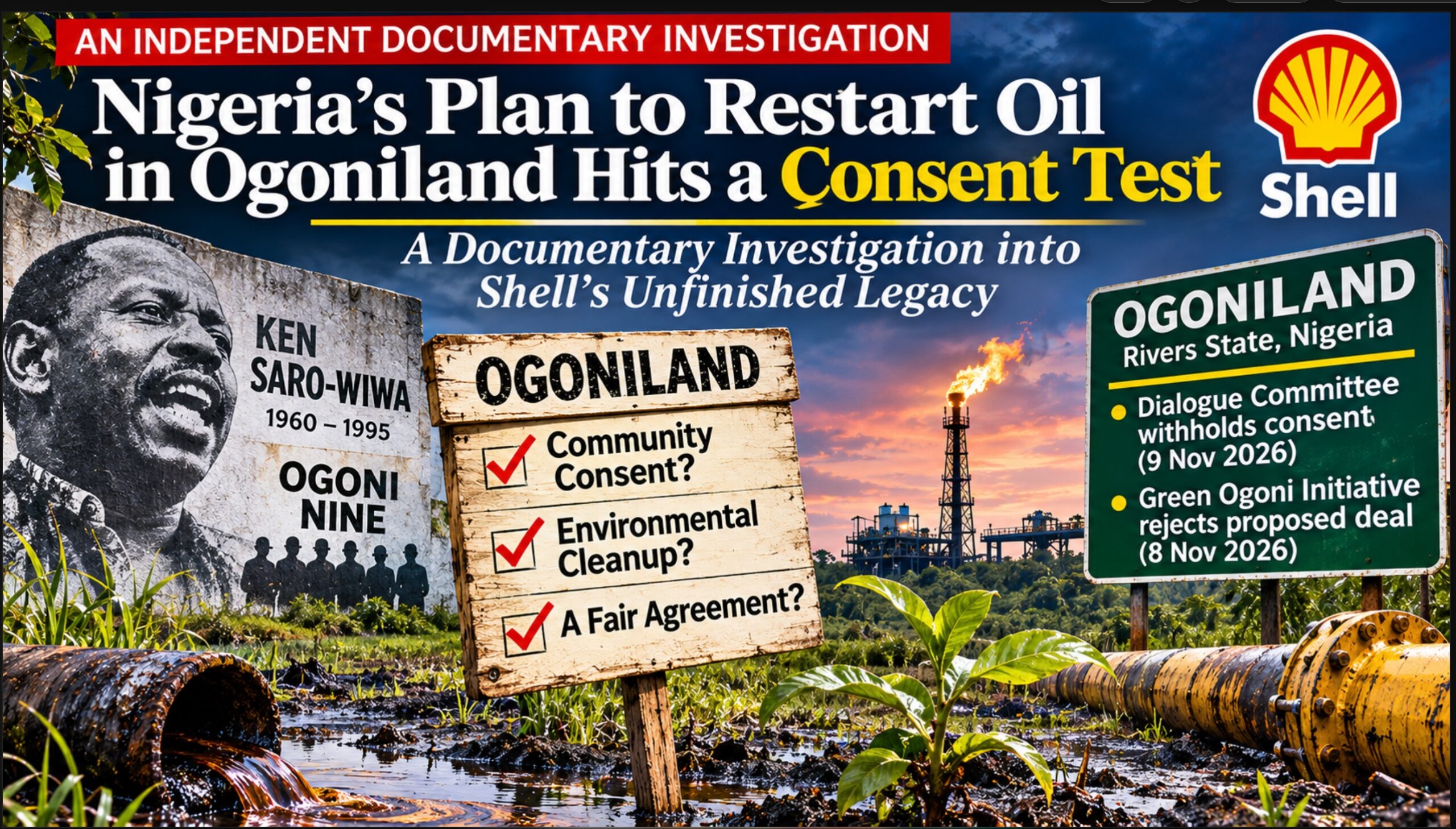
AN INDEPENDENT DOCUMENTARY INVESTIGATION
By the Donovan–Shell Archive
15 November 2026
Researched and drafted with assistance from ChatGPT.
Thirty-one years after the execution of Ken Saro-Wiwa and eight fellow Ogoni campaigners, Nigeria is again attempting to restore petroleum production in Ogoniland. But a committee involved in negotiations with the federal government has refused to sign a proposed agreement without further community consultation. A separate Ogoni organisation has rejected the arrangements more fundamentally. Government statements, recent reporting, Shell’s corporate disclosures and the United Nations’ original environmental assessment reveal why the dispute is about much more than restarting oil wells — and why Shell’s withdrawal from Nigerian onshore production has not erased its historical connection with the controversy.
An agreement that has not yet been agreed
On 9 November 2026, the Ogoni Dialogue Committee held a meeting in Port Harcourt, Rivers State, to consider proposals for the resumption of petroleum operations in Ogoniland.
Thirty-five committee members reportedly attended.
The meeting produced a significant decision.
The committee would not sign the proposed Memorandum of Understanding with the Nigerian federal government until credible community congresses had been held across the four Ogoni local government areas: Eleme, Gokana, Khana and Tai.
The committee’s position was reported by Nigerian newspapers including The Punch and subsequently Premium Times, and by Channels Television.
The King of Eleme, Philip Obele, explained that the committee would not sign until the proposed congresses had taken place under arrangements approved by the committee and organised by elected local government chairmen.
This was more than a routine request for consultation.
It established a condition that the committee itself considered necessary before entering into an agreement over the proposed restoration of petroleum activities.
The government may wish to restart production.
Some committee members support that objective.
But the latest meeting demonstrates that support for the general objective is not equivalent to approval of the particular agreement.
Contemporary reporting: The Punch, 10 November 2026 — Oil resumption: Ogoni leaders demand consent, FG action.
See also Premium Times, 11 November 2026 — Ogoni leaders withhold consent for oil resumption.
Punch Newspapers+1
The government’s earlier declaration of progress
The November decision deserves particular attention when compared with the government’s own earlier statements.
On 26 September 2025, the Nigerian National Petroleum Company Limited published an official statement concerning the proposed re-entry into Ogoniland.
The announcement followed the presentation of a report by the Presidential Committee on Ogoni Consultations.
President Bola Tinubu acknowledged the suffering experienced by the Ogoni people.
NNPC Group Chief Executive Officer Bashir Bayo Ojulari described the development as a historic opportunity for reconciliation and national progress.
The statement presented the proposed return as a means of combining petroleum development with environmental protection, infrastructure improvements and community benefits.
NNPC also credited the National Security Adviser, Nuhu Ribadu, and the presidential consultation committee chaired by Professor Don Baridam with helping establish the framework for dialogue.
The company emphasised that restarting operations would require collaboration with affected communities.
Those were important public commitments.
They were not, however, proof that every Ogoni community had approved a final agreement.
Nor did the September statement establish that commercial oil production had actually resumed.
The distinction matters.
A government announcement celebrating progress towards reconciliation is not the same thing as an executed agreement accepted by the affected communities.
The November committee decision now provides evidence that significant questions concerning consent and implementation remain unresolved.
Primary source: NNPC Ltd, 26 September 2025 — Ogoni Re-entry is a Beacon of Reconciliation through Collaboration.
NNPC
The Ogoni Dialogue Committee is not simply rejecting oil production
It would be inaccurate to interpret the committee’s November decision as unanimous opposition to petroleum development.
The publicly reported statements indicate a more complicated position.
Rev. Monsignor Pius Kii, a senior committee participant and Judicial Vicar of the Catholic Diocese of Port Harcourt, explained that the committee supported the government’s efforts to resume petroleum activities for the benefit of Nigeria and the Ogoni people.
The committee also intended to continue harmonising the proposed Memorandum of Understanding.
Local government chairmen had been instructed to engage communities before the proposed congresses.
According to the reporting, progress had already been made on those consultations.
The committee therefore appears to be attempting to establish a process through which an agreement could acquire sufficient legitimacy to proceed.
That is materially different from announcing that petroleum production must never resume.
The position can be summarised accurately:
The committee supports continued negotiations and, according to its representatives, supports the objective of restarting petroleum operations.
It does not consider the proposed agreement ready for signature.
It wants further community approval before proceeding.
Whether that approval can be obtained remains unknown.
Nor have the publicly examined reports established precisely how the congresses will be organised, who will participate, how decisions will be recorded or whether each area must approve the same terms.
Those details will matter if the process is to provide a credible foundation for any eventual agreement.
A separate Ogoni organisation rejects the proposed compromise
The Dialogue Committee is not the only organisation claiming to represent Ogoni interests.
On 8 November 2026, the Green Ogoni Initiative, describing itself as a grassroots movement involving Ogoni people in the diaspora, issued a public statement rejecting the proposed resumption arrangements.
The statement was published by Newspot Nigeria under the title:
Ogoni Rejects Dialogue Committee’s Compromise — Green Ogoni Initiative.
The organisation questioned the legitimacy of the consultation process and argued that the proposed arrangements failed to respect the Ogoni people’s right to determine their future.
It also raised concerns about the absence of an adequate environmental impact assessment.
The Green Ogoni Initiative’s position is materially more critical than that expressed by members of the Dialogue Committee following the 9 November meeting.
While the committee supports continued negotiations and proposes community congresses, the Green Ogoni Initiative challenges the underlying terms and credibility of the proposed compromise.
These differences should not be concealed.
The Ogoni people are not represented by a single organisation holding one uncontested position.
Their communities include individuals and organisations with different views about petroleum development, environmental restoration, compensation, economic opportunity and political representation.
An investigation that treats one committee’s statements as the settled view of every Ogoni resident would risk reproducing precisely the problem that the consultation process is supposed to address.
There is also a necessary evidentiary qualification.
The Green Ogoni Initiative’s published statement contains additional accusations concerning financial inducements and the conduct of committee members.
Those accusations have not been independently substantiated by the documents examined for this investigation.
They are therefore not adopted as findings of fact.
Similarly, the organisation’s concern about environmental impact assessment deserves examination, but the material reviewed does not establish whether every assessment required for a particular future petroleum development has or has not been completed.
The proper investigative questions concern the existence, scope, publication and adequacy of the relevant environmental documentation.
They cannot responsibly be answered by treating an allegation as a regulatory finding.
Why the Shell connection remains fundamental
At first sight, a dispute involving the Nigerian government and present-day Ogoni representatives might appear to be principally a Nigerian political and economic issue.
That is partly correct.
But Ogoniland’s modern petroleum history cannot be understood without reference to Shell.
Shell’s operations helped establish Nigeria’s petroleum industry, and the company’s former Nigerian subsidiary, the Shell Petroleum Development Company of Nigeria, became central to controversies concerning pollution, operating practices, community relations and responsibility for environmental damage.
Petroleum production in Ogoniland was halted in 1993 amid protests over the environmental and social consequences of oil extraction.
The subsequent execution of Ken Saro-Wiwa and eight other Ogoni campaigners by Nigeria’s military government on 10 November 1995 became an internationally recognised symbol of the struggle over oil, human rights and corporate accountability.
Shell has consistently denied responsibility for the executions.
In 2009, the company settled litigation brought in the United States concerning alleged involvement in human-rights abuses without admitting liability.
These historical events must be distinguished from the current negotiations.
The Nigerian government conducted the executions.
The existence of serious historical allegations against Shell does not mean that every allegation was judicially established.
But the controversy surrounding Shell’s former operations remains central to understanding why renewed petroleum production is such a sensitive issue.
The present dispute cannot be reduced to a disagreement over how quickly an oilfield should reopen.
It concerns whether the legacy of earlier petroleum operations has been adequately addressed and whether affected communities trust the arrangements now being proposed.
Shell has sold SPDC — but OML 11 requires a more precise explanation
An important development in Shell’s Nigerian operations occurred on 13 March 2025.
Shell completed the sale of its former onshore subsidiary, SPDC, to the Renaissance consortium.
The company was subsequently renamed Renaissance Africa Energy Company.
Shell’s official announcement confirmed that the transaction transferred its former subsidiary and the associated interest in the SPDC joint venture.
The new owner assumed the operating role previously carried out through SPDC.
Shell emphasised that it was redirecting its Nigerian investment towards deepwater petroleum production and integrated gas activities.
Those corporate facts are established.
Primary source: Shell, 13 March 2025 — Completion of sale of SPDC to Renaissance.
But a potentially important distinction has emerged from more detailed research into the Nigerian petroleum leases.
A lease-by-lease investigation published on 2 November 2026 by Africa Energies Report, an initiative of the African Petroleum Producers’ Organization, identifies Oil Mining Lease 11 as having a distinct operating history.
The report states that OML 11, which covers Ogoniland, did not pass to Renaissance as part of the wider former-SPDC portfolio.
It identifies NNPC Exploration and Production as the operator, following the earlier dispute over Shell’s entitlement to renew the lease.
The report also notes that although production in Ogoniland has been suspended since 1993, this should not be confused with the absence of all petroleum production throughout OML 11. It identifies the Otakikpo marginal field elsewhere within the lease area as having produced since 2017.
This is an important geographical and legal distinction.
The history of Shell’s former Nigerian subsidiary, the transfer of its other assets to Renaissance and the operating arrangements governing the particular Ogoni resources are related subjects.
They are not necessarily identical.
The underlying OML 11 licence and latest regulatory register have not been independently examined for this article. Consequently, the lease-specific findings are attributed to the published industry research rather than presented as a new legal determination by this archive.
Supporting source: Africa Energies Report, 2 November 2026 — The Great Handover: Who Now Runs Nigeria’s Major Oil Fields, Lease by Lease.
Africa Energies Report
The practical implication is clear.
It would be misleading to suggest that Shell plc is presently negotiating the Ogoni Memorandum of Understanding as the current operator of the proposed restarted production.
The available evidence identifies the Nigerian authorities and Ogoni representatives as the parties conducting the present dialogue.
Shell’s connection is overwhelmingly historical, while separate questions concerning legacy environmental obligations and litigation remain relevant.
That distinction does not make Shell’s earlier activities irrelevant.
It makes accurate attribution of present-day responsibility essential.
The United Nations established the environmental consequences
Any proposal to restore oil production in Ogoniland must be considered against the findings of the United Nations Environment Programme.
In 2011, UNEP published its landmark Environmental Assessment of Ogoniland.
The study was based on extensive fieldwork examining soil, groundwater, surface water, ecosystems, industrial practices and public-health risks.
The scale of the investigation was extraordinary.
UNEP examined more than 200 locations, reviewed over 5,000 medical records, surveyed 122 kilometres of pipeline rights of way and engaged thousands of residents.
More than 4,000 environmental samples were analysed.
The findings documented serious contamination.
At Nisisioken Ogale, investigators discovered benzene contamination in drinking-water wells at levels exceeding 900 times the World Health Organization guideline.
Hydrocarbons were found at substantial depths underground.
The investigation also documented damage to mangroves and other ecosystems, and identified pollution resulting from several sources, including petroleum infrastructure and illegal refining activities.
UNEP concluded that comprehensive environmental restoration could take 25 to 30 years.
It recommended urgent interventions to protect human health and substantial long-term investment in environmental remediation.
This was not simply an allegation advanced by campaigners.
It was the result of an independent scientific assessment undertaken by a United Nations body.
Its findings did not establish the legal responsibility of every individual company for every spill.
Nor did the report determine the exact legal obligations attached to any future petroleum development.
But it established an authoritative environmental baseline against which subsequent restoration claims and development proposals can be assessed.
Primary sources: UNEP — Environmental Assessment of Ogoniland, 2011 and UNEP — Executive Summary and Recommendations.
WeDocs+1
Ten years of cleanup efforts — and the question of what remains unfinished
Nigeria has not entirely ignored the UNEP recommendations.
The Hydrocarbon Pollution Remediation Project, HYPREP, has undertaken environmental restoration activities across parts of Ogoniland.
In September 2026, during events marking the tenth anniversary of the Ogoni Cleanup Programme, the Nigerian government announced further work on shoreline remediation, mangrove restoration and community infrastructure.
The government also disclosed plans for a new five-year strategic programme covering 2026 to 2031.
Minister of Environment Balarabe Lawal emphasised the importance of completing outstanding work and protecting areas where restoration had already been undertaken.
HYPREP Project Coordinator Professor Nenibarini Zabbey reported that programme activities had supported employment and training opportunities for thousands of Ogoni residents.
He also cited encouraging signs of ecological recovery in some restored areas.
These statements should be acknowledged fairly.
Environmental restoration is a long-term undertaking, and progress in individual locations can be meaningful even where other sites remain contaminated.
But government-reported progress should not be confused with independent verification that the entire Ogoni environment has been restored.
The government itself has identified outstanding and more complex restoration tasks.
That makes the relationship between cleanup and renewed petroleum development particularly important.
If additional extraction is contemplated, communities may reasonably seek evidence concerning the condition of the environment, the management of future spills, monitoring arrangements and the funding of any further remediation.
Source: Voice of Nigeria, 7 September 2026 — HYPREP Begins Five-Year Strategic Plan for Ogoni Cleanup.
Voice of Nigeria
The environmental impact assessment question
The Green Ogoni Initiative’s concerns raise a specific documentary issue.
What environmental impact assessment has been prepared for the proposed restoration of petroleum operations?
The answer cannot be established merely by observing that UNEP conducted its assessment in 2011.
The UNEP report is an authoritative investigation of historical contamination and the need for restoration.
It is not automatically equivalent to a project-specific assessment addressing the engineering works, infrastructure, production methods and environmental risks of a proposed new development.
The age and condition of infrastructure would also be relevant to an assessment of operational risk.
So would the potential for future leaks, accidental releases, illegal connections and other forms of contamination.
However, the precise legal requirements depend on the proposed activity and the applicable Nigerian regulatory framework.
A reopened existing well, a newly drilled well, a replacement pipeline and a substantially redesigned production facility may raise different approval questions.
No authenticated, complete project-specific assessment corresponding to the proposed agreement has been located in the public sources examined for this article.
That does not prove no such assessment exists.
It establishes a need for disclosure and clarification.
The Nigerian authorities should be able to identify the specific project being considered, the relevant approvals and the environmental documents supporting them.
Any eventual agreement should be examined against those records.
The road that has become part of the oil negotiations
There is another revealing aspect of the November committee meeting.
Members expressed concern about the suspension of previously agreed confidence-building projects.
Particular attention was directed towards the Eleme section of the East-West Road.
Professor Innocent Barikor, a member of the Dialogue Committee, urged the federal government to resume work.
The concern was not presented simply as a complaint about transport infrastructure.
Committee representatives linked the road project to public confidence in the government’s willingness to honour commitments.
That connection is significant.
An agreement concerning petroleum development may involve promises about roads, employment, water supply, health services and other community benefits.
Such commitments can be important to local residents independently of the value of any oil produced.
But they create questions about implementation and accountability.
Who is responsible for delivering the projects?
Are completion dates specified?
Are budgets secured?
What happens if an agreed project is delayed?
Are community benefits enforceable commitments or expressions of policy intention?
The November committee statements indicate that these matters are already affecting confidence in the negotiations.
The credibility of the proposed petroleum agreement may therefore depend partly on the delivery of infrastructure commitments made before production resumes.
That is an issue of governance and public accountability, not merely petroleum economics.
What is meant by community consent?
The phrase community consent is central to the present controversy.
But it must be used carefully.
The Ogoni Dialogue Committee has demanded community congresses before it signs the proposed agreement.
That is a reported position taken by the committee.
It is not, by itself, a judicial determination of the precise legal requirements for authorising petroleum operations under Nigerian law.
Nor can it be assumed that the committee’s proposed congresses will necessarily resolve every disagreement among Ogoni organisations.
A credible process would need to address who participates, whether dissenting organisations can present their objections, how the proposed agreement is disclosed and how competing views are recorded.
The distinction between consultation and consent is important.
A consultation may allow residents to express views without requiring approval of the final proposal.
A consent process implies a more consequential role for community agreement.
The legal effect of any particular process depends on the relevant law and the arrangements actually adopted.
The available public reporting does not establish that the proposed congresses will have the force of a legally binding referendum.
Nor does it demonstrate that their procedures have been finalised.
What can be established is that the Dialogue Committee has made these congresses a condition of signing the proposed Memorandum of Understanding.
Whether that condition will be satisfied remains to be seen.
What the original agreement could reveal
The most important missing document is the proposed Memorandum of Understanding itself.
Its precise terms would allow an independent assessment of the arrangements being offered to the Ogoni communities.
Several matters would deserve particular scrutiny.
The document should identify the entities expected to conduct petroleum operations and the legal basis for their involvement.
It should explain how community benefits are to be determined and administered.
It should distinguish government-funded infrastructure commitments from obligations placed on commercial petroleum operators.
It should clarify the arrangements for environmental monitoring, damage prevention, remediation and compensation.
And it should establish how affected communities will participate in decisions once any agreement has been signed.
Without the complete text, it is impossible to determine whether the agreement addresses these issues satisfactorily.
Nor should claims about particular financial percentages or payments be adopted without the relevant documentary evidence.
The absence of a publicly examined final text is especially consequential when different Ogoni organisations disagree about the legitimacy of the negotiating process.
Independent scrutiny requires access to the actual terms, not merely competing accounts of what those terms may contain.
Shell’s response to its Nigerian environmental legacy
Shell has defended its historical conduct in the Niger Delta.
On its current corporate website, the company maintains that oil theft, sabotage and illegal refining have caused extensive pollution.
It argues that criminal interference by third parties has been a major factor in the operational difficulties faced by its former Nigerian subsidiary.
The company also points to its participation in cleanup programmes and its cooperation with Nigerian authorities.
Following the sale of SPDC, Shell states that Renaissance retained the former subsidiary’s operating capabilities and responsibilities within the transferred joint venture.
These positions are relevant to the documentary record.
They should not be omitted simply because environmental organisations dispute Shell’s conclusions.
Source: Shell — What Are Shell’s Activities in Nigeria?.
Shell Global
There is also continuing litigation in the English courts involving Shell’s historical Nigerian operations.
The Bille and Ogale claims raise contested questions concerning pollution, the responsibilities of the former Nigerian subsidiary and the potential liability of Shell plc.
Those proceedings are distinct from the current Ogoni petroleum negotiations.
The Donovan–Shell Archive has previously examined the relevant High Court judgments, including the decision delivered in September 2026 concerning amended claims and contested allegations about earlier witness evidence.
The litigation has not established every allegation advanced against Shell.
Nor does Shell’s completion of its Nigerian onshore divestment automatically determine the outcome of those proceedings.
The appropriate distinction is between the company’s former commercial ownership, its present business activities, responsibilities assumed by successor entities and liabilities that may still be disputed in court.
Each requires separate evidence.
Thirty-one years after the Ogoni Nine
The timing of the present dispute is particularly significant.
On 10 November 2026, the thirty-first anniversary of the execution of Ken Saro-Wiwa and eight other Ogoni campaigners passed.
The anniversary came one day after the Dialogue Committee’s decision to require community congresses before signing the proposed agreement.
It also followed the Green Ogoni Initiative’s public rejection of the proposed compromise.
That sequence is historically resonant.
The original Ogoni struggle was never exclusively about the immediate financial value of the area’s petroleum.
It concerned environmental protection, political representation, community rights and the consequences of industrial activity.
Those subjects remain relevant to the current negotiations.
But historical remembrance should not be used to assume that all present-day Ogoni residents hold identical views about their economic future.
Some may support renewed production subject to enforceable safeguards and substantial community benefits.
Others may oppose it because of the environmental legacy and lack of confidence in the authorities.
Others may support development in principle while rejecting the negotiating process or the terms currently proposed.
A documentary investigation should allow those differences to emerge from the evidence.
The sacrifice of the Ogoni Nine is an essential part of the history.
It is not a substitute for examining what today’s communities are being asked to approve.
The Donovan–Shell Archive’s historical interest
On 8 November 2026, the Donovan–Shell Archive announced its intention to prepare a dedicated series entitled The Ogoni Files.
That project will examine the historical documentary record concerning Shell, the Ogoni Nine, environmental controversies, litigation, security issues and the long search for accountability.
It will also consider historical correspondence and materials preserved through the archive’s contact with Ogoni campaigners and individuals connected with the litigation.
The present investigation is separate from that archival research.
It is based on publicly accessible contemporary reporting, corporate disclosures, official Nigerian statements and the original UNEP assessment.
Unexamined private correspondence, historical allegations and trial recordings have not been treated as verified evidence for this article.
That separation is important.
The future Ogoni Files series may produce additional historical findings.
The current negotiations require scrutiny in their own right, on the basis of the evidence now available.
Related archive publication: Coming Soon: The Ogoni Files — A New Independent Documentary Investigation into Shell, the Ogoni Nine and the Long Search for Justice, 8 November 2026.
DOCUMENTARY FINDINGS
Established by official corporate and institutional records
Shell completed the sale of its Nigerian onshore subsidiary SPDC to Renaissance in March 2025.
Shell continues to operate other businesses in Nigeria, particularly deepwater petroleum and integrated gas.
NNPC publicly promoted its proposed Ogoni re-entry programme in September 2025 and linked it to reconciliation, infrastructure, community participation and petroleum development.
UNEP’s 2011 assessment established severe historical environmental contamination in parts of Ogoniland and recommended extensive long-term restoration.
The Nigerian government has subsequently undertaken cleanup activities and announced further restoration plans.
Established by attributable contemporary reporting
The Ogoni Dialogue Committee decided on 9 November 2026 not to sign the proposed Memorandum of Understanding before community congresses had been held.
The decision followed a meeting involving 35 committee members.
The committee supports continued negotiations and has expressed support for the objective of renewed petroleum activities, subject to the consultation process.
Committee representatives identified concerns about outstanding infrastructure commitments, particularly work on the Eleme section of the East-West Road.
The Green Ogoni Initiative separately issued a statement on 8 November rejecting the proposed arrangements.
Important ownership distinction
Recent industry research identifies OML 11 as having a different ownership and operating history from the assets transferred to Renaissance in the wider SPDC divestment.
This finding warrants examination against the current official petroleum licence records before any definitive legal conclusion is drawn.
Allegations and positions not independently established
The Green Ogoni Initiative’s criticisms of the proposed agreement are attributed to that organisation.
Its claims about financial inducements are not independently substantiated.
The assertion that an adequate environmental impact assessment is absent remains a matter requiring verification against the relevant regulatory records.
No complete, authenticated version of the proposed Memorandum of Understanding has been examined for this article.
The reporting does not establish that all Ogoni communities have rejected renewed petroleum development.
Nor does it establish that the government has obtained consent through the proposed congresses.
Editorial conclusion
The current negotiations demonstrate that the Nigerian government’s objective of restarting petroleum operations has not yet been translated into an uncontested agreement with the Ogoni communities.
The most consequential unresolved questions concern the legitimacy of consultation, the terms of any eventual agreement, the adequacy of environmental safeguards and the delivery of government commitments.
These questions arise within a historically significant petroleum-producing region whose environmental and human-rights controversies remain closely associated with Shell’s earlier operations.
CONCLUSION: THE OIL MAY REMAIN, BUT AGREEMENT CANNOT BE ASSUMED
Nigeria’s effort to restore petroleum production in Ogoniland has entered another important stage.
The government has identified economic and developmental reasons for proceeding.
NNPC has presented the initiative as an opportunity for reconciliation and renewed investment.
Members of the Ogoni Dialogue Committee have indicated support for continued negotiations.
Yet the committee has now refused to sign the proposed agreement until community congresses have been held.
A separate organisation has rejected the proposed compromise more fundamentally.
The government’s confidence in its earlier consultations has therefore not resolved the dispute over legitimacy and consent.
The historical background explains why this matters.
Shell’s former operations became inseparable from decades of environmental controversy and demands for accountability.
The United Nations subsequently documented severe environmental contamination requiring sustained restoration.
The Nigerian government has made progress on some cleanup initiatives while acknowledging that further work remains.
Shell has sold its former onshore subsidiary.
But the transfer of corporate ownership has not removed the need to address the environmental and social consequences of the industry’s history.
Nor has it resolved every disagreement concerning the future of petroleum operations in Ogoniland.
The decisive question is no longer simply whether Nigeria wants the oil to flow again. It is whether the proposed arrangements can withstand scrutiny by the people expected to live with their consequences.
The November committee decision establishes that the answer has not yet been settled.
An agreement may eventually be reached.
It may provide substantial economic benefits.
It may also include environmental obligations and safeguards that communities consider adequate.
But those possibilities must be demonstrated through the actual terms, approvals and implementation arrangements.
They cannot be assumed from government announcements or expressions of support from selected representatives.
For the Donovan–Shell Archive, the documentary obligation is to follow the evidence.
That means acknowledging Shell’s historical involvement without incorrectly presenting the company as the current negotiating operator.
It means recognising the government’s restoration work without declaring the environmental crisis resolved.
And it means respecting the different positions expressed by Ogoni organisations rather than choosing one to speak for the entire population.
Thirty-one years after the Ogoni Nine were executed, the future of petroleum operations in Ogoniland remains contested.
The latest evidence shows that community legitimacy is now a central condition of the proposed return.
Whether the Nigerian government can secure it remains an open question.
PRINCIPAL DOCUMENTARY SOURCES
1. Nigerian National Petroleum Company Limited — 26 September 2025
Ogoni Re-entry is a Beacon of Reconciliation through Collaboration
Official government-owned petroleum company statement outlining the rationale for re-entry, the consultation process and proposed community commitments.
2. The Punch — 10 November 2026
Oil resumption: Ogoni leaders demand consent, FG action
Contemporaneous reporting of the 9 November Dialogue Committee meeting, including attributable statements concerning community congresses, the proposed agreement and infrastructure commitments.
3. Premium Times — 11 November 2026
Ogoni leaders withhold consent for oil resumption, demand community congresses
Additional contemporary account, providing background on the federal government’s negotiations and statements from committee representatives.
4. Green Ogoni Initiative — Statement published 8 November 2026
Ogoni Rejects Dialogue Committee’s Compromise
Published advocacy statement providing a contrasting Ogoni position. Its allegations are attributed and not treated as independently established findings.
5. United Nations Environment Programme — 2011
Environmental Assessment of Ogoniland
Original independent environmental assessment establishing the historical contamination, public-health risks and long-term restoration requirements.
6. Shell plc — 13 March 2025
Shell Completes Sale of SPDC to Renaissance
Primary corporate announcement establishing the completion of Shell’s Nigerian onshore subsidiary divestment and its remaining business priorities.
7. Africa Energies Report — 2 November 2026
The Great Handover: Who Now Runs Nigeria’s Major Oil Fields, Lease by Lease
Recent industry research distinguishing OML 11 from the wider Renaissance acquisition and examining the operating arrangements associated with former international-major petroleum assets.
8. Voice of Nigeria — 7 September 2026
HYPREP Begins Five-Year Strategic Plan for Ogoni Cleanup
Reporting of the Nigerian government’s latest restoration programme, including official statements concerning achievements and outstanding work.
9. Shell plc — Current Nigerian operations and environmental position
What Are Shell’s Activities in Nigeria?
Shell’s explanation of its historical operations, sale of SPDC, remaining Nigerian businesses and position concerning environmental responsibility.
10. Donovan–Shell Archive — 8 November 2026
Earlier archive announcement providing context for the forthcoming historical documentary investigation.
DOCUMENTARY DISCLAIMER
This article is an independent documentary investigation into current proposals to resume petroleum operations in Ogoniland, Nigeria, and the historical connection of those proposals with Shell’s former Nigerian onshore activities.
The investigation is based on official statements from NNPC and Shell, the United Nations Environment Programme’s published environmental assessment, identifiable Nigerian media reporting, published statements attributed to Ogoni organisations and recent industry research.
The 9 November 2026 Ogoni Dialogue Committee decision is supported by contemporary reporting. The complete committee minutes and signed resolutions have not been independently obtained.
The proposed Memorandum of Understanding with the Nigerian government has not been examined in authenticated final form. Its complete financial, environmental, operational and governance provisions are therefore not established by this investigation.
The views of the Green Ogoni Initiative are attributed to that organisation. Unsubstantiated allegations concerning financial inducements, misconduct or other improper behaviour are not treated as facts.
Statements concerning environmental impact assessment distinguish the organisation’s criticisms from independently verified regulatory findings.
The 2011 UNEP assessment is a historical scientific investigation. It is not presented as a current assessment of every affected location or as a determination of liability for individual historical spills.
Shell’s sale of SPDC to Renaissance in March 2025 is established by the company’s corporate disclosures. The more specific operating status of OML 11 is attributed to identified industry research pending examination of the current official lease record.
No allegation is made that Shell plc is presently conducting the Ogoni negotiations as the operator of the proposed restarted petroleum development.
Historical allegations concerning Shell and the Nigerian military regime, pollution, human-rights abuses and the Ogoni Nine are distinguished from established events and relevant legal outcomes.
The article does not make a finding that Shell, Renaissance, NNPC, the Ogoni Dialogue Committee, any Ogoni organisation or any individual has acted unlawfully in connection with the current negotiations.
The Donovan–Shell Archive welcomes factual corrections, authenticated documents and responses from Shell plc, NNPC, Renaissance, the Ogoni Dialogue Committee, the Green Ogoni Initiative, Nigerian regulatory authorities and other affected representatives.
Substantiated corrections and additional evidence will be considered fairly.
This publication is documentary reporting and analysis, not legal advice or an adjudication of liability.








