AN INDEPENDENT DOCUMENTARY INVESTIGATION
By the Donovan–Shell Archive
16 November 2026
Introduction: A Warning Inside Shell Before Its Official History Appeared
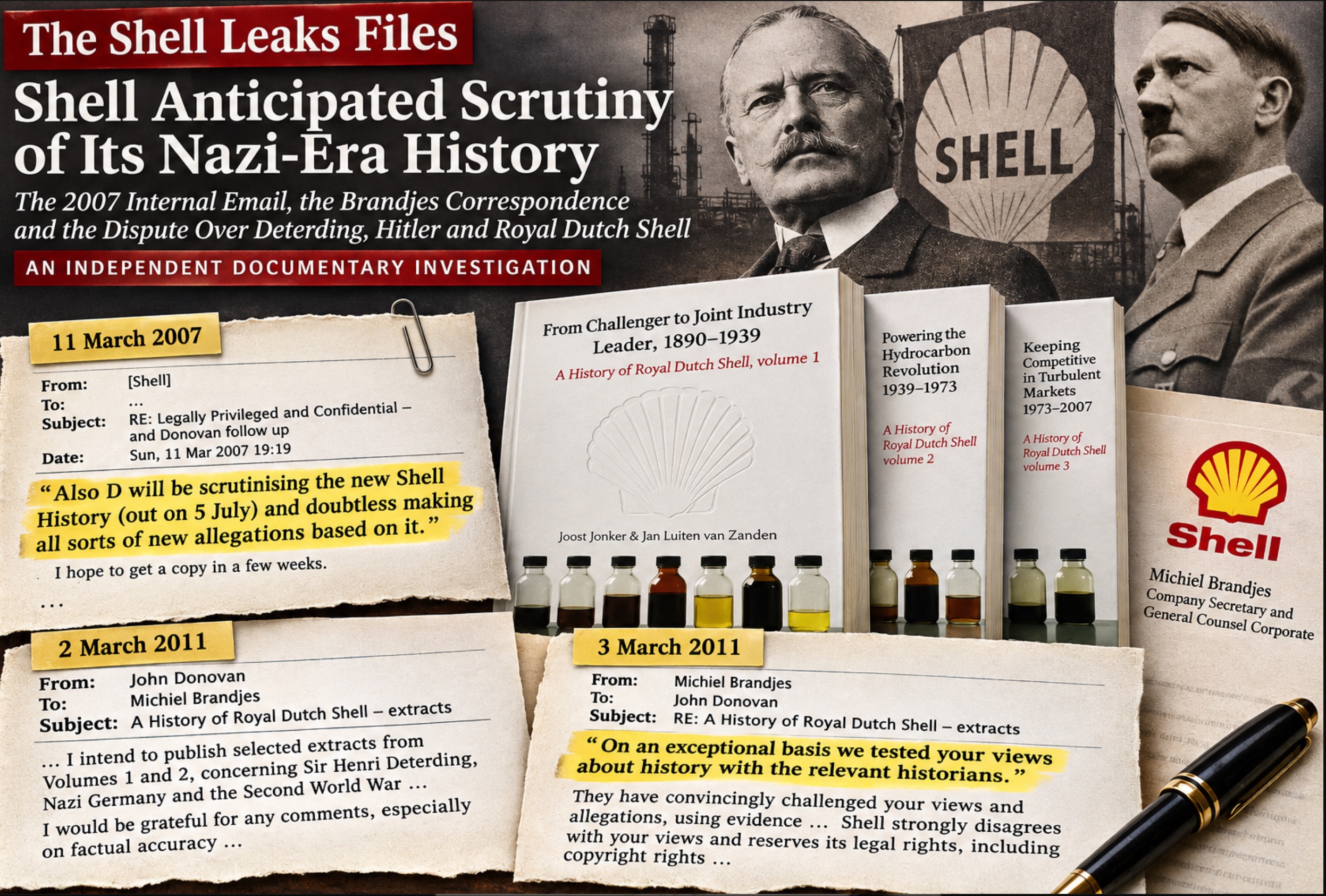
On 11 March 2007, nearly four months before the scheduled publication of A History of Royal Dutch Shell, an internal company email anticipated that the Donovan websites would subject the forthcoming history to critical scrutiny.
The author expected further allegations based on the book and suggested revisiting Shell’s approach towards its longstanding critics.
Four years later, on 3 March 2011, Shell’s Company Secretary and General Counsel Corporate, Michiel Brandjes, responded directly to John Donovan over proposed publication of extracts concerning Sir Henri Deterding, Adolf Hitler and Nazi Germany.
Brandjes rejected Donovan’s interpretation of the historical evidence and expressly reserved the company’s legal rights, including copyright rights.
These two pieces of correspondence, separated by almost four years, provide an unusual documentary record of Shell’s internal anticipation of criticism and its subsequent public-facing response.
Now that complete copies of the first three historical volumes are available for renewed examination, the Donovan–Shell Archive is revisiting both the correspondence and the historical evidence at the centre of the dispute.
The purpose is not simply to reproduce an old disagreement. It is to establish precisely what the surviving records show, what was contested, and which questions remain unresolved.
1. The Internal Email: 11 March 2007
The first document comes from Shell correspondence subsequently disclosed through the Data Protection Act process.
Dated Sunday, 11 March 2007, at 19:19, the email carries the subject line:
RE: Legally Privileged and Confidential – and Donovan follow up
The author’s concern was explicit.
The email anticipated that Donovan would examine the forthcoming Shell history, scheduled for release on 5 July 2007, and make further allegations based upon it.
It also referred to Alfred Donovan’s advancing age and the continuing determination of his son, John Donovan.
The writer favoured reconsidering Shell’s approach, suggesting a more robust response while warning that overt attention from Shell might give the websites greater credibility.
This is an exceptionally revealing document, not because it proves wrongdoing, but because it records how a Shell correspondent privately assessed the prospect of outside examination of the company’s commissioned history.
There is an important distinction.
The email does not establish that Shell intended to prevent Donovan from obtaining the books. Rather, it establishes that the writer expected the history to be scrutinised and anticipated adverse commentary arising from that scrutiny.
It also reveals an internal tension between responding forcefully to a critic and avoiding additional publicity.
Source: Shell internal email, 11 March 2007, 19:19
2. The History Shell Was Preparing to Publish
A History of Royal Dutch Shell was published in 2007 to mark the centenary of the Royal Dutch/Shell combination.
The historical research was conducted by academics associated with Utrecht University.
The principal narrative volumes were:
- Volume One: From Challenger to Joint Industry Leader, 1890–1939, by Joost Jonker and Jan Luiten van Zanden.
- Volume Two: Powering the Hydrocarbon Revolution, 1939–1973, by Stephen Howarth and Joost Jonker.
- Volume Three: Keeping Competitive in Turbulent Markets, 1973–2007, by Keetie Sluyterman.
The historians stated that they enjoyed unrestricted access to Shell’s historical archives and were free to investigate the subjects they considered relevant.
The work was nevertheless commissioned with Shell’s cooperation, and an editorial committee combining academic and company representatives monitored its progress.
These circumstances do not invalidate the authors’ independence. They do make the provenance of the publication particularly relevant to understanding the dispute that subsequently arose.
The books contain material that is potentially uncomfortable for the company’s historical reputation.
Among the subjects examined are Deterding’s increasingly controversial political associations, Nazi Germany’s intervention in the oil industry, Shell’s operations during the Second World War, and internal divisions within the Group’s leadership.
Rather than avoiding these subjects, the historians discussed them in detail.
The issue is whether all of their interpretations are adequately supported by the underlying evidence.
3. Deterding and the Disputed Historical Interpretation
Sir Henri Deterding played an extraordinary role in the creation and expansion of Royal Dutch Shell.
His commercial abilities helped establish the Group among the world’s leading oil enterprises.
During his later years, however, his intense anti-communism became increasingly associated with sympathy for Hitler’s Germany.
Volume One traces this political development and the resulting difficulties within Shell’s senior management.
The historians describe Deterding’s increasingly problematic behaviour, his growing estrangement from colleagues, and his departure from executive leadership in 1936.
The book also includes contemporary German and Dutch correspondence, newspaper clippings and photographs concerning his activities and death in 1939.
Some of this evidence supports conclusions that are beyond serious dispute.
Deterding became an outspoken admirer of aspects of the Nazi regime. His funeral in February 1939 was marked by conspicuous Nazi ceremonial participation, including tributes associated with Hitler and Hermann Göring.
Other questions, particularly the extent and mechanisms of alleged financial support for the Nazi Party, require greater care.
Contemporary allegations are not automatically established facts.
Equally, the absence of surviving documentary proof for a particular allegation does not, by itself, establish that the alleged event was impossible.
It was this distinction between the evidence and its interpretation that subsequently became central to the Donovan–Brandjes correspondence.
4. Donovan Writes to Brandjes: 2 March 2011
On 2 March 2011, John Donovan wrote to Michiel Brandjes concerning two selections of historical material that he intended to place on the internet.
The proposed extracts came from Volumes One and Two of A History of Royal Dutch Shell.
For Volume One, Donovan identified printed pages 464–493, dealing with the final period of Deterding’s leadership and his association with Nazi Germany.
For Volume Two, he selected pages concerning the years immediately preceding and during the Second World War.
The proposed publication also incorporated a newspaper report from The New York Times, dated 26 October 1934, concerning a reported meeting between Hitler and Deterding.
Donovan’s accompanying introduction alleged that the history understated the significance of Deterding’s relationship with the Nazi regime.
These were serious claims. Several went beyond what the published historical volumes themselves conclusively established.
Donovan invited Shell to identify factual inaccuracies and offered to include the company’s response.
He also advanced the view that the historical public interest justified reproducing substantial extracts.
That position necessarily raised a separate question of copyright.
A public-interest argument does not, by itself, extinguish copyright restrictions; the scope of permissible reproduction depends on applicable law, including any relevant exceptions.
The resulting disagreement therefore involved two distinct matters: historical interpretation and rights to reproduce the published material.
5. Brandjes Responds: 3 March 2011
Brandjes replied at 09:02 GMT the following morning.
His response rejected Donovan’s views and allegations and stated that Shell reserved its legal rights.
One passage is especially relevant:
“On an exceptional basis we tested your views about history with the relevant historians.”
Brandjes said those historians had convincingly challenged Donovan’s claims using evidence.
This was a substantive assertion on behalf of Shell.
However, the response reproduced in the correspondence did not identify the specific disputed statements, set out the historians’ reasoning, or attach their supporting evidence.
That limitation matters.
It would be wrong to conclude merely from Brandjes’s short response that the historians’ position lacked supporting evidence.
It would be equally wrong to treat his assertion as an independently demonstrated refutation without examining the underlying material.
The correct approach is to identify each disputed historical proposition and assess it against the available contemporaneous records.
Brandjes also reserved legal rights, including those relating to copyright.
His letter did not categorically announce that Shell would commence legal proceedings.
Source: Donovan–Brandjes correspondence, 2–3 March 2011
6. Donovan’s Reply: A Dispute About Facts and Conclusions
At 13:18 GMT on 3 March 2011, Donovan replied.
He argued that his disagreement was primarily with the historians’ conclusions rather than the historical documents reproduced in the books.
A central issue was the reported meeting between Deterding and Hitler at Berchtesgaden.
Donovan contended that contemporary newspaper coverage of such a meeting undermined any historical interpretation suggesting that Hitler had consistently refused to receive Deterding.
He also cited the Nazi ceremonial tributes at Deterding’s funeral as evidence of the regard in which the regime held him.
These arguments raise several separate questions.
Did the reported 1934 meeting occur as described?
What independent records corroborate the newspaper account?
What precisely did the historians say about Deterding’s attempts to meet Hitler, and over which periods?
If a meeting occurred, what would it establish concerning their political relationship?
And, most importantly, would it establish anything definitive about alleged financial transactions?
These questions should not be collapsed into one.
A verified meeting could affect an interpretation of the personal relationship without independently proving claims concerning political financing.
This is precisely why contemporary source verification is essential.
7. What the March 2007 Email Adds
Read in isolation, the 2011 correspondence could appear to be a conventional dispute between a company and a longstanding critic.
The earlier internal email adds another dimension.
It demonstrates that the possibility of critical scrutiny of the commissioned history was already being considered within Shell before the books became available.
The documentary sequence is therefore clear:
March 2007: A Shell correspondent anticipates criticism of the forthcoming historical publication.
July 2007: The history is scheduled for publication.
March 2011: Donovan notifies Shell of his intended publication of selected Nazi-era material and challenges aspects of the historians’ conclusions.
March 2011: Brandjes formally rejects Donovan’s position, invokes the company’s legal rights and says the historians have been consulted.
The internal email and subsequent correspondence do not establish a coordinated four-year campaign to prevent publication.
They establish something narrower but still significant: Shell was conscious of the likelihood of scrutiny and subsequently took an explicit position against the critic’s historical allegations and proposed use of the material.
That conclusion rests on documents rather than conjecture.
8. A Fresh Opportunity: Returning to the Original Sources
The Donovan–Shell Archive has now obtained complete PDF copies of the three principal narrative volumes of A History of Royal Dutch Shell.
Together they contain approximately 1,600 PDF pages covering the company’s development from 1890 to 2007.
These volumes make possible a broader research programme.
For the Deterding investigation, the immediate priorities are to examine the German and Dutch correspondence, historical newspaper reports, funeral documentation and archival footnotes.
Where the books reproduce material in German or Dutch, carefully checked English translations can make the evidence accessible to a wider readership.
The archive also intends to revisit contemporaneous newspaper reporting, including the 1934 New York Times account, to distinguish what was reported at the time from what can now be independently verified.
The central principle will be straightforward.
The published history is an important scholarly source, but its interpretations should remain open to examination in exactly the same way as the allegations made by its critics.
Neither the historians’ commissioning arrangements nor Donovan’s longstanding dispute with Shell determines the historical truth.
The evidence must do that.
9. Shell’s Wider Historical Record
The significance of these volumes extends far beyond Deterding.
Volume Two examines Shell’s wartime experience, including the company’s operations under Nazi occupation, its involvement in Allied fuel supplies and serious divisions within the Anglo-Dutch management structure.
Volume Three addresses later controversies, including Nigeria, Brent Spar, environmental policy, corporate governance and the 2004 reserves scandal.
This creates opportunities to compare Shell’s published historical narrative with court records, regulatory documents, contemporary news reports and material preserved independently in the Donovan–Shell Archive.
The resulting work can contribute to a more complete documentary history of the company, including matters on which the published account is necessarily incomplete.
Conclusion: The Correspondence Has Become Historical Evidence
In 2007, an internal Shell correspondent anticipated that John Donovan would examine the company’s forthcoming history and produce further criticism.
In 2011, that disagreement became explicit in a direct exchange with Shell’s Company Secretary and General Counsel Corporate.
In 2026, the correspondence has acquired a different significance.
It is itself part of the historical record.
The documents illustrate how Shell responded, privately and publicly, to scrutiny of an uncomfortable chapter of its corporate past.
They do not settle the disputed allegations concerning Deterding and Nazi financing.
Instead, they identify precisely why those questions deserve continuing research and careful verification.
The Donovan–Shell Archive will use the complete historical volumes, surviving internal correspondence and contemporary records to pursue that investigation, publishing evidence-based findings and distinguishing clearly between established facts, disputed claims and matters that remain unresolved.
Principal Documentary Sources
1. Shell internal correspondence, 11 March 2007, 19:19. Subject: RE: Legally Privileged and Confidential – and Donovan follow up. Preserved in the Donovan Data Protection Act archive.
2. John Donovan and Michiel Brandjes, email correspondence, 2–3 March 2011. Archived correspondence concerning the proposed publication of extracts from A History of Royal Dutch Shell.
3. Joost Jonker and Jan Luiten van Zanden. A History of Royal Dutch Shell, Volume One: From Challenger to Joint Industry Leader, 1890–1939. Oxford University Press, 2007. Particularly printed pages 464–493.
4. Stephen Howarth and Joost Jonker. A History of Royal Dutch Shell, Volume Two: Powering the Hydrocarbon Revolution, 1939–1973. Oxford University Press, 2007. Particularly the chapters dealing with the Second World War and Nazi occupation.
5. Keetie Sluyterman. A History of Royal Dutch Shell, Volume Three: Keeping Competitive in Turbulent Markets, 1973–2007. Oxford University Press, 2007.
6. The New York Times, 26 October 1934. Historical newspaper account concerning an alleged meeting between Adolf Hitler and Sir Henri Deterding. Its factual implications are subjects for further source verification.
Editorial, Historical and Legal Disclaimer
This article is an independent documentary investigation based on historical correspondence, published corporate history and archival research.
Statements concerning the views, motives or conduct of historical individuals are attributed to their respective documentary sources where appropriate. Allegations not independently established are identified as allegations or matters requiring verification.
The 2007 Shell email and 2011 Donovan–Brandjes correspondence are discussed according to the text of the available archived copies. Their publication does not establish unlawful conduct by Shell or any individual.
The authors of A History of Royal Dutch Shell were commissioned to prepare the company’s history but stated that they enjoyed scholarly independence and unrestricted access to available company archives. The description of the work as commissioned should not be understood as an accusation of dishonesty or deliberate distortion.
Short quotations are reproduced for documentary criticism and analysis. Copyright in the original historical volumes and correspondence remains subject to applicable law.
The Donovan–Shell Archive is independent of Shell plc. Shell and the historians concerned are welcome to provide factual corrections, supporting documents or responses, which will be considered fairly.
Research and drafting have been assisted by artificial intelligence, with source-based distinctions between fact, allegation and interpretation retained throughout.
The 2007 email and the 2011 correspondence support the central chronology and quotations above.
shellnews.net+1








