AN INDEPENDENT DOCUMENTARY INVESTIGATION
By the Donovan–Shell Archive
17 November 2026
Researched and drafted with assistance from ChatGPT.
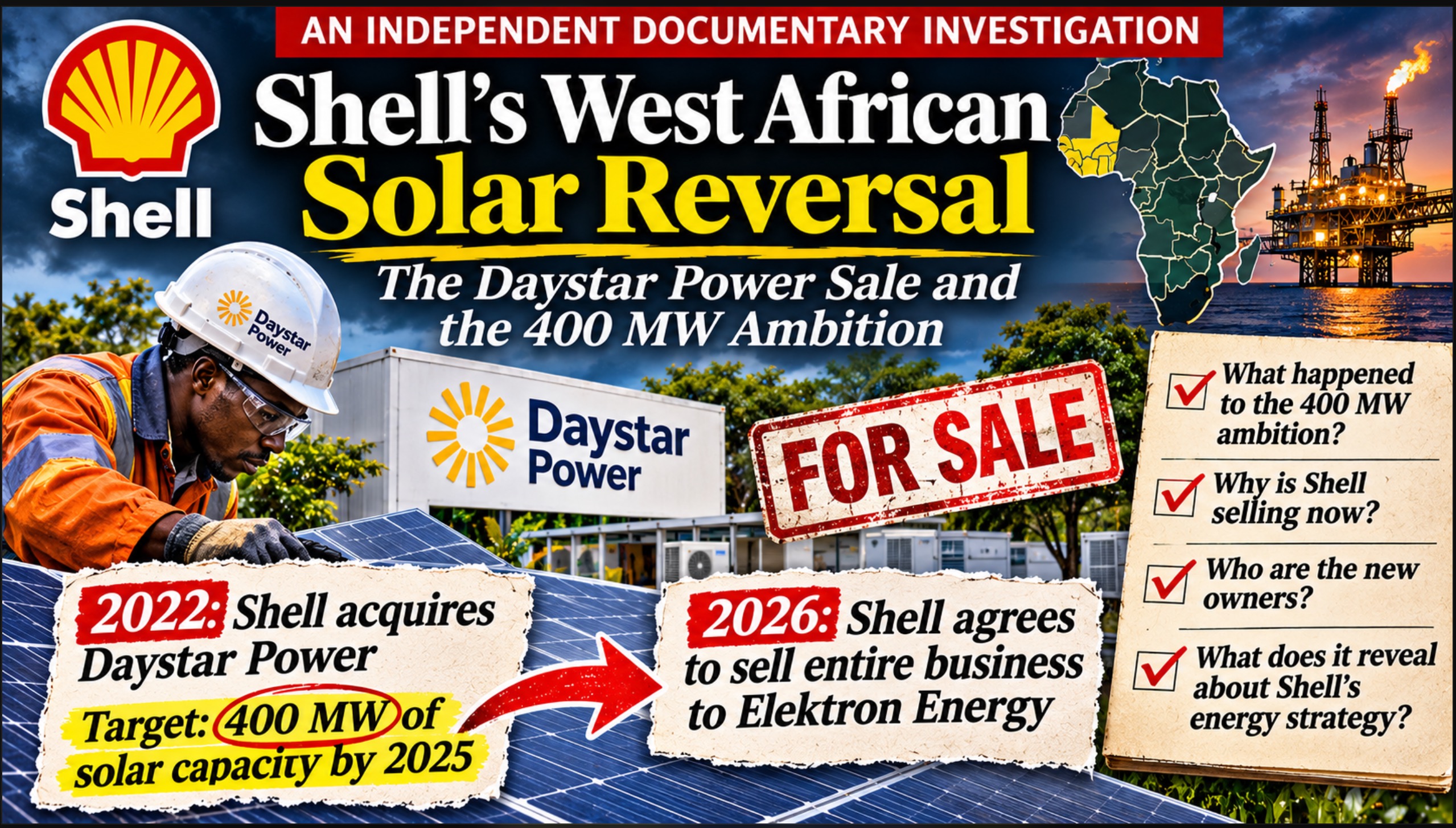
Four years after Shell acquired a promising African solar company and publicly celebrated its potential to reduce dependence on diesel generators, the oil and gas multinational has agreed to sell the entire business to a Nigerian energy infrastructure company. The disposal covers operations in five West African countries and follows Shell’s agreement to sell much of its European onshore renewable-energy portfolio. An examination of the original 2022 acquisition announcement, Daystar Power’s current operating disclosures and Shell’s revised corporate strategy reveals a substantial change in priorities — and an unanswered question about the ambitious expansion targets originally associated with the investment.
Introduction: An African renewable-energy investment changes hands
On 17 November 2026, Shell announced that Shell Overseas Investments B.V. had signed an agreement to sell its entire interest in Daystar Power Group.
The buyer is Elektron Renewables Limited, a subsidiary of Nigerian energy infrastructure company Elektron Energy Development Strategies Limited.
Daystar provides solar and hybrid electricity solutions to commercial and industrial customers across Nigeria, Ghana, Côte d’Ivoire, Senegal and Togo.
The transaction covers 100% of Shell’s ownership in the business.
It remains subject to regulatory conditions and approvals. The sale has therefore been agreed but has not yet been completed.
No purchase price was disclosed in the official announcement.
Shell described the disposal as part of its continuing programme of concentrating investment in areas where it believes it possesses particular commercial advantages.
The company specifically identified asset-backed electricity trading and associated energy services.
Primary source: Shell Nigeria — Shell Signs Agreement to Sell Daystar Power Group to Elektron Energy, 17 November 2026.
Shell Nigeria
At first sight, this might appear to be another routine corporate divestment.
But the history of Daystar’s acquisition makes the announcement more consequential.
In 2022, Shell presented its investment as an important step into renewable electricity generation in emerging African markets.
The company welcomed the prospect of expanding solar power, reducing pollution and helping businesses replace expensive diesel-fired electricity.
Now Shell is preparing to transfer that business to another owner.
The transaction does not mean Daystar’s solar installations will close.
It does not establish that the investment was commercially unsuccessful.
But it provides further documentary evidence that Shell’s present investment strategy differs substantially from the renewable-generation expansion it was publicly pursuing four years ago.
1. September 2022: Shell announces its first African power acquisition
The original announcement is worth revisiting.
On 28 September 2022, Daystar Power announced that it had agreed to be acquired by Shell.
The company’s management expected the investment to accelerate expansion across its existing markets and into other parts of Africa.
The announcement contained a particularly ambitious objective.
Daystar planned to increase installed solar capacity to 400 megawatts by 2025.
At the time, chief executive and co-founder Jasper Graf von Hardenberg described strong demand for solar electricity and said the company’s installed capacity was on course to increase substantially during 2022.
Shell was similarly enthusiastic.
Thomas Brostrøm, then Shell’s Executive Vice-President for Renewable Generation, described the acquisition as the company’s first power acquisition in Africa and an important entry into renewable electricity in emerging markets.
He emphasised the opportunity to reduce dependence on diesel generators.
This was not merely a financial investment presented without a wider strategic explanation.
Shell connected the transaction explicitly with Africa’s energy transition and the expansion of renewable generation.
The original announcement was reproduced by Invest Africa and was also discussed by the legal advisers involved in the acquisition.
Both preserved the 400 MW expansion objective.
Contemporaneous sources: Invest Africa — Daystar Power Acquisition Announcement, September 2022 and Charles Russell Speechlys — Advising Daystar Power on Its Acquisition by Shell, October 2022.
Invest Africa+1
The objective was forward-looking.
It was not a guarantee.
Nor was it a legally established obligation requiring Shell to construct 400 MW of solar generation.
Nevertheless, it formed part of the public commercial rationale for the acquisition.
Its eventual outcome is therefore a legitimate subject for scrutiny.
2. December 2022: Shell completes the takeover
On 16 December 2022, Shell confirmed completion of the acquisition.
Its announcement stated that Daystar would remain a wholly owned subsidiary operating under its established brand within Shell’s Renewables and Energy Solutions business.
Shell described sub-Saharan Africa as a market with substantial solar potential.
The company’s existing customer relationships were expected to provide a foundation for expansion.
The announcement also placed the acquisition within Shell’s broader renewable-energy investment programme.
At the time, Shell reported more than 46 GW of renewable-generation potential across its global portfolio.
That figure included operating assets, projects under construction and a much larger development pipeline.
Those categories were not equivalent to completed electricity-generating capacity.
Nevertheless, the disclosure illustrated how Shell was presenting renewable-power generation as a significant component of its developing business.
Primary source: Shell — Completion of Acquisition of Daystar Power Group, 16 December 2022.
Shell Global
The 2022 acquisition and the newly announced sale are therefore linked by an unusually clear sequence of official statements.
Shell bought the business to participate in an expanding market for distributed renewable electricity.
It is now selling the same business to concentrate resources elsewhere.
The change deserves examination independently of whether Shell ultimately makes a profit or loss on the transaction.
3. The 400 MW question: What happened to the original ambition?
One of the most interesting features of the documentary record is the difference between Daystar’s original expansion objective and its currently reported operating scale.
In September 2022, Daystar publicly targeted 400 MW of installed solar capacity by 2025.
Its current corporate website reports more than 150 MW of capacity across five countries.
It also identifies more than 400 installations.
The website describes a substantial operational business serving commercial and industrial customers.
Its client examples include Nigerian Bottling Company, Vivo Energy, Rider Steel, Ecobank and Access Bank.
Primary source: Daystar Power — Official Company Website and Current Operating Information.
Daystar Power Solutions
The figures require careful interpretation.
The original 400 MW target referred specifically to intended installed solar capacity by 2025.
The present figure describes the company’s broader solar and hybrid energy platform.
The published material examined does not provide a complete reconciliation of these measurements, including their precise definitions and the capacity installed at the end of 2025.
Consequently, it would be premature to state that Daystar definitively missed the original target by a particular amount.
It would also be inappropriate to conclude that Shell prevented the company from achieving its objectives.
The available evidence does not establish either proposition.
But the difference is sufficiently substantial to warrant further disclosure.
What installed solar capacity did Daystar actually achieve by the end of 2025?
Was the 400 MW objective formally revised?
Did the company’s geographical expansion plans change?
Were projects delayed, cancelled or transferred?
And did the eventual decision to sell the business affect its investment programme?
These are factual questions rather than accusations.
Neither the original target nor the current operating figure provides a complete explanation.
The announced disposal makes that missing information more relevant because the business is now changing ownership.
4. Why Daystar mattered in West Africa
To understand the transaction’s broader significance, it is necessary to examine the electricity market Daystar serves.
In parts of West Africa, businesses cannot always depend upon uninterrupted electricity from the public grid.
Manufacturers, financial institutions, commercial premises and industrial facilities often require supplementary generation.
Diesel generators have traditionally provided a significant part of that backup capacity.
But diesel generation can be expensive and polluting.
Fuel costs, maintenance requirements and interruptions to supply can affect business competitiveness.
Daystar developed its business around reducing those difficulties.
Rather than relying exclusively on customers to purchase and operate their own generating equipment, the company offers solar and hybrid solutions through several commercial arrangements.
These include solar-as-a-service, power-as-a-service and lease-to-own models.
The solutions may combine solar panels with batteries and other sources of generation to improve reliability.
The potential benefits depend upon the actual equipment installed, operating conditions and displaced fuel consumption.
The company’s published examples include projects intended to reduce diesel use and electricity costs.
Its website contains customer statements describing savings, improved reliability and environmental advantages.
These are company-published testimonials, not independently audited findings for every installation.
Nevertheless, they demonstrate that Daystar operates in an economically important market.
The central purpose of the business is to provide more dependable and potentially lower-emission electricity for customers whose existing supply arrangements may be costly or unreliable.
Selling the company does not eliminate that demand.
It changes who owns the business positioned to meet it.
5. The buyer: A Nigerian infrastructure company with a different portfolio
The proposed purchaser is not an anonymous investment vehicle with no identifiable operating history.
Elektron Energy Development Strategies Limited describes itself as a Nigerian energy infrastructure company founded in 2011.
Its activities include the development, financing and operation of electricity and gas infrastructure.
The company’s own website identifies projects involving embedded generation, distribution infrastructure, gas-fired electricity and hybrid-energy systems.
One example is the Task Force Road Independent Power Project in Lagos.
Elektron describes this as an operational 10.6 MW gas-fired power plant commissioned in 2013, with a distribution network serving the Lagos State Government Secretariat.
The company has discussed plans to expand this installation and incorporate solar generation.
Another project concerns the development of embedded electricity generation and distribution infrastructure for Victoria Island in Lagos.
Elektron’s publicly described business is therefore not exclusively solar.
It combines conventional and lower-carbon energy technologies with electricity infrastructure and long-term commercial supply arrangements.
Primary sources: Elektron Energy — Official Corporate Website and Elektron — Task Force Road Power Project.
elektronenergy.com+1
That background is important when assessing the proposed acquisition.
Elektron may see Daystar’s customer relationships, operating systems and regional presence as complementary to its existing activities.
According to its announcement reported by Nigerian business media, Elektron considers the acquisition a means of accelerating the development of a diversified cleaner-energy platform.
Deen Solebo, the company’s Co-Chief Executive Officer and Chief Financial Officer, welcomed the addition of Daystar’s solar and hybrid capabilities.
Contemporary reporting: Nairametrics — Elektron Energy Signs Deal to Acquire Shell-Owned Daystar Power, 17 November 2026.
Nairametrics
The buyer’s investment case is commercially understandable.
A regional electricity infrastructure company can potentially combine established renewable installations with other generation and distribution services.
But successful acquisition does not automatically guarantee further expansion.
Its eventual performance will depend upon financing, integration, management, customer relationships and market conditions.
The transaction should therefore be considered a transfer of opportunity as well as ownership.
6. The selling price: An important missing disclosure
Neither Shell’s announcement nor the buyer’s published statements examined for this investigation disclosed a purchase price.
That omission limits any assessment of the transaction’s financial outcome.
Shell acquired Daystar in December 2022.
It has owned the business for less than four years.
But without the acquisition consideration, subsequent capital contributions, financing arrangements and agreed sale proceeds, it is not possible to determine whether Shell has achieved a positive or negative financial return.
There may also be contractual and accounting factors affecting the calculation.
A sale consideration does not necessarily equal an accounting gain or loss.
Nor can the business’s current generating capacity be used alone to calculate its enterprise value.
Customer contracts, debt, lease obligations, assets under development and expected future income could all affect valuation.
The available announcements do not provide sufficient information to resolve these matters.
This investigation therefore makes no claim that Shell sold Daystar at a loss.
It makes no claim that the buyer obtained the company below fair value.
And it does not assert that the business was commercially unsuccessful under Shell’s ownership.
The absence of sufficient transaction information is itself a legitimate limitation on public scrutiny.
It is particularly relevant where the original investment had been associated with a wider corporate strategy concerning lower-carbon energy.
7. Shell’s explanation: Concentrating capital where it believes it can compete
Shell has provided a clear explanation of the disposal.
Its 17 November statement says the company is continuing to reshape its portfolio and concentrate on power activities where it considers its capabilities to be differentiated.
The company specifically identifies asset-backed electricity trading and related services.
This explanation is consistent with Shell’s more recent investor strategy.
At its Capital Markets Day on 25 March 2025, Shell announced plans to tighten capital discipline, improve returns and concentrate growth investment in businesses where it believes it possesses particular competitive strengths.
Chief Executive Wael Sawan identified integrated gas, liquefied natural gas, energy marketing and trading as central priorities.
The company also committed to maintaining its published energy-transition targets and ambitions.
Primary source: Shell — Capital Markets Day Strategy Announcement, 25 March 2025.
Shell Global
This is an important distinction.
Shell is not formally announcing an abandonment of renewable electricity or of its wider net-zero ambition.
It is placing greater emphasis on particular activities within the electricity value chain.
Owning solar installations is one commercial activity.
Trading electricity is another.
Financing or operating flexible power generation is another.
Providing energy services to customers may involve different levels of capital commitment and commercial risk.
Shell’s position is that concentrating on activities where it possesses stronger competitive advantages should improve the company’s performance.
That is a legitimate business argument.
But it also represents a change in the practical role Shell intends to play in renewable electricity development.
Instead of owning and expanding certain generating businesses, Shell is increasingly prepared to transfer them to other operators while concentrating its capital elsewhere.
Daystar is a concrete example.
8. The European precedent: Another renewable portfolio offered for sale
The Daystar agreement did not occur in isolation.
On 3 August 2026, Shell announced a separate agreement to sell its European onshore renewables portfolio to TotalEnergies.
That transaction included operating and development-stage renewable assets in Italy, the Netherlands, Spain and the United Kingdom.
Shell described approximately 500 MW of renewable-generation capacity in operation or development.
TotalEnergies’ own announcement also identified a substantial additional development pipeline.
Shell explained that the transaction would allow it to recycle capital and concentrate on its preferred electricity activities.
The wording closely resembles the explanation now provided for the Daystar sale.
Both announcements emphasise portfolio management, competitive advantages and the allocation of capital.
Primary source: Shell — Agreement to Sell European Onshore Renewables Portfolio to TotalEnergies, 3 August 2026.
Shell Global
The Donovan–Shell Archive reported that European transaction on 4 August 2026.
Previous archive coverage — Shell Sells British Solar Farms to TotalEnergies in Renewables Retreat.
The Daystar sale adds an important new geographical dimension.
It demonstrates that Shell’s strategy of disposing of selected renewable-generation assets is not confined to mature European electricity markets.
It now extends to a business operating in five West African countries, where reliable distributed generation can fulfil a particularly important commercial function.
This is not proof that Shell will sell every remaining renewable-generation asset.
No such conclusion is justified.
But the pattern of disclosed transactions is clear.
Shell is reducing direct ownership of selected renewable-generation businesses while retaining an interest in other electricity-related commercial activities.
9. A revealing coincidence: New gas production announced on the same day
Another announcement on 17 November 2026 provides useful context.
Shell confirmed that its subsidiary Sarawak Shell Berhad had started gas production from the Rosmari and Marjoram fields offshore Malaysia.
The development is located approximately 220 kilometres off the Sarawak coast.
It includes deepwater gas production, a lengthy offshore pipeline and a new onshore processing plant at Bintulu.
The processed gas will feed the PETRONAS LNG Complex.
Shell operates the project with a 71% interest.
The company’s supporting project information describes planned production capacity of approximately 800 million standard cubic feet of gas per day.
Primary sources: Shell — First Gas from Rosmari-Marjoram, 17 November 2026 and Shell — Rosmari-Marjoram Project Overview.
Shell Global+1
The two announcements concern different assets in different countries.
There is no evidence that the proceeds from the Daystar disposal are specifically financing the Malaysian development.
Nor should their coincident publication dates be interpreted as proof of a direct financial relationship.
Nevertheless, they provide a striking illustration of Shell’s stated strategic priorities.
On the same day that Shell announced the intended sale of a West African renewable-electricity business, it celebrated the start of production from a major Asian natural-gas development.
Shell argues that natural gas remains important for energy security and the energy transition.
Environmental critics question the long-term compatibility of expanding fossil-fuel production with global climate objectives.
Both positions form part of the wider debate.
For this investigation, the narrower documentary conclusion is sufficient.
Shell’s actual investment and disposal decisions are consistent with its publicly stated priority of strengthening integrated gas while selectively reducing capital committed to other activities.
10. Does selling Daystar undermine Shell’s energy-transition commitments?
It would be too simplistic to answer this question solely by counting renewable-energy businesses sold.
The climate consequences of an asset sale depend partly on what happens after ownership changes.
If Elektron continues operating Daystar’s installations and expands the business, electricity generation from those assets may continue or increase.
The renewable equipment does not cease functioning because its owner changes.
Likewise, a purchaser may possess local commercial relationships and infrastructure expertise that help the business grow.
There is no evidence in today’s announcement that Daystar customers will lose access to their existing systems.
Shell explicitly states that there will be no change to Daystar’s day-to-day operations before completion.
On the other hand, the sale raises questions about Shell’s future contribution to the financing and ownership of distributed renewable electricity in West Africa.
In 2022, Shell presented its acquisition as part of helping expand access to solar power and reduce diesel dependence.
In 2026, it is preparing to relinquish that business.
Those facts establish a change in ownership strategy.
They do not, by themselves, establish that global or regional greenhouse-gas emissions will increase because of the sale.
Nor do they establish that Shell has breached an environmental commitment.
An independent assessment would require information about the projects, electricity generated, displaced fossil-fuel consumption, future investment and subsequent operating performance.
The documentary evidence currently available is sufficient to identify a strategic reversal.
It is not sufficient to calculate its environmental consequences.
11. What should Shell and Elektron now disclose?
Several questions remain unanswered by the transaction announcements.
The first concerns financial transparency.
What consideration has Elektron agreed to pay, and what was Shell’s total investment in Daystar over the period of ownership?
The second concerns operational performance.
What installed solar capacity had Daystar achieved by the end of 2025, and how did that compare with the original 400 MW ambition?
The third concerns the transaction itself.
Which regulatory approvals are required, and when is completion expected?
The fourth concerns continuity.
Will Daystar retain its existing management, brand, customer agreements and geographical expansion programme after the sale?
Finally, there is the question of Shell’s future role in African renewable electricity.
Does the disposal mark the end of its direct ownership of this type of distributed commercial and industrial solar business in West Africa, or does Shell envisage participation through other structures?
These are questions that the company’s existing statements do not fully answer.
They do not imply that either party has acted improperly.
They are relevant because the transaction concerns an operating energy business whose original acquisition was promoted as part of a wider energy-transition strategy.
12. What the documentary record establishes
The investigation rests on three distinct categories of evidence.
Established facts
Shell completed the acquisition of Daystar Power in December 2022.
The original acquisition announcement associated the investment with renewable-electricity expansion and reducing dependence on diesel generation.
Daystar’s public objective in September 2022 was to reach 400 MW of installed solar capacity by 2025.
Daystar’s current website reports more than 400 installations and more than 150 MW of solar and hybrid capacity across five West African markets.
On 17 November 2026, Shell announced a signed agreement to sell its entire ownership interest to Elektron Renewables Limited.
The transaction remains subject to regulatory conditions and approvals.
Shell separately announced the proposed sale of its European onshore renewables portfolio in August 2026.
Shell also announced first gas from its Malaysian Rosmari-Marjoram project on 17 November 2026.
Company positions and forward-looking statements
Shell states that the Daystar disposal reflects its strategy of concentrating capital where it considers its commercial capabilities to be strongest.
Elektron states that the acquisition will strengthen its renewable and hybrid-energy platform.
The original 400 MW objective was an expansion target, not an achieved result.
Neither the proposed buyer’s future investment plans nor Shell’s expected financial results from the disposal can be treated as established outcomes.
Matters not established
The public material examined does not establish the sale price.
It does not provide the total acquisition and subsequent investment costs necessary to calculate Shell’s financial return.
It does not reconcile Daystar’s 2022 installed-solar target with its current solar-and-hybrid capacity figure.
It does not establish that Shell deliberately restricted Daystar’s growth.
It does not establish that the business is financially distressed.
It does not establish that the sale will increase regional carbon emissions.
And it does not establish that regulatory approval or completion is guaranteed.
Conclusion: Four years can make a considerable difference
The history of Shell’s investment in Daystar Power illustrates how quickly corporate energy strategies can change.
In September 2022, Shell welcomed an African renewable-electricity acquisition with ambitions extending well beyond the company’s existing operations.
Daystar was expected to grow rapidly.
Its solar technology offered potential benefits for businesses struggling with unreliable electricity and the expense of diesel generation.
Shell described the transaction as a significant step into renewable electricity in emerging markets.
Four years later, the company has agreed to sell the entire business.
The buyer is another energy infrastructure company with an established presence in Nigeria and experience in both conventional and renewable electricity systems.
There is no established reason to assume that Daystar cannot prosper under its proposed new ownership.
Indeed, Elektron presents the acquisition as an opportunity for further expansion.
But the transaction reveals something important about Shell.
The company is no longer pursuing every renewable-energy opportunity that once appeared attractive.
Instead, its recent announcements demonstrate a more selective approach, concentrating on trading, flexible power, integrated gas and other activities it considers commercially advantageous.
That is Shell’s stated strategy.
The documentary significance lies in comparing the company’s earlier ambitions with its subsequent decisions.
Daystar provides an unusually clear example because the original acquisition statements, ambitious expansion objective, current operating disclosures and sale announcement are all publicly accessible.
The most interesting unanswered issue is not whether renewable electricity remains valuable in West Africa.
The need for reliable power has not disappeared.
It is whether the original vision of substantial expansion under Shell ownership was realised, modified or overtaken by a change in corporate priorities.
The current documents do not establish the answer.
They do establish that the planned ownership has changed.
Shell entered the West African solar market as an investor intending to help expand a promising renewable-electricity business. It is preparing to leave that investment less than four years later, while strengthening its positions elsewhere in the global energy industry.
That is a significant corporate development.
The full consequences for Daystar, its customers, the buyer and the region’s renewable-electricity market remain to be seen.
For the Donovan–Shell Archive, the appropriate conclusion is neither that Shell has betrayed a legally binding promise nor that the transaction is necessarily a commercial success.
It is that the documentary record reveals a substantial reversal in investment priorities — one that deserves scrutiny against the ambitions publicly expressed when the business was acquired.
Principal documentary sources
1. Shell Nigeria — Agreement to Sell Daystar Power Group, 17 November 2026. Original corporate announcement establishing the seller, buyer, transaction status and Shell’s stated rationale.
2. Shell — Completion of Daystar Power Acquisition, 16 December 2022. Original corporate announcement explaining the acquisition’s strategic purpose.
3. Invest Africa — Original Daystar Acquisition Announcement, September 2022. Preserves the original acquisition announcement and Daystar’s stated 400 MW ambition.
4. Charles Russell Speechlys — Legal Advisers’ Announcement, October 2022. Independent transaction-related confirmation of the original expansion objective.
5. Daystar Power — Official Website. Current company-published operating capacity, installation figures and customer examples.
6. Elektron Energy — Official Website. Buyer background, existing energy infrastructure activities and commercial positioning.
7. Nairametrics — Elektron Energy to Acquire Shell-Owned Daystar Power, 17 November 2026. Contemporary Nigerian reporting, including statements attributed to the buyer.
8. Shell — Capital Markets Day Strategy, 25 March 2025. Primary corporate disclosure explaining revised investment and business priorities.
9. Shell — European Onshore Renewables Disposal, 3 August 2026. Original announcement establishing the earlier portfolio disposal.
10. Shell — Rosmari-Marjoram First Gas, 17 November 2026. Independent corporate confirmation of the new Malaysian gas development.
Documentary disclaimer
This article is an independent documentary investigation based on publicly accessible corporate announcements, contemporaneous transaction statements, company operating disclosures and identifiable business reporting.
Shell’s agreement to sell Daystar Power Group was announced on 17 November 2026. The transaction remains subject to regulatory conditions and approvals and must not be described as completed.
The original 400 MW objective was a forward-looking expansion target announced in September 2022. The investigation does not represent it as an enforceable promise or an achieved operating result.
Daystar’s current 150 MW-plus operating figure describes its reported solar and hybrid platform. The measurement is not necessarily directly comparable with the earlier installed-solar target. No independently audited reconciliation of these figures has been obtained.
Financial terms of the proposed disposal have not been established. Accordingly, the article makes no finding concerning profit, loss, asset valuation or investment performance.
Company statements about commercial benefits, future growth, environmental improvements and strategic objectives are attributed to the organisations making them.
No allegation is made that Shell, Daystar Power, Elektron Energy or any individual has breached the law, misled investors or deliberately obstructed renewable-energy development.
The comparison between the Daystar sale and Shell’s Malaysian gas development is an editorial examination of publicly disclosed corporate priorities. It does not suggest a directly linked financing arrangement.
The Donovan–Shell Archive welcomes factual corrections, relevant corporate documents and responses from Shell plc, Daystar Power Group, Elektron Energy Development Strategies Limited and other parties identified in this investigation.
Substantiated corrections and relevant additional evidence will be considered fairly.
This article is independent corporate and documentary analysis, not investment advice or a legal determination.