AN INDEPENDENT DOCUMENTARY INVESTIGATION
By the Donovan–Shell Archive
18 November 2026
Researched and drafted with assistance from ChatGPT.
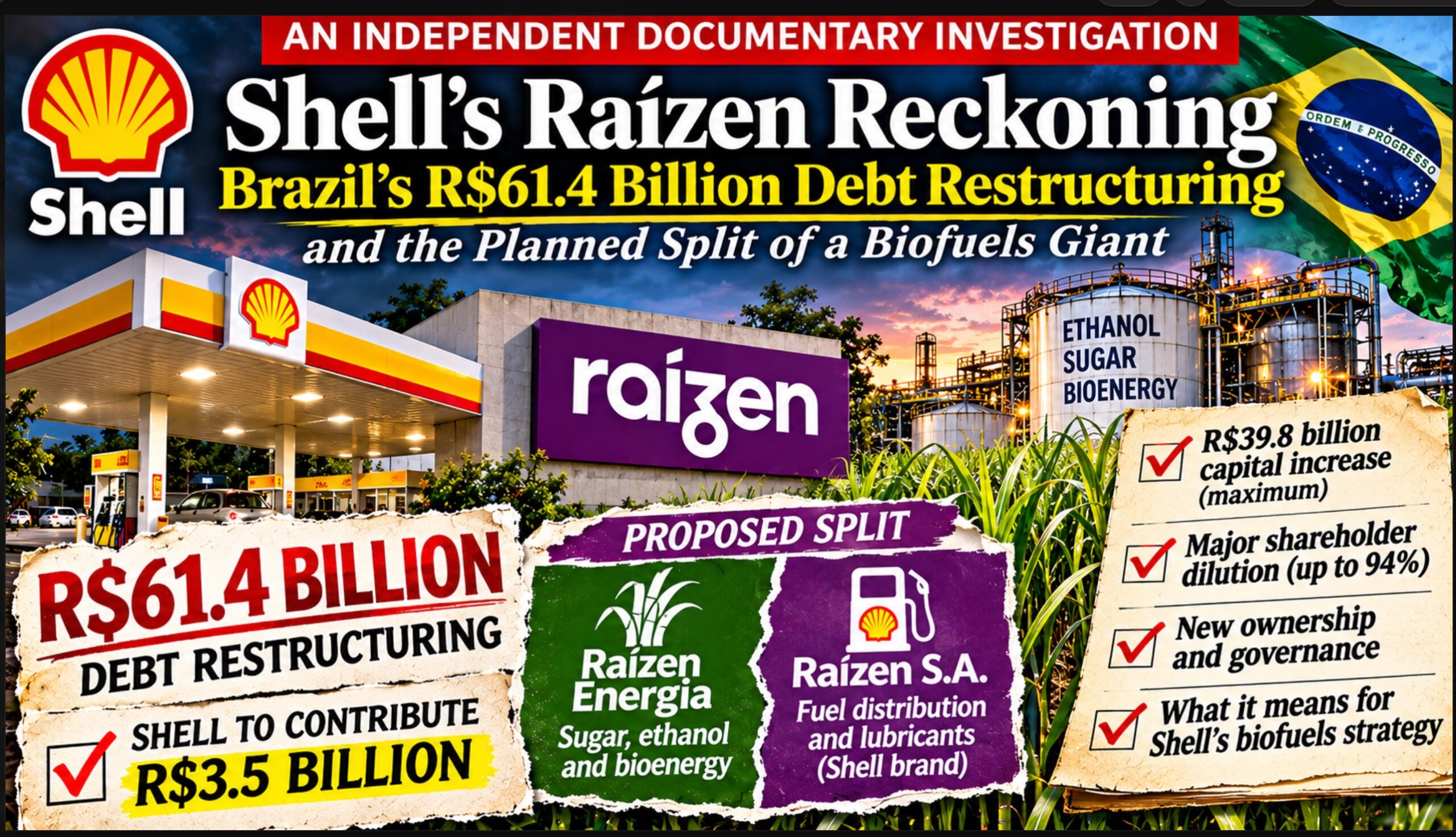
Fifteen years after Shell and Brazil’s Cosan established Raízen as a major international biofuels venture, the partnership faces a fundamental restructuring. Court-approved arrangements concerning approximately R$61.4 billion of financial debt are being implemented through a combination of fresh capital, creditor participation, changes in corporate governance and a proposed division of the company into two separately listed businesses. Newly examined regulatory disclosures reveal the scale of the financial difficulties, the conditions attached to Shell’s proposed R$3.5 billion contribution and the possibility that the existing ownership structure will be substantially transformed.
Introduction: A company that helped define Shell’s biofuels ambitions faces a new future
On 6 November 2026, the board of Brazilian energy company Raízen S.A. unanimously approved the principal terms of a private capital increase that could reach almost R$39.8 billion.
The figure is striking.
But it requires immediate explanation.
The proposed transaction is not an announcement that Shell will inject R$39.8 billion in cash.
It combines a proposed R$3.5 billion contribution by Shell, possible participation by another shareholder, conversion of existing financial claims into equity and subscription rights available to other shareholders.
The operation forms part of a much larger restructuring of Raízen’s financial obligations.
A plan approved by a São Paulo court in July 2026 provides the framework for reorganising approximately R$61.4 billion of unsecured financial debt.
On 12 November, Raízen published its latest quarterly financial results, confirming that implementation of the restructuring remained central to its operations.
The company also provided further details of a planned corporate separation.
Under that arrangement, the sugar, ethanol and bioenergy businesses would be concentrated in Raízen Energia S.A., while Raízen S.A. would retain fuel distribution and lubricants operations under the Shell brand.
These are not minor adjustments to an ordinary investment portfolio.
They represent a potential transformation of one of Shell’s most important longstanding ventures in lower-carbon fuels.
Principal documentary sources: Raízen’s 6 November 2026 regulatory announcement filed with Brazil’s CVM and Raízen’s quarterly results published on 12 November 2026.
CVM+1
1. The original ambition: Shell and Cosan create a Brazilian biofuels giant
The historical significance of the restructuring becomes clearer when the partnership’s origins are examined.
On 2 June 2011, Royal Dutch Shell and Cosan publicly launched Raízen.
The venture combined Shell’s international energy business, fuel-distribution operations and biofuels expertise with Cosan’s substantial Brazilian sugar-cane and ethanol interests.
Shell and Cosan initially established the venture on a broadly equal ownership basis.
At the time, the companies presented Raízen as an important development in the commercial production of lower-carbon transport fuels.
Sugar-cane ethanol was central to the strategy.
The partners intended to combine large-scale production in Brazil with an international distribution network capable of serving customers in multiple markets.
Raízen also incorporated conventional fuel distribution.
The company therefore brought together two activities that were sometimes presented separately in public discussion: the production of biofuels and the marketing of petroleum-based fuels.
Shell’s own announcement emphasised the opportunity to expand sugar-cane ethanol production and sales.
Original Shell and Cosan joint announcement — 2 June 2011.
PR Newswire
The Donovan–Shell Archive reported the development at the time.
Shell launches ethanol project with Brazilian firm — 17 February 2011.
Raízen subsequently became a significant producer and marketer of sugar, ethanol and bioenergy, while also operating a substantial network of fuel-distribution activities associated with the Shell brand.
The present restructuring must be understood against that history.
Shell did not acquire a small, incidental financial holding.
It helped establish a business that became an important part of its public account of how biofuels could contribute to the future energy system.
2. March to July 2026: The debt crisis becomes a court-supervised restructuring
Raízen’s recent difficulties did not arise overnight.
Its financial position deteriorated against a background of heavy indebtedness, demanding capital requirements and difficult operating conditions.
On 11 March 2026, the company sought recuperação extrajudicial under Brazilian law.
This expression is generally translated as extrajudicial or out-of-court restructuring.
It describes a process in which a company negotiates arrangements with affected creditors and seeks judicial recognition of the resulting plan.
It should not be confused with a completed liquidation or the automatic closure of the operating business.
On 5 June, Raízen submitted a restructuring plan.
On 30 July 2026, the relevant São Paulo court approved it.
The proceedings are identified in Raízen’s own regulatory announcement as case 4037759-13.2026.8.26.0100, before the Third Bankruptcy and Judicial Restructuring Court in São Paulo.
The scale is considerable.
According to Cosan’s subsequent SEC disclosure, creditors representing approximately 81.6% of the affected financial claims supported the plan.
The resulting arrangements concern approximately R$61.4 billion in unsecured financial debt.
Not every liability owed by Raízen is necessarily included within that perimeter.
Nor should the R$61.4 billion figure be confused with the company’s total gross indebtedness or its reported net debt, which are calculated differently.
Primary source: Cosan S.A. — November 2026 Form 6-K filed with the US Securities and Exchange Commission.
SEC
The judicial approval was a major milestone.
But it did not mean that every financial and corporate measure contemplated by the plan had already been completed.
That distinction remains essential.
The November disclosures concern the continued implementation of the restructuring, not merely a retrospective description of a concluded process.
3. The R$39.8 billion headline: What Shell is actually proposing to contribute
Raízen’s 6 November filing authorised a private capital increase ranging from R$3.5 billion to approximately R$39.796 billion.
The issue price was fixed at R$0.25 for each new share.
The maximum transaction would involve issuing more than 159 billion new shares across different classes.
Those enormous figures may create the impression that billions in additional cash are about to enter Raízen.
That interpretation would be misleading.
The official document identifies several mechanisms contributing to the total value of the proposed capital increase.
Shell’s contribution
Shell Brazil Holding B.V., or an affiliated Shell company, is to contribute up to R$3.5 billion in cash under the proposed structure.
This would be exchanged for newly issued ordinary shares and a newly created class of preferred shares.
Possible additional shareholder contribution
Aguassanta Participações S.A., associated with Brazilian businessman Rubens Ometto and the Cosan controlling group, may participate with up to R$500 million.
Its participation is conditional.
Conversion of creditor claims
An important part of the recapitalisation involves creditors exchanging existing claims against Raízen for newly issued securities.
This can reduce obligations appearing on the company’s balance sheet.
But exchanging a debt claim for shares is not the same as depositing fresh cash into the company.
Raízen’s own filing makes that distinction explicit.
Participation by other shareholders
Existing shareholders have statutory subscription rights under the announced arrangements.
The permitted exercise period began on 9 November and runs until 8 December 2026.
The amount eventually subscribed depends upon the operation of these different mechanisms.
Consequently, R$39.8 billion represents the maximum approved capital increase, not a R$39.8 billion cash rescue by Shell.
That distinction is essential to understanding both the transaction and the extent of Shell’s commitment.
Source: CVM filing — Capital Increase, Units and Securities Arrangements, 6 November 2026.
CVM+1
4. A new ownership structure: The significance of Shell’s special share class
The proposed transaction contains an important governance provision.
For the capital increase to become effective under the stated conditions, at least 14 billion new shares must be subscribed.
In addition, Shell must hold, on its own, a majority of the newly issued Class B preferred shares.
That condition gives Shell a particular position within the planned recapitalisation.
But it must not be misrepresented.
A majority of Class B preferred shares is not the same thing as a majority of every share in Raízen.
The company has several share classes, and its proposed restructuring involves new securities and potentially substantial creditor ownership.
The precise outcome will depend upon completion of the various steps.
Raízen’s official ownership information provides a useful starting point.
In its shareholding disclosure dated 29 October 2026, the company reported that Shell Brazil Holding B.V. held approximately 44% of the total shares, while Cosan held a similar aggregate percentage.
The remaining shares were primarily held by public investors.
The voting and preferred-share percentages were not identical.
Shell was reported as holding approximately 42% of ordinary shares, compared with Cosan’s 58%.
Those figures describe the ownership position before implementation of the new capital increase.
They should not be presented as the expected final ownership percentages.
Raízen Investor Relations — Shareholding Composition, reference date 29 October 2026.
ri.raizen.com.br
The most important question is not whether Shell retains a majority of one class of securities.
It is what the complete restructured ownership and governance arrangements will mean for the company.
Who will appoint directors?
Which decisions will require special approval?
How will creditor shareholders participate in governance?
And which entity will ultimately control strategic decisions concerning ethanol production, fuel distribution and future capital expenditure?
The filings identify the proposed mechanisms.
They do not yet provide an established final result.
5. Existing shareholders face substantial potential dilution
The 6 November filing also contains an unusually clear warning concerning dilution.
Raízen estimates that shareholders who do not exercise their subscription rights could experience a reduction in their percentage ownership of approximately 57% if only the minimum number of shares is issued.
If the maximum number is issued, the company calculates potential dilution of up to approximately 94%.
These figures concern percentage ownership, not an established monetary loss of the same size.
They also do not mean that every existing shareholder will necessarily experience those outcomes.
Participation in the capital increase, the number of securities ultimately issued and the operation of the creditor arrangements will affect the result.
Nevertheless, the disclosure demonstrates the potential scale of the change.
This is not an ordinary financing exercise involving a modest increase in issued capital.
It is a restructuring capable of radically altering the relationship between existing shareholders and creditors.
Cosan’s own SEC filing acknowledges that implementation may significantly dilute its existing interest and change the nature of its involvement in Raízen.
It also recognises the possibility that Cosan could cease to exercise joint control over the company.
That is a particularly significant statement from one of the two organisations that originally established Raízen.
The historical 50–50 partnership may therefore be moving towards a substantially different governance arrangement.
No final outcome should be assumed before the recapitalisation takes effect.
Sources: Raízen’s CVM disclosure and Cosan’s SEC filing.
CVM+1
6. The planned corporate split: Bioenergy on one side, Shell-branded fuels on the other
The second major component of the restructuring concerns the future organisation of the business.
Under arrangements approved by shareholders on 30 October, Raízen is preparing to separate its activities into two independently listed corporate structures.
Raízen Energia S.A. is intended to concentrate the production and commercialisation of ethanol, sugar and bioenergy.
Raízen S.A. is intended to retain fuel distribution and lubricants operations associated with the Shell brand.
The plan also envisages a reduction in share capital of up to R$35 billion through the distribution to shareholders of securities issued by Raízen Energia.
That does not mean shareholders are necessarily to receive R$35 billion in cash.
The proposed transaction involves the delivery of securities as part of a corporate reorganisation.
Raízen has already described the intended appointment of new governing bodies for the businesses.
However, the effectiveness of the changes remains linked to implementation of the restructuring plan.
The company’s 12 November results expressly state that completion of the separation is subject to the relevant conditions.
Primary sources: Raízen — New Boards and Corporate Restructuring, 30 October 2026 and Raízen — Results for the Second Quarter of the 2026/27 Crop Year.
Raízen+1
For Shell, the distinction between the two future businesses is particularly important.
The original Raízen partnership was built around the combination of petroleum distribution and large-scale biofuels production.
The restructuring proposes to separate those activities into different listed entities.
That does not necessarily mean Shell will withdraw from bioenergy.
Nor does it establish that the Shell-branded distribution business will be sold.
The future ownership arrangements remain conditional.
But the proposed separation marks a significant departure from the integrated corporate structure around which the original venture developed.
7. The financial evidence: An improving quarter does not erase the debt problem
The November financial results complicate any simplistic account of Raízen as a business experiencing uniform operational collapse.
For the July–September 2026 quarter, Raízen reported net revenue of approximately R$53.5 billion.
Adjusted EBITDA reached approximately R$4.38 billion, an increase of 41.3% over the corresponding period of the previous year.
The company’s consolidated net loss narrowed to approximately R$843.7 million, compared with a loss of R$2.31 billion a year earlier.
Those figures indicate an improvement in reported quarterly performance.
But Raízen remained loss-making.
Its reported net debt at 30 September stood at approximately R$55.68 billion.
The ratio of net debt to adjusted EBITDA over the preceding twelve months was approximately 4.3 times.
The company also reported that its gross debt, including derivatives, exceeded R$71 billion.
These amounts refer to different financial measures and should not be treated as interchangeable.
The distinction between the company’s principal business segments is equally important.
Fuel distribution and lubricants performed strongly.
Adjusted EBITDA in that segment reached approximately R$3.62 billion, compared with R$1.36 billion in the equivalent quarter a year earlier.
The sugar, ethanol and bioenergy business faced more difficult conditions.
Raízen identified excessive rainfall in Brazil’s Centre-South region, reduced effective harvesting days, lower production and sales volumes, and pressure on realised prices.
The company also pointed to measures intended to improve efficiency and reduce costs.
These explanations are those provided by management.
The published results support the conclusion that the distribution business contributed substantially to the quarter’s improved operating performance.
They do not establish that every operational and financial difficulty affecting the bioenergy business has been resolved.
Primary source: Raízen’s 12 November 2026 Results Release — consolidated financial and segment figures.
FinancialFilings+1
The wider restructuring must therefore be assessed against two simultaneous realities.
Raízen remains a substantial operating business generating significant revenue.
It also faces a financial position serious enough to require court-approved debt reorganisation, creditor concessions and a fundamental review of its corporate structure.
Both facts matter.
8. An especially revealing disclosure from Cosan
Among the most consequential documents examined for this investigation is Cosan’s November 2026 filing with the United States Securities and Exchange Commission.
Cosan is not an outside commentator.
It is Shell’s founding partner in Raízen.
Its financial statements therefore provide a direct account of how the restructuring is affecting one of the existing owners.
The filing records that Raízen’s annual financial statements released in June 2026 identified significant uncertainty concerning its ability to continue as a going concern.
The factors cited included high indebtedness, substantial cash consumption, credit-rating downgrades and breaches of certain financial covenants.
Cosan also reported that its investment in Raízen remained at zero on Cosan’s own balance sheet.
It explained that its management had concluded, after reviewing the relevant arrangements, that Cosan did not have additional legal or constructive obligations to support the joint venture financially.
This is a statement about Cosan’s accounting treatment and assessment of its obligations.
It does not mean that Raízen’s factories, distribution networks and other assets are worthless.
Nor does it establish Shell’s accounting valuation of its own interest.
Nevertheless, it is an unusually stark disclosure concerning the financial consequences experienced by a founding shareholder.
Cosan further states that the planned restructuring may alter the basis on which it accounts for its continuing interest.
If it loses joint control, the investment may have to be classified and measured differently.
That possibility illustrates how the restructuring extends beyond changes to repayment dates and borrowing arrangements.
It may change the legal, financial and governance relationships between Raízen and the organisations that established it.
Primary source: Cosan S.A. — November 2026 SEC Form 6-K, note concerning Raízen’s going-concern uncertainty and restructuring.
SEC
9. The federal tax settlement: Another important condition
The restructuring also involves a substantial agreement with Brazilian federal tax authorities.
On 28 October 2026, Raízen announced a settlement involving the Office of the Attorney General of the National Treasury and Brazil’s Federal Revenue Service.
According to the company, the agreement covered specified federal tax liabilities totalling approximately R$22.4 billion.
The disclosed allocation was important.
Of that amount, approximately R$16.7 billion represented obligations for which Raízen bore economic responsibility.
A further R$5.7 billion was attributed to the ultimate economic responsibility of its controlling shareholders under the relevant arrangements.
For Raízen’s own portion, the agreement provided approximately R$8.5 billion in reductions relating to penalties and interest.
The remaining R$8.2 billion was to be settled through the use of tax-loss credits worth approximately R$5.7 billion and a cash payment of approximately R$2.5 billion.
These figures must not be confused.
The R$22.4 billion total does not represent a cash payment of that amount.
Nor does it mean that the entire amount was forgiven.
Equally, the R$8.5 billion reduction in penalties and interest should not be described as a direct cash benefit paid to Shell plc.
The settlement represents one component of Raízen’s financial restructuring.
It is also identified as a condition relevant to implementing the wider plan.
Primary source: Raízen — Federal Tax Settlement, 28 October 2026, filed with the CVM.
CVM
The agreement demonstrates the range of counterparties involved in Raízen’s financial recovery.
Private financial creditors, existing shareholders, public investors and federal tax authorities all have roles in different parts of the process.
That complexity is another reason why the restructuring cannot accurately be reduced to the description of a straightforward Shell bailout.
10. What does this mean for Shell’s wider biofuels strategy?
The Raízen restructuring presents an interesting contrast with some of Shell’s other recent decisions.
On 3 September 2025, Shell announced that it would not restart construction of its planned biofuels facility in Rotterdam.
The company explained that its commercial and technical reassessment had concluded the project would not be sufficiently competitive.
However, Shell simultaneously reaffirmed its belief in the continuing importance of lower-carbon fuels.
Its announcement specifically identified Raízen as an important producer of bioethanol and reported Shell’s 44% interest in the Brazilian venture.
Shell — Decision Not to Restart Rotterdam Biofuels Plant, 3 September 2025.
Shell Global
The present developments provide a more complicated picture than a simple withdrawal from renewable or lower-carbon energy.
Shell is proposing to commit substantial additional cash to Raízen.
At the same time, the joint venture is planning to separate biofuels production from the fuel-distribution business.
These developments should be considered alongside Shell’s stated preference for commercial discipline and selective capital allocation.
But they should not be interpreted as proving that Shell intends to abandon ethanol production.
The available documents do not support that conclusion.
The proposed cash contribution could be consistent with several commercial objectives, including preserving the value of an existing investment, maintaining a role in the restructured business or supporting the continuity of important supply and marketing arrangements.
Determining which objectives carry the greatest weight would require further evidence.
What is firmly established is that Shell is participating in a financial restructuring of exceptional scale.
That participation deserves scrutiny against the company’s long-standing public descriptions of Raízen’s importance to its biofuels business.
11. The questions Shell, Cosan and Raízen have not yet fully answered
The documentary record establishes the principal structure of the planned transaction.
But several important matters remain unresolved.
The first concerns the final ownership arrangements.
Shell is to hold a majority of the newly issued Class B preferred shares under the stated conditions. That does not settle the overall distribution of economic interests, voting rights or governance powers once the various new securities have been issued.
The second concerns creditor participation.
The final allocation of shares will depend upon implementation of the plan, including the conversion of eligible claims and completion of the subscription process.
The third concerns the future of the bioenergy business.
Raízen Energia is intended to become a separately listed company. Its eventual shareholder composition, financing arrangements and investment priorities will matter greatly to anyone assessing the future of Shell’s participation in Brazilian ethanol production.
The fourth concerns the relationship between the two businesses.
Fuel distribution and biofuels production have historically been linked within the Raízen structure.
The commercial agreements governing future supply, distribution, branding and financing will therefore be important.
The fifth concerns the ultimate financial consequences for Shell itself.
The Brazilian subsidiary’s proposed R$3.5 billion contribution is publicly documented.
But the effect upon Shell plc’s consolidated reporting, the valuation of its continuing interests and any eventual changes in control will need to be assessed against subsequent Shell disclosures.
Finally, there is the question of timing.
Raízen’s November results stated that management expected the extrajudicial restructuring process to conclude in December 2026, earlier than the previously anticipated March 2027.
A board meeting concerning ratification of the capital increase was scheduled for 16 December 2026.
These are announced expectations and planned dates, not established future outcomes.
The restructuring and separation should not be described as completed before the relevant conditions have been satisfied.
12. What the evidence establishes — and what it does not
The principal regulatory and corporate records establish that Raízen entered an extrajudicial restructuring process in March 2026, submitted a plan in June and obtained court approval in July.
They establish that approximately R$61.4 billion of unsecured financial debt is covered by the relevant restructuring arrangements.
They establish that the company has approved the terms of a capital increase potentially approaching R$39.8 billion.
They establish Shell’s proposed R$3.5 billion cash participation, the possible contribution from Aguassanta and the role of converting creditor claims into shares.
They establish that significant dilution of existing shareholders is possible.
And they establish the approved framework for separating the bioenergy and Shell-branded fuel-distribution businesses, subject to implementation conditions.
The documents also show continuing operational activity, improved quarterly results in fuel distribution and significant remaining indebtedness.
What they do not establish is equally important.
They do not establish that Shell has already completed its proposed cash contribution.
They do not establish that Shell will own a majority of Raízen’s total equity after the restructuring.
They do not establish that every financial claim will be converted into shares.
They do not establish that the proposed corporate separation has been completed.
They do not establish that Raízen has ceased operating or entered liquidation.
And they do not establish wrongdoing by Shell, Cosan, Raízen or their directors.
The present investigation concerns the substance and implications of publicly disclosed corporate restructuring arrangements.
Any allegation of unlawful conduct would require separate evidence and a distinct legal assessment.
Conclusion: The original Shell–Cosan partnership is approaching a turning point
Raízen began in 2011 as an ambitious partnership between an international oil company and a major Brazilian sugar and ethanol producer.
Shell contributed its fuel-distribution expertise, global commercial reach and biofuels interests.
Cosan contributed extensive experience and assets in sugar-cane production, ethanol and the Brazilian market.
The venture was presented as a major opportunity to combine conventional energy distribution with large-scale lower-carbon fuel production.
Fifteen years later, the company faces an exceptionally substantial financial restructuring.
Its creditors are being offered a route into equity ownership.
Its existing shareholders face potential dilution.
Its governance arrangements are being revised.
And its two principal business divisions are intended to become separate listed companies.
Shell’s proposed R$3.5 billion contribution places it at the centre of the recapitalisation process.
But the extent of its eventual ownership and governance rights cannot be determined merely from the headline value of the proposed capital increase.
The documents reveal a business undergoing a fundamental change in its financial and corporate architecture.
They also reveal the importance of separating commercial ambition from demonstrated outcomes.
Raízen remains a substantial operating enterprise.
Its fuel-distribution business has recently delivered stronger results.
Its ethanol and bioenergy operations continue to have economic significance.
Nevertheless, the financial pressures have become sufficiently serious to require extraordinary measures.
The central historical question is how a venture launched as a defining example of Shell’s international biofuels ambitions came to require restructuring on this scale — and what role Shell will ultimately retain in the businesses that emerge.
The recently published regulatory filings provide a firmer basis for examining that question than speculation about share prices or corporate intentions.
They document the financial mechanisms, governance changes and conditions still to be fulfilled.
The decisive outcomes remain ahead.
For the Donovan–Shell Archive, this investigation establishes an important documentary checkpoint in the history of Shell’s Brazilian operations.
The original partnership was built around integration.
The proposed future is built around financial restructuring and separation.
Whether that produces a stronger, more sustainable business is not yet established.
What is established is that Raízen’s next chapter may look fundamentally different from the company Shell and Cosan created in 2011.
Principal documentary sources
1. Raízen S.A. — Material Fact, 6 November 2026: Capital Increase, Units and Securities Arrangements. Official Brazilian CVM filing describing the recapitalisation, proposed cash contributions, securities and conditions.
2. Raízen S.A. — Second-Quarter 2026/27 Financial Results, published 12 November 2026. Original company results release covering financial performance, debt, tax arrangements and restructuring developments.
3. Cosan S.A. — November 2026 Form 6-K, US Securities and Exchange Commission. Primary disclosure concerning creditor approval, court proceedings, going-concern uncertainty, Cosan’s accounting treatment and prospective changes in control.
4. Raízen S.A. — Federal Tax Settlement, 28 October 2026. Official CVM filing identifying the settlement amounts, discounts and payment mechanisms.
5. Raízen — Shareholding Composition, 29 October 2026. Company-published ownership snapshot before the proposed capital increase.
6. Raízen — Approval of New Board Structures and Restructuring Measures, 30 October 2026. Company announcement describing the planned separation and conditional governance arrangements.
7. Shell and Cosan — Original Raízen Joint-Venture Announcement, 2 June 2011. Contemporary statement explaining the original purpose and biofuels ambitions.
8. Shell plc — Rotterdam Biofuels Decision, 3 September 2025. Shell’s explanation of its continuing biofuels strategy and its interest in Raízen.
9. Reuters — Raízen Narrows Quarterly Loss, 12 November 2026. Independent reporting corroborating key quarterly financial figures.
10. Donovan–Shell Archive — Shell Doubles Down on Brazil’s Sugar-Fuel Empire, 6 March 2026. Earlier archive coverage providing historical context for the subsequent restructuring.
Documentary disclaimer
This article is an independent documentary investigation prepared from publicly available corporate announcements, regulatory filings, financial statements, historical publications and contemporaneous news reporting.
The principal documents include Raízen’s filings with the Brazilian Securities and Exchange Commission, Cosan’s November 2026 filing with the United States Securities and Exchange Commission, and Raízen’s published quarterly financial results.
The investigation has examined the court proceedings through the companies’ official disclosures. It has not independently inspected the complete Brazilian court docket or every underlying restructuring agreement.
References to approval of the restructuring plan concern the judicial recognition of that plan in July 2026. They should not be interpreted as confirmation that every subsequent recapitalisation, corporate separation or governance change has been implemented.
Shell’s proposed cash contribution, creditor conversions, future ownership percentages, board changes and business separation remain subject to the terms and conditions identified in the relevant documents.
The accounting treatment disclosed by Cosan concerns Cosan’s own financial statements and should not be attributed to Shell plc without separate verification.
Statements about Raízen’s operational performance, planned financial recovery and future business arrangements are attributed to company management where appropriate. Forecasts and planned completion dates are not guaranteed outcomes.
No allegation is made that Shell plc, Cosan S.A., Raízen S.A. or any named individual has acted unlawfully, breached a legal duty or deliberately misrepresented financial information.
Editorial conclusions concerning the historical significance of the restructuring are analytical interpretations of the documented evidence, not judicial findings or investment recommendations.
The Donovan–Shell Archive welcomes relevant documentary evidence, factual corrections and responses from Shell plc, Cosan, Raízen, affected creditors, regulatory authorities and other interested parties.
Substantiated corrections and material additional evidence will be considered fairly and incorporated where appropriate.