AN INDEPENDENT DOCUMENTARY INVESTIGATION
By the Donovan–Shell Archive
23 November 2026
Researched and drafted with assistance from ChatGPT.
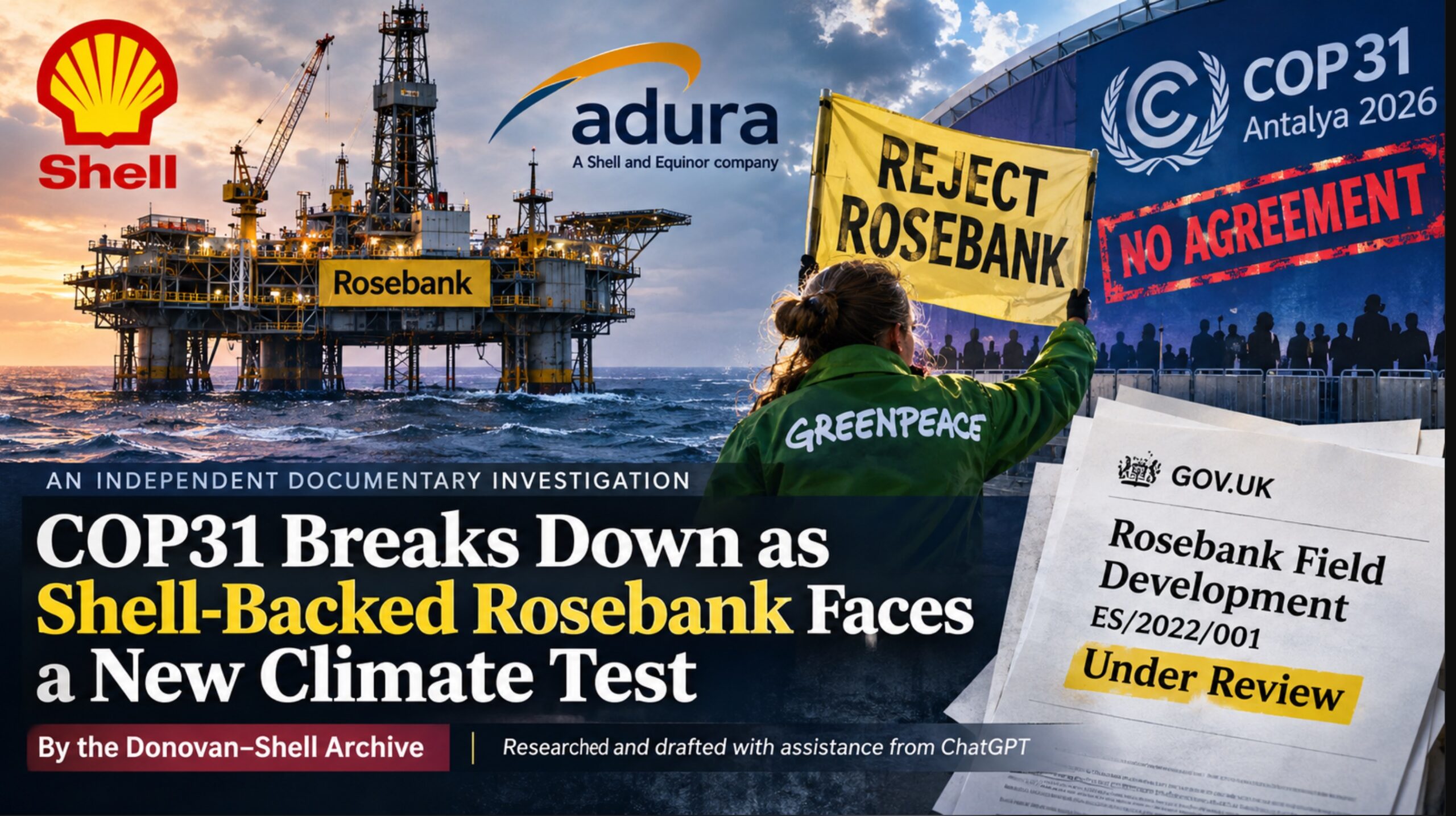
The collapse of negotiations over a central climate agreement at COP31 has brought renewed attention to one of Britain’s most controversial proposed oil developments. Within hours of the summit’s conclusion, Greenpeace demanded that Prime Minister Andy Burnham reject Rosebank, the multibillion-pound oilfield operated by Adura, the North Sea company jointly owned by Shell and Equinor. But the original regulatory documents reveal an important distinction: the international climate impasse has not changed Rosebank’s legal status. Its application remains under review, its previous development consent was set aside following a court challenge, and the government must make a fresh decision through the applicable regulatory process.
A failed climate agreement — and a new confrontation over Rosebank
On Sunday, 22 November 2026, the United Nations climate conference COP31 concluded in Antalya, Türkiye, without agreement on its proposed overarching political declaration.
The disputed draft, commonly described as the Antalya Pact, failed to obtain the consensus required for adoption.
The United Kingdom, European Union and other participating countries objected to a text they considered inadequate, particularly because it did not explicitly address fossil fuels.
The breakdown was serious, although it would be incorrect to suggest that every aspect of COP31 failed. Other decisions were adopted, including measures concerning a just transition.
UN Climate Change Executive Secretary Simon Stiell acknowledged the failure to reach agreement on the principal political outcomes while emphasising that other negotiating decisions had been achieved.
The British government issued its own statement on 22 November.
It argued that the proposed agreement did not adequately reflect the urgency of the climate crisis and reaffirmed its commitment to accelerating the transition away from fossil fuels.
The government’s position is documented in its official statement, UK Government Position on COP31 Outcome.
The UN’s account is available in Simon Stiell’s closing remarks.
These developments became directly relevant to Shell when Greenpeace UK issued a statement linking the failed negotiations to the government’s impending decision on Rosebank.
Its message was unambiguous.
The organisation wanted the British government to demonstrate its climate commitment by refusing permission for the offshore development.
This was a new intervention in an existing controversy, rather than the announcement of a new lawsuit or regulatory decision.
GOV.UK+2
Greenpeace demands that Britain reject Rosebank
On 22 November, Greenpeace UK published a statement headed:
Fossil Fuel Interests Torpedoed COP31: Burnham Must Confront Them Back Home.
Its co-executive director, Areeba Hamid, attributed the failure of the talks partly to fossil-fuel lobbying and disagreements over climate finance.
She acknowledged the Prime Minister’s participation at COP31 but argued that Britain now needed to demonstrate leadership domestically.
Greenpeace specifically called for Rosebank to be rejected.
The significance of this intervention lies in its timing.
Rosebank is not a theoretical future project. It is a major development for which substantial preparatory investment has already been undertaken.
The question of whether it should proceed is before the British regulatory authorities.
Greenpeace is seeking to connect the government’s international climate position with the decision it must make on the proposed oilfield.
There is, however, an essential evidentiary distinction.
Greenpeace’s allegation that fossil-fuel interests obstructed COP31 is its own assessment. The documents examined for this investigation do not establish that Shell or Adura individually caused the failure of the negotiations.
Nor does the statement identify a judicial finding that Shell engaged in improper lobbying at COP31.
The campaign’s direct relevance to Shell is instead that Rosebank is operated by a company in which Shell holds a substantial ownership interest.
To understand that relationship, the corporate structure matters.
Who actually owns Rosebank?
Shell does not directly operate Rosebank as a standalone Shell UK project.
On 1 December 2025, Shell and Equinor completed the creation of Adura, combining substantial parts of their British offshore oil and gas operations.
Shell’s announcement stated that the new company would be owned equally by the two groups.
Each holds 50%.
Adura subsequently became the operator of Rosebank.
According to Ithaca Energy’s official project information, Adura holds an 80% working interest in the field, while Ithaca holds the remaining 20%.
The ownership structure therefore involves three distinct levels.
Shell and Equinor own Adura jointly.
Adura is the project operator and majority interest holder.
Ithaca Energy is the minority participant.
This distinction is important when discussing corporate responsibility, investment decisions and project risk.
Adura is a separate corporate entity, although Shell has a substantial indirect economic interest in its activities.
The development cannot accurately be described as wholly owned or operated directly by Shell plc.
Shell’s own announcement confirms that Rosebank was among the projects transferred into Adura’s portfolio.
The relevant corporate disclosures are:
Shell and Equinor Complete Formation of Adura — 1 December 2025
Ithaca Energy — Rosebank Project and Ownership
These records establish Shell’s connection to the project without requiring speculation about the relationship.
Shell Global+1
The original approval was overturned
Rosebank’s present difficulties arise partly from an important earlier judicial decision.
In January 2025, Scotland’s Court of Session ruled that previous development consents for Rosebank and the separate Jackdaw gasfield had been granted unlawfully.
The central problem concerned environmental impact assessments.
The original assessments had not adequately included the downstream greenhouse-gas emissions resulting from the eventual use of the oil and gas extracted.
These are commonly described as Scope 3 emissions.
The decision followed the UK Supreme Court’s interpretation of environmental impact assessment requirements in the Finch litigation.
In the Rosebank and Jackdaw proceedings, the Scottish court determined that the relevant consents could not stand as previously granted.
The judgment is identified as Petitions of Greenpeace Limited and Uplift, [2025] CSOH 10.
This did not constitute a permanent judicial prohibition on either development.
Instead, the authorities needed to reconsider the applications in accordance with the applicable environmental assessment requirements.
Adura’s own Rosebank project website acknowledges the January 2025 ruling and explains that the earlier consents were no longer valid.
It also states that preparatory work could continue while the fresh consenting process was undertaken.
The distinction is significant.
A project may have an investment decision, construction contracts and substantial equipment in preparation without having every regulatory permission required to commence production.
That is the position in which Rosebank has found itself.
Primary developer source: Adura — Rosebank.
Contemporaneous legal reporting: Greenpeace — January 2025 Court Decision.
Adura+1
The government register provides the decisive evidence
The most important documentary finding in this investigation concerns the project’s present regulatory status.
The British government’s Offshore Petroleum Regulator for Environment and Decommissioning maintains an online record of the Rosebank development application.
That record was most recently updated on 5 November 2026.
Its current heading identifies the project as:
Rosebank Field Development — Adura Operations Limited — ES/2022/001 — Under Review.
The register records that further environmental information was requested from the developer during 2025 and 2026.
It also confirms receipt of additional information on 19 June 2026.
A further period of public consultation opened on 16 July and closed on 17 August 2026.
On 5 November, the regulator added redacted representations submitted during the July consultation.
Those representations are available through the government’s official project record.
The publication of consultation submissions does not mean the arguments contained in them have been accepted by the regulator.
They form part of the evidence and representations available for consideration.
As of 23 November 2026, the official register continues to describe Rosebank as under review.
No fresh approval or refusal resulting from the renewed environmental assessment is recorded there.
This is more authoritative than speculation about the likely political outcome.
Original regulatory record: GOV.UK — Rosebank Field Development.
GOV.UK
The significance of the 5 November document release
The latest additions to the government record deserve particular attention.
The regulator has published five sets of redacted representations associated with the July 2026 public notice.
These extensive documentary collections provide a route for examining the arguments and technical concerns raised during the renewed consultation.
However, publication of the material should not be confused with a determination of its merits.
Individual submissions may contain scientific arguments, commercial assessments, legal interpretations or expressions of public concern.
Their inclusion on an official government website confirms that they were received and published.
It does not establish that every statement in them is correct.
An examination of those records would require distinguishing the evidence presented by different parties from the regulator’s eventual findings.
The documents may prove valuable for understanding how competing claims about Rosebank’s environmental consequences were placed before the authorities.
But the present investigation does not claim to have independently evaluated every submission in those extensive collections.
What is already established is that the renewed process has generated a substantial public documentary record.
That should provide an important basis for examining the government’s eventual decision.
The economic argument advanced by Adura
Adura presents Rosebank as an important investment in Britain’s energy infrastructure and industrial economy.
In a statement issued on 16 July 2026, the company described the development as involving approximately £8.7 billion of investment.
It argued that approval would support British supply-chain businesses, employment, energy production and economic activity.
Adura also discussed Rosebank alongside Jackdaw, another major North Sea development within its portfolio.
The company estimated that the two projects together could generate £28.7 billion in gross value added over their producing lifetimes.
It also projected employment and tax benefits.
These estimates form an important part of the case for development.
However, they require careful interpretation.
The £28.7 billion figure concerns Rosebank and Jackdaw combined, not Rosebank alone.
It is a company projection, rather than a guaranteed economic result.
Similarly, estimated jobs and future tax revenues are dependent on assumptions concerning project execution, operations, production, costs and market conditions.
The company’s Rosebank project information separately forecasts an average of approximately 525 UK-based full-time jobs during the field’s lifetime.
These are material considerations for the affected workforce, local suppliers and the wider economy.
They should not be dismissed merely because environmental campaigners oppose the project.
But neither should they be represented as independently verified outcomes.
Corporate source: Adura — Public Consultation Opens on £8.7 Billion Rosebank Project, 16 July 2026.
Adura
An important distinction about emissions
Adura also presents Rosebank as a comparatively low-emissions offshore production development.
Its project information describes an expected production emissions intensity of approximately 12 kilograms of carbon dioxide per barrel before electrification.
The company says that electrifying the production vessel could substantially reduce operational emissions.
Those claims concern the emissions generated in extracting and processing hydrocarbons.
They must be distinguished from the emissions generated when the oil and gas are ultimately used.
A low operational emissions intensity does not mean that burning the extracted products creates no greenhouse-gas emissions.
Conversely, a project with substantial downstream emissions is not necessarily unlawful merely because those emissions exist.
The regulatory question concerns the applicable statutory assessment, the evidence before the decision-maker and the legal requirements governing consent.
That distinction was central to the earlier court proceedings.
It also explains why the renewed environmental assessment is consequential.
The court required the relevant downstream effects to be considered.
It did not establish an automatic rule that every petroleum development must be refused because its products produce greenhouse gases.
The distinction between proper environmental assessment and a predetermined approval or refusal is fundamental to the legal process.
Does Rosebank improve British energy security?
The competing arguments about energy security also deserve scrutiny.
Adura says Rosebank will contribute to domestic energy supplies and support Europe’s wider energy needs.
Its project description explains that oil would be carried by shuttle tankers to refineries, while gas would travel through the West of Shetland pipeline system into the British gas network.
That difference matters.
Oil produced in British waters is not necessarily consumed by British households or sold at a special domestic price.
Oil prices are substantially influenced by international markets.
Gas delivered into Britain’s infrastructure may contribute more directly to domestic physical supply, although its price is also influenced by wider market conditions.
On 21 November, The Times reported comments by Energy Secretary Miatta Fahnbulleh indicating that Rosebank’s approval would not itself reduce household bills because the oil would be traded in international markets.
That is an important challenge to overly broad claims about consumer benefits.
But the opposite assertion—that domestic production has no possible energy-security value—would also require qualification.
Domestic gas supply, infrastructure utilisation, employment, import dependence and international pricing are different questions.
A project may affect some of them without producing a meaningful reduction in retail energy bills.
These distinctions should form part of the government’s and public’s assessment.
Source: The Times — Rosebank Oilfield Won’t Cut Bills, Warns Energy Secretary, 21 November 2026.
The COP31 breakdown does not itself decide Rosebank
This is the central legal qualification.
COP31’s failure to agree an overarching political declaration does not confer development consent on Rosebank.
Nor does the British government’s rejection of the proposed Antalya Pact legally require it to refuse Rosebank.
Likewise, Greenpeace’s demand is a legitimate intervention in public debate, not a binding instruction to the regulatory authorities.
The project must be assessed under the legislation and regulatory requirements that govern it.
There are potentially important questions about how international climate commitments inform domestic policy and legal decision-making.
But those questions cannot be resolved simply by asserting that a political statement made at COP31 dictates the outcome of an individual petroleum development application.
The environmental assessment must be considered properly.
The relevant statutory requirements must be satisfied.
The decision must be made by the responsible authorities.
The outcome may ultimately be challenged in court, but the existence of that possibility does not establish in advance that a decision would be unlawful.
This is especially important because both sides of the Rosebank debate have strong reasons to argue their positions forcefully.
Campaigners believe further major oil developments are inconsistent with the urgent reduction of greenhouse-gas emissions.
Industry supporters believe continued investment in established North Sea resources can protect skilled employment, strengthen supplies and reduce the economic disruption associated with declining domestic production.
Both positions can be examined without presenting either as an established judicial finding.
A further complication: Britain’s changing North Sea policy
The Rosebank decision is also taking place during an important change in British energy policy.
On 4 November 2026, the government introduced the Energy Independence Bill, including proposals intended to restrict new oil and gas exploration licensing.
The Donovan–Shell Archive examined those proposals in an earlier investigation:
That investigation established an important distinction between prohibiting new exploration licences and permitting certain further developments associated with existing resources.
Rosebank must not be treated as automatically prohibited by a policy announcement concerning future exploration.
Its current consent application requires consideration on its own terms.
The new COP31 controversy adds political pressure to an existing regulatory decision.
It does not erase the distinctions identified in the earlier investigation.
What Shell’s involvement means
For Shell, Rosebank represents more than a political argument about British climate policy.
Through its 50% ownership of Adura, Shell participates in a company whose future depends partly on the continued operation and development of North Sea petroleum assets.
Adura includes producing fields, established infrastructure and major development projects.
Its commercial prospects are affected by regulatory approvals, production volumes, costs, taxation, environmental obligations and eventual decommissioning responsibilities.
Rosebank is a particularly visible example because of its scale and the controversy surrounding its environmental assessment.
An approval could permit the project to advance towards production, subject to the necessary remaining requirements.
A refusal could have significant implications for Adura and the project’s other investors.
But those consequences should not be confused with evidence of improper conduct.
The documentary record examined here does not establish that Shell has manipulated the consent process or secured preferential treatment.
Nor does it establish that its investment interest should be ignored when assessing the significance of the pending decision.
Shell’s position is commercially material because of its ownership interest in Adura. The legal responsibility for the renewed application lies within the actual corporate and regulatory arrangements governing the project.
That is the basis on which the development should be reported.
The unanswered questions
Several important questions remain open.
The first is whether the government considers the renewed environmental information sufficient to satisfy the relevant assessment requirements.
The second concerns how the evidence about downstream greenhouse-gas emissions will be evaluated.
The third is how environmental findings will be weighed within the statutory framework governing consent.
The fourth concerns the degree to which the developer’s projected economic and energy-security benefits can be substantiated.
The fifth concerns timing.
Adura’s project information anticipates production beginning in 2027, but that timetable depends upon securing necessary permissions and completing the relevant development work.
A commercial timetable is not a substitute for regulatory approval.
The eventual government decision should be examined alongside the underlying environmental assessment, the statutory reasoning and the material made available to the public.
If permission is granted, the documentary questions will concern why the authorities considered the applicable legal requirements satisfied.
If permission is refused, the corresponding questions will concern the legal and evidentiary grounds for refusal.
Either outcome deserves examination on its actual merits.
Documentary findings
The following distinctions are essential to an accurate understanding of the available evidence.
Established facts: COP31 concluded on 22 November 2026 without agreement on its proposed overarching political declaration. The United Kingdom rejected the draft as inadequate. Greenpeace UK subsequently demanded that Rosebank be refused. Shell and Equinor each own 50% of Adura. Adura operates Rosebank and holds an 80% working interest, with Ithaca Energy holding 20%. The earlier development consent was affected by the January 2025 Scottish court ruling. The official government register continues to describe the renewed Rosebank environmental assessment as under review.
Positions and projections: Greenpeace argues that further oil development is inconsistent with urgent climate action. Adura argues that Rosebank would provide substantial investment, employment and energy-security benefits. Its investment and economic figures are company estimates. The competing climate and economic arguments remain matters of public and regulatory debate.
Not established: No evidence examined for this investigation demonstrates that Shell or Adura individually caused the failure of COP31. The summit’s breakdown does not itself approve or prohibit Rosebank. No fresh Rosebank development consent or refusal was identified in the official register as of 23 November 2026. No conclusion about the lawfulness of a future decision can be reached before that decision and its reasons are known.
Conclusion: an international failure meets a domestic decision
The immediate importance of the COP31 breakdown lies in what it reveals about the continuing disagreement over the future of fossil fuels.
Governments remain divided over the pace and form of the transition.
Climate campaigners argue that delay is becoming increasingly dangerous.
Oil and gas producers and their supporters contend that energy security, industrial employment and the economics of existing infrastructure require continued consideration.
These conflicts are now converging on Rosebank.
For Greenpeace, refusing the project would demonstrate that Britain is willing to act domestically upon the principles it defended internationally.
For Adura and its investors, the project represents a major industrial development that the company argues would provide important economic and energy benefits.
For Shell, the significance is indirect but substantial, reflecting its half-ownership of Adura.
For the British government, the responsibility is different.
It must make a decision that is defensible under the applicable law and based upon the relevant evidence.
The documents examined establish that Rosebank remains under review.
They do not establish which outcome the government will choose.
The appropriate test of the eventual decision will not be whether it satisfies the demands of one campaign group or the commercial preferences of one energy company. It will be whether the responsible authorities have applied the law correctly, examined the evidence adequately and explained their conclusions transparently.
The COP31 breakdown has intensified the debate.
The Rosebank decision itself remains to be made.
Principal documentary sources
United Kingdom Government — 22 November 2026
UK Government Position on COP31 Outcome
Official statement explaining the UK’s rejection of the proposed COP31 cover decision and its continuing international climate-policy commitments.
United Nations Framework Convention on Climate Change — 22 November 2026
Simon Stiell’s Closing Remarks at COP31
Official account acknowledging the failure to reach agreement on the principal political outcomes while identifying other negotiating decisions.
Greenpeace UK — 22 November 2026
Fossil Fuel Interests Torpedoed COP31: Burnham Must Confront Them Back Home
The campaign organisation’s original statement calling upon the British government to reject Rosebank.
Offshore Petroleum Regulator for Environment and Decommissioning — Updated 5 November 2026
Rosebank Field Development — Official Regulatory Register
Primary government record of the Rosebank environmental assessment, consultation dates, further information received, published representations and current review status.
Shell plc — 1 December 2025
Shell and Equinor Complete Formation of Adura
Primary corporate disclosure establishing the ownership of Adura and the inclusion of Rosebank within its portfolio.
Ithaca Energy — Corporate Project Information
Confirmation of Adura’s 80% working interest and Ithaca Energy’s 20% participation.
Adura — Corporate Project Information
Developer’s account of project arrangements, proposed production, operating emissions, claimed economic benefits and legal background.
Adura — 16 July 2026
Public Consultation Opens on £8.7 Billion Rosebank Project
Developer’s economic projections and account of the renewed public consultation.
Donovan–Shell Archive — 4 November 2026
Britain’s New Oil and Gas Ban Has a Second Door
Earlier independent investigation examining the distinction between new exploration licensing and additional development under existing North Sea arrangements.
Documentary disclaimer
This article is an independent documentary investigation based upon publicly accessible government records, United Nations statements, corporate disclosures, regulatory publications, court-related material, campaign statements and contemporary reporting available as of 23 November 2026.
The breakdown of the COP31 negotiations is an established event. The assertion that fossil-fuel interests were responsible for that breakdown is attributed to Greenpeace and is not presented as a judicial or regulatory finding against Shell or Adura.
Shell plc’s connection with Rosebank arises through its 50% ownership of Adura, a separate company jointly owned with Equinor. The article distinguishes Shell’s ownership interest from Adura’s role as operator and Ithaca Energy’s minority participation.
The economic, employment, production and emissions estimates discussed are attributed to their respective sources. Company forecasts are not represented as guaranteed outcomes or independent official findings.
The previous Rosebank development consent was affected by the January 2025 Court of Session ruling. The continuing regulatory process is distinguished from the earlier consent and from the political debate following COP31.
The official Rosebank environmental-assessment register was checked during preparation of this article and continued to record the project as under review. No claim is made that a fresh approval or refusal has been issued.
The article does not allege that Shell or Adura unlawfully influenced the COP31 negotiations, improperly interfered with the British regulatory process or secured unlawful preferential treatment.
References to the positions of environmental campaigners, government representatives and the developer are clearly attributed. Editorial analysis is distinguished from established factual findings.
The Donovan–Shell Archive welcomes substantiated corrections, authenticated documents and responses from Shell, Adura, Ithaca Energy, government authorities, Greenpeace and other parties concerned.
This investigation has been researched and drafted with assistance from ChatGPT. It is independent documentary journalism and analysis, not legal advice or a determination of any party’s legal liability.