If you ever needed a case study in how fossil fuel profits can turn into long-term liabilities, look no further than Groningen — where the bill for decades of gas extraction has finally landed… and nobody wants to pay it.
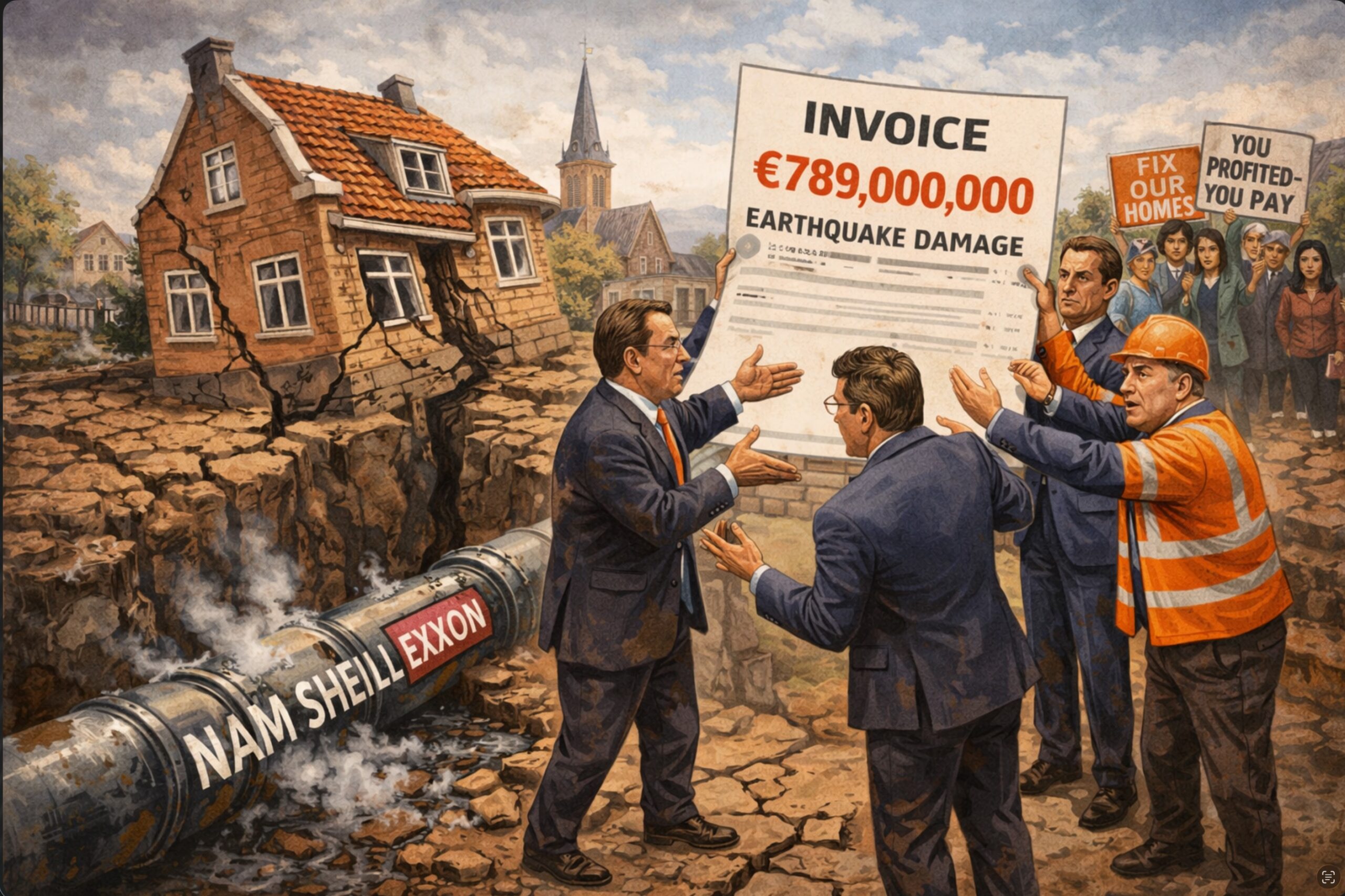
This week, the Dutch state and Nederlandse Aardolie Maatschappij (NAM) — the Shell-Exxon joint venture that once turned Groningen into Europe’s gas powerhouse — faced off in court over who should cover hundreds of millions of euros in earthquake damage compensation.
The sum in dispute? A modest €789 million. Pocket change for an oil major — until it isn’t.
From Energy Treasure to Seismic Nightmare
For decades, Groningen was a crown jewel of European energy supply. Discovered in 1959, the gas field became one of the largest in the world, generating hundreds of billions in revenue for the Dutch state and its corporate partners — including Shell.
Then came the earthquakes.
Gas extraction caused the ground to shift, triggering thousands of tremors that damaged homes, destabilised buildings, and eroded public trust. Entire communities found themselves living above what increasingly felt like a slow-motion disaster.
By the 2010s, it became impossible to ignore. Public outrage forced the Dutch government to begin winding down production — a process now largely complete.
But closing the taps did not make the consequences disappear.
The €789 Million Question: Who Pays?
At the centre of the current legal battle is a deceptively simple question:
Who should pay for the damage caused by decades of gas extraction?
The Dutch government argues that NAM — and therefore its shareholders, Shell and ExxonMobil — should cover a significant portion of the compensation costs.
NAM, unsurprisingly, sees things differently.
The company has argued that agreements with the Dutch state limit its liability, effectively shifting more of the financial burden onto taxpayers. In other words: the profits were shared, but the clean-up — well, that’s open to interpretation.
The result is a courtroom standoff where both sides are attempting to redraw the boundaries of responsibility — years after the damage was done.
Shell’s Familiar Pattern
For critics, the Groningen dispute fits a broader pattern.
Shell has long faced accusations of extracting value first and dealing with consequences later — from oil spills in Nigeria to climate litigation in Europe.
In Groningen, the controversy is particularly stark because the damage is not theoretical or long-term. It is visible, structural, and personal.
Cracked walls. Unsafe homes. Communities still waiting for compensation.
And now, a legal argument over who picks up the tab.
Investors Watch — Quietly
Behind the scenes, Shell’s largest institutional investors — including BlackRock, Vanguard, and State Street — will be watching closely.
Not because €789 million threatens Shell’s survival. It doesn’t.
But because Groningen represents something far more significant:
a precedent.
If courts determine that oil and gas companies must bear greater responsibility for the long-term consequences of extraction, the financial implications could extend far beyond the Netherlands.
In an era of increasing climate litigation, that possibility matters.
The Cost of “Cheap” Energy
For years, Groningen gas helped power Europe with relatively low-cost energy. Governments benefited. Corporations profited. Consumers enjoyed stable supply.
But as the current dispute makes clear, “cheap” energy often comes with deferred costs.
Costs that eventually surface — sometimes decades later — in courtrooms rather than balance sheets.
A Reckoning, Long Overdue
The Groningen case is not just about €789 million.
It is about accountability.
It is about whether companies like Shell can limit their exposure to the long-term consequences of their operations — even when those consequences shake entire regions.
And it is about whether governments, having once championed fossil fuel extraction, are willing to force their former partners to share the burden when things go wrong.
For residents of Groningen, the answer cannot come soon enough.
For Shell, it’s another reminder that the past has a habit of catching up — usually with interest
DISCLAIMER
This article is opinion and commentary based on publicly reported information and is intended for informational and journalistic purposes only. It does not constitute financial or investment advice. Readers should conduct their own independent research before making any financial decisions.
*This website and sisters royaldutchshellgroup.com, shellnazihistory.com, royaldutchshell.website, johndonovan.website, shellnews.net, and shellwikipedia.com, are owned by John Donovan - more information here. There is also a Wikipedia segment, the Shell DPA Files, "Shell and the Spies", the Shell Leaks files, as well as books written and published by John Donovan - Kindle eBooks. Timeline of the Donovan Shell Feud. Toxic History of Royal Dutch Shell Group. Shell and the Donovans: The Full Media Record — 550+ Articles, 110 Books, 40 Years. *All created and supported by internet wizz, Nick Gill.