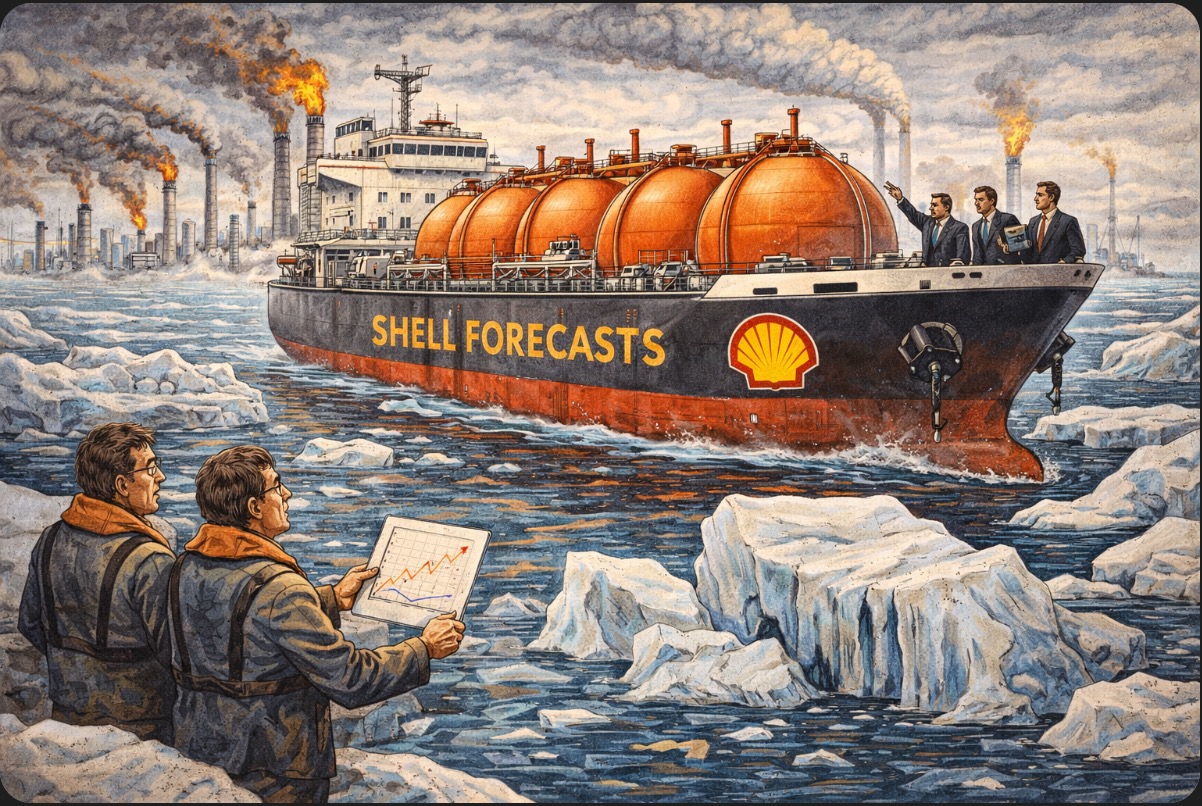
A massive LNG tanker labelled “Energy Transition” crossing a bridge made of pipelines. The bridge stretches endlessly into the horizon, never reaching land. Below, rising sea levels and melting icebergs. Shell executives stand on deck pointing forward, while climate scientists look concerned in the water below.
Shell has delivered its latest vision of the future — and, surprise, it looks remarkably like the past, just chilled to minus 162°C.
According to its newest outlook, global demand for liquefied natural gas (LNG) is expected to rise by at least 54% by 2040, reinforcing the company’s long-standing belief that the world simply cannot quit fossil fuels — even as it promises to do exactly that.
In other words: the energy transition is alive and well — as long as it runs on gas.
The Forecast: More Gas, More Growth, More… Everything
Shell, the world’s largest LNG trader, says demand could climb to between 630 million and 718 million tonnes annually by 2040, driven largely by:
-
Rapid economic growth in Asia
-
Industrial demand (especially replacing coal)
-
Expanding energy needs from sectors like AI and heavy industry
China, India, and Southeast Asia are expected to lead the charge, with LNG framed as a “cleaner” alternative to coal — a narrative the industry has been polishing for years.
Even Europe, despite its green ambitions, is expected to remain dependent on LNG to balance intermittent renewables and maintain energy security.
So while policymakers talk about wind and solar, Shell is quietly betting on… more gas.
The Convenient Role of LNG: The “Bridge” That Never Ends
The industry’s favourite phrase — “bridge fuel” — makes another appearance.
Gas, we are told, is the stepping stone between coal and a renewable future.
The only problem? The bridge appears to be getting longer.
Much longer.
Because if demand is rising by more than 50% through 2040, that suggests not a temporary transition — but a multi-decade expansion of fossil fuel infrastructure.
And infrastructure, once built, tends to stick around.
War, Volatility — and Opportunity
Recent geopolitical instability — including tensions affecting global energy markets — has only strengthened Shell’s case.
Disruptions to traditional gas supplies and concerns over energy security have pushed countries toward LNG imports as a flexible alternative.
Shell’s message is clear:
In an uncertain world, gas isn’t the problem — it’s the solution.
Or, more precisely, it’s the most profitable solution currently available.
The Climate Reality Check
Here’s where things get awkward.
While Shell forecasts booming LNG demand, other bodies — including the International Energy Agency — have suggested that global gas demand could peak much sooner if the world is serious about meeting climate targets.
That creates a glaring contradiction:
-
Shell’s outlook assumes continued fossil fuel growth
-
Climate goals require rapid fossil fuel decline
Both cannot be true at the same time.
And yet, in boardrooms and investor presentations, the tension is often smoothed over with carefully chosen language and optimistic timelines.
Follow the Money (Again)
Shell’s LNG strategy isn’t just about energy — it’s about positioning.
LNG is one of the company’s most profitable and strategically important businesses, offering:
-
Long-term contracts
-
Global trading flexibility
-
Strong margins compared to many renewables
And investors — including BlackRock, Vanguard, and State Street — have consistently backed strategies that prioritise stable returns over rapid transformation.
Which helps explain why LNG continues to feature so prominently in Shell’s future plans.
The Bigger Picture: Transition or Expansion?
Shell insists that gas will help reduce emissions by replacing coal, particularly in fast-growing economies.
Critics counter that:
-
LNG still produces significant emissions
-
Methane leakage undermines its “cleaner” credentials
-
Expanding gas risks locking in fossil fuel dependence for decades
Both arguments contain truth.
But only one aligns neatly with Shell’s business model.
Conclusion: The Future, According to Shell
If Shell’s forecast proves accurate, the world of 2040 will still be heavily reliant on fossil fuels — just in a slightly different form.
Less coal, perhaps. More LNG. Plenty of profits.
And the energy transition?
Still in progress. Still promised. Still just over the horizon
DISCLAIMER
This article is opinion and commentary based on publicly available information and reporting, including Reuters and Bloomberg. It is intended for informational and journalistic purposes only and does not constitute financial or investment advice. Readers should conduct their own independent research before making financial decisions.
*This website and sisters royaldutchshellgroup.com, shellnazihistory.com, royaldutchshell.website, johndonovan.website, shellnews.net, and shellwikipedia.com, are owned by John Donovan - more information here. There is also a Wikipedia segment, the Shell DPA Files, "Shell and the Spies", the Shell Leaks files, as well as books written and published by John Donovan - Kindle eBooks. Timeline of the Donovan Shell Feud. Toxic History of Royal Dutch Shell Group. Shell and the Donovans: The Full Media Record — 550+ Articles, 110 Books, 40 Years. *All created and supported by internet wizz, Nick Gill.