By John Donovan
A combined and satirical rewrite of three John Donovan archive chapters on Shell corporate espionage, later cyber-monitoring activity, and the sensitive Shell issues that may have kept the corporate-security boiler room bubbling.
Source chapters: Chapter 5: Shell corporate espionage in the run-up to the Smart trial, Chapter 12: Shell corporate espionage in more recent years, and Chapter 13: What prompted the more recent sinister activity?.

There are oil companies, and then there is Shell: part energy giant, part legal steamroller, part international archive of “how did that memo get out?” moments. According to the Donovan archive, when Shell found itself facing criticism, litigation and leaks, the response was not always limited to sober correspondence on heavy paper. No, this was Shell in spy-thriller mode: lawyers, private investigators, corporate intelligence firms, redacted emails, “legally privileged” battle-plans and enough cloak-and-dagger atmosphere to make a boardroom smell faintly of raincoats.
The three chapters combined here tell one broad story. First came the run-up to the Shell SMART High Court trial, when Don Marketing and the Donovans say witnesses and evidence were targeted by undercover activity. Then came the later era of global monitoring, when Shell emails and the Reuters report archived by ShellNews.net recorded Shell’s concern about the Donovan websites. Finally came the obvious question: what, exactly, had Shell so jumpy?
The answer, in the archive’s telling, is a full buffet: Shell’s corporate history books, Nazi-era material, Iran, Dr John Huong, Sakhalin II, Motiva, Shell employee leaks, and the general irritation of a critic who would not stay quietly in the corner while the oil giant adjusted its cufflinks.
Act One: The SMART Trial, Or Shell Discovers The Trench Coat
Chapter 5 begins in the late 1990s, when the dispute over Shell’s SMART loyalty-card scheme was heading toward the High Court. John Donovan had already written to Shell executives about investigative activity, including a 15 June 1998 letter to Dr Chris Fay and an earlier 23 April 1998 letter to Sir Peter Holmes MC. The timing was not casual. A breach of confidence writ had been served, and press coverage was already circling, including Financial Mail on Sunday and Marketing Week.
According to the source chapter, witnesses were approached by an undercover agent posing as a journalist, while evidence was accessed under false pretences. The archive says evidence was also scrutinised and tampered with during what police were said to have regarded unofficially as targeted burglaries. For a company whose published principles leaned heavily on “honesty, integrity and openness”, this was not so much brand alignment as brand gymnastics.
Shell later brought counterclaims against Don Marketing UK Limited, Alfred Donovan and John Donovan. The archive argues that the information-gathering and the counterstrategy were not separate weather systems. They were, in its view, part of the same storm front.
The Hakluyt Connection: When The Boardroom Grew A Secret Door
Chapter 5 places special emphasis on Hakluyt & Company, the London corporate intelligence firm founded by former senior MI6 officers and described in public sources as a private intelligence company. The archive notes that the late Sir Peter Holmes and Sir William Purves, both connected with Shell, were also linked with Hakluyt. If the Shell saga had a credits sequence, this is where the brass section would start getting excited.
Hakluyt’s name had already surfaced publicly in connection with Shell and environmental campaigners. The source chapter links to archive material on Hakluyt, Hakluyt coverage, Powerbase material, Shell and Hakluyt, and the Sunday Times front-page story on spying on green groups.
The point is not that every Shell executive was sitting behind a potted plant with a tape recorder. The point is sharper: Shell, a company that liked to talk in polished corporate language, had connections to a world where the language was intelligence, counterstrategy, sources, and deniable-looking activity. The archive’s satirical headline could write itself: “Oil Giant Shocked To Find Critics Still Criticising After Being Watched.”
The Correspondence Blizzard
One of the stranger features of the saga is how thoroughly documented it became. Letters flew between Don Marketing, Shell, Shell’s lawyers, DJ Freeman, Royds Treadwell, newspapers, police and senior Shell figures. The archive preserves, among many other items, a 21 May 1998 DJ Freeman letter, a 25 May 1998 response, correspondence from The European, Alfred Donovan’s letter to Mark Moody-Stuart, and a Suffolk Police letter.
There are also direct Shell legal communications, including a Richard Wiseman letter and trial material such as cross-examination material. The whole file reads like a paper factory having an argument with a litigation department.

Act Two: The Internet Arrives, And Shell Appears To Need A Bigger Notebook
By Chapter 12, the story has moved beyond the High Court and into the era of websites, servers, employee leaks, internal monitoring and cyber-flavoured anxiety. The archive says Shell’s later activity targeted John Donovan, his website and Shell’s own employees. The centrepiece is the Reuters report, now retained here via a working ShellNews.net archived copy, about Shell concern over the Donovan website.
The line that deserves its own tabloid splash is the one from a Shell email quoted in the Reuters report: “no attempt to do anything visible to Donovan”. The phrase is short, chilly and gloriously bureaucratic. It is the sort of sentence that enters a room wearing sensible shoes and leaves carrying the curtains.
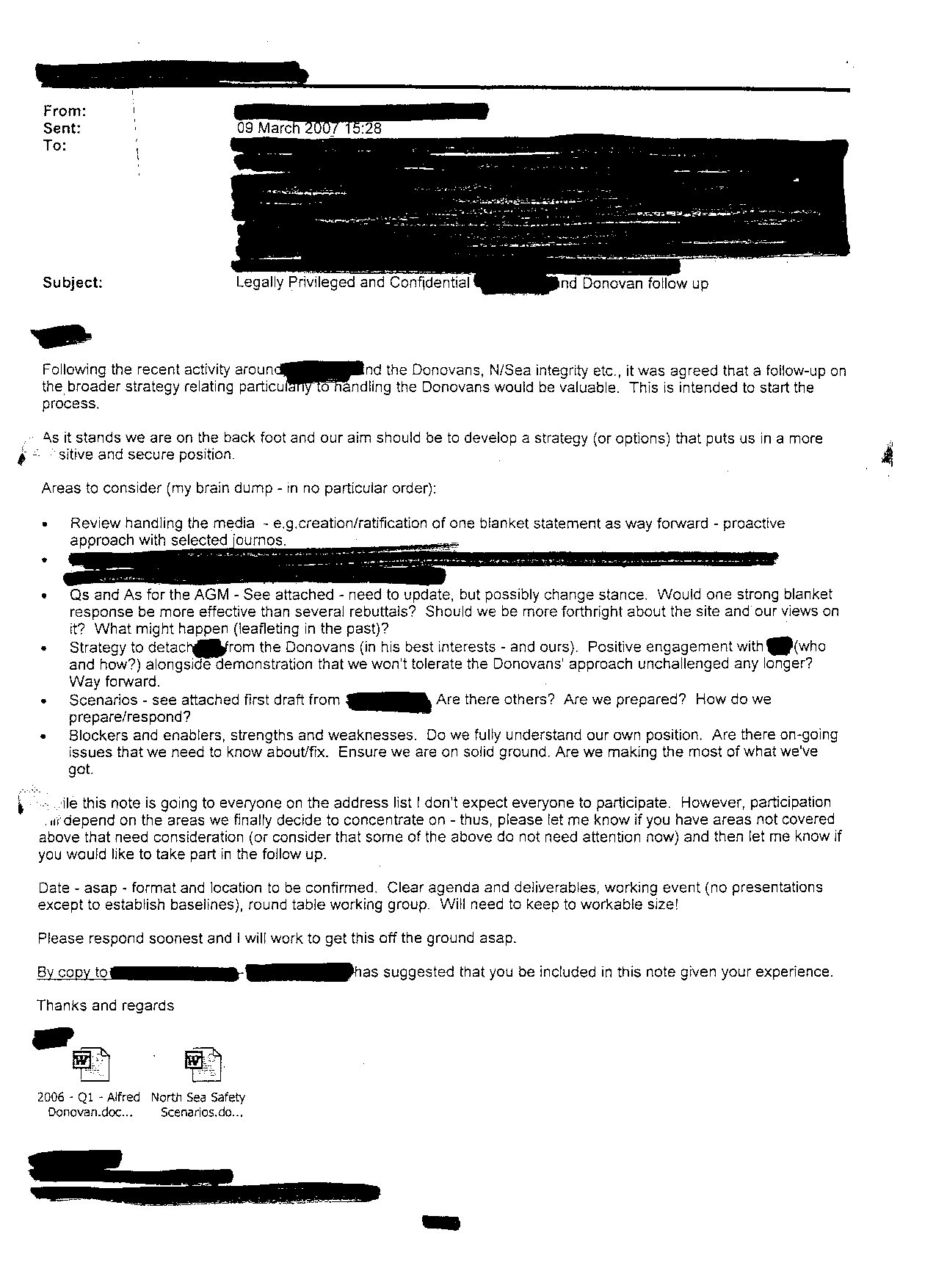
The same chapter links Shell internal material about a counter-measures team, including a 9 March 2007 internal email, a 19 March 2007 internal email, and a 20 March 2007 email. There are also annual “Focal Point” links for 2006, 2007, 2008, 2009 and 2010.
The archive also cites a Shell internal email about trying to “kill” a Sunday Times story, preserved as 2 February 2007 material, and an FT-related Shell email thread. If this was public relations, it came with a suspiciously large toolbox.

The Website Wars: BlueHost, Deactivation And The Digital Banana Skin
The later chapters also point to episodes involving the Donovan websites themselves. Chapter 12 links a 25 June 2007 email about BlueHost and deactivation, a related article on correspondence with Shell, a 2014 article on a denial-of-service attack, and a later account of Shell’s failed attempt to kill royaldutchshell.website.
For a multinational that could drill, ship, refine and lobby its way around the planet, the archive presents Shell as strangely flustered by a stubborn website. The grand irony is delicious: an oil major with global reach, pitted against an archive that survived partly because Shell kept creating material worth archiving.
Act Three: What Had Shell So Nervous?
Chapter 13 asks the obvious question. If the later activity happened as described, what caused the corporate-security kettle to boil? The chapter points first to CAS, described as a Shell Group Corporate Affairs unit populated by security and intelligence professionals. It also cites a June 2017 U.S. court document and related coverage of a falling-out among security professionals at Shell.

The chapter identifies several possible triggers. One was Shell’s own official history. Internal Shell emails from 11 March 2007, 19/20 March 2007 and 6 June 2007 showed concern that Donovan would scrutinise the new Shell history volumes, including Nazi-era material. This later fed into the Shell Nazi history strand, including Royal Dutch Shell, Tom Cruise, YouTube and Hitler and the article on whether Shell would block internet publication of its Nazi past.
Another trigger was Iran. Chapter 13 links the Wall Street Journal article Oil Trade With Iran Thrives, Discreetly, Donovan’s own article on Royal Dutch Shell Iranian treachery, an email to Bill O’Reilly at Fox News, and the resulting Shell Oil and Royal Dutch Shell correspondence. It also preserves a reactive press statement prepared by Shell.
Then there was Dr John Huong, the former Shell Malaysia geologist. The combined archive links to the Dr John Huong index, where Shell’s litigation against him and related documents are gathered. A critic with a website is one thing. A critic with whistleblower material, legal records and stubborn filing habits is quite another.
Sakhalin II also loomed large. Chapter 13 links How Chris Finlayson bungled the Mother of all Projects: Sakhalin II, the Financial Times-related Pipeliners All memo story, and the Daily Mail article Shell on back foot as gripe site alleges safety concerns. In tabloid terms: Big Oil met Little Website, then tripped over a leaked memo on the way out.
Motiva, Employees And The Leaky Pipe Problem
The archive also points to Motiva and employee commentary. Chapter 13 links Donovan’s email to Shell/Motiva vice president Tom Purves, a later article on a leaked Shell internal email from Tom Purves, a 21 March 2007 confidential Shell email, and a 17 June 2009 Shell email.
It also links a series of Shell Blog comments by posters including Jim Hartsock, Motivasux, Motivaman, JerrBear, another motivasux posting, grim reaper, and harley.
If Shell had a leak problem, it was not just geological. It was informational. The source chapters show employees, former employees, lawyers, campaigners and critics all feeding a public archive that Shell could not easily cap.
The Bigger Punchline: Shell Already Had Spies In Governments
Chapter 13 ends by widening the lens. It links the RoyalDutchShellPlc.com article Shell embedded spies in host governments of Nigeria, Dubai and Iraq and The Guardian’s WikiLeaks-based report Cables reveal Shell’s grip on Nigerian state. At that point, the Donovan story stops looking like an isolated feud and starts looking like a side window into a much larger corporate-security culture.
Of course, Shell would no doubt prefer the phrase “stakeholder management”. It sounds cleaner. It has PowerPoint energy. It wears a lanyard. But the archive trail says that behind the spotless phrases lay a harsher world: information-gathering, pressure, monitoring, counter-measures and legal muscle.
Final Word: The Petrol Pump With A Periscope
The delicious absurdity of the Shell-Donovan saga is that the more Shell appeared to watch, warn, threaten or manoeuvre, the more paperwork it generated. Every letter, memo, email, press clipping and court document became fuel for the archive. The company trying to control the narrative helped write it.
That is the tabloid moral of the tale: if you are a multinational oil giant with a reputation problem, perhaps do not behave like a spy novel with a compliance department. Because one day the filing cabinets open, the PDFs march out, and the public discovers that the petrol pump had a periscope all along.
Working Source Links Retained From The Three Chapters
The following working links are retained from the three source chapters, excluding social-share links, protected email links, and links that did not return a working response during the link check.
Chapter 5 Source Links
- Letter dated 15 June 1998
- Letter to Sir Peter Holmes MC dated 23 April 1998
- Breach of confidence writ on Shell
- Shell card in legal row
- High Court papers unveil secret Shell writ losses
- Shell defence and counterclaim
- The Neptune Strategy
- DJ Freeman letter dated 21 May 1998
- 25 May 1998 letter
- Response letter from The European
- Marie Neal
- McLibel case
- Alfred Donovan letter to Mark Moody-Stuart
- Letter to Dr Chris Fay
- Royds letter to DJ Freeman, 18 June 1998
- DJ Freeman response, 19 June 1998
- DJ Freeman response by Royds Treadwell
- Shell letter dated 24 June 1998
- DJ Freeman letter dated 3 July 1998
- DJ Freeman letter dated 26 October 1998
- Alfred Donovan letter to Colin Joseph, 23 November 1998
- Suffolk Police letter dated 16 October 1998
- Richard Wiseman letter
- Cross-examination material
- John Donovan letter to The European
- Letter from Lynn Moorlen of The European
- John Donovan letter to Dr Chris Fay
- DJ Freeman reply on behalf of Dr Fay
- John Donovan letter to The European, 16 June 1998
- Royds fax to DJ Freeman
- Royds letter to John Donovan
- John Donovan letter to Colin Joseph of DJ Freeman
- John Donovan letter to Mark Moody-Stuart
- John Donovan letter to Richard Wiseman
- DJ Freeman letter to Royds Treadwell
- Richard Wiseman letter to John Donovan
- Royds letter to DJ Freeman, 25 June 1998
- Richard Wiseman letter, 1 July 1998
- Richard Wiseman letter, 9 July 1998
- DJ Freeman letter, 9 July 1998
- DJ Freeman letter, 7 August 1998
- DJ Freeman letter, 11 August 1998
- Shell Hakluyt correspondence links
- Hakluyt & Company
- Hakluyt story, July 2008
- FT and Scotsman Hakluyt articles archive
- Powerbase: Hakluyt
- Shell connection with Hakluyt & Company Limited
- Sunday Times MI6 firm article
- Royal Dutch Shell spooks
- John Alfred Dyer statement
- Irish Times Corrib surveillance article
- Former head of GCHQ advising Shell and private intelligence firm
- Donovan takes SMART case against Shell to court
- The Guardian: Paul Brown profile
Chapter 12 Source Links
- Reuters archived copy: Shell critic says oil major targeting his website
- Havana syndrome
- Pentagon memo dated 15 September 2021
- DPA document 1
- DPA document 2
- DPA document 3
- DPA document 4
- DPA document 5
- DPA document 6
- Shell internal email dated 9 March 2007
- Shell internal email dated 19 March 2007
- Shell internal email dated 20 March 2007
- Focal Point 2006
- Focal Point 2007
- Focal Point 2008
- Focal Point 2009
- Focal Point 2010
- Exchange with Shell chairman John Jennings
- Shell internal email dated 11 March 2007
- Shell internal email dated 2 February 2007
- FT Shell DPA email thread
- DPA documents September/October 2010
- BlueHost deactivation email
- Correspondence with Shell on Ian Craig allegations
- RoyalDutchShellPlc.com under denial-of-service attack
- Shell’s failed blundering attempt to kill royaldutchshell.website
Chapter 13 Source Links
- June 2017 U.S. court document
- Spectacular falling out of security professionals at Shell
- Shell internal emails dated 19/20 March 2007
- Shell internal email dated 6 June 2007
- Oil Trade With Iran Thrives, Discreetly
- Royal Dutch Shell Iranian treachery
- Email to Bill O’Reilly at Fox News
- Fox News complete Shell correspondence
- Shell reactive press statement
- Dr John Huong index
- How Chris Finlayson bungled Sakhalin II
- Pipeliners All Shell memo to Sakhalin
- Daily Mail: Shell on back foot as gripe site alleges safety concerns
- DPA document dated 21 February 2007
- DPA document dated 19 March 2007
- DPA index page
- DPA document dated 9 September 2007
- DPA document dated 19 October 2007
- Focal Point 26 December 2007
- DPA document dated 19 February 2008
- DPA document dated 29 April 2008
- Focal Point 8 July 2009
- DPA document dated 30 July 2009
- Royal Dutch Shell, Tom Cruise, YouTube and Hitler
- Will Shell block internet publication of its Nazi past?
- Email to Shell/Motiva Vice President Tom Purves
- Leaked Shell email from Tom Purves
- Confidential Shell internal email, 21 March 2007
- Key Shell internal email, 17 June 2009
- Shell Blog comment by Jim Hartsock
- Shell Blog comment by Motivasux
- Shell Blog comment by Motivaman
- Shell Blog comment by JerrBear
- Shell Blog comment by motivasux
- Shell Blog comment by grim reaper
- Shell Blog comment by harley
- DPA documents single web page
- Shell embedded spies in host governments
- The Guardian: Cables reveal Shell’s grip on Nigerian state
Screenshot Exhibits Retained From The Source Chapters
The source chapters included many screenshot exhibits. The direct working image links are retained below.
Chapter 5 Screenshot Exhibits
- Screenshot exhibit 1
- Screenshot exhibit 2
- Screenshot exhibit 3
- Screenshot exhibit 4
- Screenshot exhibit 5
- Screenshot exhibit 6
- Screenshot exhibit 7
- Screenshot exhibit 8
- Screenshot exhibit 9
- Screenshot exhibit 10
- Screenshot exhibit 11
- Screenshot exhibit 12
- Screenshot exhibit 13
- Screenshot exhibit 14
- Screenshot exhibit 15
- Screenshot exhibit 16
- Screenshot exhibit 17
- Screenshot exhibit 18
- Screenshot exhibit 19
- Screenshot exhibit 20
- Screenshot exhibit 21
- Screenshot exhibit 22
- Screenshot exhibit 23
- Screenshot exhibit 24
- Screenshot exhibit 25
- Screenshot exhibit 26
Chapter 12 Screenshot Exhibits
- Screenshot exhibit 1
- Screenshot exhibit 2
- Screenshot exhibit 3
- Screenshot exhibit 4
- Screenshot exhibit 5
- Screenshot exhibit 6
- Screenshot exhibit 7
- Screenshot exhibit 8
Chapter 13 Screenshot Exhibits
- Screenshot exhibit 1
- Screenshot exhibit 2
- Screenshot exhibit 3
- Screenshot exhibit 4
- Screenshot exhibit 5
- Screenshot exhibit 6
- Screenshot exhibit 7
- Screenshot exhibit 8
- Screenshot exhibit 9
Related Donovan Websites And Background
shellplc.website and its sister non-profit websites royaldutchshellplc.com, royaldutchshellgroup.com, shellenergy.website, shellnazihistory.com, royaldutchshell.website, johndonovan.website, shellnews.net and shell2004.com are owned by John Donovan.
There is also a Wikipedia feature referring to RoyalDutchShellPlc.com.
*This website and sisters royaldutchshellgroup.com, shellnazihistory.com, royaldutchshell.website, johndonovan.website, shellnews.net, and shellwikipedia.com, are owned by John Donovan - more information here. There is also a Wikipedia segment, the Shell DPA Files, "Shell and the Spies", the Shell Leaks files, as well as books written and published by John Donovan - Kindle eBooks. Timeline of the Donovan Shell Feud. Toxic History of Royal Dutch Shell Group. Shell and the Donovans: The Full Media Record — 550+ Articles, 110 Books, 40 Years. *All created and supported by internet wizz, Nick Gill.