By John Donovan
A tabloid-satirical rewrite of Chapter 11 of the John Donovan Shell archive: “Shell insider information.”
Source chapter: CHAPTER 11: Shell insider information, first published 30 October 2018 and later modified on 29 June 2026.
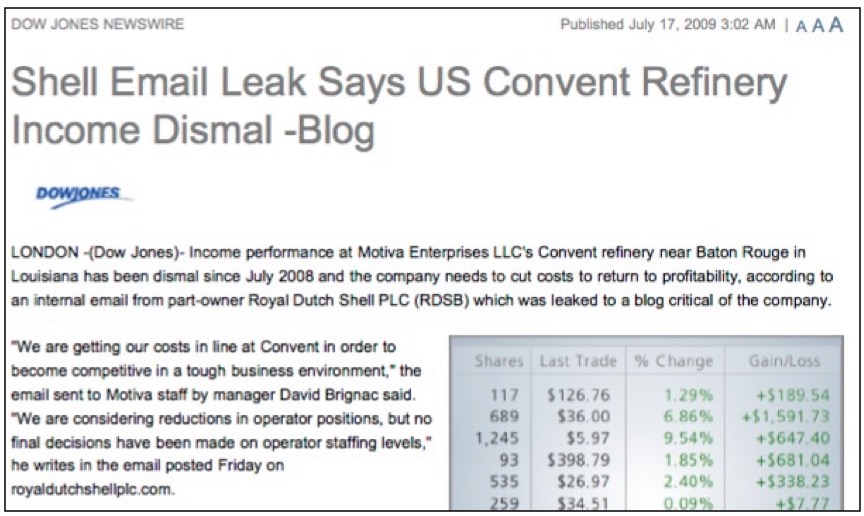
Every giant corporation has a fantasy version of itself: disciplined, confidential, on-message and guarded by enough procedure to make a filing cabinet salute. Chapter 11 is about what happens when that fantasy meets the awkward little realities of human beings, email, court records, leaks, Subject Access Requests and the occasional executive pressing the wrong button.
Shell had global communications teams, lawyers, security people and polished lines. John Donovan had sources, public court access, SAR applications, a website, and the patience to publish what Shell would presumably have preferred to leave in the corporate sock drawer.
The result was a recurring spectacle: insider material escaping from one of the world’s largest oil companies and turning up on RoyalDutchShellPlc.com, where journalists, employees, campaigners and Shell’s own people could read it. In tabloid terms, Shell’s internal plumbing had sprung a leak, and the bucket underneath it had a domain name.
The Four Leak Pipes
Chapter 11 identifies several sources of insider Shell information. The first was Shell itself, via Subject Access Requests. Those requests produced internal Shell documents and emails, including material that, according to the chapter, revealed a counter-measures team and a global spying operation aimed at stopping the flow of insider information to John Donovan.
The second source was disgruntled Shell employees and former employees. That is where the corporate bunker becomes awkward. A company can lock down its servers, polish its statements and hire expensive advisers, but it cannot always stop its own people from deciding that the outside world should see what is happening inside.
The third source was accidental disclosure. Chapter 11 recalls that in June 2004, Shell Legal Director Richard Wiseman accidentally sent John Donovan an email about Alfred Donovan that was apparently intended for senior Shell executives Jeroen van der Veer and Malcolm Brinded. If corporate secrecy were a circus act, that was the moment the trapeze artist dropped the memo into the audience.
The fourth source was litigation. The chapter says John Donovan paid to use the American PACER system to retrieve Shell-related court filings and publish many thousands of pages of legal documents, witness statements and case material that would otherwise be tucked behind a paywall. That is not hacking. That is public record with a torch shone on it.
The Voser Email: Same-Day Embarrassment Delivery
One of the chapter’s sharpest examples is the leaked internal email from Peter Voser, then incoming Chief Executive Officer of Royal Dutch Shell Plc. The source chapter links the 27 May 2009 RoyalDutchShellPlc.com article Leaked email Royal Dutch Shell exec Peter Voser sent at 10am today.
The point is not merely that an email leaked. It is the timing. Same-day publication of a senior executive’s internal message is a special kind of corporate indigestion. Shell’s leadership had barely warmed the chair before its communications were being served to the public with a headline and a side order of embarrassment.
Chapter 11 also links a front-page Financial Times-related story about Shell’s revamp and management shake-up. The broader theme is plain: insider information was not just website gossip. It could become mainstream financial news.

When Shell Accidentally Supplied The Plot
The Wiseman email is important because it shows how an accidental message could confirm what the Donovans had long suspected: Shell’s most senior people were being kept informed about their activities. According to Chapter 11, the email also suggested that Shell “PX” kept a standard response about the Donovans ready for use.
That is deliciously corporate. Somewhere, apparently, there was a ready-to-serve Donovan line: just add media query and stir. Yet, according to the chapter, the item itself was never produced despite numerous SAR applications.
Thus the accidental email became more than a mistake. It became evidence of the machinery behind Shell’s public face. The curtain twitched; the archive noticed.
Retired Insiders With Expert Ammunition
Chapter 11 is not only about leaked documents. It also credits commentary and articles from prominent retired Shell people, including former global executive Paddy Briggs, retired HSE Group Auditor Bill Campbell and retired Global Chief Petroleum Engineer Iain Percival.
That matters because insider information is not just a file attachment. Sometimes it is expertise. A retired senior Shell figure can read a corporate statement and hear the missing notes. A former auditor can look at a safety controversy and know where the bones are buried. A retired petroleum engineer can separate technical fog from hard fact.
For Shell, this must have been particularly irritating. It is one thing to be criticised by outsiders. It is another to have former insiders explaining the machinery in language readers can understand. That is not a leak. That is a guided tour.

The 2021 Vaccine Mandate Leak
The source chapter was later updated to include a notable September 2021 leak: Shell’s internal discussion of possible mandatory Covid vaccination for some workers. The linked RoyalDutchShellPlc.com article is Shell considers mandatory covid vaccination and firing staff who refuse.
The leaked material, according to the chapter, included a six-page “Note for discussion” sponsored by Ronan Cassidy, then Chief HR and Corporate Officer at Royal Dutch Shell, and circulated by James W.D. Hall, then recently Head of Shell Global Security. The chapter also links background on James W.D. Hall.
The leaked paper reportedly weighed the case for and against company-mandated vaccination, especially for offshore and other difficult-to-isolate operations. It raised safety duties, human rights concerns, privacy issues, discrimination risks, legal challenge and reputational impact. In other words, Shell was not merely asking whether staff should get a jab. It was asking how to turn a public-health problem into a policy that would not explode in HR, law, operations, reputation and the press at the same time.
The phrase that did the damage was the one about employees refusing to comply. The leaked document said Shell would make reasonable efforts to avoid termination but could be left with no alternative. That line travelled fast. The Financial Times, Reuters, The Telegraph, The Wall Street Journal and others all reported the story, though several original links from the source chapter now sit behind blocked or subscription responses.
Two working Reuters-related links remain useful: Shell weighs ‘jab or job’ policy for employees -document and Shell weighs COVID-19 vaccine mandate, firing staff who resist – FT. A working syndicated Reuters version is also preserved by WKZO.
The tabloid summary is simple: Shell held an internal discussion about a possible jab-or-job policy. The document leaked. Global media noticed. Shell declined to comment. Somewhere in the comms department, a kettle presumably boiled itself dry.
Why This Chapter Matters
Chapter 11 is really about the collapse of one of corporate power’s favourite comforts: information asymmetry. Shell knew more than the public. Shell knew more than shareholders. Shell knew more than affected communities. Shell knew more than most journalists. But the Donovan archive narrowed the gap by publishing documents, leaks, court filings and expert insider comment.
That is why Shell’s leaked material mattered. It did not merely embarrass the company for a day. It helped create a record. A leaked email could become a news story. A court filing could become a public exhibit. A Subject Access Request could become a dossier. A retired insider’s comment could become a guide to the machinery.
Corporations like to manage information as if it were a private reservoir. The Donovan websites behaved more like a drainage channel. Drop something into the system, and there was always a chance it would come out downstream with a headline attached.
The Final Word: The Inbox That Would Not Behave
Shell’s problem was not that John Donovan had a website. Lots of people have websites. Shell’s problem was that the website had sources, documents, persistence and an audience. It could receive a leak, publish a PDF, link a court record, quote a former insider and then sit there patiently while Google did the rest.
Chapter 11 shows a company repeatedly undone by the oldest problem in secrecy: people talk, documents travel, and the wrong email sometimes lands in exactly the right inbox.
For Shell, the lesson was grim. You can have a legal department, a security apparatus, an executive committee and a polished comms line. But if your own information keeps walking out of the building, the website outside starts to look less like a nuisance and more like a public archive with a very good memory.
Working Source Links Retained From The Chapter
The following working links are retained from the source chapter, excluding social-share URLs, Cloudflare email-protection links, one malformed Reuters “FULL ARTICLE” URL, broken i0.wp.com image-CDN links, and blocked/paywalled FT, Telegraph, WSJ, Reuters company-profile and Seeking Alpha URLs.
- Source chapter: CHAPTER 11: Shell insider information
- Surprise departure as Shell set for revamp
- Leaked email Royal Dutch Shell exec Peter Voser sent at 10am today
- Richard Wiseman email sent accidentally on 24 June 2004
- Royal Dutch Shell reserves litigation, May 2007
- Shell considers mandatory covid vaccination and firing staff who refuse
- Background: Donovan v Royal Dutch Shell
- Lawsuits involving James W.D. Hall, Head of Royal Dutch Shell Global Corporate Security
- Shell.com
- WKZO / Reuters syndicated article: Shell weighs jab-or-job policy
- Reuters: Shell weighs jab-or-job policy for employees -document
- Reuters: Shell weighs COVID-19 vaccine mandate, firing staff who resist – FT
- RoyalDutchShellGroup.com
- ShellNaziHistory.com
- RoyalDutchShell.website
- JohnDonovan.website
- ShellNews.net
- ShellWikipedia.com
- Background to Shell’s feud with John Donovan
- EverybodyWiki: John Donovan
- Wikipedia segment on RoyalDutchShellPlc.com
- John Donovan Kindle eBooks
- Timeline of the Donovan Shell Feud
- Toxic History of Royal Dutch Shell Group
- Shell and the Donovans: The Full Media Record
- Damaging leak involving Shell VP James W.D. Hall
- Science Museum to remove climate placard from Shell-sponsored show
- shellplc.website
- royaldutchshellplc.com
- royaldutchshellgroup.com
- shellenergy.website
- shellnazihistory.com
- royaldutchshell.website
- johndonovan.website
- shellnews.net
- shell2004.com
Screenshot Exhibits Retained From The Source Chapter
The source chapter used i0.wp.com CDN links for these images, but those CDN links returned 404 during checking. The direct johndonovan.website image files below returned working responses and are retained instead.
- Screenshot exhibit 1
- Screenshot exhibit 2
- Screenshot exhibit 3
- Screenshot exhibit 4
- Screenshot exhibit 5
- Screenshot exhibit 6
- Screenshot exhibit 7
- Screenshot exhibit 8
- Screenshot exhibit 9
- Screenshot exhibit 10
- Screenshot exhibit 11
- Screenshot exhibit 12
- Screenshot exhibit 13
- Screenshot exhibit 14










