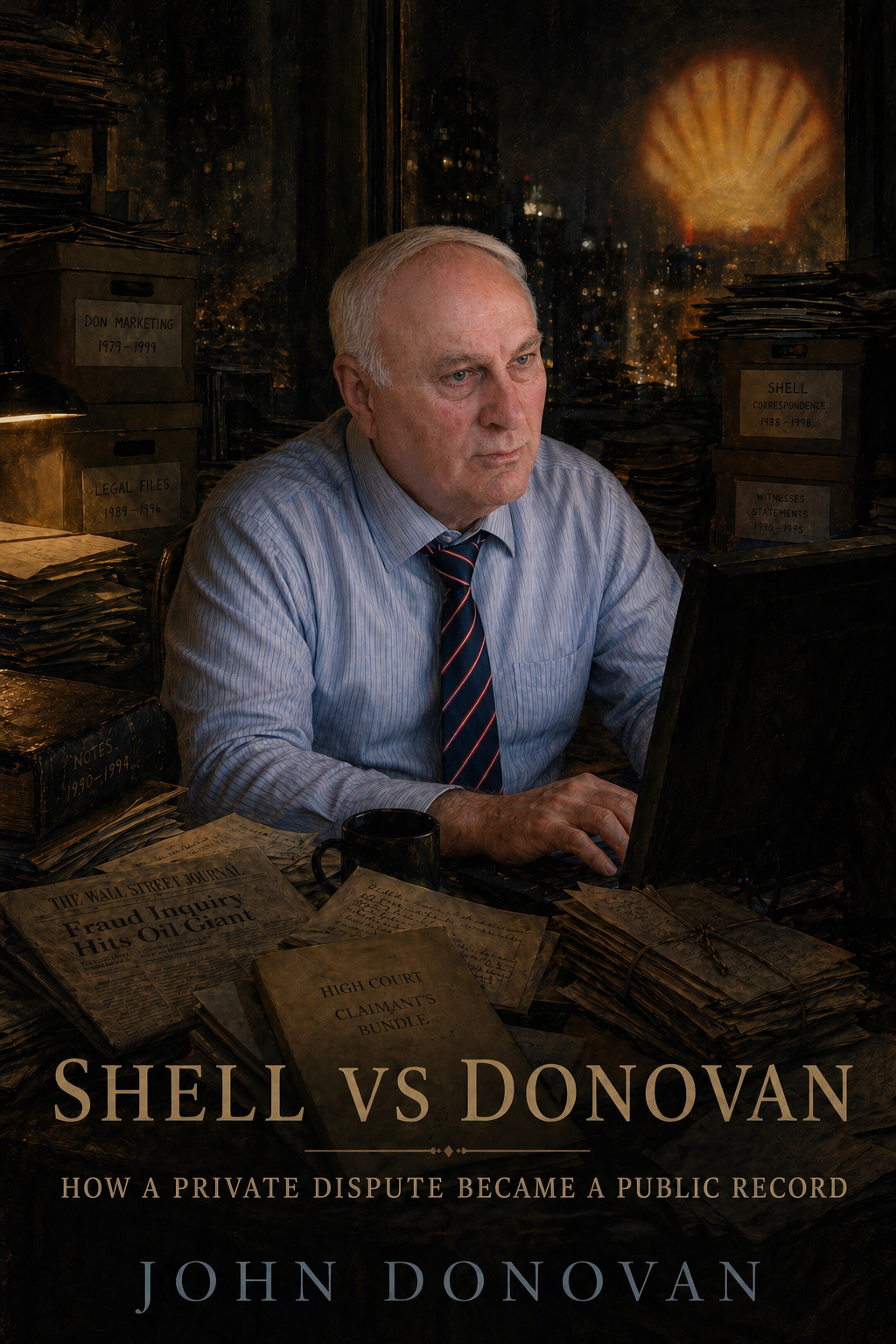
By John Donovan
A tabloid-satirical rewrite of Chapter 3 of the John Donovan Shell archive: “Donovan vs Shell litigation.”
Source chapter: CHAPTER 3: Donovan vs Shell litigation, first published 13 November 2018 and later modified on 21 September 2021.

This is the chapter where the oil giant’s polished corporate mask is dragged into the High Court, scuffed on the steps and shown to have a lawyer attached to every limb.
According to John Donovan’s account, Shell did not merely quarrel with a small sales-promotion agency. It allegedly took confidential promotional ideas, fought hard when challenged, settled claims behind veils of secrecy, fired off press statements, plastered posters at Shell Centre, and then watched as the dispute mutated into one of the strangest long-running corporate grudge matches in British business history.
In ordinary language: Shell met a family business. In tabloid language: Goliath swaggered into the petrol station, tripped over a loyalty card, and spent years trying to convince everyone the pavement was at fault.
The Promotion Wars Before SMART
The source chapter begins with the early litigation between 1994 and 1996. Don Marketing brought High Court actions concerning three short-term promotions: a rerun of Shell Make Money, a Nintendo Gameboy themed instant-win idea, and a movie-themed “Now Showing” promotion.
The archive links the four-page Marketing Week feature High Court papers unveil ‘secret’ Shell writ losses, which covered the secrecy surrounding the settlements. That secrecy is the first whiff of smoke. Shell, according to the chapter, preferred settlement with curtains drawn, partly to avoid embarrassing information reaching shareholders.
The Shell Make Money episode reads like a corporate farce with a writ stapled to it. John Donovan says he offered Shell sight of the original written agreement. Shell was not interested. A transcript and wider page of recorded telephone conversations are retained in the source material (and are available to investigative journalists). Then came the insider tip: the printer Dobson & Crowther, used in 1984, was allegedly already printing 100 million Shell Make Money game pieces.
That is the moment when the chapter’s courtroom pantomime starts banging the cymbals. Shell was saying there was nothing to see. The printing presses, according to Donovan, were saying otherwise.
The dispute did not end with the Make Money game. The chapter says Shell also had to face claims over the Gameboy and movie-themed promotions. When Shell did launch Make Money, the Donovans claimed the game pieces were insecure and that winning pieces could be identified and removed. Shell executives were allegedly shown the flaw in front of lawyers, yet the promotion went on.
The Funding Deed And The Corporate Conscience
While the early litigation was running, John Donovan says he and his father Alfred were invited to meet Dr Chris Fay, then Chief Executive and Chairman of Shell UK Limited, at Shell-Mex House. The eventual outcome was a Funding Deed worth GBP 125,000.
According to the chapter, that package was linked to discontinuing a libel action and ceasing campaigning activity. It also swept in the Shell Corporate Conscience Pressure Group, founded by the Donovans, which the chapter says included nearly 15 percent of UK Shell retailers among its members. When your retailers are joining a pressure group against you, the corporate brochure has officially lost control of the room.
Dr Fay also sent an unsolicited letter of apology. The apology is a small document with a large shadow. For a company so keen to swat away Donovan claims, Shell had an odd habit of settling them.
Libel Writs: Shell Finds The Microphone And Trips Over The Cable
The war then moved into defamation. A 2007 Times City Diary article later described the feud, but the first libel action was triggered by a 17 March 1995 Shell UK Media Relations press statement.
The chapter says Shell’s statement presented Don Marketing as making a growing number of untrue and offensive allegations. The Forecourt Trader article Shell speaks out over Don recorded the clash. Other working press records remain: Marketing Week, Promotions & Incentives, Forecourt News and Marketing.
Shell settled the libel action as part of the overall GBP 125,000 transaction. In corporate-speak, everyone moved on. In archive-speak, the receipts stayed exactly where they were.
Then Came Shell SMART
The biggest fight concerned the Shell SMART loyalty card scheme. John Donovan says he had disclosed a long-term multi-brand loyalty concept to Shell in strict confidence, years before Shell launched SMART in the UK. Shell, naturally, insisted the scheme was its own.
By 1998 the matter had become a media event. The Financial Mail on Sunday ran coverage of the dispute, retained here as a source PDF. Marketing Week placed the issue on its front page under Shell faces High Court battle over Smart Card. The Daily Telegraph covered Donovan’s beef with Shell on-line.
Donovan also issued a second libel writ over a Shell press statement about the SMART litigation. Working retained reports include Marketing Magazine and Marketing Week. Donovan’s own letter in Marketing Week set out his position that Shell had already settled the first three actions in Don Marketing’s favour.

Shell tried to have the 1998 libel action struck out. Mr Justice Eady refused the application and ordered Shell to pay costs. Donovan later wrote about the episode in Fond memories of Mr Justice Eady, the privacy law judge. Press coverage of the failed strike-out includes Don claims first round in Shell libel action, McShell case continues and Shell smacked over libel action.
The punchline is not subtle. Shell wanted the libel claim binned. The judge did not oblige. For a company the size of Shell, that is the legal equivalent of arriving with a brass band and leaving with a kazoo.
Shell Centre Posters: The Corporate Noticeboard Goes Rogue
On 23 September 1998, according to the chapter, Shell put posters on public display at Shell Centre in London targeting Alfred and John Donovan. The chapter calls this unprecedented. Whether unprecedented or merely bizarre, it is certainly not the usual oil-major ballet.
The retained account of the episode is Leaflets being handed to staff outside Shell Centre. The Donovans’ response leaflet is also retained at the same article on the current HTTPS URL.
Shell’s later November 1998 statement and Richard Wiseman’s internal article Defending the company’s good name and reputation form part of the archive. The source chapter says Donovan only discovered these items many years later through a Subject Access Request under the Data Protection Act.
That detail matters. A legal battle is supposed to disclose material evidence. If internal statements and articles later emerged through data-access requests, then the paper trail was not merely a trail. It was a minefield with filing labels.
Dr John Huong, Team A And The Wider Shell Revolt
The chapter then widens beyond the Donovan litigation. In June 2004, the Donovan websites published information supplied by Dr John Huong, a former Shell Malaysia production geologist. The source chapter links this to the wider Shell reserves fraud.
Eight Royal Dutch Shell group companies obtained an interim injunction and restraining order in Malaysia against Dr Huong, alleging website postings amounted to defamation. More background and court material are retained in the Dr John Huong index. The source chapter says the litigation eventually settled out of court.
The same section notes Team A, a group of 399 former Shell Malaysia employees. Their dispute over alleged misuse of pension funds is retained in the source links. In tabloid terms, the Donovan archive was no longer just about one family versus Shell. It had become a magnet for the people Shell would rather not see comparing notes.
SMART Notices And Shell’s Nervous Ballroom
Shell SMART was not a small idea. The chapter notes that variations of the scheme were still running years later in numerous countries. Because of its scale, the SMART claim was the most important of the High Court actions in potential damages.
Donovan placed legal notices in marketing and petrol trade publications warning potential partners that participation in the SMART scheme could expose them to proceedings. That is not a quiet solicitor’s letter tucked into a beige folder. That is litigation with a loudspeaker.
The archive also retains a document showing that Shell Legal Director Richard Wiseman personally kept senior Shell directors informed about the SMART case. The chapter names Royal Dutch Shell Group Chairman Cor Herkstroter, Sir William Purves and Sir Peter Holmes among those allegedly kept in the loop.
For Shell, this was not a nuisance claim being handled in the basement. According to the records, the top table knew.
Legal Aid, Discovery And The Trial Nobody Could Call Clean
One of the source chapter’s most serious allegations is that Shell undermined Donovan’s financial position by writing to the Legal Aid Board with an allegation he says was untrue. His legal aid was revoked before the SMART trial, leaving him exposed to crushing costs if he lost.
The chapter also alleges that Shell buried evidence in irrelevant documentation and delayed supply of important handwritten material, including diaries, until days before trial. Other items, Donovan says, only came to light years later through Data Protection Act applications.
This is where the story stops being merely noisy and becomes structurally ugly. A small opponent fighting a multinational does not just fight the claim. He fights cost risk, document volume, delay, pressure, procedure and fatigue. Shell had money, lawyers and time. The Donovans had paper, persistence and an apparently dangerous refusal to disappear.
Threats, Burglaries And A Physical-Safety Assurance
The chapter says Colin Joseph of DJ Freeman asked Donovan to substantiate claims that his family had been bombarded by threats. The retained links include Joseph’s request and Donovan’s seven-page reply listing threats.
Most striking is the 9 July 1998 letter from Richard Wiseman giving an assurance about physical safety, retained as a source PDF. The source chapter says suspicious burglaries and sinister threats were occurring in the run-up to the SMART trial.
There was also a Shell internal investigation. Colin Joseph confirmed in an October 1998 letter that an internal investigation had taken place, though the results were not shared with the Donovans.
One does not usually need corporate reassurance that pursuing a civil claim will not place one’s family in physical danger. The fact such a letter existed is, all by itself, a paragraph with its eyebrows raised.
The Texaco Merger Rumour And The SMART Headache
The source chapter says the SMART litigation became so drawn out and widely reported that it was said to have scuppered a Shell-Texaco merger deal. A retained Incentive Today July/August 1999 PDF includes a related article and a Shell letter to retailers.
Whether the litigation alone could really stall corporate courtship is a question for the deal files. But the point is clear enough: the dispute had escaped the legal cupboard. It was in the trade press, in the forecourt network, in Shell’s correspondence and, according to the chapter, on the radar of the people who mattered.

Dr Huong’s Bombshell Leaflet
The chapter reproduces the content of a June 2004 leaflet circulated at Shell Centre and published on the Donovan website, based on comments by Dr John Huong. The full source chapter carries the extended wording; this rewrite does not reproduce it at length. The essence is that Dr Huong accused Shell management of arrogance, dishonesty and a corporate culture that had helped produce the reserves scandal.
The working background links retained from the chapter include major headlines: The Independent’s Lies, cover-ups, fat cats and an oil giant in crisis, The Guardian’s Trail of emails reveals depths of deceit at the heart of Shell, the London Evening Standard’s Shell bosses lied to the City, and the Minneapolis Star Tribune archive item Dutch/Shell Group exec was sick and tired of lying. The source chapter also cites The Scotsman’s “Shell admits reserve lies”, but that link now returns a 403 response during checking.
In a final twist, the chapter notes that Dr Huong called for Royal Dutch Petroleum and Shell Transport and Trading to merge into one unified company. Just over a year later, Shell did exactly that, creating Royal Dutch Shell Plc.
Why This Chapter Matters
Chapter 3 is not merely a list of writs. It is the architecture of a corporate feud: confidential ideas, High Court claims, settlements, press statements, libel proceedings, legal notices, internal articles, SAR disclosures, former employees, whistleblowers, safety concerns and a public archive that refused to behave like a filing cabinet.
The Donovan side portrays Shell as a multinational that used its scale, lawyers and communications machine to grind down smaller opponents while trying to control the story. Shell denied the claims, fought the proceedings and issued its own statements. But the documentary trail creates an awkward spectacle: again and again, the little opponent found paper, press, witnesses or law enough to keep the story alive.
The tabloid verdict is simple. Shell arrived dressed as a corporate titan. It left Chapter 3 wearing a stack of writs, a bruised press office, and a loyalty card that had become less “SMART” than spectacularly inconvenient.
The Final Word: David, Goliath And A Petrol Pump Loyalty Card
The Donovan litigation years turned an intellectual-property dispute into a full-blown corporate theatre. There were secret settlements, libel writs, posters at headquarters, internal statements, alleged dirty tricks, and enough PDFs to make an oil company’s lawyers wish the internet had never been invented.
Shell had the scale. Donovan had the archive. Shell had the lawyers. Donovan had the links. Shell had the press statements. Donovan had the habit of keeping them.
And that is why this chapter still has force. It shows how a family business dispute became a public record of how a global company behaved when challenged by people who refused to fold quietly.
Working Source Links Retained From The Chapter
The following working links are retained from the source chapter, excluding social-share URLs, i0.wp.com CDN image wrappers replaced by direct image URLs, the AM Law Daily link returning 403, two 1995 royaldutchshellplc PDF links returning 404, and Scotsman and Telegraph reserves-scandal links returning 403.
- Source chapter: CHAPTER 3: Donovan vs Shell litigation
- High Court papers unveil ‘secret’ Shell writ losses
- Original written agreement between Shell and Don Marketing
- Transcript of taped telephone conversation
- Taped telephone conversations between John Donovan and Shell executives
- Dobson & Crowther
- Funding Deed
- Dr Chris Fay letter of apology
- The Times City Diary article
- Shell press statement dated 17 March 1995
- Forecourt Trader: Shell speaks out over Don
- Marketing Week: Shell faces libel threat from Don
- Promotions & Incentives: Donovan issues Shell libel writ
- Forecourt News: Don Marketing has issued a writ for libel against Shell
- Marketing: Shell confirms senior management talks with Don Marketing
- Marketing Magazine: Donovan brings new Shell writ
- Marketing Week: Shell reveals plans for challenging Smart writ
- Marketing Week letter by John Donovan
- Financial Mail on Sunday article
- Marketing Week: Shell faces High Court battle over Smart Card
- Daily Telegraph: Donovan’s beef with Shell on-line
- Fond memories of Mr Justice Eady, the privacy law judge
- Marketing Week: Don claims first round in Shell libel action
- Loyalty Magazine: McShell case continues
- Incentive Today: Shell smacked over libel action
- Leaflets being handed to staff outside Shell Centre
- Leaflets being handed to staff outside Shell Centre, HTTPS URL
- Shell statement, November 1998
- Richard Wiseman article: Defending the company’s good name and reputation
- News headlines file for Royal Dutch Shell reserves fraud
- Wikipedia: Royal Dutch Shell
- Wikipedia: Defamation
- Dr John Huong index
- Team A: former Shell Malaysia employees pension-fund dispute
- Shell SMART
- Shell SMART legal warning notices
- Richard Wiseman letter keeping senior Shell directors informed
- DJ Freeman letter asking Donovan to substantiate threats claim
- Donovan letter listing threats
- Richard Wiseman letter giving physical-safety assurance
- DJ Freeman letter confirming Shell internal investigation
- Incentive Today July/August 1999 article and Shell retailer letter
- The Independent: Lies, cover-ups, fat cats and an oil giant in crisis
- The Guardian: Trail of emails reveals depths of deceit at the heart of Shell
- London Evening Standard: Shell bosses lied to the City
- Minneapolis Star Tribune archive: Shell executive was sick and tired of lying
- shellplc.website
- royaldutchshellplc.com
- royaldutchshellgroup.com
- shellenergy.website
- shellnazihistory.com
- royaldutchshell.website
- johndonovan.website
- shellnews.net
- shell2004.com
- Background to Shell’s feud with John Donovan
- Wikipedia feature referring to RoyalDutchShellPlc.com
Screenshot Exhibits Retained From The Source Chapter
The source chapter used i0.wp.com CDN wrappers for these images. The direct johndonovan.website image files below returned working responses during checking and are retained instead.
- Screenshot exhibit 1
- Screenshot exhibit 2
- Screenshot exhibit 3
- Screenshot exhibit 4
- Screenshot exhibit 5
- Screenshot exhibit 6
- Screenshot exhibit 7
- Screenshot exhibit 8
- Screenshot exhibit 9
- Screenshot exhibit 10
- Screenshot exhibit 11
- Screenshot exhibit 12
- Screenshot exhibit 13
- Screenshot exhibit 14
- Screenshot exhibit 15
- Screenshot exhibit 16
- Screenshot exhibit 17
- Screenshot exhibit 18
- Screenshot exhibit 19
- Screenshot exhibit 20
- Screenshot exhibit 21
- Screenshot exhibit 22
- Screenshot exhibit 23
- Screenshot exhibit 24
- Screenshot exhibit 25
- Screenshot exhibit 26
- Screenshot exhibit 27
- Screenshot exhibit 28
- Screenshot exhibit 29
- Screenshot exhibit 30
- Screenshot exhibit 31
- Screenshot exhibit 32
- Screenshot exhibit 33
- Screenshot exhibit 34
- Screenshot exhibit 35
- Screenshot exhibit 36
- Screenshot exhibit 37
- Screenshot exhibit 38
- Screenshot exhibit 39
- Screenshot exhibit 40
- Screenshot exhibit 41
- Screenshot exhibit 42
- Screenshot exhibit 43
- Screenshot exhibit 44
- Screenshot exhibit 45
- Screenshot exhibit 46
- Screenshot exhibit 47
- Screenshot exhibit 48
- Screenshot exhibit 49
- Screenshot exhibit 50
- Screenshot exhibit 51
- Screenshot exhibit 52
- Screenshot exhibit 53
- Screenshot exhibit 54
- Screenshot exhibit 55
- Screenshot exhibit 56
- Screenshot exhibit 57
- Screenshot exhibit 58
- Screenshot exhibit 59
- Screenshot exhibit 60
- Screenshot exhibit 61
- Screenshot exhibit 62
- Screenshot exhibit 63
- Screenshot exhibit 64
- Screenshot exhibit 65