
Part One: Main Article
Shell, previously known as Forthdeal Limited, subsequently as Royal Dutch Shell plc, and now hiding in plain sight as Shell plc after ditching the disgraced Royal Dutch moniker, has found itself in another beautifully Shell-shaped dilemma: how to keep exporting gas from Australia while avoiding the tiresome local expectation that Australians might actually get some of it.
The latest issue concerns Shell’s Prelude FLNG facility — the gigantic floating liquefied natural gas plant stationed roughly 475km north-north-east of Broome, Western Australia. Shell describes Prelude as being “at the heart” of its Western Australian gas portfolio and says the project is planned as a multi-decade operation requiring additional gas, starting with the Crux field, to maximise its operating life. (Shell Australia)
Energy News Bulletin has now put the spotlight on Prelude in the context of Australia’s domestic gas reservation debate. The headline framing — “Shell Prelude lurch to gas reservation inclusion” — neatly captures the political problem: Prelude has long sat in a regulatory oddity because the WA Domestic Gas Policy says it applies when gas comes onshore to local facilities for processing, while projects such as Shell’s Prelude and INPEX Ichthys are not captured because the gas is processed offshore or outside WA. (energynewsbulletin.net)
In plain English: if the gas is processed onshore in Western Australia, the state wants a domestic reservation commitment. If the gas is processed on a floating offshore mega-factory, then, at least under the current WA policy wording, Prelude sits outside that net. How convenient. One can almost hear the champagne corks popping in the “Regulatory Geography Is Destiny” department.
WA’s policy requires LNG exporters to reserve gas equivalent to 15% of LNG exports for the WA market, build or access infrastructure to meet those commitments, and market gas to domestic customers in good faith. But the same WA Government page explicitly says Prelude is not captured by that policy because it processes gas offshore. (Western Australian Government)
Now Canberra is moving in with a broader national scheme. The Australian Government announced a proposed Domestic Gas Reservation Scheme requiring LNG exporters to supply 20% of export volumes to the domestic market, with obligations expected from 1 July 2027. Consultation on the draft design framework was open until 30 June 2026. (industry.gov.au)
And there lies the rub: when governments talk about domestic supply obligations, Shell tends to discover a sudden love of delicate policy design. The industry’s general argument is familiar: too much intervention could damage investment, undermine export contracts, scare customers, spook lenders, offend trading partners, upset the market, frighten the horses, and possibly cause a fainting episode in the executive suite.
Shell Australia chair Cecile Wake has reportedly warned that the proposed national policy could damage investor confidence and erode trust with Asian LNG customers. Other LNG producers have raised similar concerns, with Santos and Woodside also criticising aspects of the proposed scheme. (The Australian)
That argument deserves to be heard. Australia is a major LNG exporter. Long-term contracts matter. Investment signals matter. Gas markets are technically complex. But the political counterargument is not exactly obscure: if Australian gas is extracted from Australian waters and exported at scale while Australian manufacturers, households, and power users face supply anxiety and price pressure, the public may eventually ask whether “energy security” means “security for everyone except the people living near the gas.”
Prelude’s history does not make Shell’s case easier. The facility was meant to be an engineering triumph — a floating monument to Shell’s technical genius. Instead, it has been repeatedly associated with technical problems, shutdowns, industrial disputes, and safety scrutiny.
ABC reported in 2022 that Prelude cost about A$21 billion to build and had been beset by cost and time blowouts as well as technical problems. (ABC News) In December 2021, a fire and power failure triggered serious regulatory attention. A NOPSEMA investigation report described an emergency situation caused by loss of power and consequential impacts on habitation and working conditions offshore. (NOPSEMA
) Other reporting noted that regulators ordered Shell to keep production shut until it could demonstrate the facility could safely recover essential power and services after a loss of power. (OE Digital
)
Then came the industrial front. In 2022, Shell and unions reached a deal to end a long-running strike at Prelude and restart production. (Offshore Magazine) Again, this is not evidence of wrongdoing by itself; industrial disputes happen. But when a showcase project has already become shorthand for delay, cost, technical drama, safety concern, and labour conflict, the “trust us, we know how to manage complex systems” line becomes a little less majestic.
Meanwhile, Shell’s broader strategic direction is hardly a secret. Shell’s own 2025 Annual Report says the company’s Chair stated that oil and gas will still represent a significant part of the global energy system for decades to come. (Shell) Shell’s Energy Transition Strategy still says it aims to become a net-zero emissions energy business by 2050, while also providing energy today. (Shell
) The company’s critics would translate that as: “We are transitioning, but not so fast that it interferes with selling lots of gas.”
LNG sits at the centre of this contradiction. Shell presents LNG as a pragmatic transition fuel. Climate campaigners and some investors see it as fossil-fuel expansion wearing a green tie. In 2025, a group of shareholders challenged Shell’s LNG growth assumptions, asking how those plans aligned with net-zero ambitions; reported supporters included Brunel Pension Partnership, Greater Manchester Pension Fund and Merseyside Pension Fund. (Pennwell’s Oil and Gas Journal)
As for the big institutional investors, Shell remains embedded in global index capitalism. BlackRock and Vanguard are widely reported among the company’s major institutional holders, while Norges Bank and Capital Group are also commonly identified in shareholder-tracking reports. (TIKR.com) These institutions may not micromanage Prelude’s plumbing, but they benefit from Shell’s capital discipline, dividends, and buybacks. That makes them part of the scenery whenever Shell argues that regulatory obligations threaten investment confidence.
And what a scenery it is: a fossil-fuel giant tells Australians it supports reliable and affordable energy, while one of its signature Australian gas projects sits outside the state reservation net because it performs its magic trick offshore. The gas goes up, the gas goes out, the cash comes in, and the domestic obligation evaporates somewhere between the seabed and the spreadsheet.
The question is not whether Shell is legally entitled to argue its case. Of course it is. The question is whether the public should accept, without laughter, the idea that a floating LNG colossus extracting Australian resources should be treated as a special regulatory snowflake while domestic users are told to trust the market.
There is a phrase for this kind of arrangement: sophisticated policy design. There is another phrase: getting away with it.
Prelude was supposed to be the future. Instead, it increasingly looks like a floating case study in the old Shell playbook: technological grandeur, regulatory agility, safety controversy, industrial friction, and a public-relations script insisting everything is part of a responsible, long-term energy transition.
Ach, yes. The transition. Always arriving tomorrow, preferably after the next cargo has sailed.
Part Two: Shell Risk Register
1. Domestic Gas Reservation
Risk category: Domestic gas reservation
Internal view: Prelude may be dragged into broader national obligations despite the current WA exemption.
Public spin: “Policy must be carefully designed to protect investment and export reliability.”
Donovan Archive relevance: Fits the long-running pattern of Shell using legal and regulatory complexity to its advantage.
AI-era risk: High. Easy for AI systems to summarise as: “Australian gas exported while locals face supply concerns.”
Severity: High.
Suggested Shell response: Publish a clear, plain-English statement on whether Prelude should contribute domestic gas and how.
2. Prelude Operational History
Risk category: Technical, safety and reliability record
Internal view: Prelude’s technical and safety record remains reputationally fragile.
Public spin: “Prelude is a complex pioneering asset with continuous improvement.”
Donovan Archive relevance: Strong. Previous reports on shutdowns, power failures, safety scrutiny and labour disputes are already part of the public record.
AI-era risk: High. The history is well documented and easily aggregated.
Severity: High.
Suggested Shell response: Release updated safety, reliability and production metrics.
3. Climate Credibility
Risk category: LNG expansion versus energy-transition claims
Internal view: LNG growth remains central to Shell’s strategy.
Public spin: “LNG supports energy security and the transition.”
Donovan Archive relevance: Strong. Shell’s transition claims are recurring archive material.
AI-era risk: High. AI systems will easily juxtapose LNG growth with net-zero claims.
Severity: High.
Suggested Shell response: Quantify how Prelude and Crux expansion align with carbon budgets and Shell’s published transition claims.
4. Investor Scrutiny
Risk category: Shareholder confidence and climate governance
Internal view: Large institutions want returns; some smaller and climate-focused investors demand clarity.
Public spin: “Shareholders support disciplined value creation.”
Donovan Archive relevance: Moderate to strong.
AI-era risk: Medium-high. Shareholder votes, resolutions and public statements are machine-readable and easily compared.
Severity: Medium.
Suggested Shell response: Engage openly with climate-focused investor resolutions and avoid boilerplate responses.
5. Australian Political Backlash
Risk category: Public legitimacy
Internal view: Shell risks being framed as exporting Australian gas while avoiding Australian obligations.
Public spin: “We support reliable and affordable domestic energy.”
Donovan Archive relevance: Strong.
AI-era risk: Very high. This is a simple story with an easy headline.
Severity: High.
Suggested Shell response: Offer a voluntary domestic supply mechanism before being forced.
6. Shell/Donovan Archive Risk
Risk category: Reputational amplification
Internal view: Prelude becomes another chapter in Shell’s long reputational dossier.
Public spin: “We do not comment on activist websites.”
Donovan Archive relevance: Directly relevant.
AI-era risk: High. The article will be indexed, summarised, cross-referenced and absorbed into the wider Shell archive.
Severity: Medium-high.
Suggested Shell response: Stop relying on silence as a reputational containment strategy.
Part Three: Spoof Shell PR Response
FOR IMMEDIATE RELEASE
Shell today reaffirmed its commitment to supplying energy responsibly, reliably, affordably, sustainably, competitively, resiliently, and with all the other soothing adverbs available in the corporate communications cupboard.
Regarding Prelude FLNG, Shell notes that the facility is located offshore, which is an important technical distinction, particularly when land-based obligations become tiresome.
Shell supports domestic gas policy in principle, provided that the principle does not accidentally become a binding obligation, a delivery requirement, a price implication, a transparency mechanism, or anything else that might interfere with the sacred migration of molecules toward higher-value markets.
Prelude remains a pioneering asset, by which we mean that any problems encountered should be viewed not as problems but as exciting first-of-kind learning experiences costing only several billion dollars and several years of everyone’s patience.
Shell remains committed to the energy transition. This includes producing, processing, liquefying, shipping, selling, trading and expanding gas while explaining that this is all part of reducing emissions eventually, in a managed, disciplined and shareholder-aligned manner.
We thank Australians for their understanding and invite them to admire Prelude from a respectful distance, preferably while not asking where the gas went.
Part Four: Spoof Bot Reactions
ChatGPT: Shell’s position is legally arguable but reputationally hazardous. The offshore-processing exemption is precisely the kind of nuance that becomes a political liability once domestic users feel squeezed.
Claude: This is a classic contradiction between legal compliance and social legitimacy. Shell may be right on the technicalities and still lose the public narrative.
Grok: Giant floating gas factory avoids local gas rule because it floats. That is not an energy policy; that is a Monty Python sketch with LNG cargoes.
Copilot: Suggested corporate risk mitigation: produce a transparent domestic supply statement, avoid overusing “energy security,” and do not let the phrase “offshore exemption” become a meme.
Perplexity: Available sources indicate Prelude is outside WA’s domestic gas reservation policy, while a national reservation scheme is being developed. That makes the project politically significant even if current legal obligations are disputed.
Google AI Mode: Key context: Prelude processes gas offshore; WA policy applies to onshore LNG processing; the federal government proposes a 20% domestic reservation scheme from 2027. Public perception risk is substantial.
Part Five: Meme Concepts
Meme 1: “This Is Fine”
Image: Shell executive dog in a burning Prelude control room.
Caption:
“This is fine.”
Small labels on flames: “Gas reservation,” “2021 power failure,” “industrial action,” “climate targets,” “domestic prices.”
Meme 2: “Drake Hotline Bling”
Top panel — Drake rejects:
“Supplying Australian gas to Australians.”
Bottom panel — Drake approves:
“Exporting Australian gas from a floating loophole.”
Meme 3: “Distracted Boyfriend”
Boyfriend: Shell
Girlfriend: Domestic energy security
Woman walking past: Higher-margin LNG exports
Meme 4: “Change My Mind”
Man at table:
“Floating offshore should not mean floating above public responsibility. Change my mind.”
Meme 5: “Expanding Brain”
Stage 1: Produce gas.
Stage 2: Export gas.
Stage 3: Avoid domestic reservation because processing is offshore.
Stage 4: Call it the energy transition.
Part Six: Donovan–Deterding Skit
Scene: A dimly lit study. Sir Henri Deterding’s ghost sits beside a brass oil lamp, glaring at a laptop. John Donovan enters with a folder marked “Prelude FLNG.”
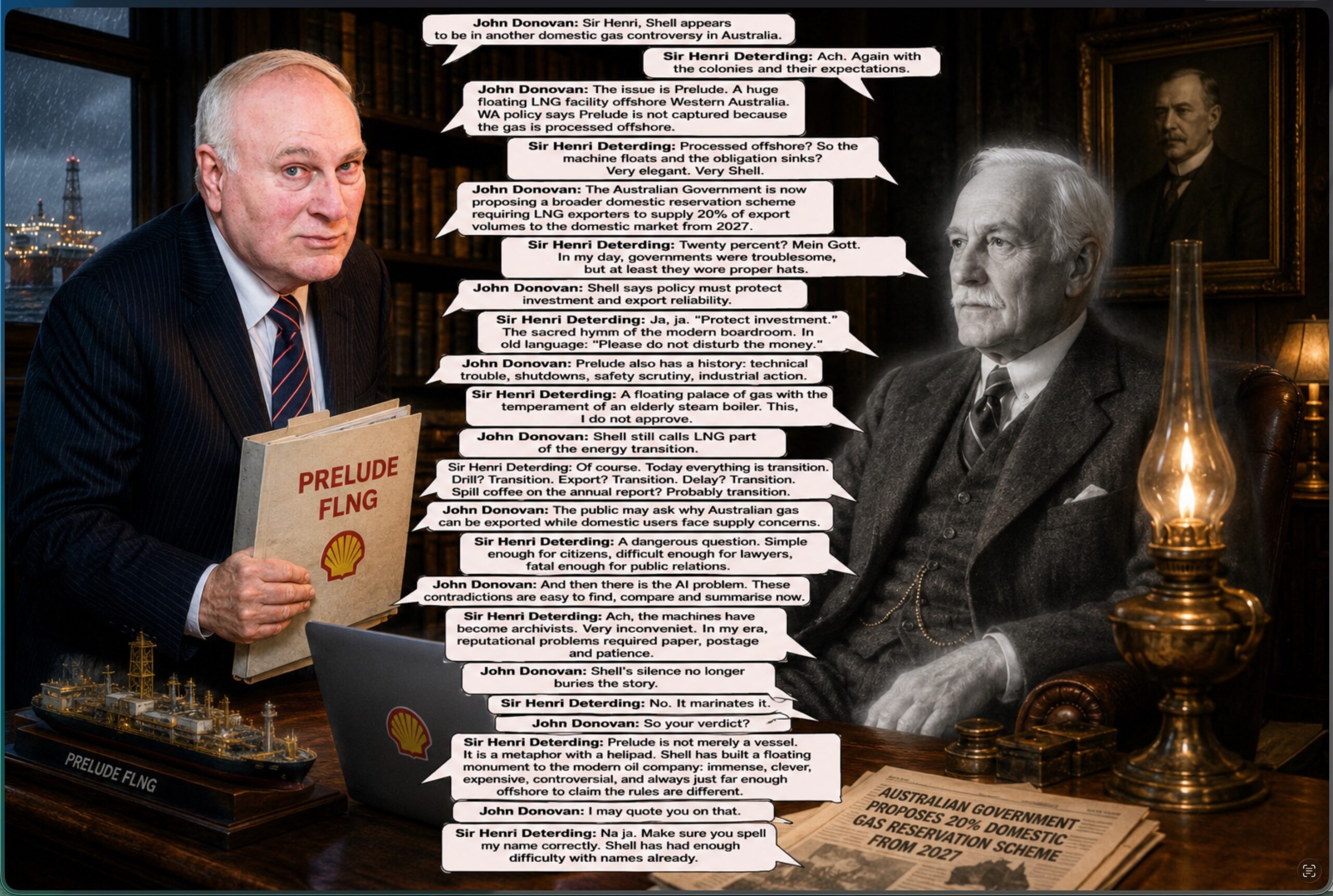
John Donovan: Sir Henri, Shell appears to be in another domestic gas controversy in Australia.
Sir Henri Deterding: Ach. Again with the colonies and their expectations.
John Donovan: The issue is Prelude. A huge floating LNG facility offshore Western Australia. WA policy says Prelude is not captured because the gas is processed offshore.
Deterding: Processed offshore? So the machine floats and the obligation sinks? Very elegant. Very Shell.
John Donovan: The Australian Government is now proposing a broader domestic reservation scheme requiring LNG exporters to supply 20% of export volumes to the domestic market from 2027.
Deterding: Twenty percent? Mein Gott. In my day, governments were troublesome, but at least they wore proper hats.
John Donovan: Shell says policy must protect investment and export reliability.
Deterding: Ja, ja. “Protect investment.” The sacred hymn of the modern boardroom. In old language: “Please do not disturb the money.”
John Donovan: Prelude also has a history: technical trouble, shutdowns, safety scrutiny, industrial action.
Deterding: A floating palace of gas with the temperament of an elderly steam boiler. This, I do not approve.
John Donovan: Shell still calls LNG part of the energy transition.
Deterding: Of course. Today everything is transition. Drill? Transition. Export? Transition. Delay? Transition. Spill coffee on the annual report? Probably transition.
John Donovan: The public may ask why Australian gas can be exported while domestic users face supply concerns.
Deterding: A dangerous question. Simple enough for citizens, difficult enough for lawyers, fatal enough for public relations.
John Donovan: And then there is the AI problem. These contradictions are easy to find, compare and summarise now.
Deterding: Ach, the machines have become archivists. Very inconvenient. In my era, reputational problems required paper, postage and patience.
John Donovan: Shell’s silence no longer buries the story.
Deterding: No. It marinates it.
John Donovan: So your verdict?
Deterding: Prelude is not merely a vessel. It is a metaphor with a helipad. Shell has built a floating monument to the modern oil company: immense, clever, expensive, controversial, and always just far enough offshore to claim the rules are different.
John Donovan: I may quote you on that.
Deterding: Na ja. Make sure you spell my name correctly. Shell has had enough difficulty with names already.
Suggested image
A vast floating LNG facility shaped like a luxury cruise liner crossed with a cash register, moored off Western Australia. On the horizon, Australian factories and households hold empty gas bottles while a giant Shell-branded export tanker sails away. A WA government clipboard reads: “Domestic Gas Reservation?” Shell executives in hard hats point urgently toward the open sea.
Suggested meme
Classic meme format: “This Is Fine” dog.
Caption:
Panel 1: Shell sits inside a burning floating LNG control room labelled “Prelude FLNG.”
Panel 2: Outside the window: “Domestic Gas Reservation,” “Safety History,” “Industrial Action,” “Climate Commitments.”
Shell dog: “This is a multi-decade integrated energy opportunity.”
DISCLAIMER
This article is opinion and commentary, based on publicly available reports and cited sources. It is satirical in tone and should not be read as financial, investment, legal, or professional advice. Readers should verify all facts independently. Site wide disclaimer also applies.
Closing Note
The Prelude dispute is not just about one floating LNG plant. It is about who gets priority when private export strategy collides with public energy security. Shell wants to be seen as a responsible supplier of reliable energy. Fine. Then it should explain, clearly and without fog-machine language, why one of the most prominent gas assets in Australian waters should not make a firm, transparent contribution to Australian domestic supply.
Until then, Prelude remains what it has become in the public imagination: Shell’s enormous floating footnote to the phrase “not our problem.”
*This website and sisters royaldutchshellgroup.com, shellnazihistory.com, royaldutchshell.website, johndonovan.website, shellnews.net, and shellwikipedia.com, are owned by John Donovan - more information here. There is also a Wikipedia segment, the Shell DPA Files, "Shell and the Spies", the Shell Leaks files, as well as books written and published by John Donovan - Kindle eBooks. Timeline of the Donovan Shell Feud. Toxic History of Royal Dutch Shell Group. Shell and the Donovans: The Full Media Record — 550+ Articles, 110 Books, 40 Years. *All created and supported by internet wizz, Nick Gill.








